Standing yoga poses are asanas practiced from an upright, weight-bearing position that build leg strength, improve balance, and train postural alignment through the hips, spine, and shoulders. Classics like Mountain Pose (Tadasana), Warrior I-III (Virabhadrasana), Tree Pose (Vrikshasana), and Triangle Pose (Trikonasana) form the backbone of most vinyasa and hatha sequences because they engage the largest muscle groups in the body while demanding real concentration to hold steady. Most standing poses are held for 5 to 10 breaths and can be modified with a wall, chair, or yoga block, which makes this pose family one of the most accessible entry points into a regular practice, whether you’re brand new to yoga poses or refining your alignment years into practice.
What Are Standing Yoga Poses?
Standing yoga poses are any asana performed from a vertical, feet-grounded starting position, as opposed to poses done seated, lying down, or inverted. They form one of the primary families within the broader system of yoga asanas, alongside seated poses, backbends, twists, forward folds, and inversions. What separates standing poses from the rest is the constant demand on the legs and feet: the body must actively resist gravity while the pose is held, which is why this category is so effective for building functional strength rather than just flexibility.
Standing poses typically fall into four functional groups: balance poses (like Tree Pose or Eagle Pose), strength poses (like the Warrior series or Chair Pose), forward-folding standing poses (like Triangle Pose or Wide-Legged Forward Fold), and standing twists. Many sequences move through all four in a single class, since they complement each other: a strength pose fatigues the legs, a balance pose retrains stability, and a twist or fold resets the spine.
What Are the Benefits of Standing Yoga Poses?
Standing poses condition the body in ways that seated or supine poses simply can’t replicate, because they force the nervous system to stabilize the whole kinetic chain from feet to head against gravity.
- Leg and core strength: Poses like Chair Pose (Utkatasana) and Warrior II isometrically load the quadriceps, glutes, and calves while the core stabilizes the spine, building strength comparable to functional lower-body training.
- Balance and proprioception: Single-leg poses such as Tree Pose and Eagle Pose train the small stabilizer muscles around the ankle and hip that rarely get challenged in daily life, which is one reason balance training is commonly recommended as part of healthy aging strategies.
- Postural alignment: Mountain Pose and Triangle Pose teach the body to stack the ears over the shoulders, shoulders over the hips, and hips over the ankles, a template that carries over into how you stand and sit throughout the day.
- Hip and hamstring mobility: Deep lunges like Warrior I and forward folds like Pyramid Pose lengthen the hip flexors and hamstrings, tissues that tend to shorten from long hours of sitting.
- Mental focus: Because standing poses require active balance, they naturally pull attention into the present moment, which is part of why many practitioners pair them with breathwork explored in guides on pranayama and yoga for stress relief.
Standing Yoga Poses Chart: 12 Foundational Asanas
A standing yoga poses chart is simply a reference table pairing each pose’s common English name with its Sanskrit name and primary benefit, useful for quickly identifying poses in a sequence or building your own practice. Below is a chart of the poses most commonly taught in beginner and intermediate classes.
| English Name | Sanskrit Name | Primary Benefit |
|---|---|---|
| Mountain Pose | Tadasana | Postural alignment, grounding |
| Tree Pose | Vrikshasana | Balance, ankle and hip stability |
| Warrior I | Virabhadrasana I | Hip opening, leg strength |
| Warrior II | Virabhadrasana II | Stamina, hip mobility |
| Warrior III | Virabhadrasana III | Balance, core and hamstring strength |
| Triangle Pose | Trikonasana | Hamstring stretch, side-body length |
| Extended Side Angle | Utthita Parsvakonasana | Hip and groin opening, stamina |
| Chair Pose | Utkatasana | Quadriceps and glute strength |
| Eagle Pose | Garudasana | Balance, shoulder mobility |
| Standing Forward Fold | Uttanasana | Hamstring and spine release |
| Pyramid Pose | Parsvottanasana | Hamstring stretch, balance |
| Half Moon Pose | Ardha Chandrasana | Balance, core and hip strength |
This chart mirrors the structure used in most yoga poses names reference guides, and it’s worth printing or saving if you’re building a home sequence, since standing poses generally work best when ordered from simpler grounding poses toward more demanding balance poses.
What Are 5 Standing Yoga Asanas Every Beginner Should Learn?
If you only learn five standing poses, these are the ones that appear in nearly every yoga style, from hatha yoga to vinyasa yoga, and they cover strength, balance, and flexibility between them.
- Mountain Pose (Tadasana): The foundation of every standing pose. Stand with feet hip-width apart, weight distributed evenly across both feet, arms relaxed at your sides, and the crown of the head reaching upward. It looks passive but actively teaches the alignment every other standing pose builds on.
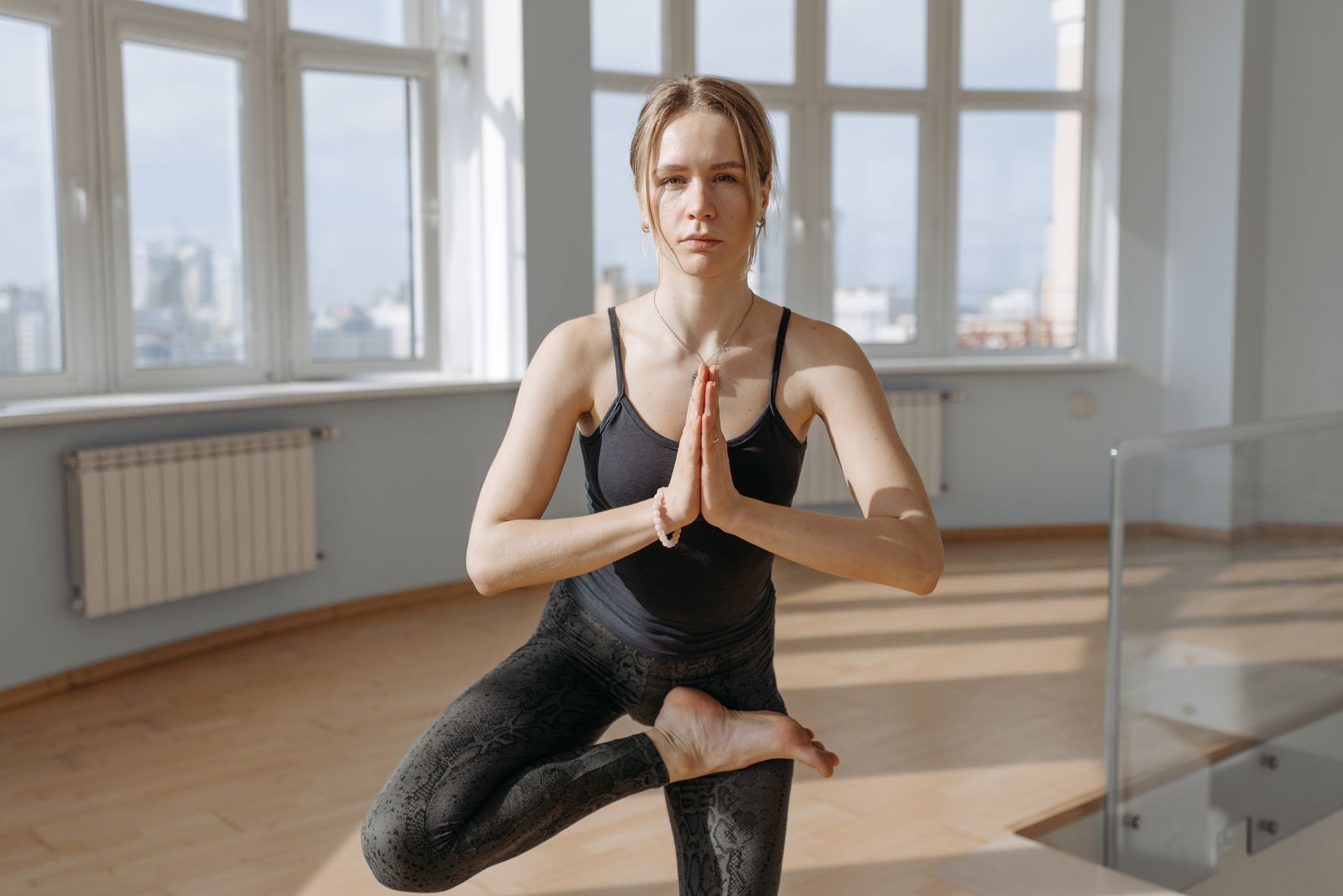
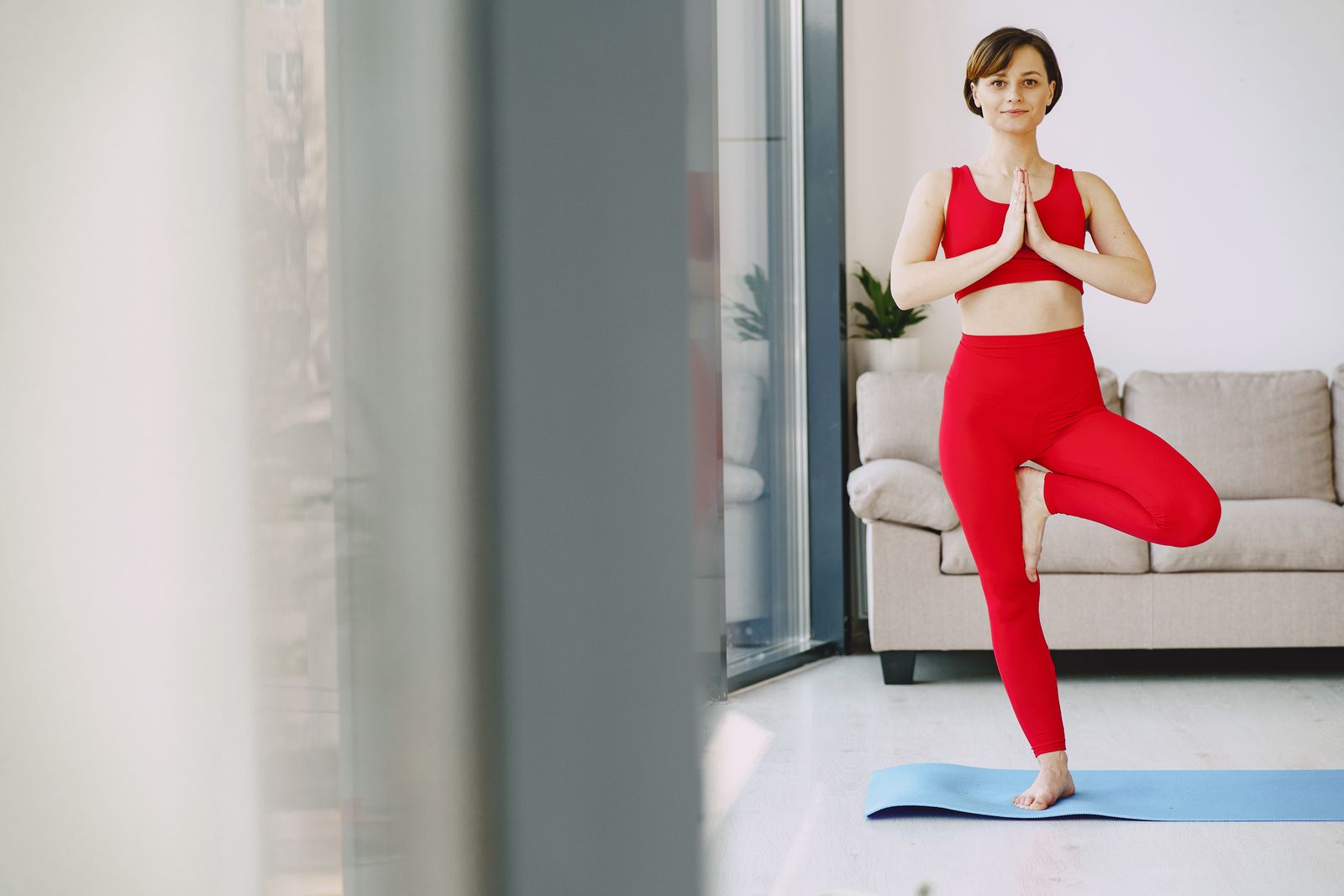
- Tree Pose (Vrikshasana): Shift weight into one foot, place the sole of the other foot against the inner calf or thigh (never directly on the knee joint), and bring hands to prayer position at the heart or overhead. Hold for 5 to 8 breaths per side.
- Warrior II (Virabhadrasana II): Step the feet wide, turn one foot out 90 degrees, bend that knee to a right angle, and extend the arms parallel to the floor. The gaze stays over the front fingertips.
- Triangle Pose (Trikonasana): From a wide stance with the front foot turned out, hinge at the hip and reach the front hand toward the shin, ankle, or a block, extending the top arm toward the ceiling.
- Chair Pose (Utkatasana): Bend the knees as though sitting into an invisible chair, keeping the weight in the heels and the arms reaching overhead. This pose builds heat and leg strength fast.
What Are Some Easy Standing Yoga Poses for Beginners?
Easy standing yoga poses for beginners are those that require minimal flexibility and can be modified with props, making them the safest entry point before progressing to more demanding balance or backbend variations.
- Mountain Pose (Tadasana): No flexibility or balance challenge; purely a postural pose.
- Standing Forward Fold with bent knees (Uttanasana): Bending the knees generously removes strain on tight hamstrings while still releasing the low back.
- Wide-Legged Forward Fold (Prasarita Padottanasana): A wider base gives more stability than a single-leg fold.
- Chair Pose against a wall: Sliding the back down a wall while bending the knees teaches the position with far less strain on the thighs.
- Tree Pose with the foot at the ankle: Placing the lifted foot low on the ankle, rather than high on the thigh, makes balance dramatically easier while you build stability.
For a full breakdown of how to sequence these into a session appropriate for someone just starting out, see our guide to yoga for beginners.
How Do You Do Warrior I, II, and III Correctly?
The three Warrior poses (Virabhadrasana I, II, and III) are named after a fierce warrior from Hindu mythology and are widely taught as a progression of increasing balance and strength demand.
Warrior I is done with the hips squared toward the front of the mat, back heel grounded at roughly a 45-degree angle, front knee bent to 90 degrees, and arms reaching straight overhead. It emphasizes hip flexor stretch on the back leg and quadriceps strength on the front leg.
Warrior II opens the hips to the side, with the torso facing the long edge of the mat, arms extended parallel to the floor in opposite directions, and the gaze over the front hand. It builds stamina in the legs and is often held longer than Warrior I to build endurance.
Warrior III is the most demanding of the three: standing on one leg, the torso and the extended back leg form a straight line parallel to the floor, arms reaching forward or back alongside the torso. It requires significant core, hamstring, and glute strength on the standing leg, so most practitioners work up to it gradually, sometimes using a wall or chair for support while the balance develops.
How Do You Balance on One Leg in Yoga?
Standing on one leg in yoga, as in Tree Pose, Eagle Pose, or Warrior III, depends less on ankle flexibility and more on where you fix your gaze and how actively you engage the standing leg.
- Pick a fixed point (drishti): Focusing on one unmoving spot at eye level, rather than letting the eyes wander, is one of the fastest ways to steady a wobbling pose.
- Root through all four corners of the standing foot: Pressing evenly through the big toe mound, little toe mound, and both sides of the heel creates a stable base, rather than letting weight collapse to the inner or outer edge.
- Engage the standing leg’s quadriceps: A soft or “locked-back” knee is far less stable than a leg with the kneecap actively lifted by the thigh muscle.
- Use a wall or chair while learning: Placing a hand on a wall or chair back removes the fear of falling, and lets you focus purely on hip and leg alignment.
- Build up gradually: Balance is trainable. Holding a single-leg pose for even 10 to 15 seconds daily builds the proprioceptive feedback loop that makes longer holds easier over weeks, a principle covered further in our guide to yoga for flexibility.
Is There a Standing Yoga Pose Where You Balance on Your Hands?
Yes, though these are more accurately called standing arm-balance or inversion poses rather than pure standing poses, since the hands, not the feet, bear the body’s weight. The most common entry-level version is Crow Pose (Bakasana), where the knees rest on the backs of the upper arms while the feet lift off the floor. A more advanced variation is Handstand (Adho Mukha Vrksasana), where the full body inverts with the hands as the base of support. Both require significant wrist, shoulder, and core strength, and are typically introduced only after a practitioner is comfortable with foundational standing and arm-support poses. Beginners usually build toward these gradually through poses like Plank and Downward-Facing Dog, foundational shapes covered in most ashtanga yoga curricula before students attempt inversions.
What Muscles Do Standing Yoga Poses Work?
Standing poses recruit far more muscle groups simultaneously than most people expect, which is why a single 60-minute standing-focused class can leave the legs fatigued in a way that feels similar to strength training.
- Quadriceps and hamstrings: Heavily loaded in Warrior I, II, and Chair Pose, especially in the front bent leg.
- Glutes: Stabilize the pelvis in single-leg poses like Tree Pose and Warrior III, and drive hip extension in Warrior poses.
- Calves and ankle stabilizers: Constantly firing in any single-leg balance pose to make micro-adjustments.
- Core (transverse abdominis and obliques): Essential for keeping the torso upright and stable in Warrior III and Half Moon Pose.
- Shoulders and upper back: Engaged whenever the arms extend overhead or out to the sides, as in Warrior II or Triangle Pose.
Because so many muscle groups are involved, standing poses are frequently recommended in sequences built around yoga for weight loss and general conditioning, since they elevate heart rate and build lean muscle simultaneously.
How Do Standing Yoga Poses Help With Back Pain and Posture?
Standing poses are commonly recommended as part of a broader approach to yoga for back pain because they strengthen the muscles that support the spine while simultaneously correcting the postural habits that contribute to chronic discomfort. Mountain Pose retrains the body to stack the spine’s natural curves correctly instead of collapsing into a slouched stance. Triangle Pose and Extended Side Angle lengthen the muscles along the sides of the torso that often tighten from sitting, which can reduce the pull on the lower back. Warrior poses strengthen the glutes and core, muscles that, when weak, force the lower back to compensate during everyday movements like standing up or lifting. That said, anyone with an existing back injury or condition should consult a physician or physical therapist before starting a new standing pose practice, and should always be willing to modify depth and range of motion within the pose.
How Long Should You Hold a Standing Yoga Pose?
Most standing poses are held for 5 to 10 breaths in a typical vinyasa or hatha class, which usually works out to roughly 20 to 40 seconds depending on breath pace. In a slower-paced or restorative-adjacent practice, some standing poses like Triangle Pose or Warrior II may be held for a full minute or longer to build muscular endurance and deepen the stretch. Balance poses like Tree Pose or Warrior III are often held for shorter periods at first, since fatigue in the stabilizer muscles sets in faster than in bilateral poses. As strength and familiarity build, hold times can be gradually extended; there’s no fixed rule, and many experienced practitioners simply hold until the breath starts to feel strained, then release with control.
What’s the Difference Between Standing Yoga Poses and Seated or Balancing Poses?
Standing poses, seated poses, and balancing poses are often discussed as separate categories, but the real distinction comes down to base of support and the demand placed on the legs. Standing poses keep both feet (or one foot, in single-leg variations) on the ground and require active leg engagement throughout. Seated poses, like Seated Forward Fold or Lotus Pose, remove the weight-bearing demand from the legs and instead emphasize hip opening, spinal length, or meditation. Balancing poses can be a subcategory of standing poses (like Tree Pose) or can use other bases of support entirely, such as forearm or hand balances. A sequence made up only of standing poses builds strength and stamina but may neglect the deeper hip and hamstring release that seated poses and yin yoga provide.
How Do You Sequence Standing Yoga Poses in a Practice?
A well-built standing sequence generally moves from grounding to dynamic to balance-focused poses, which allows the body to warm up before it’s asked to hold more demanding positions.
- Start with Mountain Pose to establish alignment and breath awareness before any movement begins.
- Move into gentle standing forward folds like Uttanasana to warm the hamstrings and low back.
- Progress to strength-based poses like Chair Pose and Warrior I and II, which build heat and activate the legs.
- Add standing stretches like Triangle Pose and Extended Side Angle to lengthen the side body once the legs are warm.
- Finish with balance poses like Tree Pose, Half Moon, or Warrior III, since these require the most focus and are easier once the body is already warmed up.
This progression mirrors how most vinyasa classes are structured, and it’s a useful template whether you’re teaching a class or building a home practice from the types of yoga that emphasize standing work, such as power yoga or Ashtanga.
What Equipment Helps With Standing Yoga Poses?
Standing poses require very little equipment, but a few props make a meaningful difference for beginners and anyone working with limited flexibility or balance.
- Yoga blocks: Placed under the bottom hand in Triangle Pose or Half Moon Pose, blocks bring the floor closer so the pose can be done with proper alignment rather than straining to reach.
- A wall: Invaluable for practicing Tree Pose, Warrior III, or Chair Pose while building confidence in balance.
- A sturdy chair: Useful for Warrior III or Half Moon Pose, letting the hand rest on the chair back for support.
- A non-slip yoga mat: Standing poses put significant lateral pressure through the feet, so good traction matters more here than in seated or reclined poses.
Questions People Ask About Standing Yoga Poses
What is the easiest standing yoga pose?
Mountain Pose (Tadasana) is widely considered the easiest standing yoga pose because it requires no flexibility, no balance challenge, and no complex movement. It’s simply a upright standing position with even weight distribution and an aligned spine, which makes it the foundation every other standing pose builds from.
How many standing yoga poses are there?
There’s no single official count, since different yoga traditions and teachers name and vary poses differently, but most beginner-to-intermediate curricula teach somewhere between 10 and 20 core standing poses, including variations like Warrior I, II, and III, Triangle Pose, Tree Pose, Chair Pose, and Half Moon Pose.
Can beginners do standing yoga poses every day?
Yes, standing poses are generally safe to practice daily, since they’re low-impact and can be modified in intensity and hold time. Many practitioners do a short 10 to 15 minute standing sequence each morning to build strength and improve balance gradually, adjusting depth based on how the body feels that day.
Do standing yoga poses build muscle?
Standing poses can build meaningful muscle tone and endurance, particularly in the legs, glutes, and core, because many are held isometrically for extended periods, similar to a wall-sit or lunge hold in strength training. They’re not a full substitute for progressive resistance training, but they do measurably improve muscular endurance over consistent practice.
Why do I shake in standing yoga poses?
Shaking during a standing pose, especially a balance pose or a long hold like Warrior II, usually means the muscles being used aren’t yet accustomed to that specific demand, similar to the tremor felt during a challenging strength-training set. It’s a normal sign of muscular effort, not a sign of doing the pose wrong, and it typically lessens as strength and stability improve.
What should I eat or avoid before practicing standing yoga poses?
Most instructors recommend practicing on a relatively empty stomach, waiting at least 1.5 to 2 hours after a full meal, since bending, twisting, and balancing can feel uncomfortable with a full stomach. A light snack beforehand is generally fine if a full class would otherwise leave you low on energy.
Try This for Yourself
Reading about standing yoga poses only goes so far; the balance, strength, and alignment cues really click once you practice them with real-time feedback. If you want personalized guidance on building a standing pose sequence suited to your body and goals, explore FitStrot’s online yoga classes and work with an instructor who can correct your alignment live, session by session.
Related reading: Yoga Poses | Yoga Asanas | Yoga Poses Names | Yoga for Beginners | Online Yoga Classes