Ashtanga yoga is a physically demanding style of yoga that links breath to a fixed, progressive sequence of postures, practiced in the same order every time. Built on Patanjali’s eight-limbed path (ashtau meaning “eight” and anga meaning “limb”), it was systematized in the 20th century by Sri K. Pattabhi Jois in Mysore, India, who taught it as a method for purifying the body and steadying the mind through vinyasa (breath-synchronized movement), drishti (gaze points), and bandhas (internal locks). Unlike free-flowing vinyasa classes, ashtanga follows set series — Primary, Intermediate, and beyond — that students memorize and eventually practice independently.
What Is Ashtanga Yoga?
Ashtanga yoga is both a philosophical framework and a specific physical practice, and the two meanings often get confused. In Patanjali’s Yoga Sutras, “ashtanga” simply names the eight limbs of yoga as a complete path toward self-realization. In the modern studio sense — the one most people mean when they search for ashtanga yoga classes — it refers to the dynamic, sequence-based system that Pattabhi Jois taught at his institute in Mysore starting in 1948. This style organizes postures into fixed series, each one building strength and flexibility before the next is introduced. If you are searching for what is yoga at a foundational level, ashtanga is one of the clearest structured answers to that question, because every element of the practice traces back to a specific limb of Patanjali’s system.
What Are the Eight Limbs of Ashtanga Yoga According to Patanjali?
Patanjali’s Yoga Sutras, generally dated to somewhere between the 1st and 3rd centuries CE, describe eight limbs that move from external conduct to internal absorption:
- Yama — ethical restraints toward others (non-violence, truthfulness, non-stealing, moderation, non-attachment)
- Niyama — personal observances (purity, contentment, discipline, self-study, surrender)
- Asana — physical postures, originally meant to prepare the body for seated meditation
- Pranayama — breath control and regulation
- Pratyahara — withdrawal of the senses from external distraction
- Dharana — concentrated focus on a single point
- Dhyana — sustained, uninterrupted meditation
- Samadhi — a state of absorption or union, the traditional goal of the whole path
Modern ashtanga vinyasa classes draw heavily on the third and fourth limbs — asana and pranayama — but serious practitioners treat the postures as a doorway into the subtler limbs, not an end in themselves. This is a useful lens if you are comparing ashtanga to hatha yoga, which shares the same eight-limb foundation but moves at a slower, more static pace.
How Did Ashtanga Yoga Develop in Mysore?
The modern ashtanga vinyasa system was developed by Sri K. Pattabhi Jois (1915-2009), who studied under the influential teacher T. Krishnamacharya beginning in 1927 and later in Mysore from 1932 onward. Jois founded the Ashtanga Yoga Research Institute in the Lakshmipuram area of Mysore in 1948, teaching a fixed sequence of postures linked by vinyasa breathing. The institute expanded in 1964 and later relocated to Mysore’s Gokulam neighborhood in 2002, where it continues to operate as the Shri K. Pattabhi Jois Ashtanga Yoga Institute (KPJAYI). Jois began teaching Western students in the 1970s, traveling abroad for the first time in 1974 and spending an extended period teaching in California in 1975. That period marks the start of ashtanga’s spread beyond India into the studios most practitioners recognize today.
What Is the Mysore Method?
“Ashtanga yoga Mysore” refers to the traditional self-practice format, distinct from a led class where a teacher counts every breath aloud. In the Mysore method, students memorize their sequence and move through it at their own pace while a teacher circulates the room, offering hands-on adjustments and introducing new postures only when a student is ready. This format is considered the authentic transmission style of the practice, since it mirrors how Jois originally taught in his Mysore shala (studio). Students who train this way tend to build a genuinely personal, self-directed practice rather than depending on someone else’s count — a skill that also transfers well if you later explore vinyasa yoga or other flow-based styles.
What Are the Ashtanga Yoga Series?
Ashtanga is organized into a progression of set series, each with a fixed order of postures:
- Primary Series (Yoga Chikitsa) — meaning “yoga therapy,” this foundational series focuses on forward bends and detoxifying the body, building the baseline strength and flexibility for everything after it
- Intermediate Series (Nadi Shodhana) — meaning “nerve cleansing,” this series introduces backbends and deeper hip openers to clear energy channels
- Advanced Series (Sthira Bhaga A-D) — meaning “divine stability,” these four advanced series demand significant strength, flexibility, and years of consistent practice
Most students spend months or years in the Primary Series alone before a teacher authorizes them to move on. This is intentional: the sequence is designed to be mastered in order, not rushed. If your interest is building general strength before attempting ashtanga, starting with beginner yoga poses is a sensible on-ramp.
What Are the Steps of an Ashtanga Yoga Practice?
A full ashtanga session follows a consistent internal structure regardless of which series a student is practicing:
- Opening chant — a traditional invocation that signals the start of practice
- Sun salutations (Surya Namaskar A and B) — five rounds of Surya Namaskar A followed by five rounds of Surya Namaskar B to build heat and rhythm
- Standing postures — a set sequence of standing poses that build balance and alignment
- Series-specific postures — the seated and floor-based postures unique to Primary, Intermediate, or Advanced series
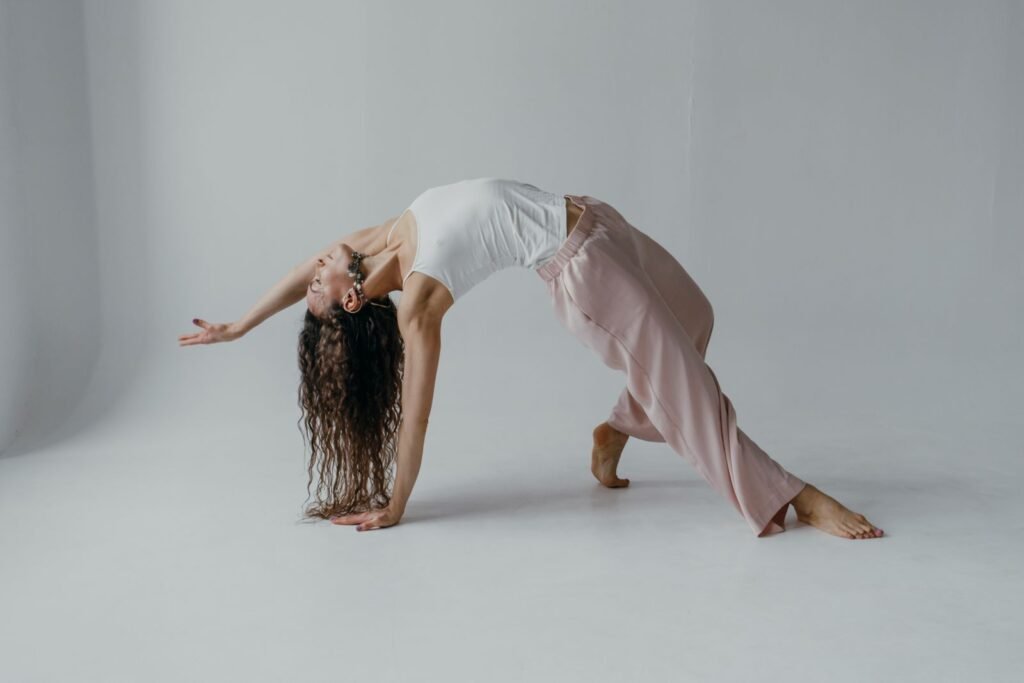
- Backbends — typically Urdhva Dhanurasana (upward bow) repeated several times
- Finishing sequence — inversions, seated forward folds, and a final relaxation
- Closing chant — a brief mantra that ends the practice
This is why so many people search for “ashtanga yoga steps” — the practice is genuinely procedural, almost like a formula, which is part of why it appeals to practitioners who prefer structure over improvisation.
Why Do Surya Namaskar A and B Matter So Much in Ashtanga?
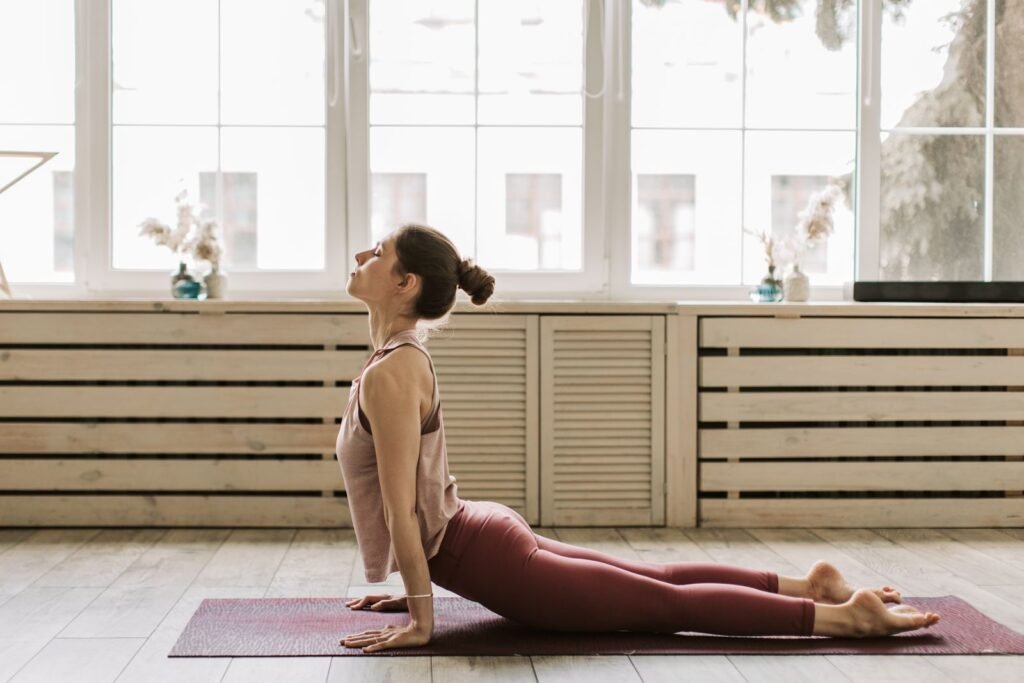
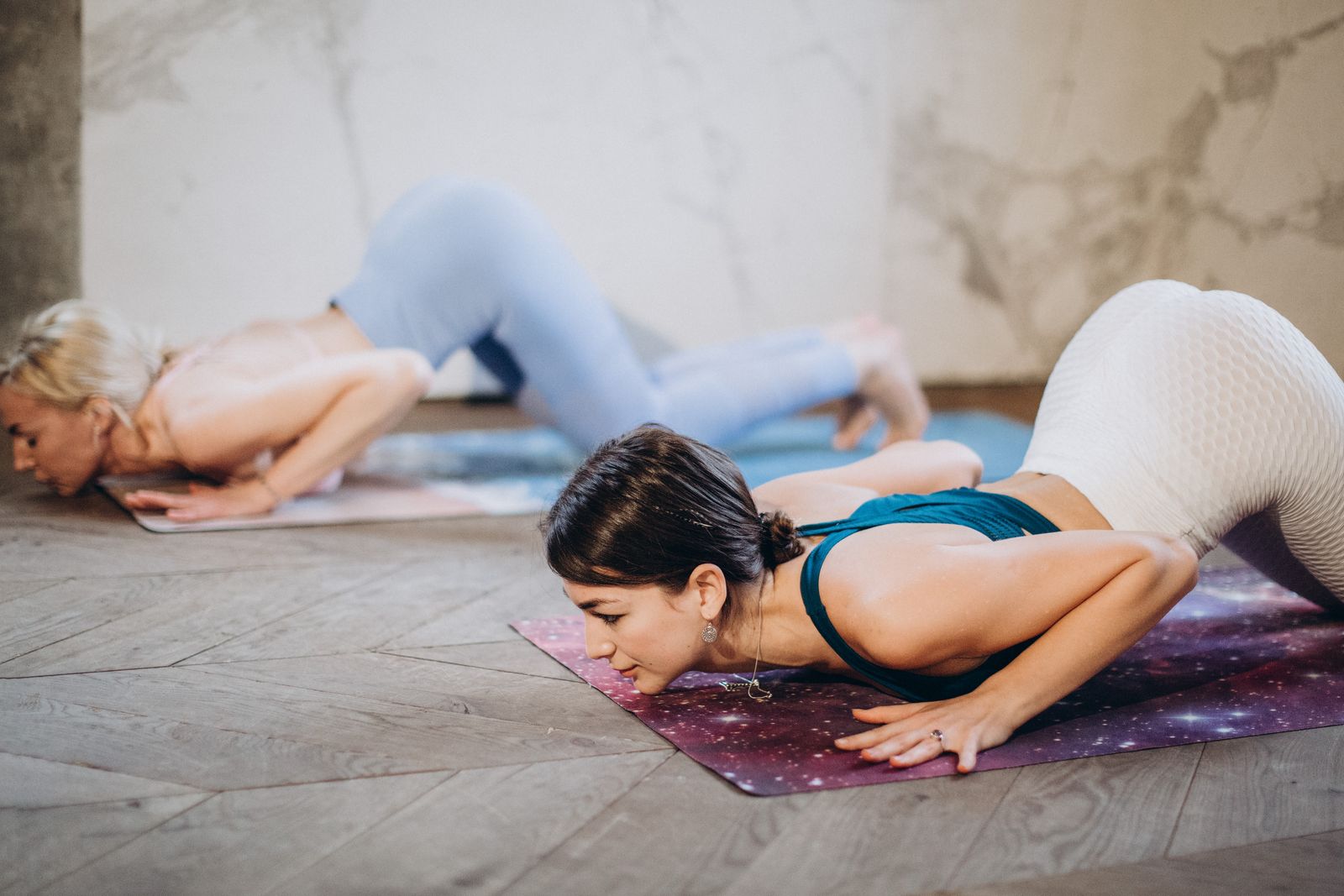
Surya namaskar, or sun salutation, is the engine that opens and sustains every ashtanga practice. Surya Namaskar A is a nine-breath sequence moving through forward fold, plank, chaturanga, upward dog, and downward dog. Surya Namaskar B adds Utkatasana (chair pose) and Virabhadrasana I (warrior I) to that same skeleton, extending it to seventeen breaths. Practicing five rounds of each at the start of every session builds cardiovascular heat, mobilizes the spine, and rehearses the vinyasa transitions — jump-backs and jump-throughs — that appear throughout the rest of the sequence. Because every subsequent posture connects back to this rhythm, weak or rushed sun salutations tend to show up as fatigue later in the practice. For a deeper breakdown of the individual postures involved, see sun salutation steps.
What Does Vinyasa Mean Inside Ashtanga Yoga?
In the ashtanga context, vinyasa refers to a specific breath-movement count linking one posture to the next, not the broader “flow yoga” style that has since borrowed its name. Every movement in and out of a posture corresponds to one inhale or one exhale, so a posture entered on an inhale and exited on an exhale has a defined vinyasa count attached to it. This one-breath-one-movement discipline is what gives ashtanga its momentum and its meditative, almost hypnotic quality once a practitioner knows the sequence well enough to stop thinking about what comes next.
What Are Bandhas and Drishti in Ashtanga Practice?
Two techniques distinguish ashtanga from many other physical yoga styles: bandhas and drishti. Bandhas are internal muscular locks — primarily Mula Bandha (root lock, engaging the pelvic floor) and Uddiyana Bandha (abdominal lock, drawing the lower belly in and up) — that practitioners engage throughout practice to support the spine and direct energy. Drishti are fixed gaze points assigned to each posture, intended to train concentration (dharana, the sixth limb) while the body moves. Together, bandhas and drishti turn what looks like a purely physical workout into a moving meditation, which is part of why long-term practitioners describe ashtanga as much more mental than it appears from the outside.
What Are the Benefits of Ashtanga Yoga?
Because ashtanga combines strength-building postures, cardiovascular sun salutations, and controlled breathing in a single session, practitioners commonly report a mix of physical and mental benefits: improved strength and muscular endurance from repeated chaturangas and arm balances, greater flexibility in the hips, hamstrings, and spine from the forward bends and backbends, better cardiovascular conditioning from the constant vinyasa pace, and improved focus and stress resilience from combining breath, gaze, and movement in a fixed order. Because the sequence never changes, many students also find it easier to notice their own progress over weeks and months — a posture that felt impossible in January often becomes accessible by summer. If stress relief is your main goal, it’s also worth comparing ashtanga against gentler options like restorative yoga or yoga nidra, which prioritize the nervous system over strength-building.
Is Ashtanga Yoga Good for Beginners?
Ashtanga is demanding, but it is not off-limits to beginners — it simply asks for patience with the learning curve. Most Mysore-style studios welcome new students into the Primary Series at whatever pace they can manage, with a teacher modifying postures individually rather than expecting a beginner to keep up with advanced practitioners in the room. That said, someone who has never done a chaturanga or downward dog will likely find the pace exhausting in the first few weeks. Many teachers suggest building a base with hatha yoga or general beginner yoga poses before committing to a full ashtanga series, simply so the body has some familiarity with foundational shapes like downward dog and forward folds.
How Is Ashtanga Yoga Different From Other Yoga Styles?
Ashtanga is often compared to vinyasa, hatha, and power yoga because all four involve physical postures, but the differences matter:
- Ashtanga vs. vinyasa — ashtanga uses one fixed sequence every time; vinyasa yoga varies the sequence class to class, often choreographed to music
- Ashtanga vs. hatha — hatha yoga moves slower, holding postures longer with more rest between them, while ashtanga keeps a continuous breath-linked pace
- Ashtanga vs. power yoga — power yoga borrows ashtanga’s intensity and vinyasa flow but drops the fixed sequence, letting instructors design their own class structure
- Ashtanga vs. kriya yoga — kriya yoga is a meditation-and-breathwork lineage with far less emphasis on physical postures, focused instead on specific techniques for accelerating spiritual growth
- Ashtanga vs. karma yoga — karma yoga isn’t a physical practice at all; it’s the path of selfless action and service described in the Bhagavad Gita
Understanding these distinctions matters if you’re trying to choose the right entry point among the many types of yoga available today, since “yoga” as a search term covers everything from gentle stretching to intense athletic sequences.
What Does “Ashtanga Yoga in Hindi” Mean?
Ashtanga is a Sanskrit compound word: “ashta” (आठ/अष्ट) meaning eight, and “anga” (अंग) meaning limb or part, so ashtanga yoga in Hindi is commonly explained as “अष्टांग योग,” or the eight-limbed path of yoga. Sanskrit and Hindi share this vocabulary closely, since Hindi draws heavily from Sanskrit roots, so the term needs little translation — it is used the same way in Hindi-language yoga instruction as it is in the original Sanskrit texts. Indian yoga teachers explaining the concept in Hindi generally walk through the same eight limbs — yam, niyam, asana, pranayama, pratyahara, dharana, dhyana, and samadhi — using the Sanskrit terms directly rather than translating each one.
What Did Patanjali Actually Say About Ashtanga Yoga?
Patanjali did not invent yoga; he is credited with compiling and systematizing existing yogic knowledge into the Yoga Sutras, a text of aphorisms structured across four chapters (padas). The eight-limbed path appears primarily in the second and third chapters, where Patanjali lays out the limbs as a sequence: outer disciplines (yama, niyama) prepare the practitioner for physical steadiness (asana) and breath control (pranayama), which in turn support the more internal limbs of withdrawal, concentration, meditation, and ultimately samadhi. Patanjali frames these not as a checklist to complete but as a unified path — practicing the outer limbs is meant to naturally support progress on the inner ones. This is the root definition behind every modern claim to the name “ashtanga,” whether it’s describing the Mysore-based physical practice or the eight-limb philosophy itself.
Can I Learn Ashtanga Yoga From a PDF or Book?
Searching for an “ashtanga yoga PDF” is common because the Primary Series has a fixed, learnable order that many students want to memorize outside the studio. Written references and posture charts can help with sequencing and Sanskrit names, but ashtanga was traditionally taught through direct, hands-on instruction precisely because alignment, breath timing, and bandha engagement are difficult to self-correct from a page or diagram. A printed sequence can serve as a helpful memory aid once you’re already training with a qualified teacher, but it is a poor substitute for someone watching your form, especially in a demanding practice where poor alignment in postures like backbends can lead to injury.
Questions People Ask About Ashtanga Yoga
What is ashtanga yoga?
Ashtanga yoga is a dynamic, sequence-based style of yoga that links each posture to a specific breath through vinyasa, moving through a fixed series of postures in the same order every session. It was systematized by Sri K. Pattabhi Jois in Mysore, India, starting in 1948, and it draws its name and philosophical framework from Patanjali’s eight-limbed (ashtanga) path.
What is ashtanga yoga according to Patanjali?
According to Patanjali’s Yoga Sutras, ashtanga refers to the eight limbs of yoga: yama, niyama, asana, pranayama, pratyahara, dharana, dhyana, and samadhi. These form a complete path from ethical conduct and physical discipline toward meditative absorption, rather than a single physical exercise routine.
What are the benefits of ashtanga yoga?
Ashtanga builds strength, flexibility, and cardiovascular endurance through its continuous vinyasa pace, while its fixed structure and breath-focused technique support concentration and stress resilience. Because the sequence stays the same, practitioners can track physical and mental progress clearly over time, session after session.
Can you explain what ashtanga yoga is in simple terms?
In simple terms, ashtanga yoga is a set routine of yoga poses done in the same order every time, each move paired with an inhale or exhale, building heat, strength, and focus. It comes from Patanjali’s eight-limb philosophy but is best known today as the fast-paced physical style Pattabhi Jois taught in Mysore.
What is ashtanga yoga in Hindi?
In Hindi, ashtanga yoga is called “अष्टांग योग,” combining “ashta” (eight) and “anga” (limb), referring to the same eight-limbed path described in Patanjali’s Yoga Sutras. Indian teachers generally use the original Sanskrit terms for each limb rather than translating them further.
What is ashtanga yoga of Patanjali versus modern ashtanga classes?
Patanjali’s ashtanga is a philosophical map of eight limbs leading toward meditative absorption, with asana as just one part of a much larger path. Modern ashtanga vinyasa classes, developed by Pattabhi Jois, are a specific physical practice built around fixed postural series — an application of the asana limb, not the full eight-limb system itself.
Try This for Yourself
Reading about ashtanga only goes so far — the breath counts, bandhas, and drishti points make far more sense once you’re moving through them with guidance. If you want to experience a properly sequenced practice without traveling to Mysore, you can book a live online yoga class with FitStrot and work with an instructor who can pace the practice to your current level, correct your form in real time, and help you build toward a fuller ashtanga sequence safely.
Related reading: Explore more on hatha yoga, kriya yoga, karma yoga, and types of yoga, or go ahead and try an online yoga class to put what you’ve learned into practice.