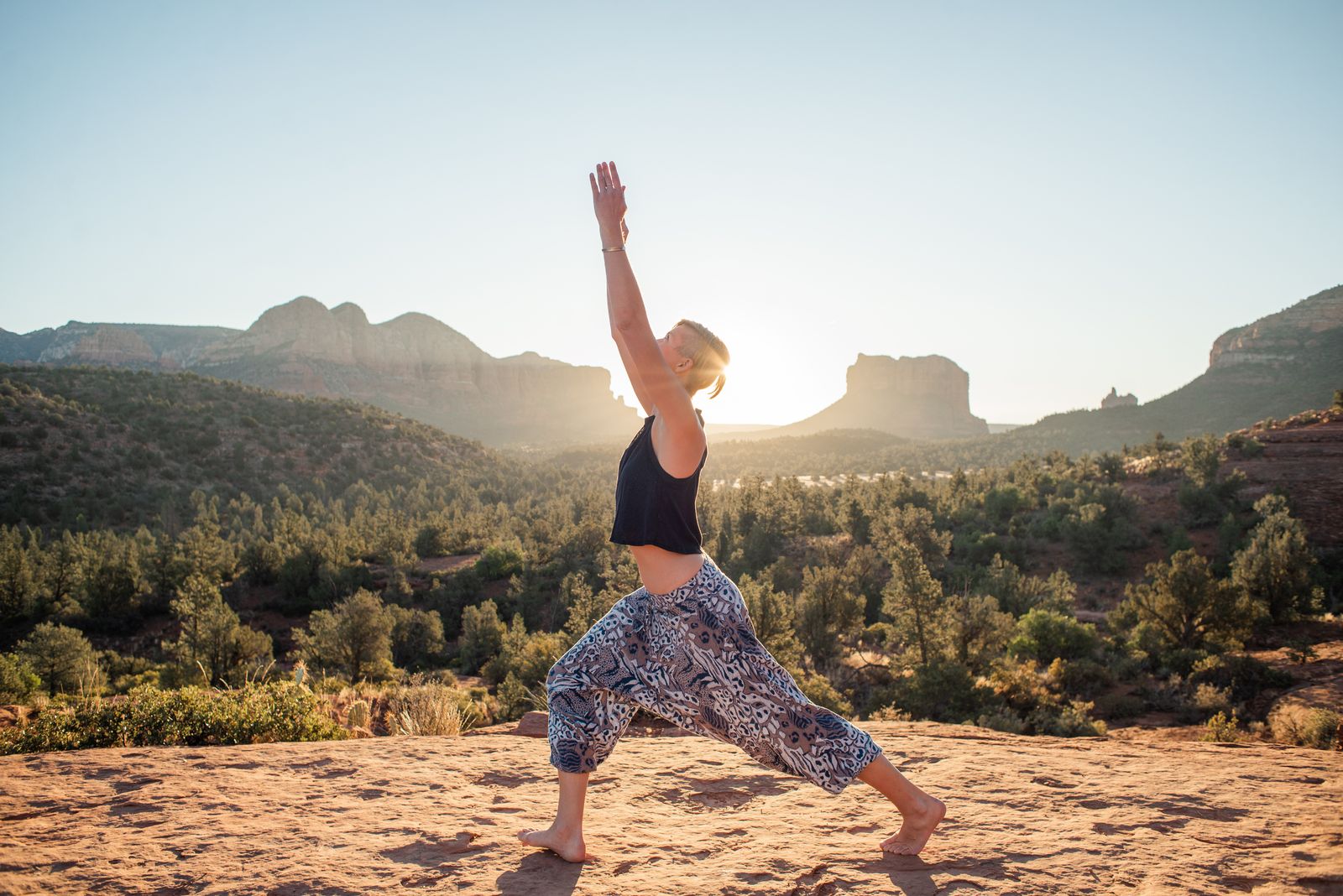
Anjaneyasana, known as Low Lunge or Crescent Lunge Pose, is a foundational yoga posture where the front knee bends deeply at a 90-degree angle while the back leg extends straight behind you, either with the knee resting on the mat or lifted for a more dynamic variation. It stretches the hip flexors and quadriceps of the back leg, strengthens the front thigh and glutes, and opens the chest and shoulders when the arms reach overhead. Named after the Hindu deity Hanuman (whose father was Anjani, giving the pose its name, sometimes called “Low Lunge” or “Anjaneya’s Pose”), it appears in Surya Namaskar (Sun Salutation) sequences and works as both a standalone hip-opener and a transitional shape between standing and seated postures.
What Is Anjaneyasana in Yoga?
Anjaneyasana comes from the Sanskrit words “Anjaneya,” a name associated with Hanuman, and “asana,” meaning pose or seat. Because Hanuman is traditionally described as the son of Anjani, the pose is often translated as “Anjani’s Pose” or, more loosely, “Hanuman’s Pose” in some teaching lineages, though full Hanumanasana (the front splits) is a separate, more advanced posture. Anjaneyasana itself is a low lunge: front knee stacked over the ankle at roughly 90 degrees, back leg extended long behind you, hips sinking forward and down, and the spine lifting tall or arching gently backward with the arms raised.
You will recognize it instantly if you have ever practiced Surya Namaskar, since it forms the “high lunge” or “low lunge” transition step between the forward fold and the plank position. As a standalone pose, it is usually held for 5 to 10 breaths per side, making it a staple in beginner and intermediate yoga poses sequences worldwide. It is also frequently taught early in different styles of yoga, from gentle hatha classes to faster-paced vinyasa flows, because the shape scales so easily from a passive stretch to an active, strength-building lunge.
How Do You Do Anjaneyasana Step by Step?
Getting into Low Lunge correctly protects your knees and lower back while maximizing the stretch through your hips. Follow this sequence slowly the first several times you practice.
- Start in Tabletop or Downward Dog. From Tadasana (Mountain Pose), fold forward and step back into a plank or downward-facing dog to set your base.
- Step one foot forward. Bring your right foot between your hands, aligning the knee directly above the ankle.
- Lower the back knee. Rest your left knee on the mat, untucking the toes so the top of the foot lies flat, or keep the toes tucked for a stronger stretch through the calf.
- Sink the hips forward and down. Let gravity draw your pelvis toward the floor rather than forcing it; you should feel a stretch along the front of the back hip and thigh.
- Lift the torso and raise the arms. Inhale, sweep your arms overhead, biceps by your ears, and lengthen through the side waist. Keep the front ribs drawn in so you do not overarch the lower back.
- Hold and breathe. Stay for 5 to 10 slow breaths, then release the arms, step back to plank or downward dog, and repeat on the other side.
What Muscles Does Anjaneyasana Stretch and Strengthen?
Low Lunge works multiple muscle groups simultaneously, which is part of why it shows up so often in warm-up sequences and hip-opening classes. The back leg’s hip flexor group, specifically the iliopsoas and rectus femoris, lengthens as the hip extends behind you. The quadriceps of the back thigh stretch as the knee bends. Meanwhile, the front leg’s glutes and quadriceps engage isometrically to stabilize the bent knee, and the core muscles, particularly the transverse abdominis and obliques, activate to keep the torso upright and prevent the lower back from overarching. If you raise the arms overhead, the shoulders, lats, and upper back also get an active stretch. This combination of stretching on one side and strengthening on the other is a hallmark of many standing and lunging asanas, including Vrksasana (Tree Pose), where balance and strength work together. If you are curious about the broader anatomy behind these hip-opening effects, most guides on yoga for flexibility point to exactly this kind of active-stretch, passive-lengthen pairing as the mechanism behind long-term range-of-motion gains.
What Are the Health Benefits of Anjaneyasana?
Regular practice of Anjaneyasana offers benefits that extend beyond simple flexibility. Because tight hip flexors are common among people who sit for long hours at desks or during long commutes, this pose directly counteracts a very modern postural problem.
Hip Flexor and Quadriceps Flexibility
The deepest benefit of Low Lunge is the release it provides through the hip flexors and quadriceps of the back leg. Chronically tight hip flexors are commonly associated with prolonged sitting and can contribute to an anterior pelvic tilt, so opening this area gradually through consistent practice may support more neutral hip alignment over time. This makes Anjaneyasana a popular recommendation in sequences built around yoga for back pain, since tight hip flexors often pull on the lower back and contribute to discomfort during long periods of sitting or standing.
Improved Balance and Core Stability
Holding the pose, especially with the arms raised overhead, challenges your balance and recruits the deep core stabilizers. This carries over into other standing balance postures and into everyday movements like stepping over obstacles or catching yourself on uneven ground.
Gentle Spinal Extension
Lifting the chest and reaching the arms overhead creates a mild backbend through the upper spine, which can help counteract the forward-rounded posture that comes from hours spent looking at screens.
Preparation for Deeper Poses
Anjaneyasana is frequently used as a preparatory shape for deeper hip openers and backbends, including Hanumanasana (the splits) and Kapotasana (Pigeon variations), because it gradually acclimates the hip flexors and quadriceps to lengthening under load.
Stress Relief Through Breath-Linked Movement
Because the pose asks you to coordinate breath with a gentle backbend and hip opener, it can also contribute to the calming effect many practitioners associate with slower, mindful sequences, similar to the grounding benefits described in guides to online yoga for stress relief.
How Does Anjaneyasana Fit Into a Sun Salutation Sequence?
If you have practiced Surya Namaskar, you have already done a version of this pose without necessarily naming it. In the traditional twelve-step sequence, the lunge appears twice: once as you step one leg back into a low lunge on the way down toward plank, and again as you step the same leg forward on the way back up toward standing. In faster-paced vinyasa classes, instructors often cue “high lunge” (back heel lifted, leg straight) rather than the classical Anjaneyasana with the back knee down, but the underlying hip mechanics are nearly identical. Practicing the slower, grounded version of Anjaneyasana as a standalone pose helps you build the strength and awareness needed to move through the faster Sun Salutation variation with better alignment and less strain on the knees. This is also why many teachers of vinyasa yoga spend extra time on the lunge transition early in a beginner’s training, since sloppy knee alignment here tends to carry over into every subsequent Sun Salutation round.
What Are Common Variations of Anjaneyasana?
Anjaneyasana adapts easily to different goals, from a deep quad stretch to a full-body opener. Knowing the variations lets you tailor the pose to what your body needs on a given day.
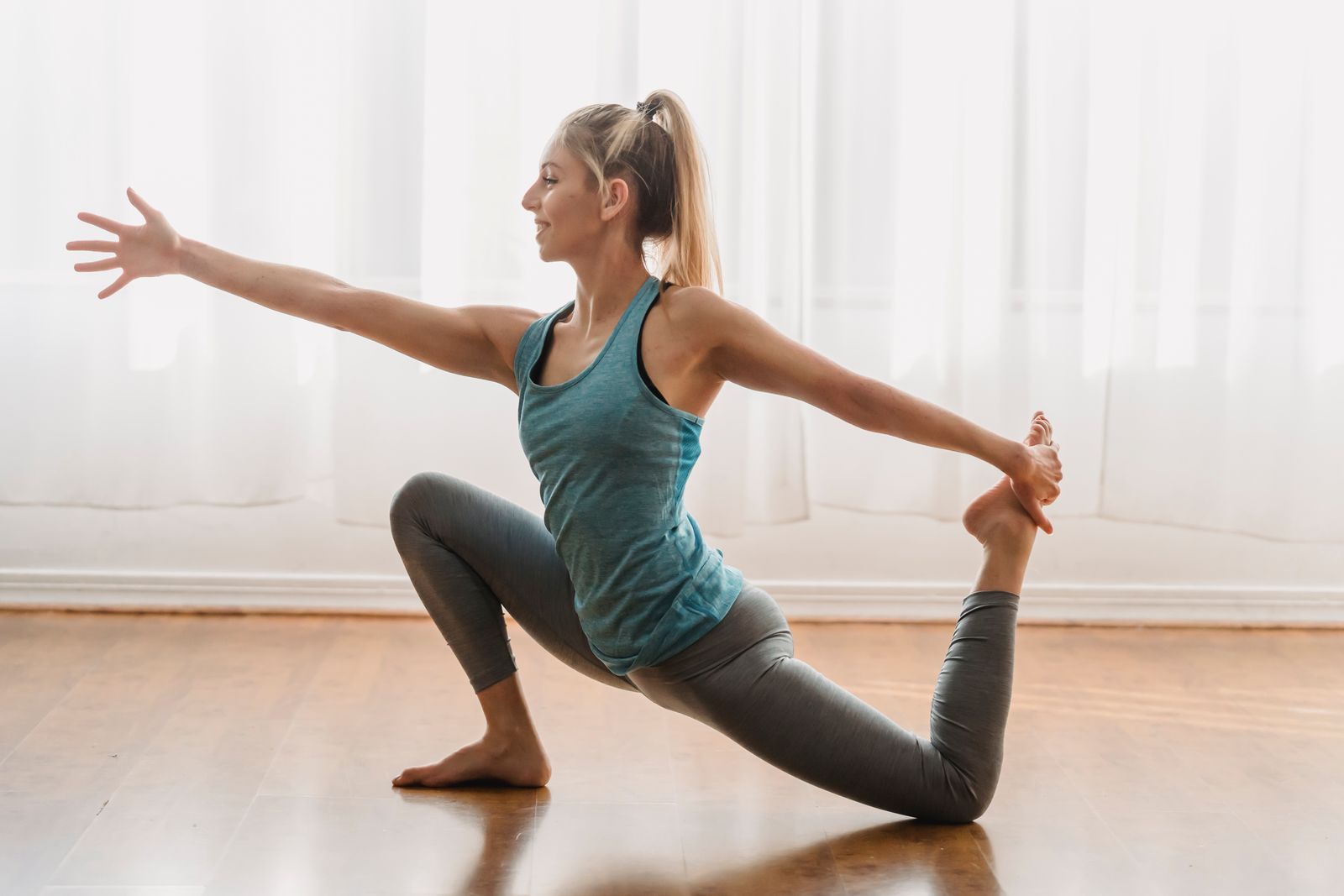
Low Lunge with Quad Stretch
Reach back with the same-side hand to hold the back foot, drawing the heel toward the glutes for an intensified stretch through the quadriceps, similar in feeling to a standing quad stretch but performed from a kneeling base.
High Lunge (Back Heel Lifted)
Instead of resting the back knee on the mat, tuck the back toes and lift the knee off the floor, straightening the back leg. This variation demands more strength and balance and is common in faster vinyasa flows and in Surya Namaskar.
Anjaneyasana with a Backbend
Once you feel stable in the basic shape, arch the upper back and gaze slightly upward while reaching the arms overhead, deepening the stretch through the chest and shoulders. This should only be attempted once the hips feel grounded.
Supported Low Lunge with Blocks
Placing yoga blocks under both hands beside the front foot allows beginners, or anyone with tight hips, to keep the spine long without collapsing forward, making the pose accessible regardless of current flexibility. This kind of prop-supported approach is common across yoga for beginners programs, where the goal is building confidence in the shape before chasing depth.
What Are Common Mistakes in Anjaneyasana?
Even a seemingly simple lunge can go wrong in ways that reduce the benefit or create strain. Watch for these frequent errors.
Front Knee Passing the Ankle
Letting the front knee drift forward past the toes shifts excess load onto the knee joint. Check your alignment by glancing down; you should be able to see your big toe just beyond the knee.
Collapsing Into the Lower Back
Many practitioners overarch the lumbar spine to fake a deeper backbend when reaching the arms overhead. Instead, lengthen through the side waist and draw the front ribs in gently to protect the lower back.
Skipping the Warm-Up
Moving into a deep hip flexor stretch on cold muscles increases strain risk. A few rounds of gentle standing forward folds or Cat-Cow Pose before Anjaneyasana prepares the hips and spine.
Ignoring the Back Foot Position
Letting the back foot roll to one side reduces stability. Keep the top of the back foot pressing evenly into the mat, or the toes tucked evenly if you are lifting the knee.
Who Should Modify or Avoid Anjaneyasana?
Anjaneyasana is generally safe for most practitioners, but certain conditions call for caution or modification. People with acute knee injuries, recent hip surgery, or significant sacroiliac joint instability should approach the pose carefully or skip it until cleared by a physiotherapist or doctor. Pregnant practitioners often continue a modified, wider-stance version well into the second trimester as part of a broader prenatal yoga routine, though it is always sensible to check with a qualified prenatal yoga instructor or physician first, since individual circumstances vary. If you experience sharp pain, as opposed to a general stretching sensation, at any point, ease out of the pose immediately and consider using a folded blanket under the back knee for cushioning, or bringing the back foot slightly wider for better stability.
How Long Should You Hold Anjaneyasana?
For a general flexibility and warm-up context, holding Anjaneyasana for 5 to 8 breaths per side is typical in most beginner and intermediate classes. If your goal is a deeper hip-opening stretch, extending the hold to 30 to 60 seconds per side, breathing slowly and consciously softening deeper into the stretch with each exhale, tends to be more effective for lasting flexibility gains than a quick, shallow hold. In restorative or yin-influenced styles, some teachers extend passive variations of the lunge to two minutes or more, though this should only be attempted once you are familiar with the pose’s alignment cues. If longer, slower holds appeal to you, it is worth exploring a dedicated yin yoga class, where connective tissue, rather than muscle, is the primary target.
How Does Anjaneyasana Compare to Similar Poses?
Understanding where Anjaneyasana sits relative to other standing and lunging postures helps you sequence your practice more intelligently. Compared to Vrksasana (Tree Pose), which emphasizes single-leg balance and stillness, Anjaneyasana is more dynamic and stretch-focused, working the hip flexors actively rather than testing static balance on one leg. Compared to Warrior I (Virabhadrasana I), which shares a similar lunging shape but keeps the back heel grounded and angled, Anjaneyasana typically has the back knee down or the back leg fully extended with the foot in a more neutral position, making it gentler on the ankles and more oriented toward stretching than strengthening. If you are building a well-rounded home practice, pairing Anjaneyasana with Tadasana for postural grounding and a standing balance pose like Vrksasana gives you a complete foundation covering flexibility, strength, and balance. For a deeper dive into how these standing shapes relate to one another, a guide on standing yoga poses is a useful next stop.
How Can Beginners Build Up to Anjaneyasana?
If a full low lunge feels inaccessible right away, especially for practitioners with tight hips or limited knee mobility, there is no need to force the classical shape immediately. Start by practicing gentle hip circles and standing forward folds to loosen the hip joint generally. Then try a supported version with both hands on yoga blocks or a chair seat, keeping the back knee cushioned with a folded blanket or towel. As mobility improves over several weeks of consistent practice, gradually lower the hands closer to the floor and hold the pose longer. Many teachers recommend approaching new hip-openers this way, as part of a broader foundational sequence found in most yoga poses guides for beginners, rather than attempting advanced variations before the basic alignment feels stable. Pairing this gradual approach with a wider look at the overall benefits of yoga can also help you stay motivated while your hips slowly open over several weeks.
How Does Anjaneyasana Support Mental Focus and Breath Awareness?
Beyond the physical stretch, Anjaneyasana asks for sustained attention to balance and alignment, which naturally draws the mind away from external distractions and into present-moment awareness. Coordinating the breath with the pose, inhaling as you lift the arms and lengthen the spine, exhaling as you settle deeper into the hip stretch, reinforces the broader yogic principle of linking movement to breath (vinyasa in its most literal sense). This breath-body connection is one reason lunging poses like Anjaneyasana are used not just for physical flexibility but also as a grounding transition point within longer flow sequences, giving practitioners a moment to reset their attention before moving into the next posture. If breath-linked movement is something you want to explore further, a guide to pranayama breathing techniques pairs naturally with an asana practice built around poses like this one.
Questions People Ask About Anjaneyasana
What does Anjaneyasana mean in yoga?
Anjaneyasana means “Anjani’s Pose” or is loosely translated as “Low Lunge” or “Crescent Lunge.” The name references Anjani, the mother of Hanuman in Hindu tradition, though the pose itself is distinct from the deeper Hanumanasana splits pose.
Is Anjaneyasana the same as Crescent Lunge?
Anjaneyasana and Crescent Lunge are often used interchangeably, though some teachers reserve “Crescent Lunge” for the high lunge variation with the back knee lifted, while using “Anjaneyasana” or “Low Lunge” for the version with the back knee resting on the mat.
What are the main benefits of Anjaneyasana?
Anjaneyasana stretches the hip flexors and quadriceps, strengthens the front thigh and glutes, improves balance, and gently opens the chest and shoulders when the arms reach overhead. It is also commonly used to counteract tightness from prolonged sitting.
Can beginners do Anjaneyasana?
Yes, Anjaneyasana is considered a beginner-friendly pose, especially with modifications like a cushioned back knee or yoga blocks under the hands. Beginners should move slowly into the hip stretch and avoid forcing depth before the hips feel warmed up.
How is Anjaneyasana different from Hanumanasana?
Anjaneyasana is a low lunge with the back knee bent or extended along the floor, while Hanumanasana is the full front splits with both legs completely straight. Anjaneyasana is often used as a preparatory pose that gradually builds the flexibility needed for Hanumanasana.
Which muscles get the deepest stretch in Anjaneyasana?
The hip flexors (iliopsoas) and quadriceps of the back leg receive the deepest stretch in Anjaneyasana. The front leg’s glutes and thigh muscles work isometrically to stabilize the bent knee rather than being stretched.
Try This for Yourself
Reading about Anjaneyasana only goes so far. The fastest way to feel the hip-opening benefits and correct your alignment in real time is to practice alongside an instructor who can see your form and adjust it live. Join a FitStrot online yoga class and work through Low Lunge and the rest of a balanced asana sequence with guided, personalized feedback from wherever you are.
Related reading: Yoga Poses, Surya Namaskar, Tadasana, Vrksasana, Yoga for Flexibility, and FitStrot’s Online Yoga Classes.