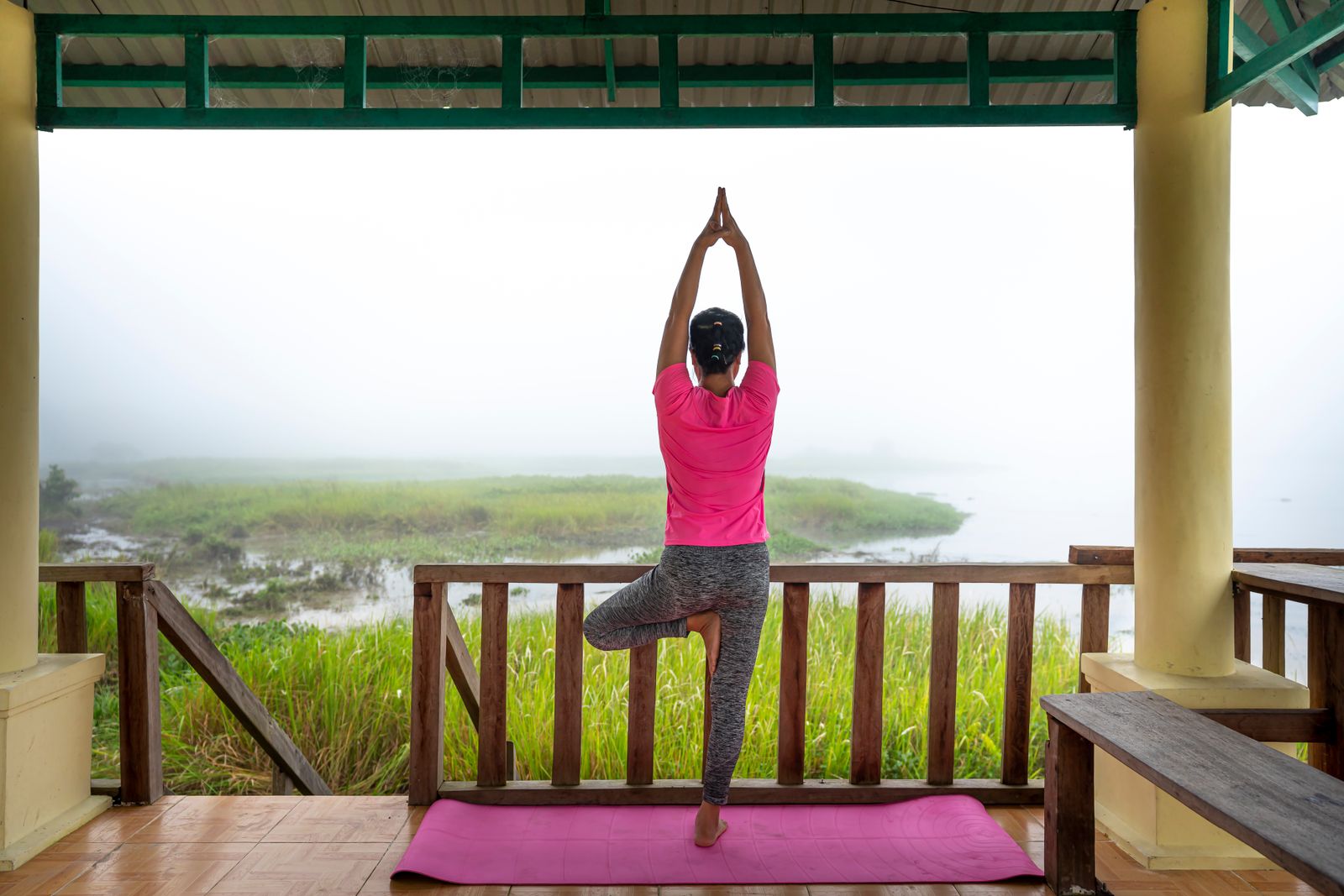
Vrksasana, or Tree Pose, is a standing balance posture in which you root one foot into the ground, place the sole of the other foot against your standing leg, and lift both arms overhead like branches. It builds ankle and core stability, sharpens mental focus, and strengthens the hips, thighs, and spine, making it one of the most commonly taught postures for beginners in yoga classes worldwide. The pose is typically held for 5 to 10 breaths on each side and can be modified with a lower foot placement or a wall for support if balance is still developing.
What Does Vrksasana Mean and Where Does It Come From?
The word “Vrksasana” comes from Sanskrit: “vriksha” means tree, and “asana” means posture or seat. Together, the name describes exactly what the pose looks like: a single trunk rising from the ground with limbs branching out and upward. Tree Pose is one of the foundational standing balances taught in classical Hatha Yoga sequences and appears in nearly every beginner-level yoga curriculum, from Hatha to Vinyasa styles. Because it asks the body to mimic something as still yet alive as a tree, teachers often use it to introduce the idea that stillness in yoga is never really static: a tree sways gently in the wind while staying rooted, and the same subtle micro-adjustments happen in your standing leg and core when you hold this pose well.
How Do You Practice Vrksasana Step by Step?
Follow these steps to move into Vrksasana with control and stability:
- Start in Tadasana. Stand tall in Tadasana (Mountain Pose), feet hip-width apart, weight distributed evenly.
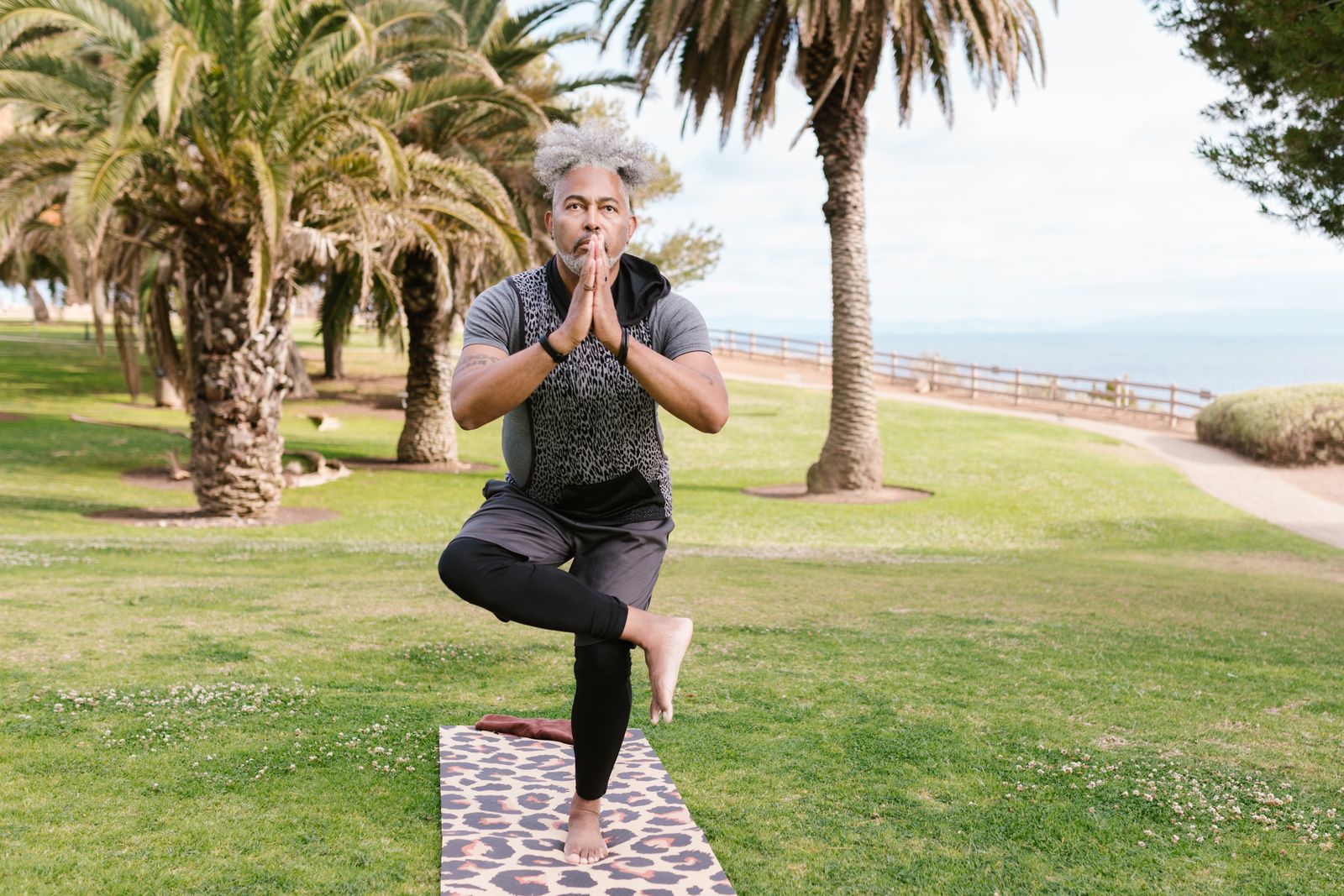
- Shift your weight and lift one foot. Shift your weight onto your left foot, bend your right knee, and bring the sole of your right foot to rest against your inner left calf or inner thigh, avoiding direct pressure on the knee joint.
- Press foot and leg together. Press your lifted foot and standing leg firmly against each other to create stability.
- Position your hands. Bring your palms together at your heart center, or extend your arms overhead with palms facing each other, fingers reaching toward the ceiling.
- Fix your gaze and breathe. Fix your gaze on a still point ahead of you, a technique called drishti, and breathe steadily for 5 to 10 breaths.
- Release with control. Lower slowly with control, then repeat on the other side.
Moving out of the pose with the same intention you used to enter it prevents the wobble-and-catch pattern that undermines balance training over time.
What Are the Physical Benefits of Vrksasana Yoga?
Tree Pose strengthens the muscles of the standing leg, including the quadriceps, calf, and the small stabilizer muscles around the ankle that rarely get targeted in everyday movement. It also activates the hip abductors and core, particularly the obliques and transverse abdominis, which fire continuously to keep the pelvis level while one leg is lifted. Regular practice tends to improve postural alignment because the pose demands a neutral spine and an engaged core rather than a locked or overarched lower back. The bent leg also opens the hip joint, offering a gentle stretch to the groin and inner thigh, which can be useful for people who sit for long stretches during the day. Combined with a well-rounded flow such as Surya Namaskar, Vrksasana adds a balance-specific stimulus that most sun salutation sequences don’t otherwise include.
Can Vrksasana Improve Balance and Coordination?
Yes, and this is arguably its best-documented benefit. Standing balance postures like Vrksasana require the nervous system to constantly process input from three sources: the inner ear (vestibular system), the eyes (visual feedback), and receptors in the muscles and joints (proprioception). Holding a one-legged stance trains these systems to communicate faster and more accurately, which is why balance poses are frequently recommended in fall-prevention programs for older adults. A small controlled study on the effects of Vrksasana practice reported improvements in balance-related outcomes among participants who practiced it regularly, though as with most single-pose research, results vary by population and program length, so it’s best understood as one useful tool within a broader balance-training routine rather than a stand-alone fix.
Does Tree Pose Help with Mental Focus and Stress?
Balance poses demand a specific kind of attention that’s hard to fake: if your mind wanders, your body wobbles. This built-in feedback loop is part of why Vrksasana is often used as a mindfulness anchor in yoga classes. Fixing your gaze on a single point, regulating your breath, and maintaining postural awareness simultaneously pulls attention away from racing thoughts and into the present moment. Many practitioners report that a few rounds of Tree Pose before a stressful meeting or exam helps settle pre-event nerves, likely through the same slow, diaphragmatic breathing pattern encouraged throughout yoga for stress relief practices generally.
What Muscles Does Vrksasana Strengthen?
The standing leg does the most obvious work, engaging the quadriceps, hamstrings, gluteus medius, and the intrinsic muscles of the foot and ankle. The core, especially the obliques and deep abdominal stabilizers, works to keep the torso upright and prevent the hips from tilting toward the lifted leg. The muscles around the shoulder girdle, including the serratus anterior and lower trapezius, engage when the arms are raised overhead, helping build shoulder stability alongside balance. Because so many muscle groups fire together rather than in isolation, Tree Pose is often described as a full-body integration posture rather than a pose that isolates one area, which is part of why it pairs so well with strength-focused sequences like those built around Vajrasana for seated grounding work afterward.
What Are Common Mistakes People Make in Vrksasana?
A few alignment errors show up again and again in Vrksasana, and each one is easy to correct once you know what to look for:
- Foot resting on the knee. Placing the lifted foot directly against the side of the standing knee puts unwanted lateral pressure on a joint that isn’t designed to absorb it; the foot should sit above or below the knee, never on it.
- Hip jutting outward. Letting the hip of the lifted leg jut out twists the pelvis and defeats the pose’s alignment benefits; keeping both hip points facing forward keeps the stretch and the balance challenge honest.
- Holding the breath. Breath-holding under balance stress tends to make wobbling worse, since shallow or held breath tightens the diaphragm and destabilizes the core.
- Fixing your gaze on a moving point. Many beginners fix their gaze on a moving object, such as another person, which makes maintaining balance considerably harder than focusing on something still.
How Do Beginners Modify Vrksasana Safely?
If balance feels unsteady, lower the foot placement to rest against the ankle rather than the thigh, or keep the toes of the lifted foot lightly touching the floor for extra support while the raised knee still opens outward. Practicing next to a wall, with one hand lightly touching it for reference rather than full support, is a common and effective progression. Beginners can also keep their hands at the heart center instead of overhead, since raising the arms shifts the body’s center of gravity higher and makes the balance more demanding. Building comfort with these modifications before attempting the full-arm variation tends to produce more stable, sustainable balance gains than pushing straight into the advanced form.
Who Should Be Cautious with Vrksasana?
People recovering from ankle, knee, or hip injuries should approach Tree Pose carefully and may benefit from practicing near a wall or chair for support until strength and confidence return. Those with low blood pressure or a history of dizziness should come in and out of the pose slowly, since standing balance postures can occasionally trigger lightheadedness if performed too quickly after a change in position. Pregnant practitioners, particularly in later trimesters, often find a wall or the back of a sturdy chair helpful given the natural shift in center of gravity during pregnancy. As with any new physical practice, anyone with a pre-existing joint condition should check with a physician or a qualified yoga instructor before attempting full-depth variations.
What Are the Main Variations of Vrksasana?
Beyond the classic overhead-arms version, Tree Pose has several variations that shift the challenge or the focus. Eagle-armed Tree Pose wraps the arms around each other in front of the chest, adding a shoulder stretch to the balance challenge. A backbend variation, where the practitioner arches gently backward while in the pose, increases the demand on core stability and spinal extension. Closed-eye Tree Pose removes visual feedback entirely, forcing the practitioner to rely on proprioception and inner-ear balance alone, which is a considerably more advanced version reserved for people who are already stable with eyes open. Some styles also incorporate a moving or “dancing” Tree Pose, gently swaying the raised arms or torso to build dynamic rather than purely static balance.
How Does Vrksasana Fit Into a Full Yoga Practice?
Tree Pose is typically placed in the standing portion of a sequence, after the body has been warmed up through a few rounds of dynamic movement such as Surya Namaskar, and before deeper standing postures or seated work. It works well as a transition pose because it re-centers attention and breath after more dynamic movement, and it pairs naturally with other standing balance poses in a themed balance-focused class. Teachers often sequence it alongside Tadasana at the start and close of a sequence, using both poses as bookends that reinforce posture and grounding. For practitioners building a personal home routine, Tree Pose is a reliable inclusion in any beginner yoga sequence because it delivers strength, focus, and balance benefits in a single, relatively low-impact posture.
Can Vrksasana Help with Posture and Back Pain?
Because the pose requires an elongated spine and an engaged core to maintain balance, regular practice can reinforce the habit of standing tall rather than slumping, which carries over into daily posture outside the yoga mat. The pose also strengthens the muscles that support the lower back indirectly, through core and hip engagement, without loading the spine in the way seated forward bends or deep backbends can. That said, Tree Pose is a supportive addition to a back-care routine rather than a targeted treatment, and people managing chronic back pain should look at it as one piece within a broader plan such as the guidance found in yoga for back pain programs, ideally under professional guidance.
How Long Does It Take to Get Comfortable with Vrksasana?
Most beginners can hold a modified version of Tree Pose, with the foot resting at ankle height, within their first one or two classes. Achieving a stable full-depth version, with the foot at the inner thigh and arms extended overhead for a full 8 to 10 breaths without wobbling, commonly takes several weeks of consistent practice, since balance is a trainable skill that improves with repetition much like any other motor pattern. Practicing three to four times a week, even for just a few minutes of standing balance work, tends to produce noticeable improvement faster than infrequent, longer sessions. Patience here matters more than intensity: balance training rewards consistency over force.
Questions People Ask About Vrksasana
Is Vrksasana good for beginners?
Yes, Vrksasana is considered one of the more accessible standing balance poses and is commonly taught in beginner classes. It can be modified by lowering the foot placement or practicing near a wall, which makes it approachable for people who are new to yoga or still building core and ankle stability.
Which leg should you balance on first in Tree Pose?
There’s no fixed rule; most teachers suggest starting with whichever side feels more stable so you build confidence in the pattern before challenging the less stable side. Practicing both sides evenly over time helps address any strength or balance asymmetry between your left and right leg.
Why do I keep falling out of Tree Pose?
Wobbling is normal and is actually part of how the balance system trains itself. Common causes include a moving gaze point, shallow breathing, or placing the lifted foot directly on the knee joint instead of above or below it. Slowing down your entry and fixing your eyes on a still point usually improves stability quickly.
Can Vrksasana be done every day?
Yes, Tree Pose is low-impact enough to practice daily and many people include it in a short morning routine. Because it primarily trains balance and postural muscles rather than creating deep muscular fatigue, it doesn’t typically require rest days between sessions.
What is the difference between Vrksasana and other balance poses?
Vrksasana is generally considered an entry-level balance pose because the bent knee opens out to the side and the standing leg stays vertical, which keeps the base of support relatively stable compared to poses like Half Moon or Eagle Pose that shift weight forward or twist the torso. It’s often used as the first balance pose taught before progressing to more complex variations.
Do I need any equipment to practice Vrksasana?
No special equipment is required, though a non-slip yoga mat helps prevent the standing foot from sliding. A wall or sturdy chair nearby can be useful as an optional support for beginners while balance and confidence develop.
Try This for Yourself
Reading about Vrksasana is a good start, but balance is a skill you build through repetition, feedback, and gentle correction, which is exactly what a live instructor provides. If you’d like structured guidance on alignment, breathing, and progressive variations tailored to your level, try a class with FitStrot’s online yoga classes and build your balance practice with real-time feedback from a certified instructor.
Related reading: Yoga Poses, Tadasana, Surya Namaskar, Vajrasana, and FitStrot’s online yoga classes.