Talasana, or Palm Tree Pose, is a standing yoga posture in which you rise onto your toes or heels with both arms stretched straight overhead, palms together, creating one long line of extension from your feet to your fingertips, mirroring the tall, upright trunk of a palm tree. It is one of the simplest full-body stretches in yoga, yet it delivers an outsized return: it lengthens the spine, opens the chest and shoulders, strengthens the ankles and calves, and improves balance, all in a pose that takes under a minute to learn. Because it requires no floor space beyond a single mat and no prior flexibility, Talasana is commonly taught as one of the first standing stretches in a beginner’s practice and remains a staple warm-up in nearly every style of yoga, from a gentle Hatha yoga class to a flowing Vinyasa yoga sequence.
What Is Talasana and Where Does the Name Come From?
The word “Talasana” comes from the Sanskrit “tala,” meaning palm tree, and “asana,” meaning seat or pose. The name is a direct visual reference: when you extend your arms overhead and rise onto your toes, your body forms the same tall, straight silhouette as a palm tree trunk reaching toward the sky. Some teachers also call it “Urdhva Hastasana” (Upward Salute) when the pose is done with heels flat on the floor, though many traditional lineages, including the Yogendra school of yoga, treat Talasana as its own named pose with a heel-raise as a core part of the shape. Whichever name your teacher uses, the essential action is the same: root down through the feet, then lift and lengthen everything above them, a principle that runs through most standing postures in the broader types of yoga practiced today.
How Do You Perform Talasana Step by Step?
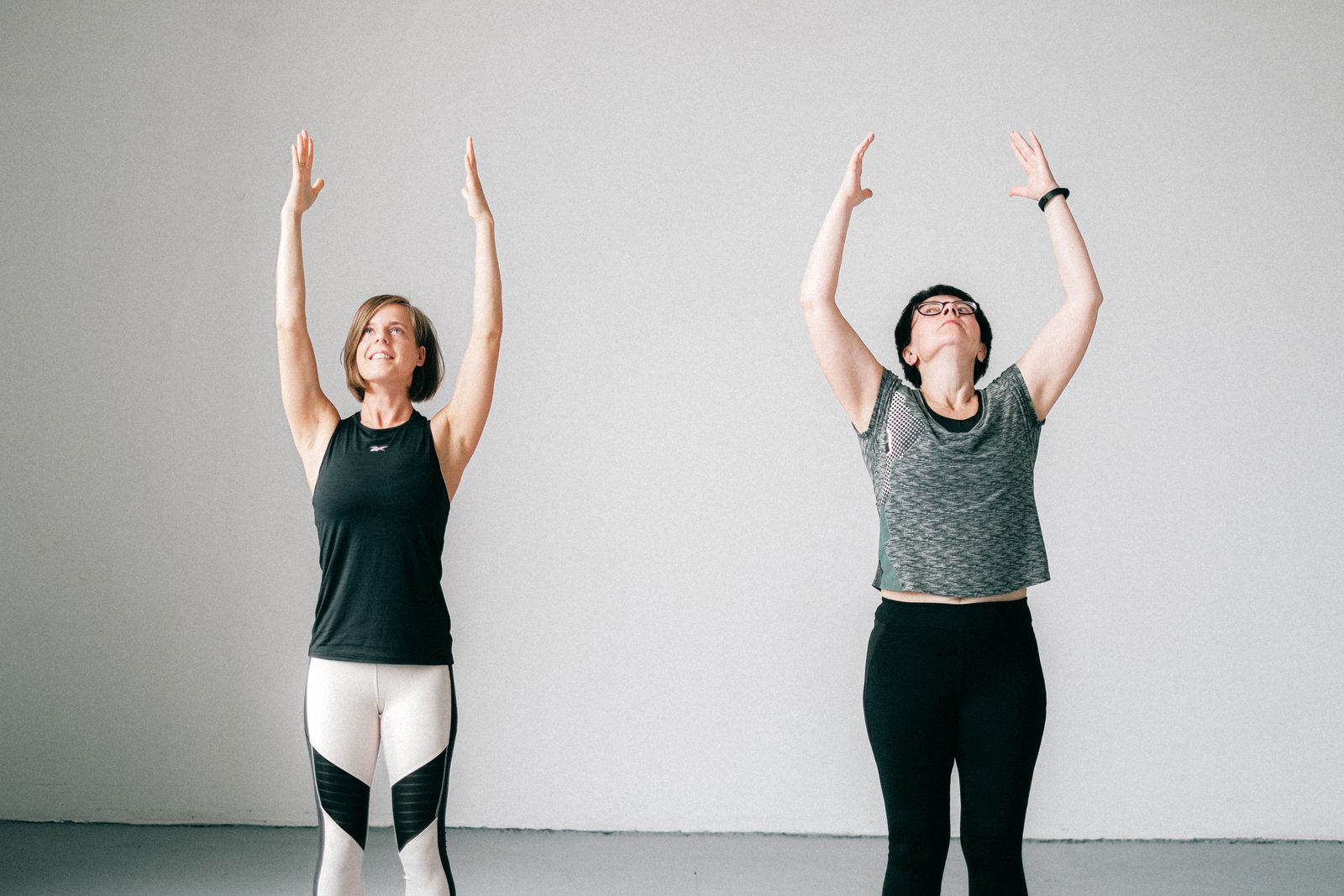
Begin standing in Tadasana (Mountain Pose), with your feet hip-width apart and your weight distributed evenly across both feet. Inhale as you sweep your arms out to the sides and up overhead, interlacing your fingers or pressing your palms together with index fingers pointed up. As you reach upward, press through your palms and draw your shoulder blades down your back rather than hunching them toward your ears. On your next inhale, rise onto the balls of your feet, lifting your heels off the mat while keeping your legs active and your core gently engaged for balance. Hold for three to five breaths, feeling the stretch travel from your heels through your torso to your fingertips, then exhale as you lower your heels and release your arms back to your sides. Repeat two to three times, and if balance is challenging, keep your heels grounded and focus on the overhead reach instead, applying the same patient, prop-free approach recommended for anyone just starting out with yoga for beginners.
What Muscles Does Talasana Stretch and Strengthen?
Talasana simultaneously stretches and strengthens muscle groups at opposite ends of the body. The intercostal muscles between the ribs, the latissimus dorsi along the sides of the torso, and the shoulder and upper back muscles all lengthen as the arms reach overhead, which is why the pose is so often used to counteract the rounded, closed posture created by long hours at a desk. At the same time, the gastrocnemius and soleus muscles of the calves, along with the small stabilizing muscles of the feet and ankles, work hard to hold you steady on your toes. The core, particularly the transverse abdominis, engages isometrically to keep the ribs from flaring and the spine from over-arching. This combination of upper-body lengthening and lower-body strengthening is similar in spirit to Hastapadasana, which also uses a full spinal stretch to build both flexibility and stability in a single shape, and it reflects the broader benefits of yoga as a practice that trains flexibility and strength together rather than treating them as separate goals.
What Are the Benefits of Practicing Talasana?
Regular practice of Talasana is commonly associated with a range of benefits reported by yoga teachers and practitioners:
- A longer, more mobile spine, since the upward reach decompresses the vertebrae and creates space between spinal segments after long periods of sitting or standing.
- Improved posture, as the pose actively trains the shoulders to draw back and down rather than rounding forward, which can help counteract the effects of screen-based work.
- Stronger ankles, calves, and feet, from the toe-raise portion of the pose, which builds the fine balance and stabilizing strength used in many other standing postures.
- Better overall balance and body awareness, since holding steady on the toes with arms overhead demands constant small adjustments from the whole body.
- A gentle boost in circulation and alertness, which is one reason Talasana is frequently used as a quick reset between longer holds or at the start of a class, much like the energizing role Surya Namaskar plays in warming up the body.
- Stress relief through mindful movement, since coordinating breath with a full-body stretch shifts attention away from mental chatter and toward the sensations of the body, a benefit closely tied to yoga for stress relief more broadly.
What Are the Different Variations of Talasana?
Talasana is typically taught with four progressive variations, each adding a slightly different demand. The first is a single-arm version, where one arm reaches overhead while the other rests by the side, useful for isolating the stretch along one side of the torso. The second raises both arms together with palms facing each other or fingers interlaced. The third brings both arms up with palms pressed together directly overhead, deepening the shoulder stretch. The fourth crosses the arms in front of the body before sweeping them up and overhead in one motion, adding a shoulder mobility component to the lift. Each variation can be practiced with heels grounded for a gentler version focused purely on the upper body, or with heels raised for the fuller balance challenge. A side-bending variation, sometimes called Talasana Side Bend, adds a lateral stretch by tipping the torso to one side once the arms are overhead, targeting the obliques and the muscles along the ribcage more directly, similar to the lateral opening found in Trikonasana (Triangle Pose).
How Is Talasana Different From Tadasana and Hastapadasana?
These three standing poses are closely related but distinct. Tadasana, or Mountain Pose, is the neutral standing foundation with arms resting at the sides, and it is the starting and ending point for most standing sequences. Talasana builds directly on Tadasana by adding the overhead arm reach and, in its classic form, a heel raise, transforming a grounding pose into an active stretch. Hastapadasana, or Standing Forward Fold, takes the body in the opposite direction, folding forward from the hips rather than reaching up, which stretches the back body, particularly the hamstrings and spine, rather than the front and sides. Practicing Talasana and Hastapadasana back to back is a common sequencing choice, since the upward stretch of one nicely offsets the forward stretch of the other, giving the spine movement in two complementary directions within the same practice.
When Should Talasana Be Practiced in a Yoga Sequence?
Talasana is versatile enough to appear almost anywhere in a sequence. Many teachers use it at the very start of class as a gentle way to wake up the spine and shoulders before moving into more demanding postures. It also works well as a transitional pose between seated or floor-based work and standing sequences, since the overhead reach naturally re-energizes the body after time spent low to the ground. Some sequences place it just before balance poses such as Vrksasana (Tree Pose), since the toe-raise variation of Talasana primes the same ankle and foot stabilizers needed for single-leg balance. It is rarely, if ever, placed at the very end of a practice, since its energizing, uplifting quality is better suited to preparing the body for activity than to winding a session down.
Who Should Avoid or Modify Talasana?
Talasana is a low-risk pose for most healthy adults, but a few groups should modify or approach it cautiously. People with shoulder injuries, frozen shoulder, or limited overhead range of motion should keep the arms only as high as is comfortable rather than forcing a full reach, and may benefit from holding a strap between the hands instead of pressing the palms together. Those with balance concerns, inner ear conditions, or low blood pressure that causes dizziness on standing should keep the heels grounded and consider practicing near a wall for support. People with significant hypertension or serious cardiac conditions are often advised to avoid the breath-holding, heel-raised version and to stick with a gentler, heels-down variation instead. As with any pose, if you feel sharp pain rather than a stretching sensation, ease out of the position and consult a qualified teacher or healthcare provider, an approach worth applying across any routine drawn from a broader yoga for back pain or joint-care program.
What Breathing Pattern Works Best With Talasana?
Talasana is traditionally paired with a simple, deliberate breath pattern: inhale as you raise the arms and heels, hold the position for a few natural breaths, then exhale as you lower back down. This inhale-up, exhale-down rhythm is not just a teaching convenience; the act of inhaling naturally slightly elongates the spine and lifts the ribcage, which supports the upward stretch the pose is designed to create. Holding the breath at the top of the stretch is generally discouraged, since sustained breath-holding can spike blood pressure and undermine the calm, steady quality the pose is meant to cultivate. Instead, aim for two to three full, unforced breaths while balanced on the toes before releasing, similar to the breath-led pacing used throughout Hatha yoga practice.
Can Talasana Help With Height and Posture Concerns?
Talasana is often mentioned in traditional yoga texts as supportive of height development in growing children and teenagers, largely because the pose stretches the spine and encourages good postural habits during years when the skeleton is still developing. For adults, the pose will not add measurable height, since long bones have finished growing, but the postural benefits are real: consistent practice can help counteract the shortened chest muscles and rounded upper back that come from long hours of sitting or phone use, effectively helping you stand taller by improving alignment rather than by lengthening bone. This makes Talasana a genuinely useful daily habit for anyone whose work involves a desk, a screen, or long periods in one static position, and it pairs well with other posture-focused practices covered under yoga for flexibility.
How Does Talasana Compare to Samakonasana for Flexibility?
Samakonasana, or the Straight Angle Pose, is a deep hip-opening posture that challenges hamstring and hip flexibility in a completely different plane of movement than Talasana. Where Talasana lengthens the body vertically through the spine and shoulders, Samakonasana works horizontally, splitting the legs wide apart while keeping the torso upright. Practicing both poses within the same broader flexibility routine gives the body a well-rounded stretch across multiple joints and directions, which is a useful principle to apply generally: pairing a spine-and-shoulder opener like Talasana with a hip-and-hamstring opener like Samakonasana covers far more ground than repeating stretches in only one direction.
Does Talasana Have a Role in Meditation or Pranayama Practice?
While Talasana itself is a dynamic, standing stretch rather than a seated meditative posture, it is often used as physical preparation before seated practices. Releasing tension from the shoulders and upper back through a few rounds of Talasana can make it noticeably easier to sit comfortably upright for pranayama or meditation afterward, since a tight, rounded upper body tends to work against long, easy seated holds. Some practitioners also use the pose’s inhale-up, exhale-down rhythm as an accessible entry point into more subtle breath awareness practices, including preparatory work before Yoni Mudra or other seated hand-gesture and breath practices that ask for a settled, upright spine, and it complements broader pranayama breathing techniques taught alongside seated meditation.
How Often Should You Practice Talasana?
Because Talasana is low-impact and gentle, it can reasonably be practiced daily, and many teachers recommend it as part of a short morning routine to counteract the stiffness that builds up overnight. Two or three rounds of the pose, each held for a handful of breaths, is generally enough to feel the stretch without fatiguing the calves and ankles. Office workers and anyone who sits for extended periods may benefit from repeating a brief version of the pose, even without the heel raise, every hour or two as a quick reset. As with most standing stretches, consistency in small, regular doses tends to produce better long-term posture and flexibility gains than occasional long sessions.
Questions People Ask About Talasana
Is Talasana the same as Tadasana?
No. Tadasana is the neutral standing pose with arms resting by the sides, used as a foundational alignment reference. Talasana builds on that same standing foundation but adds an overhead arm reach and, in its classic form, a heel raise, making it a more active stretch rather than a neutral resting posture.
Do I need to rise onto my toes to do Talasana correctly?
The heel raise is part of the traditional pose, but it is not mandatory, especially for beginners or anyone concerned about balance. Keeping the heels flat on the floor while reaching the arms overhead still delivers most of the spinal and shoulder-opening benefits, and is a perfectly valid modification.
How long should I hold Talasana?
Most teachers suggest holding the pose for three to five natural breaths, roughly fifteen to thirty seconds, before lowering back down. Beginners can start with a shorter hold and gradually build up as ankle stability and shoulder comfort improve with practice.
Can Talasana help with back pain?
Many practitioners report that the gentle spinal lengthening in Talasana helps relieve tightness associated with prolonged sitting or poor posture. It is a mild, low-impact stretch rather than a treatment, so anyone with a diagnosed back condition should check with a healthcare provider before adding it to a routine.
What is the best time of day to practice Talasana?
Talasana works well at almost any time, but it is especially popular as a morning stretch to counter overnight stiffness and as a midday reset for people who sit for long stretches at a desk. Its energizing, uplifting quality also makes it a natural fit near the start of a longer yoga sequence.
Try This for Yourself
Reading about Talasana is a good starting point, but the small alignment details, how far to reach, where to place the shoulders, whether to rise onto the toes, are best refined with live feedback. If you would like guided practice tailored to your body and goals, join a session with FitStrot’s online yoga classes and work with an instructor who can adjust the pose to suit you.
Related reading: explore the full yoga poses library, ground your alignment with Tadasana, deepen your forward fold with Hastapadasana, open your hips with Samakonasana, or start your journey with FitStrot’s online yoga classes.