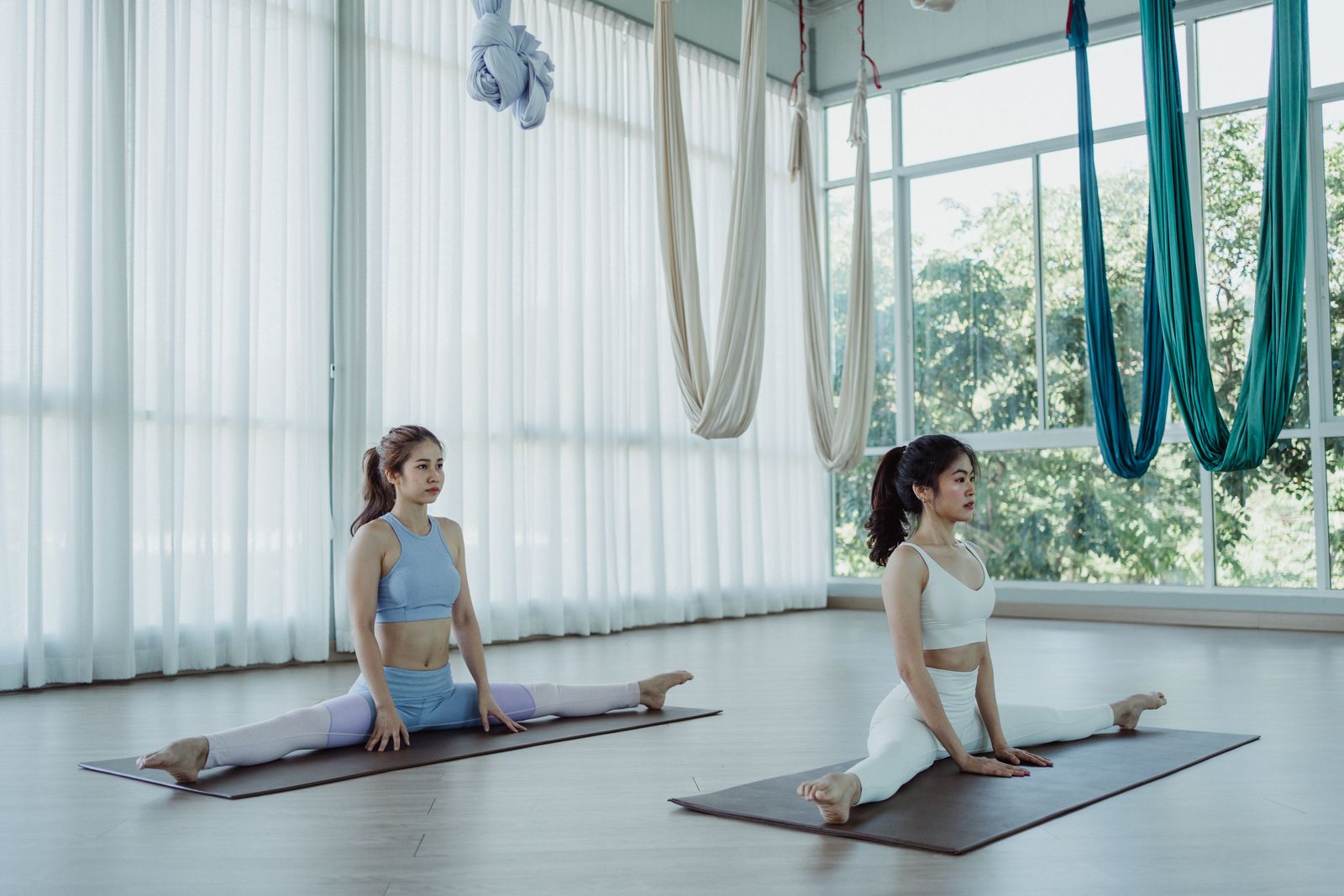
Samakonasana, or Straight Angle Pose, is an advanced seated hip-opener in which both legs extend into a wide 180-degree line, forming a “seated splits” shape with the torso upright and hips squared to the front. It deeply stretches the inner thighs, hamstrings, and groin while building hip flexibility, pelvic stability, and mental focus. Because it demands significant openness in the hips and hamstrings, it is typically approached gradually through preparatory poses rather than attempted cold, and it is not considered a beginner-friendly asana.
What Does Samakonasana Mean?
The name comes from three Sanskrit roots: sama meaning “straight” or “equal,” kona meaning “angle,” and asana meaning “seat” or “pose.” Put together, Samakonasana translates to “Straight Angle Pose” or “Equal Angle Pose,” a reference to the even 90-degree angle each leg ideally forms with the torso once both legs are extended out to the sides. In everyday studio language it’s also called Center Splits Pose, since the final shape resembles a seated version of the splits, except the legs move sideways rather than front-to-back as in Hanumanasana.
How Do You Get Into Samakonasana Step by Step?
Building the pose gradually protects the hips and hamstrings from strain. A typical sequence looks like this:
1. Sit on your mat with legs extended straight in front of you, spine tall, similar to the base position used in Dandasana.
2. Walk your hands slightly behind your hips for support and begin to slide your legs apart to the sides, only as far as feels stable.
3. Flex both feet, pressing through the heels, and keep the kneecaps drawing upward to avoid hyperextension.
4. Rotate the thighs inward slightly so the front of each thigh moves toward the floor rather than rolling outward.
5. Once you reach your maximum comfortable width, bring the palms together in front of the chest in a prayer position, or walk the hands forward onto the floor for support.
6. Lengthen the spine upward rather than collapsing forward, keeping the chest open.
7. Hold for 20 to 60 seconds, breathing steadily, then bend the knees slowly and bring the legs back together to release.
Most practitioners never reach a full 180-degree line, and that is completely normal. The angle each hip can open to is highly individual and depends on hip socket structure as much as on flexibility training.
Why Is Samakonasana Considered an Advanced Pose?
Unlike many seated stretches, Samakonasana asks the hip joint to move into extreme abduction while the pelvis stays neutral and the spine stays vertical. That combination requires open adductors (inner thigh muscles), flexible hamstrings, and enough control in the hip rotators to keep the knees tracking safely rather than twisting. Because three different muscle groups need to cooperate at once, rushing into a wide angle before the tissues are ready is one of the most common causes of strain in this pose. Teachers generally recommend treating it as a long-term goal pose reached over weeks or months of consistent practice, not a single-session stretch.
What Are the Main Benefits of Samakonasana?
Regular, careful practice of this pose is associated with several practical benefits for the hips, legs, and nervous system.
- Deep inner-thigh and groin release: The wide-leg position stretches the adductor muscles more directly than most standing poses, which can help with tightness from prolonged sitting.
- Hamstring flexibility: Keeping the legs straight and knees active while the legs spread wide lengthens the hamstrings from a different angle than forward folds like Paschimottanasana.
- Hip joint mobility: Gradually training the hips into greater abduction supports everyday movements that need a wide stance, from certain sports to simply sitting cross-legged with more ease.
- Improved posture and core engagement: Keeping the spine tall against the pull of gravity in this wide position builds core and back strength simultaneously.
- Mental focus: Because the pose demands careful attention to alignment, it naturally draws the mind away from distraction and into the present moment, a quality shared with balance poses like Talasana.
Which Poses Should You Practice Before Attempting Samakonasana?
Because the pose combines hamstring length, groin openness, and hip rotation, it helps to prepare each element separately before combining them. Useful preparatory poses include:
- Baddha Konasana (Bound Angle Pose): Opens the groin and inner thighs in a seated, supported position.
- Upavistha Konasana (Wide-Angle Seated Forward Bend): Trains the same wide-leg shape but allows the torso to fold forward, which is gentler on the hips than staying upright.
- Supta Padangusthasana (Reclining Big Toe Pose): Stretches one hamstring and inner thigh at a time from a supported reclining position, which is easier to control than a seated version.
- Standing forward fold variations and Hastapadasana: Build general hamstring flexibility that transfers into seated splits work.
- Malasana (Garland Pose): Opens the hips and groin in a squatting position, useful for practitioners who sit for long hours.
Working through these poses over several weeks builds the range of motion Samakonasana requires without forcing the joints into an end range they aren’t ready for.
What Muscles Does Samakonasana Stretch and Strengthen?
The pose primarily stretches the adductor group (inner thigh muscles), the hamstrings, and the hip external rotators. At the same time, it strengthens the erector spinae muscles along the spine, which work to keep the torso upright against the stretch, along with the deep core stabilizers and the quadriceps, which stay engaged to keep the knees straight and active. This combination of stretching some muscle groups while strengthening others simultaneously is a hallmark of many deep seated yoga postures, similar to the dual action found in Janu Sirsasana.
What Are Common Mistakes in Samakonasana?
Several habits reduce both the safety and the effectiveness of the pose.
- Forcing the width: Pushing the legs wider than the hips can comfortably support puts strain on the groin and can irritate the hip joint capsule. Depth should always come from gradual release, not from muscling the position.
- Letting the knees roll outward or inward: Both knees should point toward the ceiling with the kneecaps active. Rolling knees redirects stress into the joint rather than the muscle.
- Collapsing the lower back: Rounding the spine to get lower defeats the purpose of the pose. It’s better to stay higher up with a long spine than to round forward for a few extra degrees of width.
- Skipping warm-up: Attempting this pose on cold muscles, especially first thing in the morning, significantly increases injury risk. A short warm-up sequence of gentle hip circles and standing stretches beforehand is recommended.
- Holding the breath: Tension in an intense stretch often causes people to hold their breath, which increases muscular guarding. Steady, even breathing helps the nervous system allow the stretch to deepen safely.
Who Should Avoid Samakonasana?
This pose is not suitable for everyone, and caution is especially important given how much load it places on the hip and groin structures. Practitioners with hip, knee, or lower back injuries should avoid it, as should anyone recovering from recent abdominal or pelvic surgery. People with arthritis in the hips or knees, significant sciatica, or a history of groin strain should approach it only with a qualified teacher’s guidance, if at all. Pregnant practitioners should skip this pose because of the intensity of the stretch on the pelvic region, and beginners with limited hip flexibility should build up through preparatory poses for weeks before testing the full expression. As with any advanced posture, when in doubt, it is best to consult a doctor or experienced yoga teacher before attempting it.
How Does Samakonasana Compare to Hanumanasana?
Both poses are commonly grouped under “the splits” in yoga, but they load the hips very differently. Hanumanasana takes the legs into a front-to-back split, which primarily challenges the hip flexors of the back leg and the hamstrings of the front leg. Samakonasana instead takes the legs out to the sides, which challenges the adductors and the hip’s capacity for lateral abduction. Many practitioners find one significantly more accessible than the other, since front-to-back hip mobility and side-to-side hip mobility depend on different tissue and joint structures. Practicing both, alongside complementary standing poses like Hastapadasana, builds well-rounded hip flexibility rather than flexibility in only one direction.
How Does Samakonasana Fit Into a Broader Yoga Practice?
Samakonasana is best placed near the end of a practice, after the hips and hamstrings have already been warmed through standing poses, sun salutations, and gentler hip openers. It pairs naturally with restorative or seated practices, including pelvic-floor-focused work like Yoni Mudra, since both draw attention to the pelvic region and benefit from a calm, unhurried state of mind. For practitioners exploring different styles, this pose appears more often in Hatha Yoga and flexibility-focused classes than in faster-paced styles such as Vinyasa Yoga, simply because it needs time to enter and hold safely. If you’re building a broader foundation, it helps to first get comfortable with a wider set of yoga poses and basic standing shapes before adding deep hip-openers like this one to your routine.
How Often Should You Practice Samakonasana to See Progress?
Flexibility gains in deep stretches like this one come from consistency rather than intensity. Practicing two to four times a week, holding for 20 to 45 seconds and gradually increasing hold time or width over several weeks, tends to produce steadier, safer progress than attempting to force a deeper stretch in a single session. Many practitioners find it useful to track their hip angle informally, noting whether the legs sit a little wider or the torso stays a little taller each week, rather than expecting a dramatic change overnight. Pairing this pose with general lower-body mobility work and a broader stretching routine, including gentle backbends and twists, tends to support more balanced, sustainable progress than isolating the hips alone. Complementary practices such as Yin Yoga, which favors long, passive holds, can be especially useful for building the deep connective-tissue flexibility this pose demands.
How Does Breathing Affect Your Progress in Samakonasana?
Breath control plays a bigger role in deep stretches than most practitioners expect. Slow, even inhales and exhales help signal to the nervous system that the body is safe, which in turn allows the stretch reflex in the muscles to relax rather than tighten defensively. Many teachers suggest exhaling as you widen the legs and inhaling as you lengthen the spine upward, a rhythm borrowed from pranayama practices like Ujjayi Pranayama. Holding the breath, by contrast, tends to increase muscular guarding and can make the same stretch feel noticeably more intense than it needs to.
Questions People Ask About Samakonasana
Is Samakonasana the same as the splits?
Not exactly. Samakonasana is a seated pose where the legs spread out to the sides in a wide V, sometimes called a “center split,” while the torso stays upright. The traditional splits, or Hanumanasana, moves one leg forward and one leg back instead. Both stretch the legs deeply, but they target different hip movements and different muscle groups.
How long does it take to achieve full Samakonasana?
There’s no fixed timeline, since hip flexibility depends on individual joint structure, prior training, and how consistently someone practices. Some practitioners with naturally open hips progress within a few months of regular stretching, while others may take a year or more, or may never reach a full 180-degree line. Consistent, gentle practice matters far more than pushing for speed.
Can beginners try Samakonasana?
Beginners can work toward the pose but should not attempt the full expression right away. Starting with preparatory poses like Baddha Konasana and Upavistha Konasana, and only widening the legs to a comfortable range, allows beginners to build toward Samakonasana safely over time rather than risking strain by going too wide too soon.
What if I feel pinching in my hip during this pose?
Pinching, unlike a stretching sensation, usually signals that the hip joint itself is under strain rather than the surrounding muscles. If this happens, ease out of the pose immediately, reduce the width next time, and consider consulting a yoga teacher or physiotherapist, since pinching can indicate an alignment issue or an underlying joint limitation that needs individual attention.
Does Samakonasana help with lower back pain?
Indirectly, yes, for some people. Tight hips and hamstrings can contribute to lower back strain by limiting healthy pelvic movement, so gradually opening the hips may ease some of that tension. However, anyone with existing lower back pain should approach this pose cautiously and stop immediately if it aggravates their symptoms, since deep stretches are not appropriate for every type of back pain.
What props can help me practice Samakonasana safely?
Yoga blocks placed under the hands provide support while keeping the spine tall, and a folded blanket under the sitting bones can reduce strain on tight hamstrings by tilting the pelvis slightly forward. A yoga strap looped around the feet can also help practitioners with limited flexibility maintain length in the spine while still feeling the stretch in the inner thighs.
Try This for Yourself
Samakonasana rewards patience far more than force, and a guided practice makes it much easier to build toward the pose safely, with real-time cues on alignment, breath, and pacing. If you’d like structured support to work toward hip-opening poses like this one, explore FitStrot’s online yoga classes and practice with an instructor who can guide your progress step by step.
Related reading: Hastapadasana, Talasana (Palm Tree Pose), Yoni Mudra, Yoga Poses, and FitStrot’s online yoga classes.