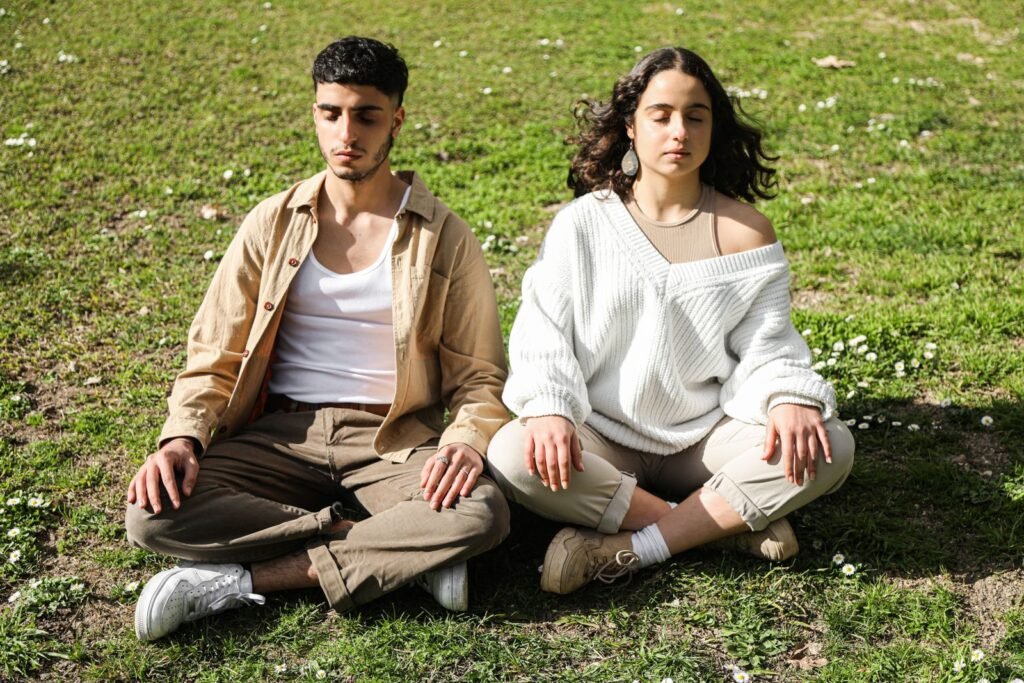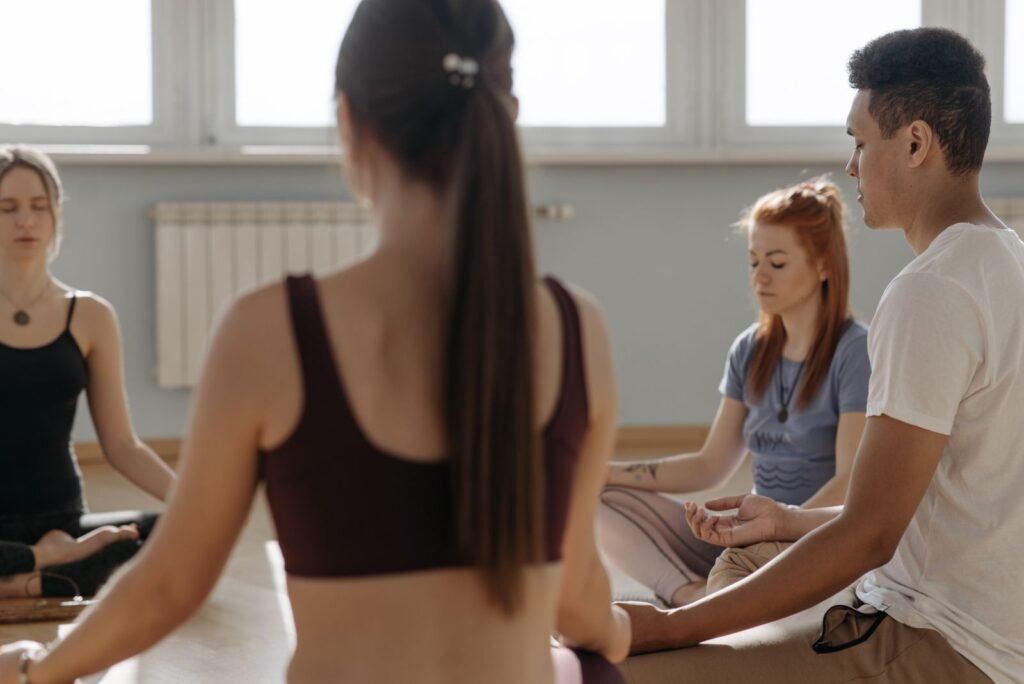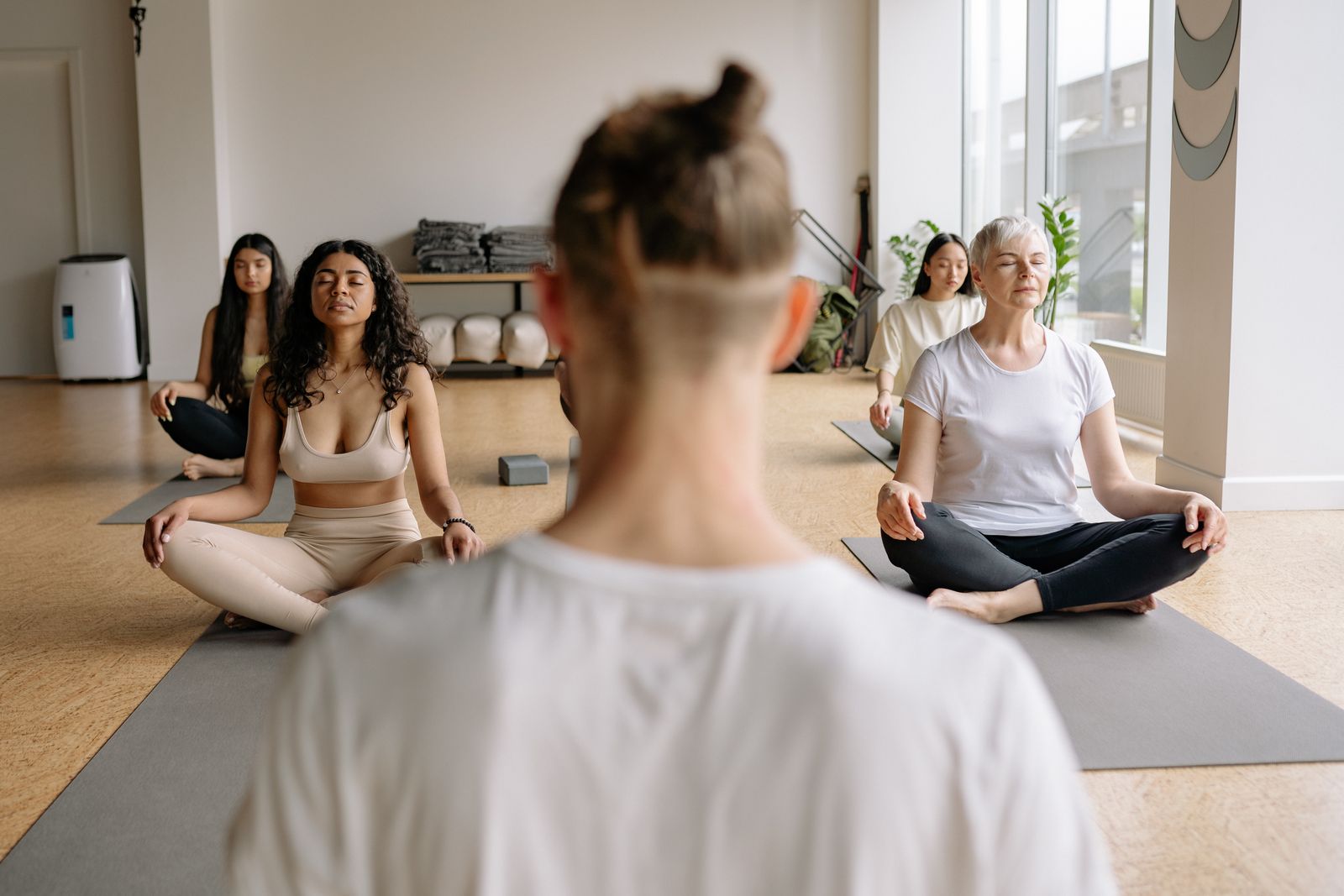
Mindfulness meditation is the practice of deliberately paying attention to the present moment, your breath, bodily sensations, thoughts, and surroundings, without judging or trying to change what you notice. It differs from concentration-only meditation because the goal isn’t to block out thoughts but to observe them non-reactively as they rise and pass. Rooted in contemplative traditions and popularized clinically through programs like Mindfulness-Based Stress Reduction (MBSR), it’s commonly practiced in sessions of 10 to 20 minutes and is widely used alongside yoga, since both disciplines train the same underlying skill: returning attention to the present, again and again, without self-criticism.
Below, we’ll unpack how mindfulness meditation actually works, how it connects to yoga postures and mudras, what the research says about its effects on stress and focus, and exactly how to start a practice that sticks, whether you’re brand new to sitting quietly or already deep into a meditation routine.
What Is Mindfulness Meditation, Exactly?
Mindfulness meditation is a mental training practice built on one simple instruction: notice what is happening right now, and let it be. That “now” might be the sensation of breath moving through your nostrils, the pressure of your feet on the floor, or the emotional weight of a thought passing through your mind. The practice isn’t about achieving a blank mind, that’s a common misconception. Instead, it’s about building the capacity to notice when your attention has wandered and gently redirect it, over and over, without frustration.
This distinguishes mindfulness from other meditation styles that rely on visualization, mantra repetition, or single-point concentration. Mindfulness is an “open monitoring” practice: you’re aware of a broad field of experience rather than locked onto one object. That said, most mindfulness sessions still use the breath as an anchor, a home base to return to whenever the mind drifts, which happens constantly and is considered a completely normal part of the process rather than a failure.
How Is Mindfulness Meditation Different from Yoga Meditation?
This is one of the most searched questions on the topic, and the honest answer is that the line is blurry by design. Yoga and mindfulness share the same root goal, present-moment awareness, but they arrive there through different doors.
| Aspect | Yoga Meditation | Mindfulness Meditation |
|---|---|---|
| Starting point | The body: postures (asana), controlled breathing (pranayama), chanting or gaze techniques (drishti) | The mind: breath, body sensations, or thoughts, observed directly while seated or lying still |
| Role of movement | Central, physical practice settles the nervous system first | Minimal to none, movement is optional rather than built in |
| How awareness arises | As a byproduct of physical practice | As the direct, primary focus from the first minute |
| Typical setting | A mat, in a yoga class or flow sequence | A cushion, chair, or quiet spot, with no equipment needed |
In practice, most modern yoga classes blend the two. A teacher might cue you to notice sensation in your hips during pigeon pose, which is mindfulness applied to an asana. That’s why “yoga mindfulness” and “mindfulness meditation and yoga” show up together so often in search behavior: practitioners aren’t choosing one over the other, they’re layering mindful attention on top of physical movement, which is arguably the most sustainable way to build the habit since it doesn’t require sitting still for extended periods before you’re ready for that.
What Does the Research Say About Mindfulness Meditation?
Mindfulness meditation is one of the more heavily studied contemplative practices in modern psychology, largely because Jon Kabat-Zinn’s Mindfulness-Based Stress Reduction (MBSR) program, developed at the University of Massachusetts Medical School in the late 1970s, gave researchers a standardized 8-week protocol to test. Research bodies including the American Psychological Association and the National Center for Complementary and Integrative Health have reviewed decades of trials on the practice, and the consistent finding is that regular mindfulness meditation is associated with meaningful reductions in self-reported stress, anxiety symptoms, and rumination, along with improvements in attention regulation and emotional reactivity.
It’s worth being precise about what the evidence supports and what it doesn’t. Mindfulness meditation is not positioned by credible research bodies as a replacement for treatment of clinical depression, anxiety disorders, or other diagnosed mental health conditions. It’s best understood as a well-supported complementary practice, one that can meaningfully lower everyday stress reactivity and improve focus, while working alongside, not instead of, professional care when that’s needed. If you’re managing a diagnosed condition, it’s worth discussing meditation as an addition to your treatment plan with a qualified provider rather than a substitute for it.
Why Are Yoga and Mindfulness Practiced Together So Often?
The pairing isn’t a marketing trend, it reflects genuine physiological overlap. Both practices activate the parasympathetic nervous system, the “rest and digest” branch that counteracts the stress-driven fight-or-flight response. Slow, controlled breathing, central to both pranayama and mindfulness meditation, signals safety to the vagus nerve, which helps lower heart rate and cortisol output over time.
Beyond the physiology, there’s a practical reason too: yoga gives restless beginners something to do with their bodies while they build the attention span that seated meditation demands. Many people find it far easier to stay present while flowing through a vinyasa sequence than while sitting motionless for fifteen minutes. Starting with movement-based mindfulness and gradually adding seated practice is a well-established, sustainable progression rather than a shortcut.
How Do You Actually Practice Mindfulness Meditation? A Step-by-Step Guide
Getting started doesn’t require an app, a cushion, or a specific room, though all three can help once you build consistency. Here’s a straightforward sequence for a first session:
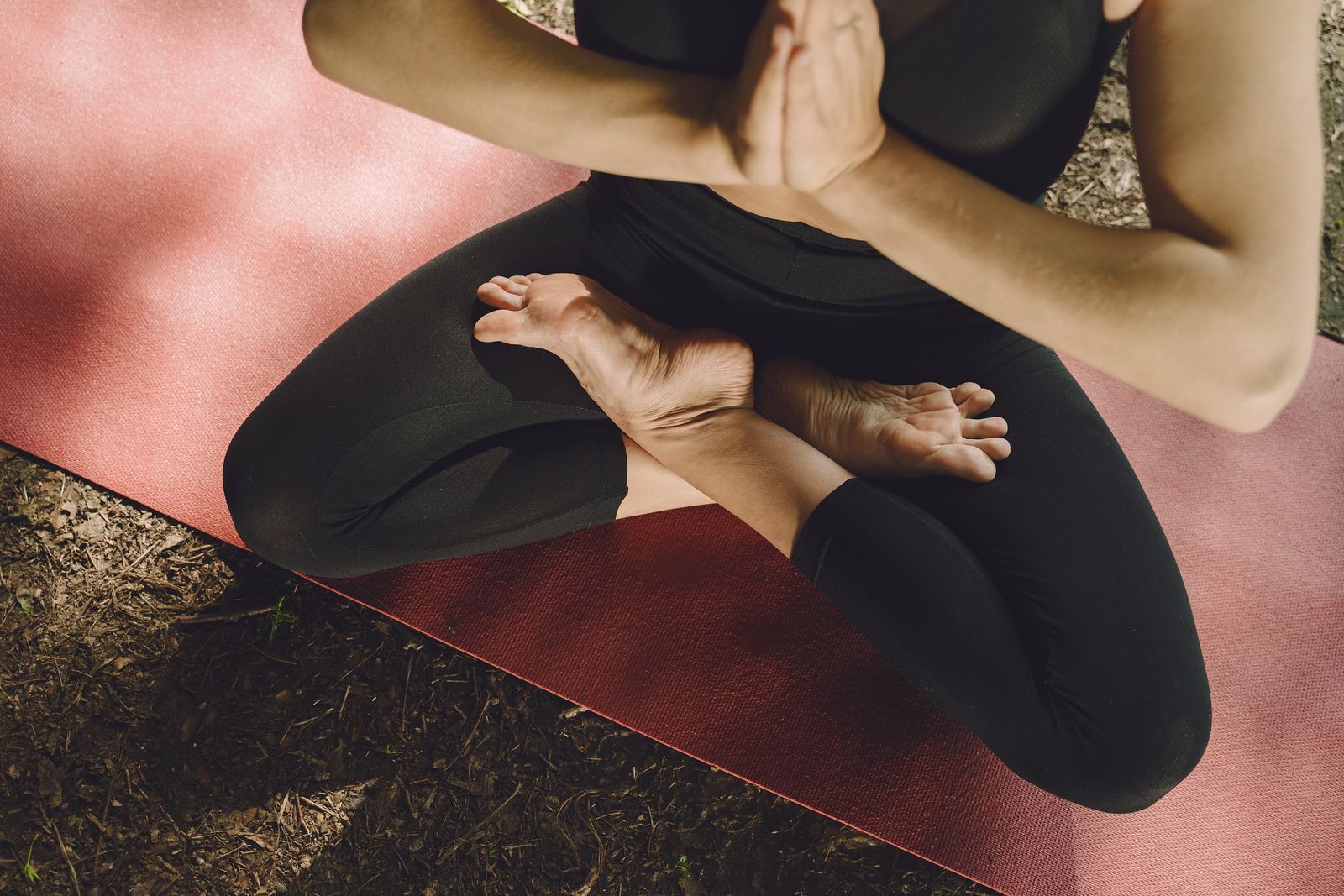
Find a quiet spot and sit in a stable position, cross-legged on the floor, on a chair with feet flat, or even lying down if sitting is uncomfortable. Close your eyes or soften your gaze downward. Take three slow breaths to signal to your body that you’re transitioning out of task mode. Then let your breath return to its natural rhythm and simply observe it, the rise and fall of your chest or belly, the coolness of air entering your nostrils.
When a thought pulls your attention away, and it will, notice that it happened without judging yourself for it, then guide your focus back to the breath. That single act, noticing and returning, repeated dozens of times per session, is the actual mechanism of the practice. It’s not a distraction from meditating; it is the meditation. For newcomers, our guide to meditation for beginners walks through common early obstacles in more depth, and our overview of core meditation techniques covers variations once the basic breath-anchor practice feels comfortable.
What Are the Different Types of Mindfulness Practices?
Mindfulness isn’t a single technique, it’s a family of related practices, each emphasizing a different anchor for attention.
- Body scan meditation — guides attention slowly through each part of the body, from toes to scalp, noticing sensation without trying to relax or change anything. It’s often used at the end of a yoga class during savasana, since the body is already still and receptive.
- Breath awareness — the most common entry point, using the natural rhythm of inhalation and exhalation as a steady anchor whenever the mind wanders.
- Mindful movement — applies present-moment attention to physical activity: walking meditation, mindful stretching, or a slow hatha yoga flow, where each movement is performed with full sensory awareness rather than autopilot.
- Loving-kindness meditation (metta) — directs attention toward generating goodwill, first toward yourself, then toward others, and is often used to soften self-criticism that can surface during quieter sitting practice.
- Open awareness — the most advanced form: instead of anchoring to one object like the breath, you rest in an open, receptive awareness of whatever arises, thoughts, sounds, sensations, without picking a single focus point.
How Do Mudras Support a Mindfulness Practice?
Hand gestures, or mudras, are frequently used during seated mindfulness and meditation practice as a subtle physical anchor for attention. Yoga mudras like Gyan Mudra, touching the thumb and index finger together, are traditionally associated with focus and calm, and functionally, they give restless hands and minds something quiet to hold onto during a session. While the specific energetic claims tied to individual mudras belong to traditional yogic frameworks rather than clinical research, their practical effect for many practitioners is straightforward: a consistent hand position becomes a physical cue that signals “this is meditation time,” reinforcing the mental transition into a mindful state through simple habit association.
How Does Mindfulness Meditation Change the Body’s Stress Response?
When you’re stressed, the sympathetic nervous system floods your body with cortisol and adrenaline, raising heart rate, tightening muscles, and narrowing attention toward the perceived threat. Mindfulness meditation interrupts this cycle primarily through breath regulation and attentional redirection. Slower, deeper breathing lowers heart rate and activates the vagus nerve, which in turn dampens the stress response and shifts the body toward a calmer physiological baseline.
Over repeated practice, many people report a shorter recovery time after stressful events, meaning the body returns to baseline more quickly after a stressful trigger rather than staying activated for hours. This is often described in the research as improved “stress resilience” rather than stress elimination, meditation doesn’t remove stressful situations from your life, it changes how quickly and intensely your body reacts to them.
Can Mindfulness Meditation Improve Focus and Productivity?
Attention is essentially a trainable skill, and mindfulness meditation trains it directly. Every time you notice mind-wandering and redirect focus back to the breath, you’re exercising the same neural circuitry involved in catching yourself drifting off task during work or study. Over consistent practice, many practitioners report noticing distraction sooner and recovering focus faster, which is functionally what “improved concentration” means in daily life.
This carries over well into yoga practices aimed at focus, where drishti (a fixed gaze point) and breath-linked movement in styles like Ashtanga yoga serve a nearly identical function to a mindfulness breath anchor, just applied while moving instead of sitting still.
Is Mindfulness Meditation Good for Kids?
Yes, and interest in this specific application, reflected in searches for mindfulness yoga for kids, has grown significantly as schools and parents look for non-pharmaceutical tools to help children manage attention and emotional regulation. Children’s mindfulness practice looks different from adult practice: sessions are shorter, often 3 to 5 minutes, and use concrete, playful anchors rather than abstract instructions. “Balloon breathing,” where kids imagine inflating a balloon in their belly on the inhale, or simple animal-themed yoga poses paired with a breath count, translate the same present-moment-awareness skill into language a child can actually use.
Combining movement with mindfulness tends to work especially well for kids, since sitting still for extended periods is developmentally difficult for younger children. A short kids’ yoga sequence that ends with two minutes of quiet breathing gives children the physical outlet they need before asking for stillness, which mirrors the same “move first, then sit” progression that works well for adult beginners too.
What Do Mindfulness Yoga Quotes Actually Teach Us?
Quotes attributed to teachers like Jon Kabat-Zinn (“You can’t stop the waves, but you can learn to surf”) and Thich Nhat Hanh (“The present moment is the only moment available to us”) are searched frequently, and it’s worth understanding why they resonate rather than just collecting them. Most widely shared mindfulness and yoga quotes converge on the same handful of ideas: that struggle often comes from resisting the present moment rather than from the moment itself, that awareness itself is the practice rather than a means to some other end, and that consistency matters more than intensity. Used well, a quote isn’t decoration, it’s a compressed reminder of a principle you can actually apply the next time your mind is racing during a session.
How Long Should You Meditate and How Often?
Research protocols like the standard 8-week MBSR course typically use daily sessions of 30 to 45 minutes, but that’s a clinical research structure, not a requirement for beginners. Starting with 5 to 10 minutes daily is a far more sustainable entry point, and consistency matters more than session length, especially early on. A short daily practice builds the habit loop that makes longer sessions feel natural later, whereas an ambitious 30-minute session attempted twice before quitting builds nothing.
A reasonable progression looks like this: 5 minutes daily for the first two weeks, 10 minutes for the following month, then extending toward 15 to 20 minutes once sitting still no longer feels like the hardest part of the practice. Pairing meditation with an existing habit, right after brushing your teeth, right before a scheduled morning yoga session, makes it far easier to remember and sustain than trying to find a new standalone time slot.
What Mistakes Do Beginners Make with Mindfulness Meditation?
The most common mistake is treating mind-wandering as failure. New practitioners often assume a “successful” session means a completely quiet mind, get frustrated when thoughts keep arising, and conclude they’re “bad at meditating.” In reality, noticing that your mind wandered and returning to the breath is the entire skill being practiced, not evidence that the practice isn’t working.
Other frequent missteps include meditating only when already highly stressed (which makes stillness harder to access), skipping days after missing one session instead of simply resuming, and choosing an uncomfortable seated position that creates physical distraction. Starting with a supported position, a chair, a cushion under the hips, or even lying down, removes an unnecessary barrier for beginners who haven’t built up seated stamina yet.
How Does Mindfulness Meditation Fit Into a Broader Wellness Routine?
Mindfulness meditation works best as one component of a broader practice rather than an isolated technique. Many practitioners pair a short morning meditation with an evening restorative yoga session, using the morning sit to set intention and focus for the day and the evening practice to physically unwind and process accumulated tension. Others fold brief mindfulness check-ins throughout the day, a minute of breath awareness before a meeting, a body scan during a work break, into an existing routine rather than treating meditation as a separate, siloed activity.
This integrated approach also tends to compound with other wellness habits: better sleep quality, more consistent movement through practices like different styles of yoga, and improved stress management all reinforce each other, making mindfulness meditation a foundational practice rather than a standalone fix.
Questions People Ask About Mindfulness Meditation
Is mindfulness meditation the same as yoga?
No, though they’re closely related. Yoga combines physical postures, breathwork, and often meditation into one practice, while mindfulness meditation is specifically the mental skill of observing the present moment without judgment. Many yoga classes incorporate mindfulness meditation, especially during breathing exercises or final relaxation, but you can practice mindfulness meditation entirely on its own, with no physical postures involved.
How long does it take to see benefits from mindfulness meditation?
Many practitioners report noticing small shifts, like feeling calmer after a session or catching distraction sooner, within the first one to two weeks of consistent daily practice. More measurable changes in stress reactivity and focus are commonly reported after 8 weeks of regular practice, which lines up with the length of standardized programs like MBSR used in research settings.
Can I practice mindfulness meditation without sitting cross-legged?
Yes. Sitting cross-legged is a traditional posture, not a requirement. You can meditate sitting in a chair with feet flat on the floor, lying down, or even during slow walking. What matters is a stable, comfortable position that lets you stay alert without physical discomfort pulling your attention away from the practice itself.
What’s the difference between mindfulness and mindfulness meditation?
Mindfulness is the broader quality of present-moment, non-judgmental awareness, something you can apply while washing dishes or walking. Mindfulness meditation is a dedicated, formal practice session, usually seated, specifically designed to train that quality of attention in a focused way. Think of mindfulness as the skill and mindfulness meditation as the deliberate training exercise for it.
Do I need an app or teacher to start mindfulness meditation?
No, though both can help with structure and accountability. A basic mindfulness meditation practice requires nothing more than a quiet space and a few minutes of attention on your breath. Apps and guided sessions can be useful for beginners who want a voice to follow, but the core practice itself has no equipment or subscription requirement.
Is mindfulness meditation safe for everyone?
For most people, yes, it’s considered a low-risk practice. However, some individuals with a history of trauma or certain mental health conditions have reported difficult emotional experiences surfacing during silent meditation. If you have a diagnosed mental health condition or a trauma history, it’s worth starting with guidance from a trained teacher or discussing the practice with a healthcare provider first.
Try This for Yourself
Reading about mindfulness meditation only goes so far, the actual shifts in calm and focus show up once you build a consistent practice. If you’d like guided support to build that habit correctly from day one, explore FitStrot’s Online Yoga Classes, where breathwork and mindful movement are woven into every session so you’re never sitting there wondering if you’re “doing it right.”
Related reading: Meditation for Beginners, Meditation Techniques, Yoga Mudras Explained, and Pranayama Breathing Guide. Ready to build a real practice? Start with FitStrot’s Online Yoga Classes.