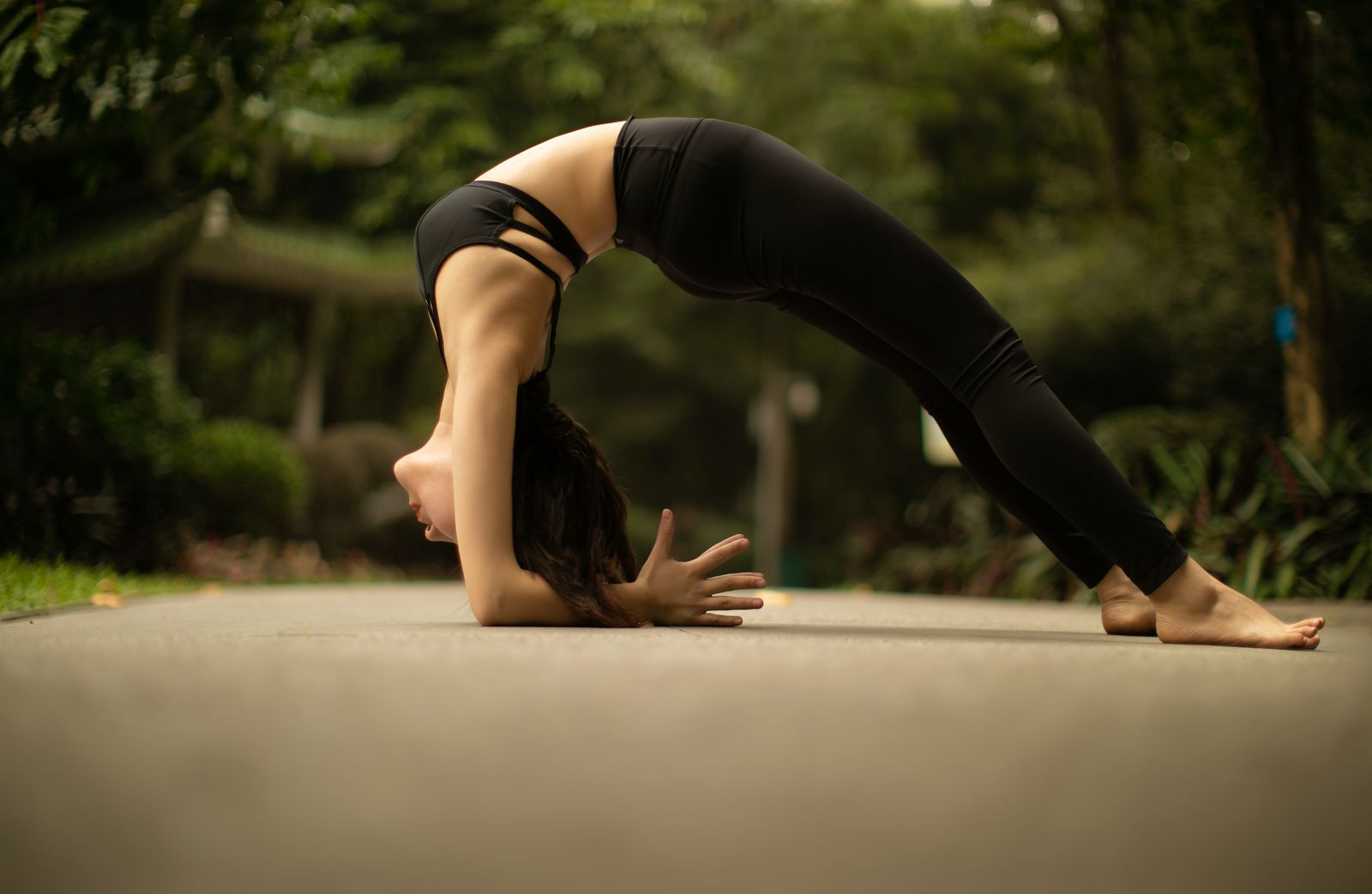
Chakrasana, or Wheel Pose, is a backbend in which the body forms an arch supported on the palms and feet, with the chest lifted and the spine curved like the rim of a wheel. It is an intermediate-to-advanced posture that builds shoulder, arm, and leg strength while opening the chest, spine, and hip flexors. Most practitioners work up to full Chakrasana through preparatory poses such as Bridge Pose and Ardha Chakrasana, since the full expression demands significant backbend flexibility and upper-body stability.
What Does the Word Chakrasana Mean?
The name comes from two Sanskrit words: “chakra,” meaning wheel, and “asana,” meaning seat or pose. The pose is called Wheel Pose because the body’s shape in the final position, an arched curve from wrists to feet, resembles the rim of a wheel. In many yoga schools, Chakrasana is used interchangeably with Urdhva Dhanurasana (“upward-facing bow pose”), though some teachers reserve the term Chakrasana specifically for the version entered by rolling backward from standing rather than lifting up from the floor. Both variations belong to the same family of deep backbends within the broader system of yoga poses classified as backbends or chakrasana-type wheel postures.
How Do You Perform Chakrasana Step by Step?
Begin by lying flat on your back on a yoga mat. Bend your knees and bring your heels close to your hips, keeping feet hip-width apart. Bend your elbows and place your palms on the floor beside your head, fingers pointing toward your shoulders. On an exhale, press firmly through your palms and feet to lift your hips, chest, and head off the mat simultaneously. Straighten your arms and legs as much as your flexibility allows, letting the crown of your head hang gently toward the floor without resting on it. Hold the position for five to ten breaths, keeping your gaze relaxed and your neck long. To release, tuck your chin slightly, bend your elbows and knees, and lower your body slowly back to the mat, vertebra by vertebra.
What Is Ardha Chakrasana and How Is It Different?
Ardha Chakrasana, or Half Wheel Pose, is the standing backbend variation and a common entry point before attempting the full floor-based pose. Standing with feet hip-width apart, you place your palms on your lower back for support, inhale, and lean backward from the hips while lifting the chest toward the ceiling. Unlike full Chakrasana, Ardha Chakrasana does not require palms on the floor, which makes it accessible to beginners and a useful warm-up within a Surya Namaskar sequence or a general backbend warm-up routine. Ardha Chakrasana strengthens the lower back and opens the chest without the wrist-loading and inversion elements of the full pose, making it a gentler daily practice option for people building toward deeper backbends.
What Is Katichakrasana and Why Do People Confuse It With Chakrasana?
Katichakrasana, or Standing Spinal Twist Pose, is frequently searched alongside Chakrasana because the names sound similar, but the two poses are unrelated in shape. “Kati” means waist, so Katichakrasana is a standing rotational stretch: you stand with feet apart, swing your arms from side to side, and twist through the waist while keeping your hips relatively stable. It targets spinal rotation and waist mobility rather than backbending. Katichakrasana is often taught early in a beginner’s sequence, alongside poses like Tadasana, as a simple way to warm up the spine before deeper stretches or twists are introduced. If you want a dedicated breakdown of the twist itself, see our full guide to Katichakrasana and how it fits into a warm-up routine for beginner yoga poses.
Here is a quick side-by-side look at how the three poses compare:
| Pose | Body Position | Movement Type | Difficulty |
|---|---|---|---|
| Chakrasana (Wheel Pose) | Palms and feet both on the floor, full arch | Deep backbend | Intermediate to advanced |
| Ardha Chakrasana (Half Wheel) | Standing, hands supporting the lower back | Standing backbend | Beginner-friendly |
| Katichakrasana (Spinal Twist) | Standing, arms swinging side to side | Rotational twist | Beginner |
What Are the Benefits of Chakrasana?
Chakrasana is valued in hatha yoga for the way it works the entire front and back of the body at once. Commonly cited benefits include:
- Improved spinal flexibility from the deep backward extension
- Stronger wrists, arms, shoulders, and legs from bearing body weight throughout the pose
- A deep stretch through the chest, abdomen, and hip flexors, which can counteract the effects of long hours spent sitting or hunched over a screen
- Better circulation and alertness, since the chest-opening action encourages fuller breathing
Some traditional texts also associate backbends like Chakrasana with stimulation of the thyroid and other glands in the neck and throat region, though this specific claim is anecdotal rather than clinically established, so it is best treated as a traditional belief rather than a proven medical effect. For a wider look at how consistent practice affects the body over time, see our overview of the benefits of yoga and how yoga improves flexibility across major muscle groups.
Who Should Avoid Practicing Chakrasana?
Chakrasana places significant load on the wrists, shoulders, and lower back, so it is not appropriate for everyone. People with wrist injuries, carpal tunnel syndrome, shoulder instability, high or low blood pressure, recent abdominal surgery, hernia, or a diagnosed heart condition are generally advised to avoid this pose or attempt it only under the direct supervision of an experienced teacher. Pregnant practitioners should skip Chakrasana entirely. Anyone with chronic lower-back pain, disc issues, or limited shoulder mobility should build up gradually through preparatory poses and should never force the backbend past a comfortable range. If you feel sharp pain, tingling, or numbness at any point, come out of the pose immediately. If back discomfort is a regular concern for you, our guide to yoga for back pain covers gentler alternatives to try before attempting deep backbends like this one.
What Poses Should You Master Before Attempting Chakrasana?
Because Chakrasana asks the body to combine several demanding actions at once, most teachers recommend a preparatory sequence rather than attempting the full pose cold. A useful progression includes Setu Bandhasana (Bridge Pose) to build the basic backbend pattern with less wrist loading, Ardha Chakrasana to introduce the standing backbend shape, Ustrasana (Camel Pose) to open the chest and hip flexors further, and gentle shoulder and wrist stretches to prepare the joints that will bear weight. Building a base of standing strength through poses such as Vrksasana and general balance work also supports the stability needed to hold Chakrasana safely, and browsing a full list of backbend yoga poses can help you sequence a safe progression. Rushing straight into the full wheel without this groundwork is one of the most common causes of strain in beginners.
How Should Beginners Modify Chakrasana?
Beginners rarely achieve the fully straightened arms and legs seen in advanced practitioners, and that is completely normal. A common modification is to keep the elbows and knees slightly bent while still lifting the hips and chest, focusing on opening the front body rather than achieving maximum height. Placing a yoga block under the lower back during Setu Bandhasana practice, or working against a wall for Ardha Chakrasana, both reduce the intensity while still training the same muscle groups. Using a folded blanket under the head or shoulders can also ease neck strain for those with limited shoulder flexibility. Consistency with these modified versions over weeks tends to build the flexibility needed to progress toward the full expression of the pose, a principle that applies broadly across different types of yoga and skill levels.
What Muscles Does Chakrasana Strengthen and Stretch?
Chakrasana works as a full-body pose rather than isolating one muscle group. It stretches the chest (pectoralis major), the front of the shoulders, the hip flexors, and the abdominal muscles, while strengthening the wrists, forearms, triceps, quadriceps, and glutes, which all bear weight to hold the arch. The spinal erector muscles running along the back are also engaged to support the extension. This combination of stretching on the front body and strengthening on the back and limbs is why the pose is often grouped with other deep backbends as a comprehensive counter-pose to forward-bending and seated postures common in daily desk work, similar to the way yoga for posture routines target the same desk-bound tightness.
How Does Chakrasana Fit Into a Broader Yoga Sequence?
Chakrasana is typically placed toward the peak of a backbend-focused practice, after the body has been warmed up with sun salutations and standing poses. A typical flow might begin with several rounds of Surya Namaskar to raise body temperature, move through standing poses like Tadasana and Vrksasana for grounding and balance, then progress into gentler backbends such as Bhujangasana (Cobra Pose) and Setu Bandhasana before attempting Chakrasana itself. After the peak backbend, a counter-stretch such as a forward fold or a gentle twist helps neutralize the spine. Ending a backbend-heavy practice with restorative poses and a few minutes of Savasana allows the nervous system to settle before you get up, in keeping with general yoga sequencing principles.
What Breathing Technique Works Best With Chakrasana?
Steady, even breathing is essential in Chakrasana because the chest is fully expanded and the body is under load. Most teachers recommend inhaling as you lift into the pose and then settling into slow diaphragmatic breathing while holding, rather than shallow chest breathing, which can increase tension in an already demanding position. Avoid holding your breath, since it raises blood pressure at a moment when the head is lowered and the heart is already working to support the arch. If you find your breath becoming ragged or you feel lightheaded, that is a signal to come out of the pose gradually rather than pushing for a longer hold.
How Long Should You Hold Chakrasana?
For most practitioners, holding Chakrasana for five to ten slow breaths, roughly 15 to 30 seconds, is a reasonable target once the pose is well established. Beginners should treat even a few seconds of a modified version as a full hold, since the pose is intense on the wrists and shoulders even briefly. Repeating two or three rounds with rest in between, rather than holding one long stretch, is often more sustainable and allows you to check your alignment each time you enter the pose. As with any backbend, quality of form matters more than duration.
How Often Should You Practice Chakrasana?
Because Chakrasana loads the wrists and lower back heavily, most teachers suggest practicing the full pose two to four times a week rather than daily, allowing connective tissue and joints time to recover between sessions. On rest days, gentler preparatory poses like Ardha Chakrasana or Bridge Pose can keep the backbend pattern active without the same joint load. Progress in flexibility for a pose like this tends to be gradual, often building over several weeks to months of consistent practice rather than appearing after a single session, so patience with the timeline matters as much as the technique itself. If you are building a broader home practice around backbends, our guide to yoga for beginners at home covers how to structure a weekly routine safely.
Questions People Ask About Chakrasana
Is Chakrasana the same as Wheel Pose?
Yes. Chakrasana is the Sanskrit name for Wheel Pose, and the two terms are used interchangeably in most yoga classes and teacher training programs. Some traditions also call the full backbend “Urdhva Dhanurasana,” meaning upward-facing bow pose, referring to the same final shape reached from lying on the back rather than from standing.
Can beginners do Chakrasana?
Full Chakrasana is generally considered an intermediate-to-advanced pose, so complete beginners are usually guided toward preparatory poses first. Building shoulder mobility, wrist strength, and basic backbend patterns through Bridge Pose and Ardha Chakrasana over several weeks makes the full pose safer and more accessible when you do attempt it.
What is the difference between Chakrasana and Ardha Chakrasana?
Chakrasana is the full backbend performed on the floor with both palms and feet grounded, forming a complete arch. Ardha Chakrasana, or Half Wheel Pose, is the standing variation where you lean backward from the hips with hands supporting the lower back, without placing your palms on the floor. Ardha Chakrasana is typically taught as a stepping stone toward the full pose.
Does Chakrasana help with back pain?
Many practitioners find that gentle backbend practice, including modified Chakrasana or its preparatory poses, helps relieve stiffness from prolonged sitting by stretching the front of the hips and chest. However, if you have an existing back injury or chronic pain condition, it is best to consult a doctor or an experienced yoga teacher before attempting deep backbends, since incorrect form can aggravate rather than relieve back issues.
What should I eat or avoid before practicing Chakrasana?
As with most yoga backbends, it is best to practice Chakrasana on an empty or light stomach, ideally two to three hours after a meal. Because the pose compresses and then stretches the abdominal area significantly, practicing right after eating can cause discomfort, nausea, or cramping.
How do I know if I am ready to attempt full Chakrasana?
A reasonable readiness check is whether you can comfortably hold Setu Bandhasana (Bridge Pose) for 30 seconds and perform Ardha Chakrasana with a full chest opening and no wrist pain. If both feel stable and pain-free, you likely have enough base strength and mobility to try full Chakrasana under guidance, ideally with a teacher present the first few times.
Try This for Yourself
Reading about Chakrasana is useful, but backbends are best learned with real-time feedback on your alignment, breath, and pacing. If you want personalized guidance on building up to Chakrasana safely, with a teacher who can adjust your form in real time, explore FitStrot’s online yoga classes and start building your backbend practice at a pace that suits your body.
Related reading: Yoga Poses and Asanas Guide, Surya Namaskar Step-by-Step, Tadasana (Mountain Pose), Vrksasana (Tree Pose), or explore FitStrot’s online yoga classes to practice with a certified instructor.