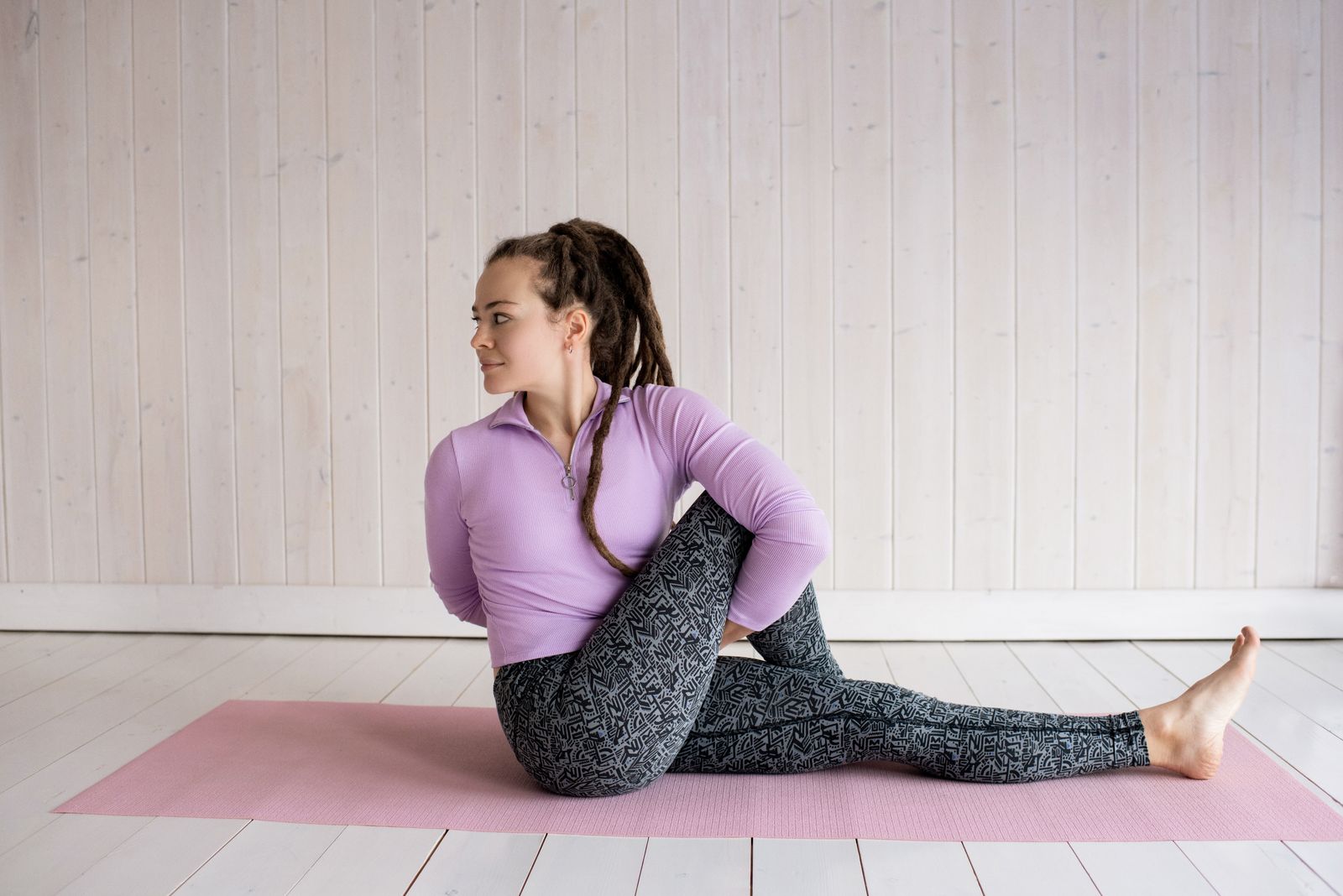
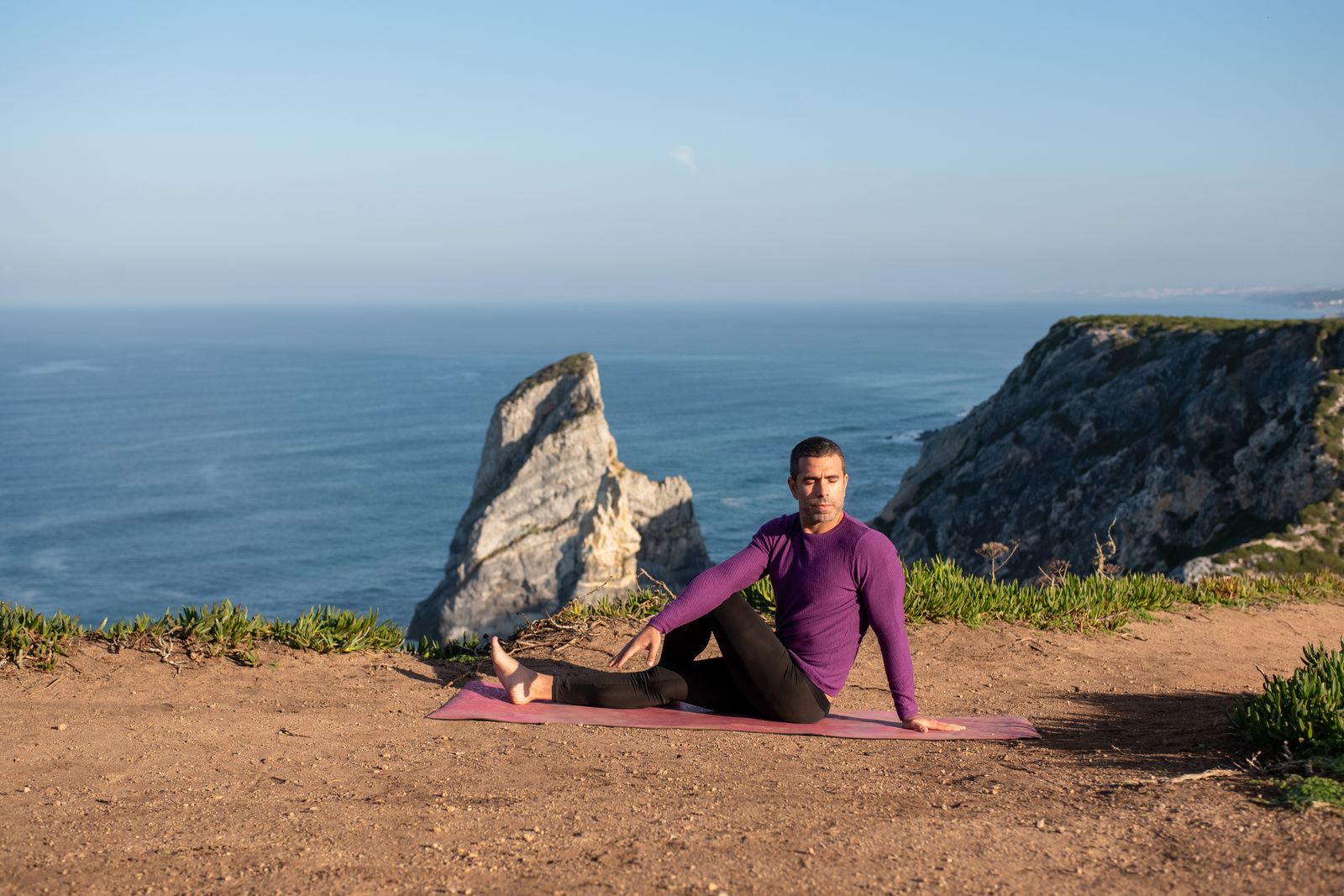
Ardha Matsyendrasana, or Half Lord of the Fishes Pose, is a seated spinal twist that rotates the torso against a stable pelvis and legs, one foot planted flat and the opposite elbow hooked outside the bent knee for leverage. Practiced for 30-60 seconds per side, it improves spinal mobility, stretches the shoulders and hips, stimulates digestion, and relieves tension built up from long hours of sitting. It’s classified as an intermediate seated twist and is one of the most commonly taught asanas in both hatha and vinyasa style classes.
What Does Ardha Matsyendrasana Mean?
The name comes from Sanskrit: “ardha” means half, “matsya” means fish, and “indra” means lord or ruler. Put together, Ardha Matsyendrasana translates to “Half Lord of the Fishes Pose.” Matsyendra is commonly described in yoga tradition as a legendary sage and one of the early teachers associated with the hatha yoga lineage. According to the stories passed down through yogic teaching, he is said to have overheard Shiva teaching the secrets of yoga to his consort Parvati while in the form of a fish, which is how the full expression of this twist, Matsyendrasana, came to carry his name. The “half” version taught in most modern classes is a simplified variation of the full pose, which involves a more complex leg bind. If you’re building foundational knowledge of asana names and their roots, our guide to yoga poses is a useful starting point before diving into individual postures like this one.
How Do You Do Ardha Matsyendrasana Step By Step?
Getting the alignment right matters more than depth in this twist. Rushing the rotation is the fastest way to strain the lower back instead of lengthening it.
- Sit on the floor or a folded blanket with your legs extended straight in front of you (Dandasana, or Staff Pose).
- Bend your right knee and place your right foot flat on the floor outside your left thigh, near the knee.
- Bend your left leg and slide your left foot near your right hip, either flat on the floor or tucked under the right thigh, whichever is comfortable for your knees.
- Press both sit bones evenly into the floor and lengthen your spine upward on an inhale.
- On an exhale, twist your torso to the right, bringing your left elbow to the outside of your right knee. Keep the elbow bent, not locked straight against the leg.
- Place your right hand on the floor behind your tailbone for support, and turn your head to look over your right shoulder.
- Hold for 5-10 breaths, using each inhale to lift the spine and each exhale to deepen the rotation slightly.
- Release on an exhale, return to center, and repeat on the other side.
Beginners often find it easier to warm up with simpler standing postures first. A short sequence through Tadasana and a gentle Surya Namaskar round can loosen the spine and shoulders before attempting a deep seated twist.
What Muscles Does Ardha Matsyendrasana Stretch and Strengthen?
This twist works the body from the hips through the shoulders. The primary muscles stretched are the erector spinae along the spine, the external and internal obliques, the piriformis and outer hip rotators of the bent leg, and the rear deltoid and pectoral muscles on the side you’re twisting away from. Meanwhile, the deep core stabilizers, including the transverse abdominis, engage isometrically to control the rotation rather than letting it collapse forward. Because the twist compresses one side of the abdomen and lengthens the other, it also mobilizes the rib cage between the ribs, part of why breathing feels different here than in a neutral seated position. Building general core strength alongside this twist, as covered in our core strength yoga guide, can make the rotation more stable and controlled over time.
What Are the Benefits of Ardha Matsyendrasana?
Seated spinal twists like this one appear in nearly every intermediate yoga sequence because the benefits touch several systems of the body at once.
- Spinal mobility: Regular twisting helps maintain rotational range of motion in the thoracic and lumbar spine, which tends to stiffen with age and prolonged sitting.
- Digestive stimulation: The compression and release action on the abdominal organs is commonly described as encouraging peristalsis, the wave-like contractions that move food through the digestive tract.
- Postural relief: The pose counters the forward-rounded shoulders and flexed spine associated with desk work and screen use.
- Hip and shoulder flexibility: The bent-leg and hooked-elbow positions open the outer hip and stretch the chest and shoulder of the twisting side.
- Nervous system regulation: Paired with slow breath, seated twists are often used to shift the body out of a stress response and into a calmer state.
If digestion is a specific focus, pairing this twist with other postures covered in our piece on yoga for digestion can round out a more targeted practice.
Is Ardha Matsyendrasana Good for Back Pain?
For many people with mild, non-acute back tightness, a gentle version of this twist can relieve tension by mobilizing the vertebrae and stretching the muscles that run alongside the spine. However, it is not a universal fix, and the effect depends heavily on the cause of the pain. If discomfort comes from muscular tightness or stiffness from sitting, a slow, well-supported twist often helps. If the pain stems from a disc issue, spinal injury, or acute inflammation, twisting can aggravate the condition rather than relieve it. Anyone with a diagnosed back condition should check with a doctor or physical therapist before adding deep twists to their routine. For a broader look at which postures are generally considered safer starting points, see our guide to yoga for back pain.
What Are Common Mistakes in Ardha Matsyendrasana?
Several small alignment errors show up repeatedly, even among practitioners who have done the pose for years.
- Twisting from the shoulders instead of the spine: The rotation should originate from the base of the spine and travel upward, not just from cranking the shoulders around.
- Lifting the sit bones off the floor: Losing contact with the floor on one side reduces the stability the twist depends on and shifts strain into the lower back.
- Forcing the elbow-knee hook: Jamming the elbow against the knee to go deeper often causes the torso to collapse forward instead of lengthening. It’s better to keep a taller spine with a smaller twist than a deep twist with a rounded back.
- Holding the breath: Twists compress the rib cage, so shallow or held breath makes the pose feel more restrictive than it needs to be. Steady exhales help the rotation deepen naturally.
- Uneven hips: If the bent leg’s knee points sharply upward or the hips are uneven on the floor, the twist becomes lopsided. A folded blanket under the sit bones can correct this.
Who Should Avoid Ardha Matsyendrasana?
This pose is generally considered safe for most healthy adults, but there are situations where it should be modified or skipped entirely. People with acute back pain, herniated or bulging discs, recent spinal surgery, or osteoporosis should avoid deep twisting until cleared by a medical professional. Pregnant practitioners are typically advised to use open, gentle twists that rotate away from the belly rather than compressing it, and many teachers suggest skipping deep seated twists in the second and third trimesters. Those with knee injuries or replacements should modify the leg position, using a straight leg instead of a fully bent one. As with any new posture, easing in gradually and stopping at sharp pain, as opposed to a normal stretching sensation, is the safest approach.
What Are the Best Variations of Ardha Matsyendrasana for Beginners?
Not everyone can access the full expression of the pose right away, and several accessible variations exist.
- Chair twist: Sitting sideways on a chair and twisting toward the backrest removes the demand for hip flexibility, making it a good entry point for tight hips or knee issues.
- Simple cross-legged twist: Sitting cross-legged and rotating the torso with a hand on the opposite knee offers a gentler version without the bent-and-crossed leg position.
- Bharadvajasana (Bharadvaja’s Twist): A seated twist with both legs folded to one side, often used as a milder alternative before progressing to the classic form.
- Supported twist with a block: A yoga block under the supporting hand helps maintain length in the spine for shorter arms or tighter shoulders.
Progressing gradually through these variations builds the hip and spinal mobility needed for the full pose without forcing a range of motion the body isn’t ready for. For more foundational postures to build a well-rounded practice, our overview of beginner yoga poses is a good companion read.
How Does Ardha Matsyendrasana Fit Into a Yoga Sequence?
Seated twists are almost always placed toward the latter half of a sequence, after the spine and hips have been warmed up through standing postures and forward folds. A typical placement might follow a round of Surya Namaskar and a hip-opening pose, and precede a final relaxation posture such as Savasana. Twisting the spine in both directions is considered important for balance; teachers commonly cue students to twist right and then left for an equal number of breaths so the spine isn’t left rotated more in one direction than the other. Because this pose also draws on the balance and stability built in postures like Vrksasana, placing a twist after a balance-focused segment can round out a session that targets both stability and mobility. This kind of sequencing logic is central to structured styles such as Vinyasa yoga, where poses are deliberately ordered to warm up, deepen, and then release each part of the body.
How Is Ardha Matsyendrasana Different From Other Yoga Twists?
Twisting postures vary widely in intensity and leg positioning. Compared to a supine twist (lying on the back with knees dropped to one side), Ardha Matsyendrasana demands more core engagement because the body isn’t supported by the floor. Compared to the full expression, Matsyendrasana, which involves binding the arms around the body and legs, the “half” version is far more accessible since it removes the demanding shoulder bind and complex leg fold. It’s also gentler than deep standing twists like Parivrtta Trikonasana (Revolved Triangle Pose), since the seated base removes balance as a variable, letting a practitioner focus purely on spinal rotation. This makes it a common bridge pose in styles ranging from gentle Hatha yoga to more dynamic classes: challenging enough to build twisting capacity, accessible enough for most intermediate practitioners.
Can Ardha Matsyendrasana Help With Stress and Anxiety?
Twisting postures paired with slow, controlled breathing are frequently used in yoga therapy contexts to support the body’s shift from a stress-activated state toward a calmer one. A single pose won’t resolve chronic stress on its own, but the combination of physical compression and release with lengthened exhales is commonly cited as a reason seated twists feel calming rather than stimulating compared to backbends or inversions. Practicing slowly, holding for several full breath cycles rather than rushing through it, tends to amplify this effect. Pairing it with a broader breath-focused practice, such as the techniques covered in our guide to pranayama, can extend these benefits beyond the mat, and combining it with restorative styles like Yin yoga builds an even calmer overall practice.
How Long Should You Hold Ardha Matsyendrasana?
Most teachers recommend holding the pose for 30 to 60 seconds per side, which typically translates to 5-10 slow breaths. Beginners may start with shorter holds of 15-20 seconds while building comfort with the position, gradually working up to longer holds as flexibility and breath control improve. It’s generally more effective to hold the twist steadily and breathe through it than to pulse in and out of the rotation repeatedly, since the muscles need a few breath cycles to release before the twist deepens naturally. Always mirror the hold time on both sides to keep the spine’s mobility balanced.
Questions People Ask About Ardha Matsyendrasana
What is Ardha Matsyendrasana in English?
In English, Ardha Matsyendrasana is called Half Lord of the Fishes Pose, sometimes shortened to Half Spinal Twist. It’s a seated posture where the torso rotates against stabilized hips and legs, with one arm hooking around the bent knee for leverage while the other supports the body from behind.
Is Ardha Matsyendrasana a beginner or advanced pose?
It’s generally classified as an intermediate pose. The basic alignment is accessible to most healthy adults, but achieving a deep, well-supported rotation without straining the back or knees takes practice. Beginners with tight hips or limited spinal mobility often start with modified versions, such as a chair twist or a simple cross-legged rotation, before working toward the full seated form.
What is the difference between Ardha Matsyendrasana and Matsyendrasana?
Ardha Matsyendrasana (“half”) is the commonly taught seated twist with one leg bent and crossed over the other. Matsyendrasana (the full pose) involves a more advanced leg bind and arm wrap around the body, requiring significantly greater hip and shoulder flexibility. Most yoga classes teach the “half” version because it’s more accessible while still delivering similar spinal and digestive benefits.
Can Ardha Matsyendrasana help with weight loss?
This pose alone isn’t a weight-loss tool, but it can support a broader fitness routine. The twisting action engages the core muscles and may stimulate digestion, which some practitioners find helpful for reducing bloating. Meaningful weight loss requires a combination of consistent movement, dietary habits, and overall activity level rather than any single asana.
How many times a day should you do Ardha Matsyendrasana?
Practicing the pose once or twice a day, holding each side for 30-60 seconds, is a common recommendation for building spinal mobility over time. It’s often included as part of a larger sequence rather than repeated many times in one session, since the goal is a controlled, well-aligned twist rather than repetition for its own sake.
Should you feel a stretch or pain in Ardha Matsyendrasana?
You should feel a moderate stretch through the back, hips, and shoulders, along with a sense of length in the spine as you rotate. Sharp, shooting, or radiating pain is not normal and signals that the twist should be released immediately. If pain persists across sessions, it’s worth having the movement assessed by a qualified yoga teacher or healthcare provider.
Try This for Yourself
Reading about a seated twist only goes so far; the alignment cues around hip position, spinal length, and breath timing are much easier to feel with real-time guidance. If you’d like personalized feedback on your form in Ardha Matsyendrasana and other postures, join a live class through FitStrot’s online yoga classes, where certified instructors can help you build a safe, effective twisting practice at your own pace.
Related reading: Yoga Poses, Tadasana, Vrksasana, Surya Namaskar, and explore FitStrot’s online yoga classes to practice with expert guidance.