A yoga routine is a repeatable sequence of poses, breathing, and stillness that you practice on a regular schedule to build strength, flexibility, and calm over time. The most effective routines are short and consistent rather than long and occasional: 15 to 30 minutes most days of the week beats a single 90-minute session once a month. A good beginner routine includes a brief warm-up, five to eight foundational poses held for 3-8 breaths each, and a short closing rest in savasana. What matters most is showing up on the mat regularly, not how advanced the poses look.
What Exactly Counts as a “Yoga Routine”?
A yoga routine is different from a single yoga class. A class is one-off; a routine is the structure you return to, day after day, so your body and mind learn what’s coming next. Think of it the way you’d think of a workout split at the gym: the specific exercises matter less than the fact that you keep doing some version of them on a schedule.
Most home routines have three parts. First, a short warm-up that raises your breathing rate and mobilizes the spine, hips, and shoulders. Second, the main sequence, usually 5 to 12 poses that move from standing to seated to floor work. Third, a cool-down that brings the heart rate down and ends in stillness. A daily yoga practice built around this three-part shape is far easier to sustain than trying to improvise a new class every single day.
How Long Should a Daily Yoga Routine Be?
For most beginners, 15 to 20 minutes is the sweet spot. It’s long enough to move through a full warm-up, a handful of standing and seated poses, and a proper rest, but short enough that it doesn’t compete with the rest of your morning or evening for time. As you build consistency, you can extend toward 30 to 45 minutes on the days you have more time, without feeling obligated to.
The research on habit formation generally points to frequency mattering more than duration when you’re trying to lock in a new behavior. A 10-minute practice done six days a week builds the habit loop faster than a 60-minute practice done once a week, even though the weekly total is similar. This is one reason a morning yoga routine tends to stick better than an evening one for many people — it happens before the day’s obligations have a chance to crowd it out.
What Should a Beginner Yoga Routine Include?
A solid beginner yoga routine at home doesn’t need more than eight or nine poses. Overloading a sequence with too many transitions is one of the most common reasons new practitioners quit within the first two weeks. Here is a simple structure that covers the major movement patterns of the body:
- Centering (1-2 minutes): Seated or lying down, a few slow breaths to arrive on the mat.
- Cat-Cow (1 minute): Warms up the spine in flexion and extension.
- Downward-Facing Dog (30-60 seconds): Lengthens the hamstrings, calves, and shoulders.
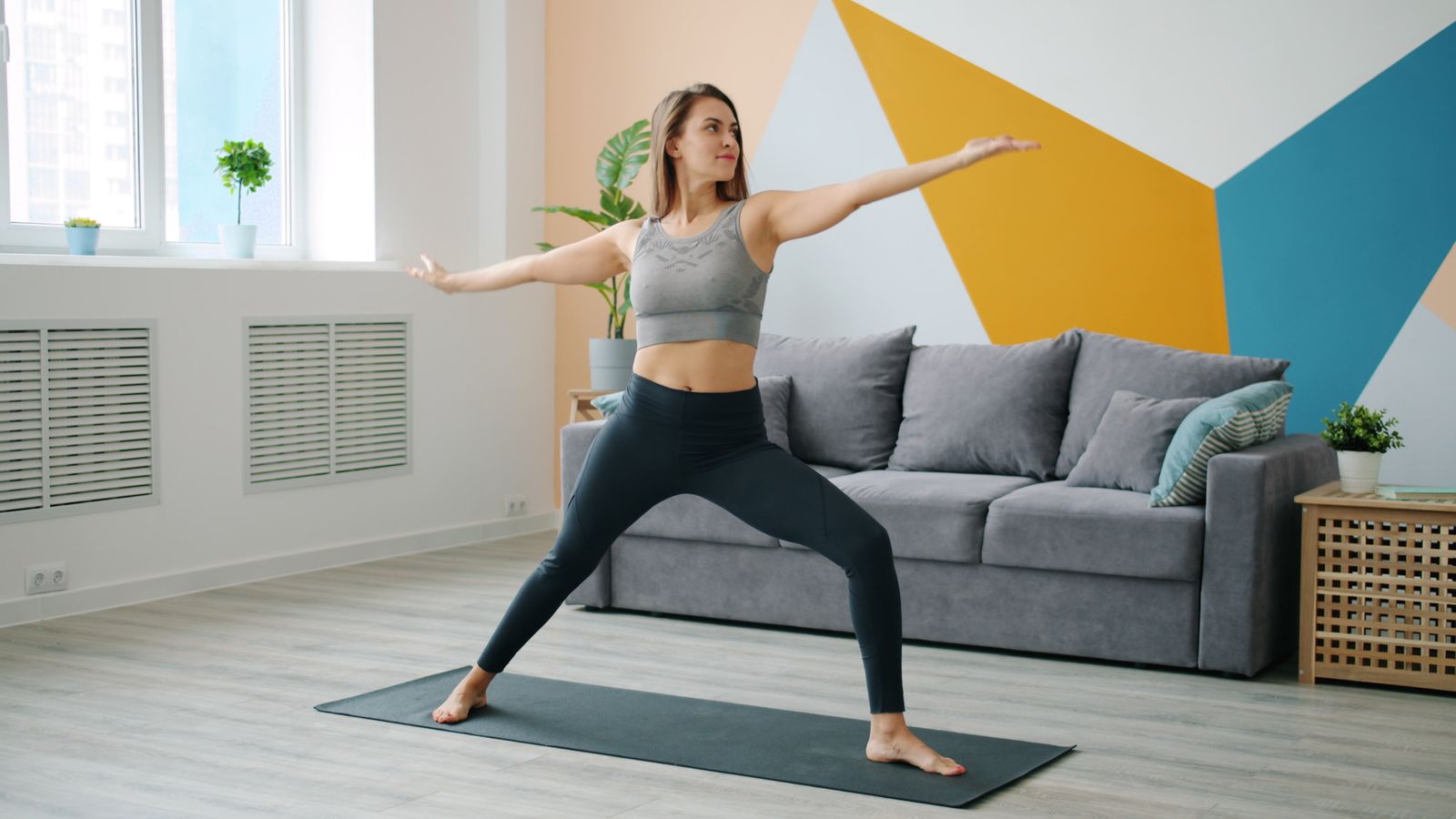
- Low Lunge to Warrior I (30 seconds per side): Opens the hips and builds leg strength.
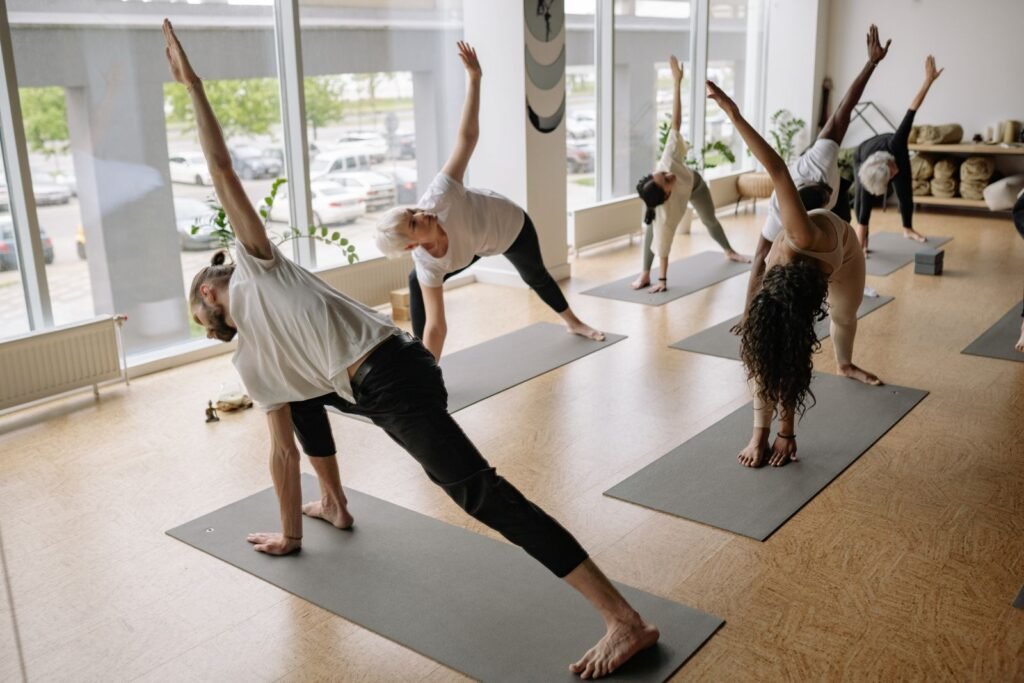
- Triangle Pose (30 seconds per side): Stretches the sides of the body and hamstrings.
- Seated Forward Fold (1 minute): Calms the nervous system and stretches the back of the legs.
- Bridge Pose (3-5 breaths, repeat twice): Strengthens the glutes and opens the chest.
- Savasana (3-5 minutes): Final rest, allowing the body to absorb the practice.
This sequence works well as a simple yoga routine for beginners because every pose has an accessible variation, and none require props beyond a mat.
How Do You Build an At-Home Yoga Routine Without a Teacher?
Practicing at home without a teacher in the room means you have to be your own guide for pacing, alignment cues, and sequencing. The easiest way to do this reliably is to pick a fixed order of poses and stick with it for at least two to three weeks before changing anything. Constantly switching sequences makes it harder to notice progress and easier to lose motivation.
A few practical habits make an at home yoga routine work over the long run:
- Practice in the same spot each time, even if it’s just a cleared corner of a bedroom. The visual cue helps your brain associate that space with the habit.
- Keep your mat visible, not stored away. Friction is the enemy of a new habit; if you have to dig the mat out of a closet, you’re less likely to unroll it.
- Use a timer instead of counting poses, especially in the early weeks. It removes the temptation to rush through the physically harder postures.
- Write your sequence on an index card or phone note so you’re not relying on memory when you’re tired or unmotivated.
If you want structured guidance rather than building the sequence entirely from scratch, joining live-guided sessions such as online yoga classes gives you the accountability of a teacher’s voice and pacing while still practicing from home.
What Does a Daily Yoga Routine Chart Actually Look Like?
A daily yoga routine chart is simply a weekly grid mapping which poses or sequence you do on which day, often varying the focus so you’re not doing the exact same routine seven days in a row. A basic weekly chart might look like this:
- Monday: Standing poses and balance (Warrior I & II, Tree Pose, Triangle)
- Tuesday: Gentle spinal mobility (Cat-Cow, Cobra, Sphinx, twists)
- Wednesday: Hip openers (Pigeon, Butterfly, Lizard Pose)
- Thursday: Core and balance (Boat Pose, Plank variations, Half Moon)
- Friday: Full yoga flow combining the week’s themes
- Saturday: Restorative or yin yoga for deeper, longer-held stretches
- Sunday: Rest or a short 10-minute gentle stretch
Printing or saving this kind of chart removes the daily decision fatigue of “what should I practice today,” which is often the real reason a routine falls apart in week two.
Is There a Reliable Yoga Routine PDF Worth Downloading?
A downloadable yoga routine PDF is useful mainly as an offline reference you can prop against a wall or glance at without pulling out your phone mid-practice. The best ones are simple: a single page per week, with pose names, hold times, and a small illustration or photo, rather than dense paragraphs of instruction. If you’re searching for a daily yoga routine pdf, look for one that separates beginner, intermediate, and restorative sequences rather than a single one-size-fits-all chart, since your energy and needs will vary day to day.
Keep in mind that a PDF is a reference tool, not a substitute for learning correct alignment. Static images can’t correct your form the way a live class or video demonstration can, so it’s worth pairing any printed chart with at least occasional guided sessions where an instructor can watch your form.
What Is a Good Basic Everyday Yoga Routine for Busy Schedules?
When time is the main obstacle, the goal shifts from a “complete” practice to a “maintenance” practice — just enough movement to keep your body from stiffening up and your mind from spiraling into stress. A basic everyday yoga routine for people with 10 minutes or less can focus on just four movements:
- Standing Forward Fold with a slow roll up through the spine (1 minute)
- Downward Dog to Cobra flow, repeated 5-6 times (2 minutes)
- Seated spinal twist, both sides (2 minutes)
- Legs-up-the-wall pose or simple savasana (4-5 minutes)
This kind of minimal routine still delivers the two things most people are actually chasing: physical release of tension held in the hips, shoulders, and lower back, and a brief mental reset. It won’t replace a full vinyasa yoga class in terms of strength-building, but it reliably prevents the “I haven’t moved all day” stiffness that builds up during desk-heavy work.
Does a Yoga Routine for Men Need to Be Different?
Physiologically, men on average carry tighter hamstrings, hips, and shoulders relative to women, largely due to differences in muscle mass distribution and, for many, years of sports or strength training that emphasize contraction over lengthening. A yoga routine for men often benefits from spending extra time on hip-opening poses like Pigeon and Lizard, and hamstring work like Downward Dog and Forward Folds, since tightness in these areas is one of the more common complaints from men new to the practice.
Beyond flexibility, there’s no meaningful difference in which poses are “appropriate” by gender. The idea that yoga is primarily a women’s practice is a modern misconception; historically, and in most traditional lineages, yoga was taught and practiced predominantly by men. Framing a routine around individual tightness and goals — not gender — produces better results than picking poses based on stereotypes.
How Do You Progress a Beginner Yoga Routine Over Time?
Progression in yoga isn’t primarily about achieving harder-looking poses; it’s about increasing control, breath awareness, and range of motion within poses you already know. A practical progression model over 8 to 12 weeks looks like this:
- Weeks 1-2: Learn the sequence, focus purely on getting the shapes roughly right and breathing steadily.
- Weeks 3-4: Extend hold times from 3 breaths to 5-8 breaths per pose.
- Weeks 5-8: Introduce one or two new poses per week that build on ones you’ve mastered (e.g., moving from Warrior I to Warrior II to Warrior III).
- Weeks 9-12: Begin linking poses into flowing transitions rather than static holds, which is the foundation of more dynamic styles like Hatha yoga or vinyasa.
Trying to skip straight to advanced yoga poses before your body has adapted to the basics is one of the more common causes of strain injuries in home practitioners, particularly around the hamstrings, lower back, and wrists.
What Are the Most Common Mistakes in a Home Yoga Routine?
Several patterns show up again and again in people who start a home practice and then abandon it within a few weeks:
- Overcomplicating the sequence. A routine with 20 different poses is hard to remember and harder to sustain than one with 8 you know by heart.
- Skipping the warm-up. Moving straight into deep stretches on cold muscles increases injury risk, especially in the hamstrings and lower back.
- Ignoring the breath. Holding your breath during effortful poses spikes tension rather than releasing it; steady nasal breathing throughout is what makes yoga different from ordinary stretching.
- Comparing your flexibility to others. Range of motion varies enormously by body type, prior injuries, and years of sitting; comparison is one of the fastest ways to lose motivation.
- Practicing only when motivated. Treating the routine as optional rather than scheduled is the single biggest predictor of dropping the habit within a month.
Should You Combine Yoga With Other Types of Exercise?
Yoga is excellent for mobility, breath control, and stress regulation, but it isn’t a complete substitute for cardiovascular training or heavy resistance work. Many practitioners get the best results by treating yoga as the connective tissue of their week — the thing that keeps the body supple and the nervous system regulated — while pairing it with strength training two to three times a week and some form of cardio, whether that’s walking, cycling, or a class like Zumba.
If your main goal is calming an overactive nervous system rather than building strength, a gentler restorative yoga or yin yoga routine, done a few evenings a week, tends to produce better sleep and stress outcomes than a vigorous flow practiced at the same time.
What Equipment Do You Actually Need for a Home Yoga Routine?
The honest answer is: a mat, and not much else. A standard 68-inch mat with reasonable grip is the one piece of equipment worth investing in, since practicing directly on a hard floor or carpet increases the risk of slipping in standing poses. Beyond that, a couple of household items can substitute for studio props:
- Two stacked books or a small stool instead of a yoga block, for supporting your hand in poses like Half Moon or Triangle
- A belt or long scarf instead of a yoga strap, for poses like seated forward folds where your hands can’t yet reach your feet
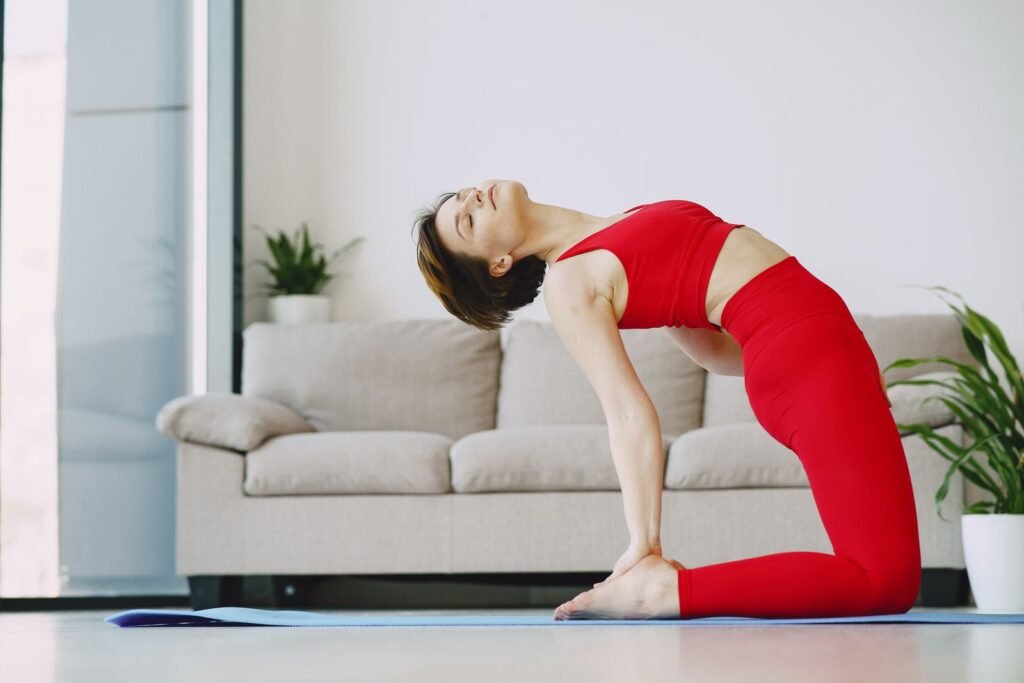
- A folded blanket or towel to cushion the knees in kneeling poses like Cat-Cow or Camel
None of these substitutes will hold you back meaningfully as a beginner. The idea that you need a fully equipped home studio to start a beginner yoga routine is one of the more persistent myths that keeps people from simply starting.
How Does Breathing Fit Into a Yoga Routine?
Breath is what separates a yoga routine from a generic stretching routine. In most home sequences, the default breathing pattern is slow, even inhales and exhales through the nose, roughly matched in length, continuing steadily through every pose rather than holding the breath during effort. This style of breathing, sometimes called ujjayi or “ocean breath” in more advanced practice, has the effect of keeping the nervous system in a calmer state even while the body is working.
A simple rule for beginners: if you notice you’re holding your breath or breathing shallowly through the mouth, that’s a signal you’re pushing too far into a pose. Backing off slightly until steady nasal breathing returns is more valuable long-term than forcing a deeper stretch.
Questions People Ask About Yoga Routines
How many days a week should I do a yoga routine?
Four to six days a week is a realistic and effective target for most beginners, with at least one full rest day. Daily practice is fine too, as long as you vary intensity — alternating a more active sequence with a gentler, restorative one so the body gets both stimulus and recovery.
Can I do a yoga routine every day without overtraining?
Yes, because yoga at a beginner and intermediate level is low-impact and largely self-limiting; you naturally back off when a stretch feels like too much. The main risk isn’t overtraining in the strength-training sense, but repetitive strain if you push the same tight area hard every single day without variation.
What time of day is best for a yoga routine?
Morning practice tends to have the highest adherence because it happens before daily obligations interfere, and it also helps loosen overnight stiffness. Evening practice, especially gentler sequences, is better suited to winding down before sleep. Both are effective; consistency matters more than the specific hour.
Do I need to be flexible to start a yoga routine?
No. Flexibility is a result of consistent practice, not a prerequisite for starting one. Every pose in a beginner sequence has a modified version — using props, bent knees, or a smaller range of motion — that makes it accessible regardless of your current flexibility.
How long until I see results from a daily yoga routine?
Most people notice improved mobility and reduced everyday stiffness within two to three weeks of consistent practice. Changes in strength, balance, and deeper flexibility (like touching your toes comfortably) typically take longer, often eight to twelve weeks of regular sessions.
Is a 10-minute yoga routine actually worth doing?
Yes. A short, consistent routine produces more durable habit formation and cumulative benefit than an occasional long session. Ten minutes of focused movement and breathing, done most days, will outperform a single weekly hour-long class for building both physical mobility and stress resilience over a few months.
Try This for Yourself
Reading about a yoga routine only gets you so far — the real benefits come from guided, consistent practice. If you’d like a structured sequence with a real instructor watching your form and pacing, explore FitStrot’s online yoga classes and build a routine that actually fits your schedule and body.
Related reading: Morning Yoga, Daily Yoga, Yoga Flow, Benefits of Yoga, and FitStrot’s online yoga classes.