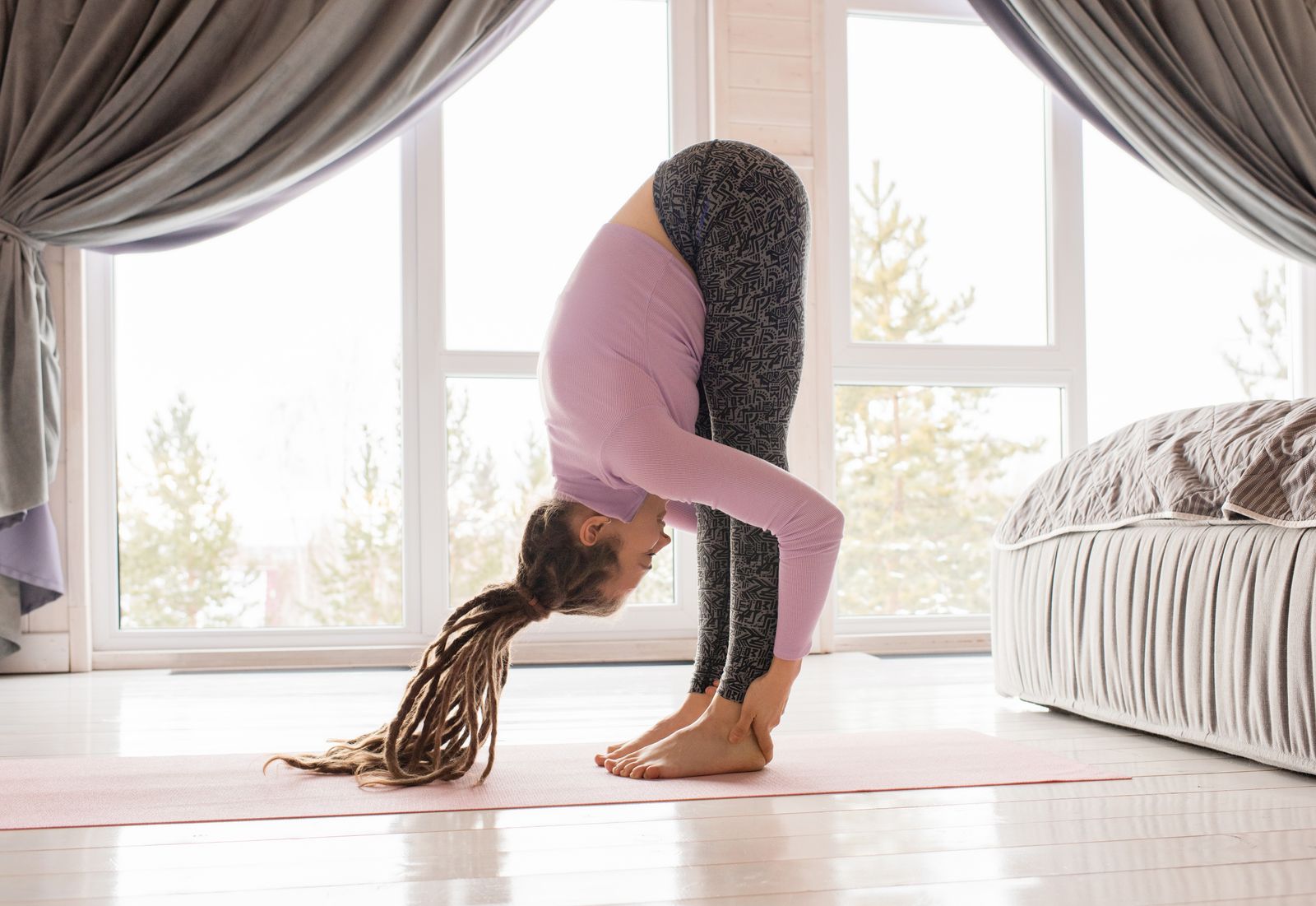
Uttanasana, or Standing Forward Bend, is a foundational yoga pose where you fold forward from the hips over straight or slightly bent legs, letting your head hang toward the floor. It stretches the hamstrings, calves, and spine while calming the nervous system, and it’s commonly taught as a cooldown pose, a Sun Salutation component, and a standalone stress-reliever. Most practitioners hold it for 30 seconds to a minute, bending the knees generously if the hamstrings are tight, and it’s considered accessible for beginners once the alignment cues are understood.
What Does “Uttanasana” Actually Mean?
The word comes from Sanskrit: “ut” means intense, and “tan” means to stretch or extend, so Uttanasana translates roughly to “intense stretch pose.” It’s also widely known by its English name, Standing Forward Bend, or sometimes Standing Forward Fold. The pose appears in nearly every yoga lineage, from Hatha to Vinyasa to Ashtanga, which says something about how fundamental it is. In Ashtanga specifically, Uttanasana shows up twice in every Sun Salutation A round, meaning a typical practice session might involve dozens of repetitions.
How Do You Get Into Uttanasana Correctly?
Start standing in Tadasana (Mountain Pose) with your feet hip-width apart and weight evenly distributed. Inhale and lengthen your spine. As you exhale, hinge forward from the hip joints, not the waist, keeping your spine as long as possible on the way down. Let your hands come to the floor, to blocks, or to your shins, wherever they reach without forcing the fold.
Keep a soft bend in your knees, especially if your hamstrings are tight or you feel any strain in your lower back. Allow your head and neck to relax completely, and let your torso hang heavy over your legs. Your goal isn’t touching your palms flat on the floor; it’s maintaining length in the spine and easing tension in the back body. To exit, bend your knees more, bring your hands to your hips, and roll up slowly one vertebra at a time, keeping your head down until last.
Step-by-Step Breakdown
- Stand tall in Tadasana with feet hip-width apart.
- Inhale, reaching your arms overhead to create space in the spine.
- Exhale, hinging at the hips to fold forward, leading with your chest rather than rounding your back first.
- Rest your hands on the floor, blocks, or your shins.
- Bend your knees as much as needed to release the lower back.
- Hold for 5 to 10 breaths, letting the head and neck relax.
- Inhale, engage your core, and roll up slowly, stacking each vertebra.
What Muscles Does Uttanasana Stretch and Strengthen?
Uttanasana primarily lengthens the hamstrings, calves, and the muscles along the entire posterior chain, including the erector spinae running along the spine. It also opens the hips and stretches the glutes. At the same time, it demands isometric engagement from the quadriceps to stabilize the knees and from the core to support a controlled, hinge-based fold rather than a collapse.
Because the pose relies on hip flexion rather than lower back rounding, consistent practice tends to improve hip mobility over time, which has a knock-on effect on movements outside of yoga entirely, like bending to pick something up off the floor or transitioning between sitting and standing without strain.
What Are the Benefits of Uttanasana?
Uttanasana is often cited by teachers and practitioners for a cluster of physical and mental effects, several of which are grounded in how forward folds affect the nervous system and circulation.
- Calms the nervous system: Forward folds are generally associated with activating the parasympathetic (“rest and digest”) response, which is why the pose is frequently placed near the end of a sequence or before Savasana.
- Relieves tension headaches and mild fatigue: Many practitioners report relief from tension headaches after holding the pose, likely linked to increased blood flow to the head and a release of tension in the neck and shoulders.
- Stretches the hamstrings and calves: Regular practice is one of the more direct ways to build hamstring flexibility, which supports better posture and gait mechanics.
- Improves spinal flexibility: The hip-hinge mechanics of the pose train the body to move the spine safely under load, a pattern that carries over into daily bending and lifting.
- Aids digestion: The gentle compression of the abdomen during the fold is commonly cited as a mild digestive stimulant, though this effect is anecdotal rather than clinically measured.
- Reduces stress and anxiety: Inversions of the head relative to the heart, even mild ones like this, are widely taught as calming, largely due to the combination of slow breathing and the relaxed head position.
It’s worth being precise about what’s well-established versus commonly cited: the flexibility and posture benefits are well-documented through repeated practice, while claims about detoxification or dramatic hormonal shifts from a single pose are generalizations that go beyond what any single asana can be credited with.
How Does Uttanasana Fit Into a Sun Salutation?
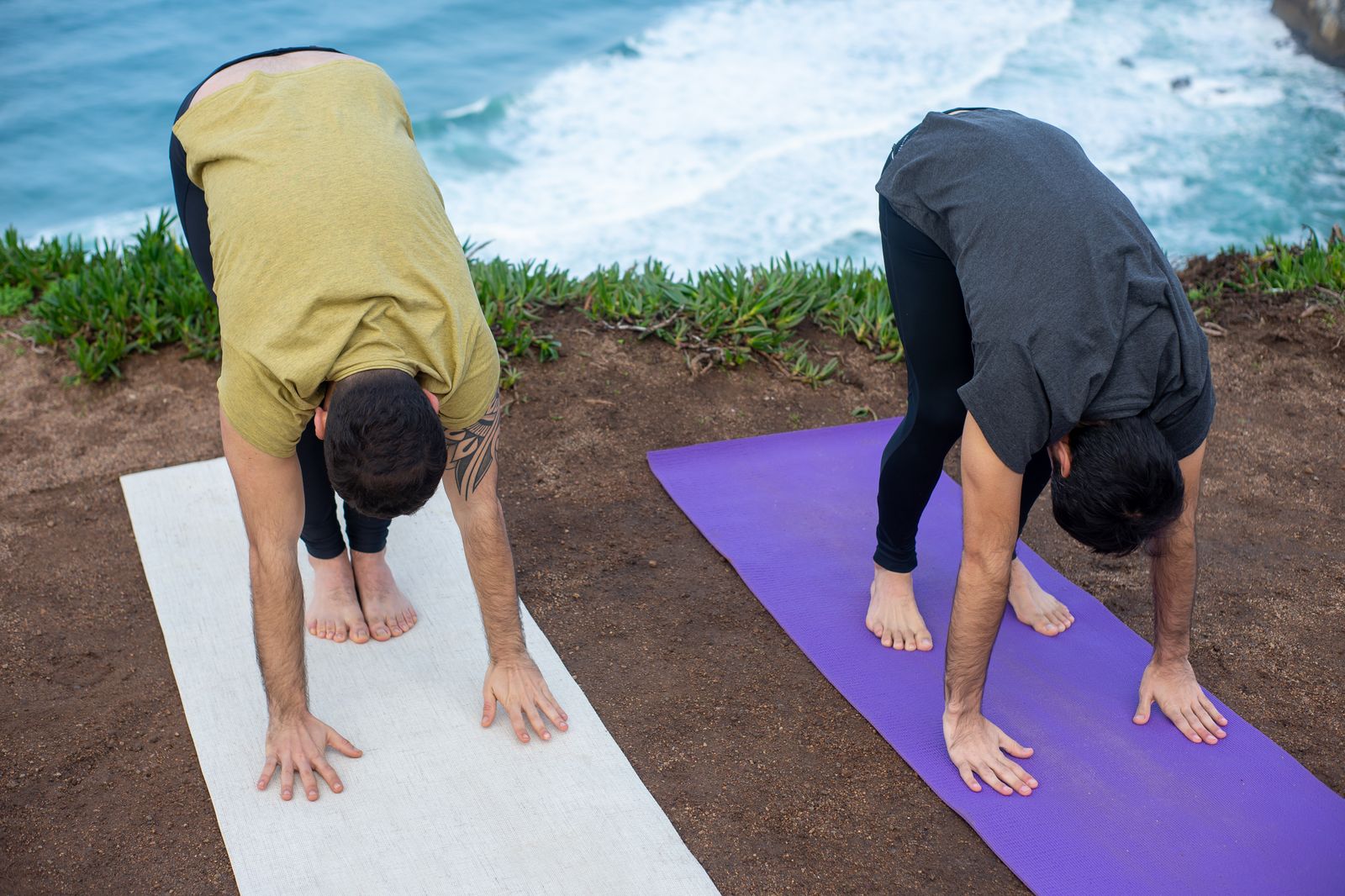
In Surya Namaskar (Sun Salutation), Uttanasana appears as the third and the second-to-last position in the classic sequence. You move into it from Mountain Pose with an exhale, then transition out of it into a lunge or plank on the next inhale. This makes it a transitional pose as much as a static one, and getting comfortable with the hip hinge here makes the entire Sun Salutation flow more smoothly. Because it repeats within each round, Uttanasana ends up being one of the most-practiced poses in any regular Vinyasa or Ashtanga class.
What Are the Common Variations of Uttanasana?
Several variations adjust the intensity or accessibility of the pose depending on your flexibility and goals.
- Ardha Uttanasana (Half Forward Bend): A flat-back variation where the torso comes only halfway down, hands resting on the shins or blocks. It’s often used as a transitional pose in Sun Salutations and is gentler on the lower back.
- Uttanasana with bent knees: Recommended for beginners or anyone with tight hamstrings, this variation prioritizes spinal length over depth of fold.
- Uttanasana with a block: Placing yoga blocks under the hands reduces the range of motion needed and helps maintain better alignment through the spine.
- Padahastasana (Hand-Under-Foot Pose): A deeper variant where the hands are tucked underneath the feet, intensifying the hamstring stretch.
- Wide-legged forward fold (Prasarita Padottanasana): A related pose using a wider stance, shifting emphasis toward the inner thighs and reducing pressure on the hamstrings.
What Are Common Mistakes in Uttanasana?
The most frequent mistake is rounding the back aggressively to force the hands to the floor, which shifts strain away from the hamstrings and into the lumbar spine. Keeping a generous bend in the knees fixes this almost immediately, since it removes the hamstring tension that’s pulling the pelvis and lower back out of a neutral position.
Another common error is locking the knees completely, which can hyperextend the joint and cut off circulation to the legs during longer holds. A third mistake is rushing the exit, standing up too quickly with a straight back, which can cause head rush or dizziness since blood has pooled toward the upper body during the fold. Standing up slowly, vertebra by vertebra, avoids this.
Who Should Be Careful With Uttanasana?
Uttanasana is generally considered safe for most healthy adults, but a few groups should modify or avoid it. People with herniated discs, sciatica, or acute lower back injuries should approach the pose cautiously and only with a bent-knee variation, ideally under guidance from a teacher or physical therapist. Those with high blood pressure or glaucoma are often advised to keep their head above heart level or avoid a full fold, since forward bends increase blood flow and pressure to the head.
Pregnant practitioners, particularly in the second and third trimesters, are typically guided toward a wide-legged variation to avoid compressing the abdomen. As with any pose, if you have a specific medical condition, checking with a doctor or a qualified yoga instructor before attempting deep forward folds is a reasonable precaution.
How Does Uttanasana Compare to Other Standing Poses?
Uttanasana is often practiced alongside other standing postures that build complementary strength and flexibility. Compared to Tadasana, which trains upright alignment and grounding, Uttanasana trains the opposite skill: controlled release and hip-hinge mechanics. Compared to Vrksasana (Tree Pose), which builds single-leg balance and focus, Uttanasana is about surrender and lengthening rather than active stabilization.
Pairing forward folds with balance poses and strength-based standing poses like Warrior poses gives a practice both mobility and stability, which is part of why most structured yoga pose sequences alternate between the two categories rather than clustering similar poses together.
How Long Should You Hold Uttanasana?
In a dynamic sequence like Sun Salutations, Uttanasana is typically held for just one or two breaths before transitioning to the next pose. As a standalone stretch, though, holding for 30 seconds to two minutes allows the hamstrings and lower back to release more fully, since connective tissue and muscle fibers need sustained, gentle tension to lengthen rather than a quick stretch.
Restorative or Yin yoga approaches to this pose sometimes extend the hold to three to five minutes, using props like a chair or bolster for support, which shifts the emphasis from active stretching toward passive release of the fascia.
How Can Beginners Build Toward a Deeper Uttanasana?
Flexibility in this pose develops gradually, and rushing it tends to backfire through strain rather than progress. A practical approach is practicing the pose with bent knees consistently for several weeks, focusing purely on spinal length rather than how close the hands get to the floor.
Incorporating complementary hamstring stretches, like Supta Padangusthasana (Reclining Big Toe Pose), on non-folding days helps build the underlying flexibility that makes Uttanasana easier without forcing the pose itself. Regular practice of Sun Salutations, where the pose repeats naturally, is often the most efficient way to build comfort with it, since repetition under guided breathing tends to outperform occasional deep stretching sessions.
Does Uttanasana Help With Back Pain?
For general muscular tightness and stiffness, gentle forward folds like Uttanasana can help by lengthening the hamstrings and lower back muscles, which are often contributors to lower back discomfort caused by prolonged sitting. However, for structural issues like disc herniation, the pose needs modification, since a deep, unsupported fold puts direct pressure on the same discs that may already be compromised.
If you’re using yoga specifically to manage back pain, it’s worth learning which forward folds are supportive versus which ones to modify or skip, ideally with input from a teacher who can assess your specific condition rather than following a generic sequence.
Questions People Ask About Uttanasana
Is Uttanasana good for beginners?
Yes. Uttanasana is one of the more accessible standing poses because it can be modified endlessly with bent knees, blocks, or a shorter hold time. Beginners should prioritize a long spine over touching the floor, since the pose’s core benefit comes from the hip hinge and controlled stretch, not from depth.
Why can’t I touch my toes in Uttanasana?
Tight hamstrings, a stiff lower back, or simply anatomical proportions can all limit how far you fold. This is completely normal and doesn’t reduce the pose’s benefit. Bending the knees generously and focusing on spinal length will build flexibility over time far more effectively than forcing a flat-legged fold.
Can Uttanasana help with anxiety?
Many practitioners and teachers report a calming effect from forward folds, generally attributed to the parasympathetic nervous system response triggered by slow breathing and the head-down position. It’s commonly used as a grounding pose in stress-focused sequences, though it works best combined with deep, deliberate breathing rather than as a quick stretch alone.
How is Uttanasana different from Padahastasana?
Uttanasana allows the hands to rest anywhere comfortable, on the floor, blocks, or shins, while Padahastasana specifically requires tucking the hands underneath the feet. Padahastasana is considered a deeper variation that demands more hamstring flexibility and is usually introduced only once a practitioner is comfortable in standard Uttanasana.
Should I do Uttanasana before or after a workout?
Both have value for different reasons. Before a workout, a gentle version with bent knees can help warm up the hamstrings and hips. After a workout, a longer hold supports recovery by lengthening muscles that tightened during exercise. Avoid a deep, forced fold on completely cold muscles, since that’s when strain is most likely.
Is it normal to feel dizzy in Uttanasana?
Mild lightheadedness can happen, especially when standing back up too quickly, since blood has pooled toward the head during the fold. Standing up slowly, one vertebra at a time, with the head coming up last, usually resolves this. Persistent or severe dizziness is a signal to stop and check with a doctor.
Try This for Yourself
Reading about Uttanasana only gets you so far. The real benefits, the loosened hamstrings, the calmer nervous system, the better hip mobility, come from consistent, guided practice. Join a FitStrot online yoga class and get real-time feedback on your alignment as you build this pose into your regular routine.
Related reading: explore our full library of yoga poses and asanas, learn the complete Surya Namaskar (Sun Salutation) sequence, ground your practice with Tadasana (Mountain Pose), build balance with Vrksasana (Tree Pose), or start today with FitStrot’s Online Yoga Classes.