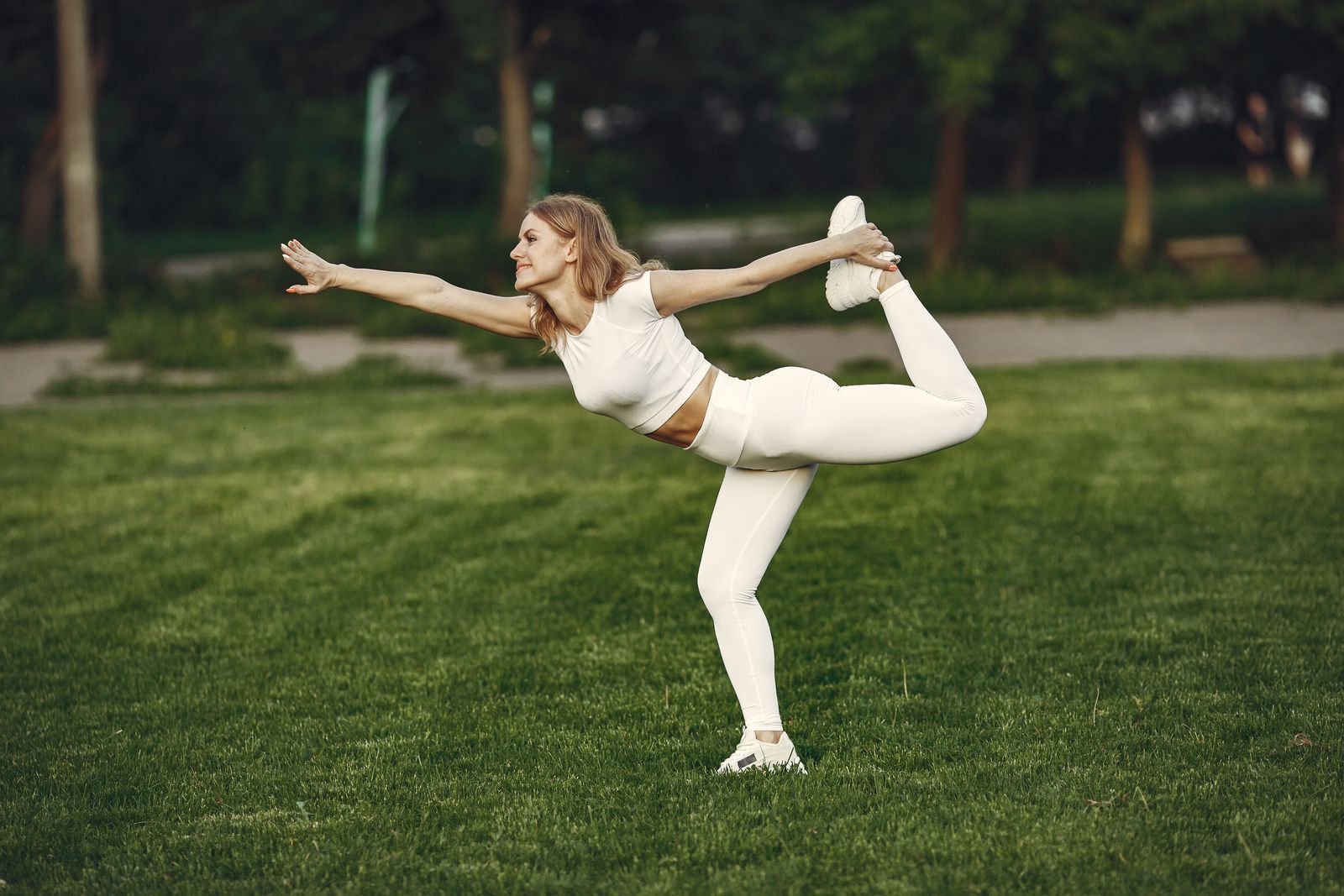
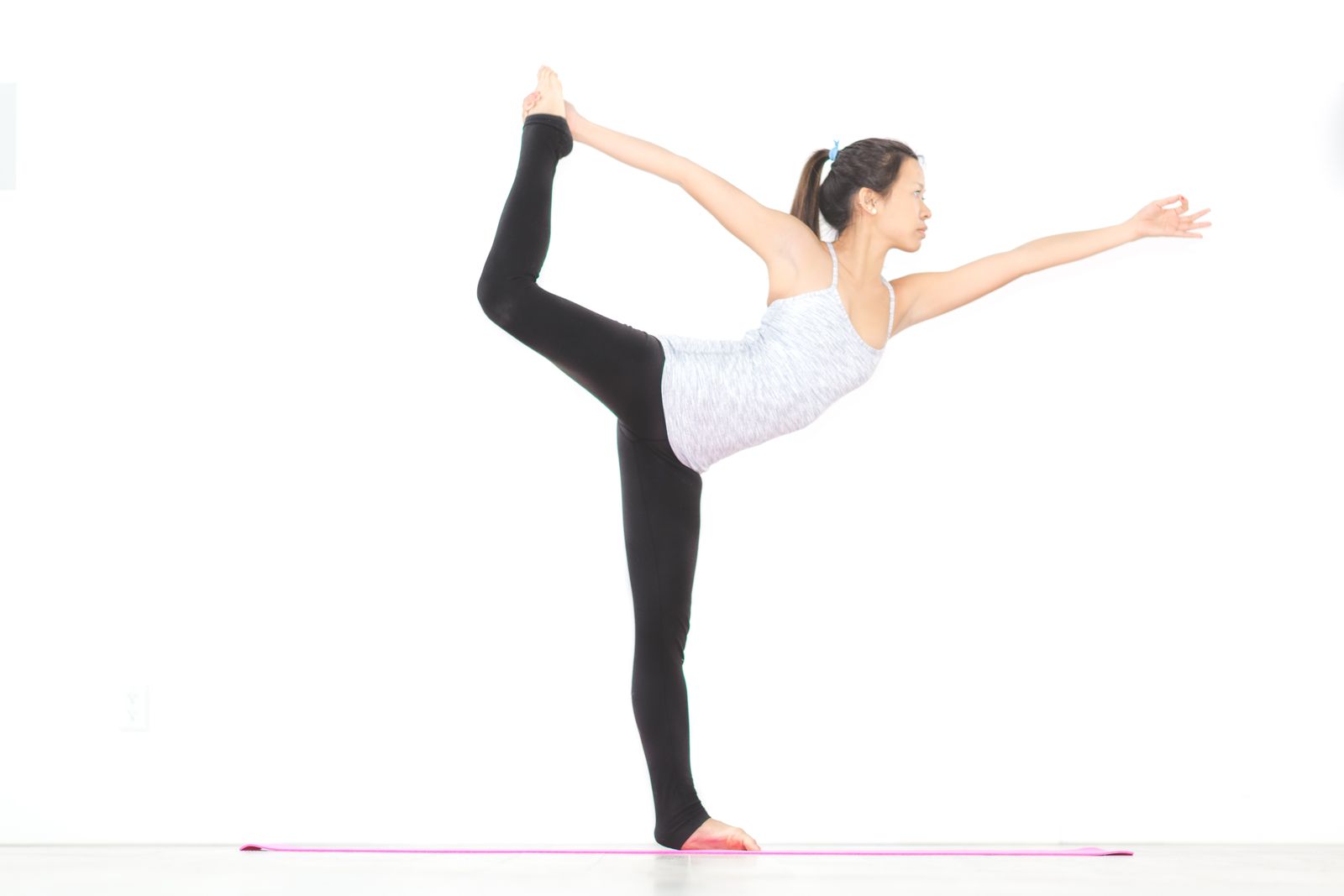
Natarajasana, or Dancer Pose, is a standing backbend in which you balance on one leg, reach the opposite arm back to grasp the raised foot, and kick that foot into your hand while extending the front arm forward. The pose builds single-leg balance, opens the shoulders and chest, and stretches the quadriceps and hip flexors of the lifted leg, all while training the deep core and back muscles needed to stay upright through a deep backbend. It looks dramatic, and it takes patience to build the flexibility and balance to hold it well, but a modified version is accessible to most reasonably fit beginners using a strap or a wall for support.
What Does Natarajasana Mean?
The name comes from three Sanskrit words: “nata” (dancer), “raja” (king or lord), and “asana” (pose or seat). Put together, Natarajasana is usually translated as “Lord of the Dance Pose” or “Dancer’s Pose.” The name refers to Nataraja, an aspect of the Hindu god Shiva depicted as the cosmic dancer whose movement is said to embody the rhythm of creation and destruction. Temple sculptures of Nataraja, most famously associated with the Chidambaram temple in Tamil Nadu, show Shiva balanced on one leg with limbs extended in a dynamic, circular shape that the yoga pose loosely echoes. In the practice itself, that mythic reference gives the shape its poetic name, but the physical work of the pose is entirely about balance, hip flexibility, and shoulder opening. If you want to see how this pose fits alongside other standing balances, our guide to yoga poses is a useful starting point.
Where Did Natarajasana Come From?
Unlike foundational seated poses that appear in centuries-old hatha yoga texts, Natarajasana is commonly cited by yoga historians as a relatively modern addition to the asana repertoire. Some scholars, notably Elliott Goldberg in his research on the history of modern yoga, point out that the pose does not appear in medieval hatha yoga manuals or in earlier traveler accounts of Indian ascetic practices, and instead credit the influential 20th-century teacher Tirumalai Krishnamacharya with introducing it into the modern teaching lineage. His student B.K.S. Iyengar later popularized the pose widely, featuring it prominently in his landmark 1966 book “Light on Yoga,” which remains one of the most referenced yoga manuals in the West. Whatever its exact origin, the pose has since become a signature standing backbend across most modern styles, from hatha to vinyasa classes.
How Do You Do Natarajasana Step by Step?
Begin standing tall in Tadasana (Mountain Pose), with your feet hip-width apart and your weight distributed evenly across both feet. Shift your weight onto your left leg, pressing firmly through the whole foot, and bend your right knee to bring the heel toward your glutes. Reach your right hand back and grasp the inside or top of your right foot or ankle. Keep your knees close together rather than letting the lifted knee splay out to the side.
From here, begin to press the right foot into your hand as you simultaneously reach it up and back, letting the movement draw your torso into a gentle forward tilt and backbend at the same time. Extend your left arm forward at shoulder height, or reach it further overhead as your balance allows, to counterbalance the backward kick of the leg. Keep your standing knee soft, not locked, and draw your lower ribs in so the backbend comes from the whole spine rather than collapsing into the lower back alone. Hold for 5 to 8 breaths, then release slowly and repeat on the other side.
What Muscles Does Natarajasana Work?
Natarajasana engages a wide range of muscle groups simultaneously, which is part of why it is considered a more advanced integration pose rather than a beginner shape. The standing leg’s quadriceps, hamstrings, and gluteal muscles work isometrically to stabilize the body, while the ankle and foot muscles make constant small adjustments to maintain balance. The lifted leg’s quadriceps and hip flexors lengthen under tension as the foot presses back into the hand, creating a deep stretch through the front of the thigh. Across the upper body, the shoulders, pectoral muscles, and biceps of the reaching arm stretch open, while the muscles of the upper back and rear shoulder work to keep the chest lifted rather than collapsed. The deep core muscles, especially the transverse abdominis and the muscles that support the lower back, work continuously to prevent the spine from over-arching in the lumbar region.
What Are the Benefits of Natarajasana?
Practicing Dancer Pose regularly offers benefits across strength, flexibility, and balance. It improves single-leg stability and proprioception, which carries over to everyday activities like walking on uneven ground or recovering from a stumble. The pose stretches the hip flexors and quadriceps of the lifted leg, an area that tends to shorten in people who sit for long stretches at a desk or in a car. It also opens the chest and shoulders, counteracting the rounded posture common with long hours at a computer or phone. Because holding the pose requires sustained focus, many practitioners also find it builds mental concentration and a sense of calm confidence, similar to the steadiness described in many general benefits of yoga discussions. For readers dealing with tight hips from running or cycling, pairing Natarajasana with poses from a yoga for hip flexibility routine can speed up progress.
What Are Common Mistakes in Natarajasana?
A few alignment errors show up again and again in Natarajasana, and most of them come down to compensating for tight hips or shoulders rather than working within your current range of motion:
- Collapsing the standing-side hip: letting it jut out to the side to compensate for tightness in the lifted leg, which twists the pelvis and reduces stability.
- Locking the standing knee: this reduces the small stabilizing movements the joint needs to make and increases the risk of strain.
- Letting the lifted knee splay wide: instead of keeping both knees pointing forward and close together, which reduces the quality of the quadriceps stretch and can stress the hip joint.
- Rushing into the deepest expression: the backbend should come gradually from an open chest and lengthened spine, not from yanking the foot higher with the arm alone.
How Do Beginners Modify Natarajasana?
Beginners should not expect to reach the classic deep backbend shape on the first attempt, and that is completely normal given how much flexibility and balance the full pose demands. A simple modification is to practice near a wall, placing the standing-leg hand lightly against it for extra stability while you get used to the balance. Using a yoga strap looped around the lifted ankle is another effective option: holding the strap instead of the foot directly lets you work on the backbend and the shoulder opening without needing full flexibility yet. Some practitioners also practice a “half” version, focusing only on the standing balance and knee-bend without attempting the backward reach, building confidence in the base of the pose before adding the arm and spine work. If balance is still shaky, practicing near a chair or countertop for light fingertip support removes the fear of falling so you can focus on alignment.
What Poses Should You Practice Before Natarajasana?
Because Natarajasana combines balance, hip-flexor flexibility, and a backbend all at once, it helps to build each component separately first. Vrksasana (Tree Pose) is an excellent starting point for single-leg balance without the added complexity of a backbend. Warrior poses build the leg strength and hip stability the standing leg needs to stay steady. For the quadriceps and hip-flexor stretch specifically, poses like a low lunge or a supported Ustrasana (Camel Pose) help prepare the front-body opening the backbend requires. Practicing a few rounds of Surya Namaskar (Sun Salutations) beforehand also warms the hips and shoulders, making the deeper stretch of Dancer Pose more accessible and safer to enter.
Is Natarajasana Safe for Everyone?
Natarajasana is generally safe for healthy adults with reasonable balance and no acute injuries, but it is not a beginner-friendly pose to attempt without preparation. People with knee injuries, hip impingement, or shoulder injuries should approach the pose cautiously or avoid the full expression, since it places load on all three joints simultaneously. Anyone with low blood pressure or a tendency to feel dizzy during balance work should practice near a wall or with support the first several times. Pregnant practitioners are generally advised to skip deep backbends and challenging single-leg balances, opting instead for gentler standing poses. As with any new pose, especially one involving spinal extension, checking with a qualified teacher or a doctor first is sensible if you have a pre-existing back or joint condition. For broader guidance on modifying practice around injuries, see our article on yoga for back pain.
How Does Natarajasana Compare to Other Backbends?
Compared to floor-based backbends like Camel Pose or Wheel Pose, Natarajasana adds the challenge of balancing on one leg while backbending, which makes it significantly harder to control. Floor backbends let you use both feet or your hands as a stable base, so you can focus entirely on spinal extension. Natarajasana removes that stability and asks the standing leg and core to do the balancing work at the same time as the shoulders and spine open. Compared to other standing balance poses such as Tree Pose or Half Moon Pose, Natarajasana is more demanding because it combines the balance challenge with an active backbend and a deep quadriceps stretch, rather than asking the body to simply hold a static shape.
How Long Does It Take to Master Natarajasana?
There is no fixed timeline, since it depends heavily on existing hip flexibility, shoulder mobility, and balance ability, but many practitioners who train consistently notice steady improvement over 8 to 12 weeks of regular practice. Early sessions are usually about tolerating the stretch in the hip flexor and getting comfortable balancing on one leg at all. As flexibility improves, the foot can be drawn higher and the backbend becomes fuller, with the front arm eventually extending overhead in the more advanced variation. Consistency matters more than intensity here: a few minutes of focused balance and hip-opening work most days will produce better results than one long session per week. Pairing Natarajasana practice with a broader beginner yoga poses routine helps build the surrounding strength and mobility that support faster progress.
How Does Natarajasana Fit Into a Yoga Sequence?
Natarajasana is typically placed in the standing portion of a class, after the body has already warmed up through sun salutations or other standing poses, since attempting a deep backbend cold increases injury risk. It pairs well following hip-opening or quad-stretching poses that prepare the lifted leg, and it is often followed by a counter-pose such as a forward fold or gentle twist to release the spine after the backbend. In a well-designed vinyasa flow, Natarajasana might appear as a peak pose partway through class, giving students something to build toward through the earlier standing sequence. In slower-paced hatha classes, it may be held longer with more attention to alignment and breath, since there is less emphasis on continuous movement between poses.
What Is the Difference Between Natarajasana and Its Variations?
Natarajasana has several variations that adjust the intensity of the backbend and the flexibility required to enter it:
| Variation | What Changes | Best For |
|---|---|---|
| Classic Natarajasana | One arm reaches back to hold the same-side foot while the other arm extends forward. | The standard, most commonly taught version. |
| King Dancer Pose | Both hands reach back to grasp the lifted foot, deepening the backbend considerably. | Practitioners with significantly more shoulder and spinal flexibility. |
| Strap-Assisted Dancer Pose | A yoga strap loops around the ankle instead of a direct hand-to-foot grip. | Beginners still building the necessary flexibility. |
| Standing Quad Stretch | Isolates the balance and hip-flexor stretch without attempting the backbend. | A standalone preparatory shape before the full pose. |
Questions People Ask About Natarajasana
Is Natarajasana good for beginners?
Natarajasana is considered an intermediate to advanced pose because it combines balance, backbending, and hip-flexor flexibility all at once. Beginners can still work toward it using a wall for support or a strap around the ankle, building the individual components of balance and flexibility gradually rather than attempting the full expression right away.
What is the Sanskrit meaning of Natarajasana?
Natarajasana comes from “nata” (dancer), “raja” (king), and “asana” (pose), commonly translated as “Lord of the Dance Pose.” The name references Nataraja, an aspect of the Hindu god Shiva shown as the cosmic dancer in temple sculpture, whose balanced, dynamic form loosely inspired the shape of this standing backbend.
Which muscles does Natarajasana stretch the most?
The pose most noticeably stretches the quadriceps and hip flexors of the lifted leg, along with the shoulders and chest of the reaching arm. At the same time, it strengthens the standing leg, ankle stabilizers, and the core and back muscles that keep the spine supported through the backbend.
Can I use a strap for Natarajasana?
Yes, looping a yoga strap around the lifted ankle and holding the strap ends instead of the foot directly is a common and effective modification. It lets you work on the backbend and shoulder opening progressively as flexibility improves, without needing to reach the foot directly on day one.
Why do I keep falling out of Natarajasana?
Falling usually comes from an unstable standing leg, a locked standing knee, or trying to deepen the backbend before the hip flexors and shoulders are ready. Practicing near a wall, softening the standing knee slightly, and focusing on a steady gaze point can significantly improve balance while the supporting flexibility develops.
Is Natarajasana a backbend or a balance pose?
It is both. Natarajasana is classified as a standing balance pose because of the single-leg stance, and as a backbend because of the spinal extension created as the lifted foot presses back into the hand. This combination is what makes it more demanding than poses that isolate just one of those elements.
Try This for Yourself
Reading about Natarajasana is a good start, but the balance, flexibility, and confidence it builds really only come from guided, consistent practice. If you would like personalized feedback on your alignment and a structured plan to build toward the full pose safely, join a live class with FitStrot’s online yoga classes and work with an instructor who can adjust the pose to your current flexibility and balance level.
Related reading: Vrksasana (Tree Pose), Tadasana (Mountain Pose), Surya Namaskar (Sun Salutations), our full guide to yoga poses, and FitStrot’s online yoga classes.