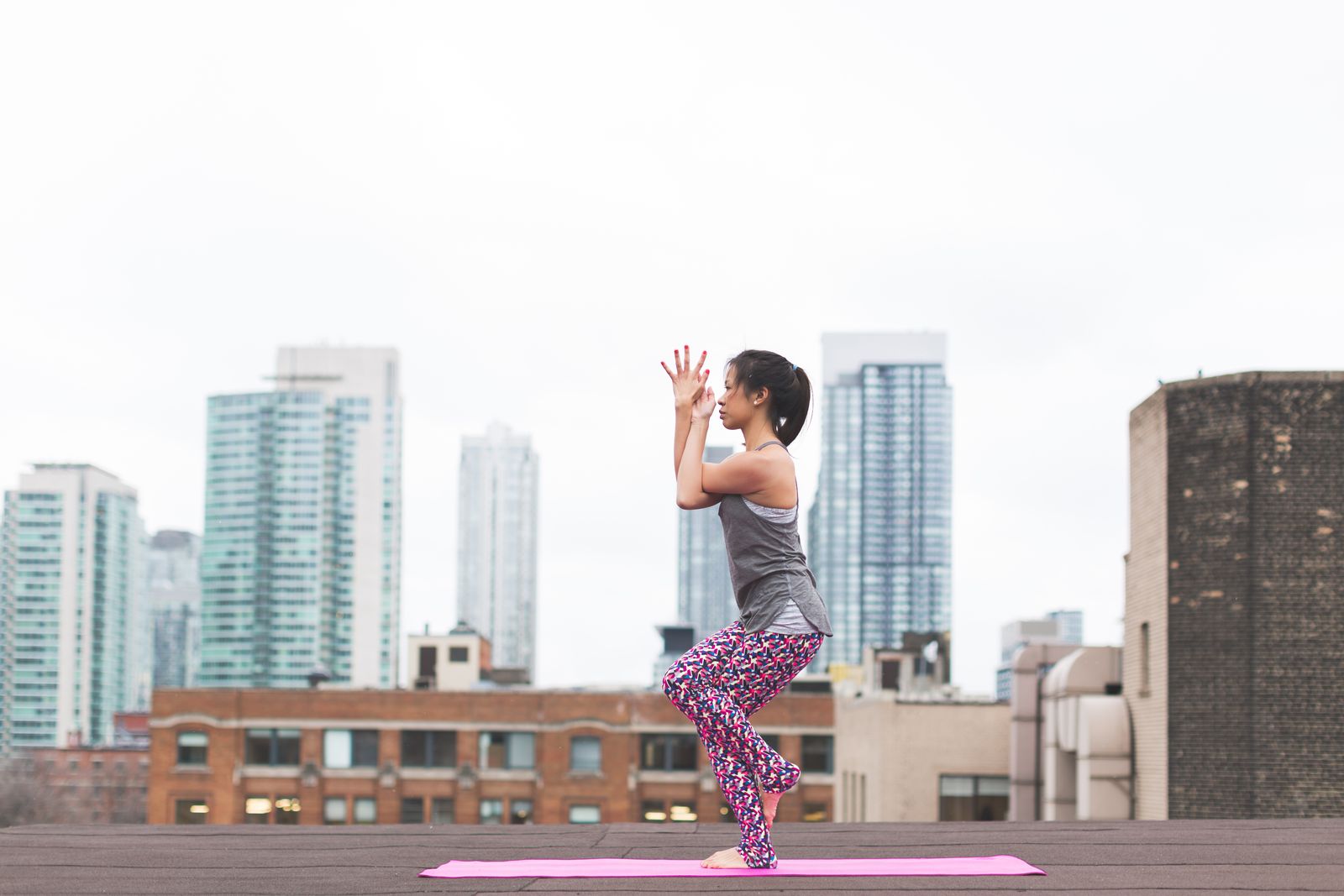
Garudasana, or Eagle Pose, is a standing balance posture in which you cross one leg over the other while wrapping your arms across your chest, palms pressed together, and hold the position for several breaths. It builds ankle and knee stability, opens the shoulders and upper back, strengthens the thighs and core, and sharpens mental focus, all at once. The name comes from the Sanskrit garuda, the mythical king of birds, and is typically practiced standing on one leg with a soft, steady gaze fixed a few feet ahead. It looks intricate the first time you see it, but the shape is built from two simple actions repeated on both sides of the body: wrap the legs, wrap the arms, breathe, and hold.
What Does Garudasana Mean in Sanskrit?
The word “garudasana” combines garuda (eagle, or more literally “devourer,” a reference to the sun’s consuming rays in Hindu myth) with asana (seat or posture). In Hindu tradition, Garuda is described as the king of birds and the vehicle of the god Vishnu, prized for keen eyesight, speed, and fierce focus. Those same qualities are what the pose asks you to cultivate: a raptor’s stillness balanced on a single point, eyes locked forward, wings folded tight. Some teachers link the crossed-palm shape at the chest to the eagle’s curved beak, which is one reason the hand position is often called “eagle arms” even when it is practiced seated or in other postures like vrksasana or a seated twist.
How Do You Do Garudasana Step by Step?
Start in Tadasana (Mountain Pose), feet hip-width apart, weight even through both feet. Shift your weight onto your right foot, bend both knees slightly, and lift your left leg. Cross your left thigh over your right, then, if your flexibility allows, hook the top of your left foot behind your right calf. Bring both arms out in front of you, cross your right arm over your left at the elbows, then bend the elbows and wrap the forearms so the backs of your hands (or palms, if you can reach) come together in front of your face. Lift the elbows to shoulder height, draw your shoulder blades apart, and soften your gaze to one fixed point a few feet in front of you. Hold for five to eight breaths, then unwind slowly and repeat on the other side. If you’re new to standing balances, practicing tadasana and vrksasana first builds the foundational stability that makes the eagle wrap easier to find.
What Are the Benefits of Garudasana Yoga?
Garudasana yoga benefits reach across strength, flexibility, and mental focus in a single short hold. Practitioners and teachers commonly report these effects:
- Improved balance and proprioception — standing on one leg while the arms and legs are wrapped forces the stabilizing muscles around the ankle, knee, and hip to fire together.
- Shoulder and upper-back opening — the arm wrap stretches the rhomboids, rear deltoids, and the muscles between the shoulder blades, which is useful for people who sit at a desk for long stretches; pairing it with a yoga for back pain routine can compound the relief.
- Strengthened thighs, hips, and ankles — the standing leg works isometrically to hold the body upright while the crossed leg stretches the outer hip and IT band.
- Sharper concentration — balance postures demand a fixed gaze point (drishti) and steady breath, which is why many teachers place garudasana in sequences meant to build focus before seated meditation.
- Better circulation in the joints — the deep compression and release of the wrapped limbs is often described as flushing stagnant blood from the joints, though this specific circulatory claim is more of a traditional yogic observation than a clinically measured outcome, so it’s best treated as a commonly cited benefit rather than a proven statistic.
For a broader look at what a consistent practice does for the body and mind over time, see our guide to the benefits of yoga.
Which Muscles Does Eagle Pose Work?
Eagle Pose is a compound posture, meaning it recruits several muscle groups simultaneously rather than isolating one area. The standing leg’s quadriceps, glutes, and calf work to hold the body steady, while the crossed leg’s adductors (inner thigh) and outer hip rotators lengthen under the wrap. Through the upper body, the rhomboids and middle trapezius stretch as the arms cross, while the front deltoids and pectorals get a gentle opening stretch. The deep core, particularly the transverse abdominis, engages to keep the torso from tipping. Because the pose asks so many muscle groups to cooperate at once, it’s often used as a diagnostic: whichever side feels noticeably tighter or wobblier usually points to an imbalance worth addressing in a broader hatha yoga or vinyasa yoga practice.
Is Garudasana Good for Beginners?
Garudasana is approachable for beginners but does require some baseline hip and shoulder mobility, so it’s usually introduced after a student is comfortable with simpler balances. If the full leg wrap feels out of reach, keep the lifted foot’s toes lightly touching the floor beside the standing foot instead of hooking it behind the calf. If pressing the palms together is too far, simply touch the backs of the hands together or hold opposite shoulders. A wall or the back of a chair nearby can also offer light support while the balance muscles adapt. Many teachers introduce this pose within a beginner-friendly hatha yoga class before layering it into faster-paced sequences.
What Are Common Alignment Mistakes in Eagle Pose?
The most frequent error is collapsing through the standing leg’s knee, which shifts weight to the inside edge of the foot and destabilizes the whole pose; keep a micro-bend in the standing knee and press evenly through all four corners of that foot. A second common mistake is letting the shoulders creep up toward the ears while wrapping the arms — actively drawing the shoulder blades down the back keeps the neck free. Rounding the upper back excessively to force the palms together is a third issue; it’s better to keep length in the spine and accept a smaller version of the arm wrap than to hunch. Finally, holding the breath while concentrating on balance is common but counterproductive: steady, even breathing through the nose keeps the nervous system calm and actually improves stability, a principle shared across most standing postures including surya namaskar sequences.
What Is the Drishti and Why Does It Matter?
Drishti refers to a fixed gaze point used to anchor attention and steady balance during a pose. In garudasana, most teachers recommend looking softly at a single unmoving spot roughly eye level or slightly below, rather than letting the eyes dart around the room. This isn’t just a mental trick — visual fixation reduces the small corrective movements the inner ear and eyes constantly make to keep you upright, so a steady drishti genuinely translates into a steadier body. The concept of drishti appears throughout the broader landscape of yoga poses, particularly in standing balances and arm balances where visual focus and physical balance are directly linked.
How Does Garudasana Compare to Other Standing Balance Poses?
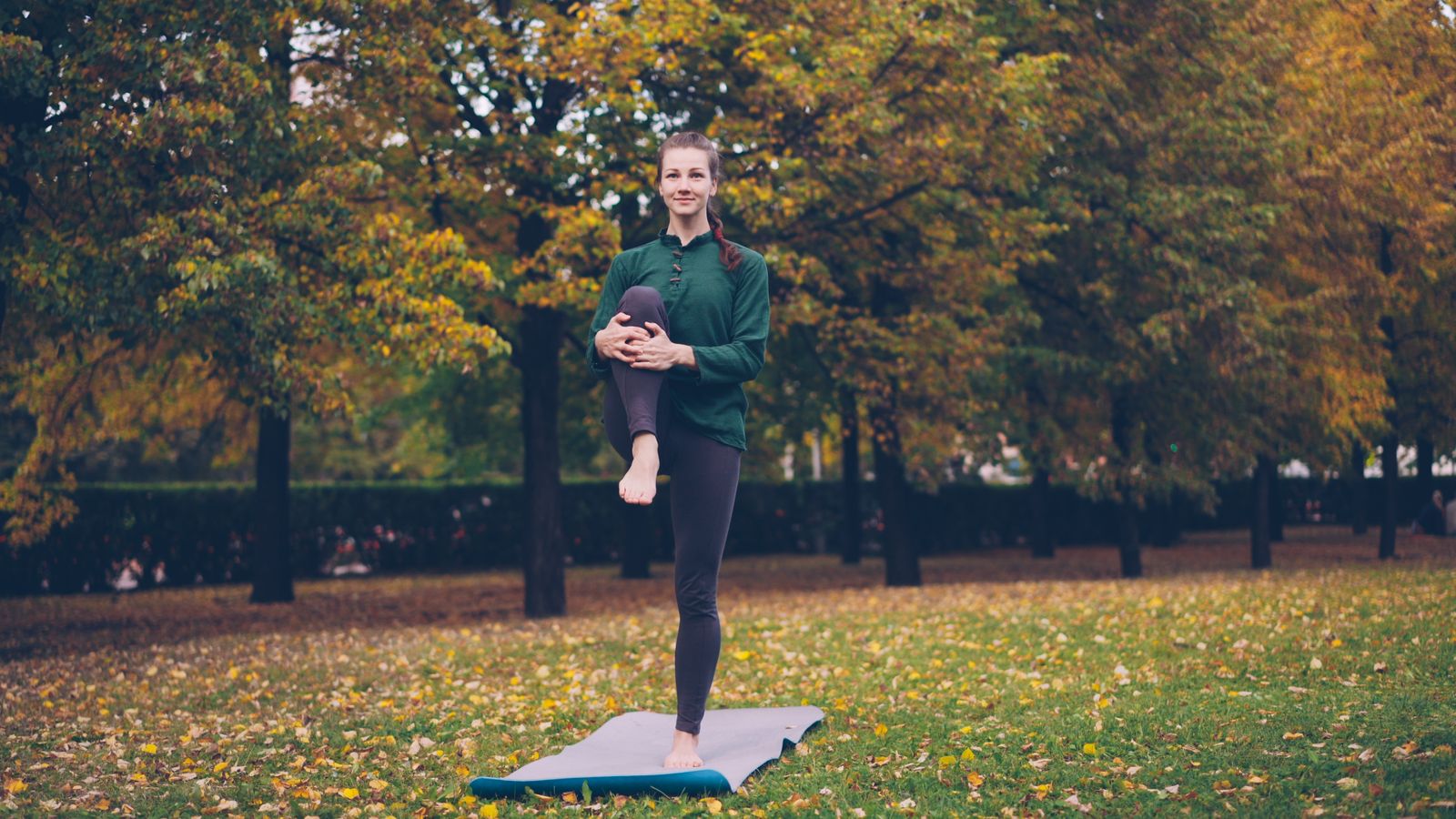
Garudasana sits at the more complex end of standing balances because it layers two separate balance challenges — a wrapped standing leg and a wrapped upper body — on top of each other. By contrast, vrksasana (Tree Pose) asks only the legs to find a one-legged shape while the arms stay free, making it a gentler entry point into single-leg balance. Tadasana (Mountain Pose), meanwhile, is a two-footed foundational posture that teaches even weight distribution and postural alignment without any balance challenge at all, which is why it’s often the first pose taught in any beginner class. Working through this progression — tadasana, then vrksasana, then garudasana — is a common and sensible way to build toward more demanding balances over several weeks of practice.
When Should You Practice Eagle Pose in a Sequence?
Garudasana is typically placed in the standing portion of a class, after the body has warmed up through sun salutations but before deep backbends or seated forward folds. Many teachers introduce it toward the middle of a surya namaskar-based flow, once the joints are lubricated and the mind has settled into the rhythm of breath and movement. Practicing it cold, without any warm-up, makes the ankle and hip mobility it requires much harder to access, so a few rounds of sun salutations or gentle hip openers beforehand noticeably improve the quality of the wrap.
Are There Variations of Garudasana?
Yes. A seated variation keeps only the “eagle arms” shape while sitting cross-legged, which is useful for people working on shoulder mobility without the added balance challenge. A supported variation uses a wall or chair back for the standing hand, reducing the demand on the standing leg while the practitioner learns the arm wrap. More advanced practitioners sometimes fold forward from the full eagle shape, bringing the crossed elbows toward the crossed knee to deepen the stretch through the upper back and outer hip simultaneously. Each variation preserves the core wrapping action while adjusting the balance and flexibility demand, which is part of why the pose remains accessible across a wide range of experience levels within a broader study of types of yoga.
What Should You Avoid or Modify With Garudasana?
People with recent knee, ankle, or shoulder injuries should approach garudasana cautiously or skip it during acute flare-ups, since the pose loads both joints under a twisted, weight-bearing position. Those with low blood pressure or balance disorders may want to practice near a wall for support. Pregnant practitioners are often advised to widen the stance and avoid the deep leg cross in later trimesters, relying instead on gentler standing postures. As with any posture that places unusual torque on the joints, easing in gradually and backing off if you feel sharp pain (as opposed to a normal stretching sensation) is the safest approach. If you have a specific health condition, checking with a qualified online yoga classes instructor before attempting the full expression is a sensible precaution.
What Do Garudasana Yoga Images Typically Show?
When people search for garudasana yoga images, they’re usually looking for a visual reference to check their own alignment: the crossed standing leg, the wrapped arms at shoulder height, and an upright, lengthened spine. Good reference images typically show the practitioner’s hips squared toward the front of the mat rather than twisted to one side, shoulders relaxed away from the ears, and a steady, forward-fixed gaze. Comparing your own pose to a handful of images from different bodies and flexibility levels is more useful than fixating on a single “perfect” photo, since the ideal depth of the wrap varies with each person’s hip and shoulder mobility.
How Does Garudasana Support Mental Focus and Stress Relief?
Balance postures like garudasana demand a kind of attention that’s hard to fake — if the mind wanders, the body wobbles almost immediately. That instant feedback loop is part of why the pose is often described as a moving meditation: it pulls scattered attention back into the present moment through physical necessity rather than willpower alone. Combined with steady nasal breathing, this focus-under-pressure practice can carry over into how practitioners handle stress off the mat, a theme explored more broadly in guides to yoga for stress relief and yoga for mental health.
Questions People Ask About Garudasana
Is Garudasana an easy or hard pose?
Garudasana is considered a moderate-difficulty pose. It’s not a beginner-day-one posture, but it doesn’t require the strength of an arm balance either. Most practitioners with a few weeks of consistent practice, particularly in balances like vrksasana, can find a reasonable version of the pose, even if the full leg-and-arm wrap takes longer to access comfortably.
How long should you hold Eagle Pose?
A typical hold is five to eight breaths per side, roughly 20 to 30 seconds. Holding longer than that usually isn’t more beneficial and can simply fatigue the standing leg; it’s more useful to repeat the pose on both sides with good form than to strain for a long single hold.
Why is it called Eagle Pose?
It’s named after Garuda, the mythical king of birds in Hindu tradition and the vehicle of the god Vishnu. The crossed-arm shape near the face is often said to resemble a bird’s folded wings or beak, and the pose’s demand for sharp focus echoes the keen-eyed, swift qualities attributed to Garuda in mythology.
Can garudasana help with knee pain?
Garudasana can strengthen the muscles that stabilize the knee when practiced with careful alignment, but it also places the knee in a rotated, weight-bearing position that isn’t appropriate for everyone. Anyone with existing knee pain or injury should modify the pose (keeping the lifted foot’s toes on the floor) or consult a teacher before attempting the full expression.
What’s the difference between garudasana and vrksasana?
Vrksasana (Tree Pose) balances on one leg with the other foot placed on the standing leg or inner thigh, arms typically raised overhead or at the heart. Garudasana adds a second layer of complexity by wrapping both the legs and the arms simultaneously, making it a more advanced balance that builds on the stability tree pose develops.
Do you need to be flexible to do Eagle Pose?
Some hip and shoulder mobility helps, but flexibility isn’t a strict prerequisite. Modifications like keeping the lifted toes on the floor or touching the backs of the hands instead of the palms let practitioners with limited flexibility still get the balance and strengthening benefits while mobility improves gradually over time.
Try This for Yourself
Reading about garudasana is useful, but the balance, the wrap, and the focus it builds only really click once you feel them in your own body. If you’d like personalized guidance on alignment, modifications, and how to fit this pose into a broader practice, join a live class with FitStrot’s online yoga classes and work with an instructor who can adjust the pose to your body in real time.
Related reading: yoga poses, surya namaskar, tadasana, vrksasana, and online yoga classes.