Couple yoga poses are two-person postures where partners use each other’s weight, balance, and breath to move deeper into a stretch than either could reach alone. They range from simple seated back-to-back breathing exercises for total beginners to advanced acro-yoga lifts that require real trust and core strength. The best couple yoga poses to start with are Seated Cat-Cow, Double Downward Dog, Partner Forward Fold, and Twin Trees, because they build communication and confidence before you attempt anything that involves lifting or balancing on top of your partner.
What Exactly Is Couple Yoga?
Couple yoga, often called partner yoga, is a style of practice where two people move through poses together instead of on separate mats. Instead of relying only on your own muscles and balance, you borrow support from your partner’s body weight, resistance, and counterbalance. It draws on the same foundations as traditional solo yoga poses but adapts them so both people are actively engaged in holding, pressing, or leaning into the shape. Some couple sequences are gentle and restorative, similar to what you’d find in a yin yoga class, while others are dynamic and strength-based, closer to a vinyasa yoga flow. What unites all couple yoga poses is that they cannot be done correctly without cooperation, so verbal check-ins and shared breathing become part of the pose itself.
Why Do Couples Practice Yoga Together?
Most couples come to partner yoga for connection first and fitness second. Physically touching another body while stretching forces you to slow your breath and match someone else’s pace, which is a very different experience from a solo flexibility routine. Because you have to communicate clearly about pressure, comfort, and readiness, couple yoga is frequently recommended alongside other stress-relief practices for partners who want to reconnect after busy or disconnected weeks. It also builds a light form of physical trust: knowing your partner will hold steady while you lean back, or that they’ll tell you honestly if a stretch is too much. None of this replaces couples counseling or medical care, but many practitioners describe it as a low-pressure way to spend focused, screen-free time with a partner while also getting a workout.
Easy Couple Yoga Poses for Beginners
If you’re new to practicing together, start with poses that require balance and trust but very little strength or flexibility. These build confidence before you try anything more demanding.
Seated Back-to-Back Breathing
Sit cross-legged with your backs pressed together, spines long. Close your eyes and simply feel your partner’s breath moving through their back. This isn’t really a “pose” in the traditional sense, but it’s the foundation every partner sequence should open with, similar to how a solo practice might begin with a few rounds of pranayama breathing.
Seated Cat-Cow
Sitting cross-legged and facing each other, hold hands or forearms. As one partner arches the spine and lifts the chest (cow), the other rounds the spine and tucks the chin (cat), then switch. This mirrors the solo Cat-Cow pose but adds a playful call-and-response rhythm that helps new partners find a shared tempo.
Partner Forward Fold
Sit facing each other with legs extended and the soles of your feet touching (or legs straddled wider if flexibility allows). Hold hands or wrists and take turns gently leaning back while the other folds forward over their own legs. This is a two-person variation on Seated Forward Bend and is one of the most requested easy couple yoga poses because it needs almost no prior experience.
Intermediate Couple Yoga Poses to Build Strength Together
Once you’re comfortable communicating and matching breath, you can move into poses that ask more of your legs, core, and balance.
Double Downward Dog
One partner comes into a standard Downward-Facing Dog. The second partner places their hands on the ground in front of the first person’s hands, then walks their feet up onto the first partner’s lower back or sacrum, forming a second downward dog on top. This builds shoulder and core stability for both people and is a favorite in “couples yoga classes near me” searches because instructors love demonstrating it live.
Twin Trees
Stand side by side, inside arms wrapped around each other’s waists or shoulders for support. Each partner lifts the outside foot into a Tree Pose shape, using the other’s steadiness to hold balance longer than they could solo. It’s a gentle introduction to shared balance work.
Partner Boat Pose
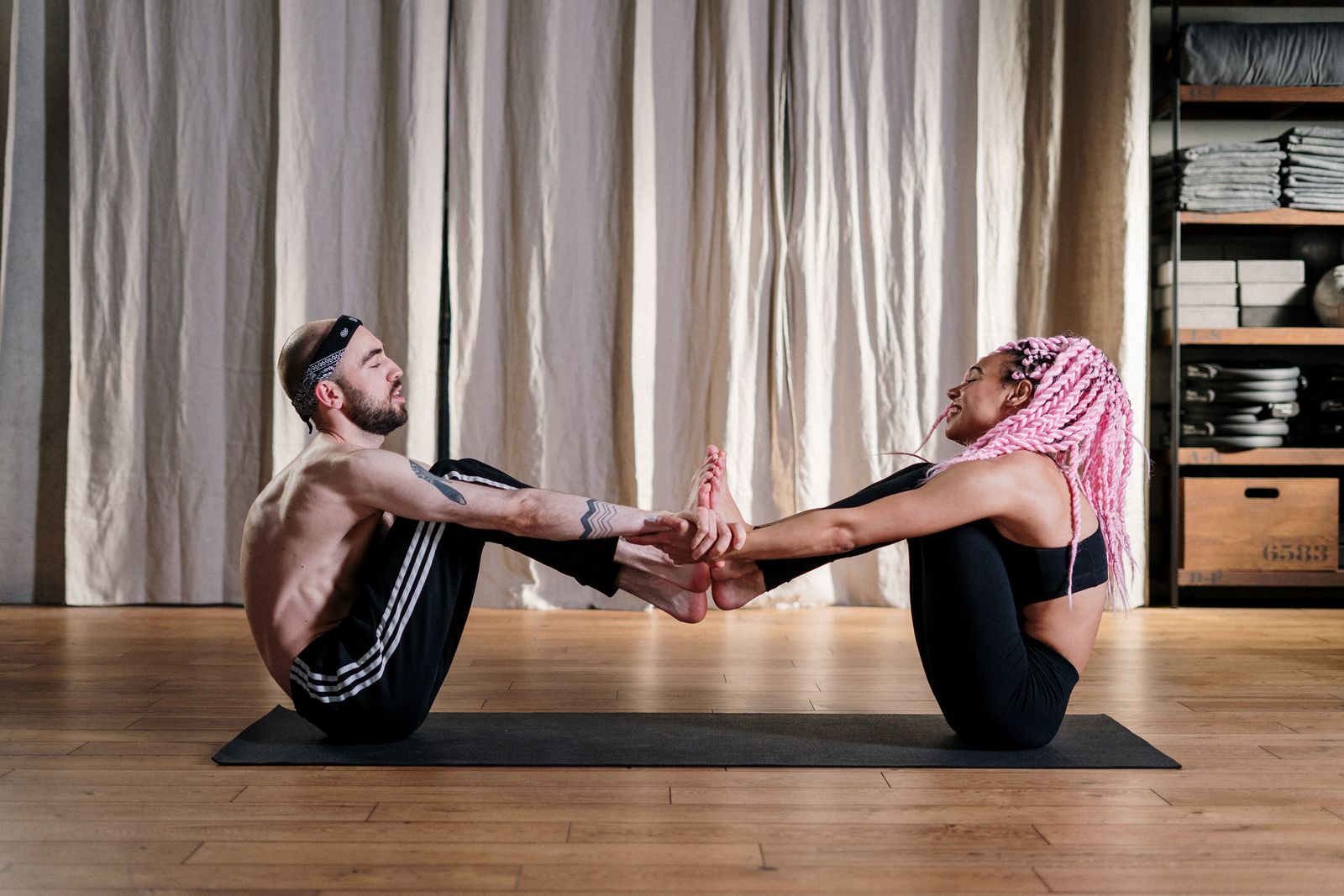
Sit facing each other, knees bent, holding hands or forearms. Lift your feet so the soles touch your partner’s soles, then slowly straighten your legs into a V shape, balancing on your sit bones. This is a two-person version of Boat Pose and is one of the best couple yoga exercises for building core strength because both partners have to engage their abs simultaneously to keep the shape stable.
Double Plank
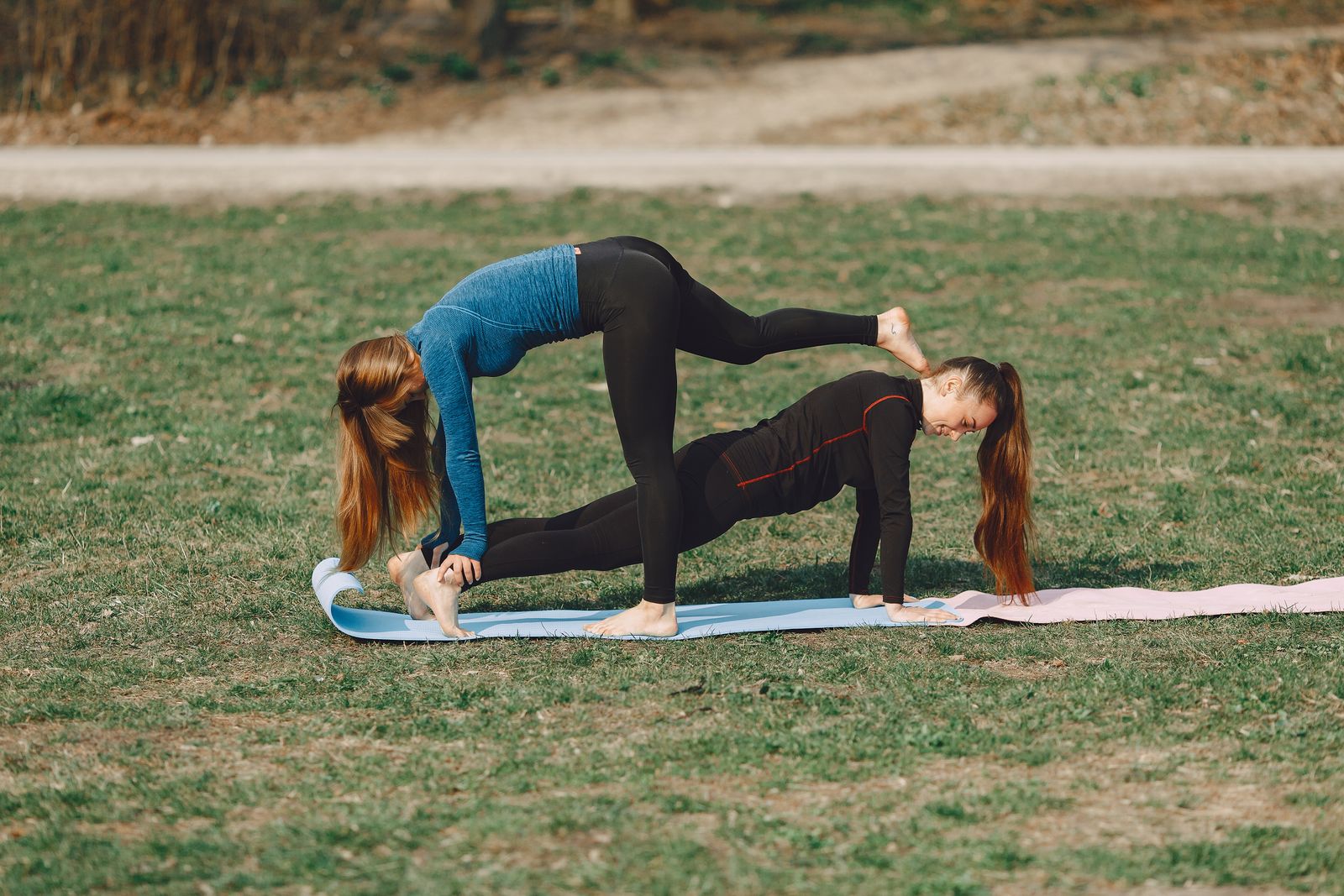
One partner holds a standard Plank Pose. The second partner places their feet on the first partner’s shoulder blades (or upper back, never the lower spine) and holds their own plank on top. This demands real core and shoulder endurance from the base partner and is best attempted only once Double Downward Dog feels stable.
Advanced Couples Yoga Poses for Experienced Practitioners
Advanced couples yoga poses usually involve one partner leaving the ground entirely, which is why they overlap heavily with acro-yoga. These should only be attempted after mastering the beginner and intermediate poses above, ideally with a qualified instructor present for the first few tries.
Bird (Flying Partner Pose)
The “base” partner lies on their back, knees bent to the chest, feet planted on the “flyer’s” hip crease. The base holds the flyer’s hands while the flyer leans forward and is lifted into the air as the base extends their legs. This is one of the most photographed advanced couples yoga poses because of how dramatic it looks, but it requires the base to have strong hip flexors and the flyer to trust the base completely.
Throne Pose
The base sits in a supported squat while the flyer sits on the base’s thighs, leaning back to rest their head near the base’s shoulder, arms extended overhead. It requires strong communication about weight distribution and is generally attempted only after a few sessions of easier lifts.
Standing Backbend Assist
One partner supports the other’s lower back with braced arms while the front partner leans into a deep backbend, similar to a supported Wheel Pose. This should be approached slowly and only by practitioners who already have solo backbend experience, since the supporting partner needs to read subtle shifts in weight to keep their partner safe.
What Are Intimate Couples Yoga Poses?
“Intimate couples yoga poses” is a common search phrase, and it generally refers to slower, closer-contact poses rather than anything explicitly sexual. Think seated heart-openers where you sit chest to chest with arms wrapped around each other, synchronized breathing holds, or a slow assisted backbend where one partner cradles the other. The intimacy comes from eye contact, matched breathing, and physical closeness rather than difficulty. If this is your goal, keep the pace slow, dim the lights, and treat the practice more like a moving meditation than a workout — many couples pair these poses with the same calming approach used in restorative yoga sessions.
What Is Tantric Couples Yoga?
Tantric couples yoga draws on tantra, a broad philosophical and spiritual tradition from India that is commonly cited as predating and influencing many later yoga schools. In the wellness-studio context most people encounter today, “tantric yoga” for couples typically means slow, breath-synchronized poses paired with extended eye contact and mindful touch, aimed at deepening emotional and energetic connection between partners. It is not the same as classical tantra as a broader philosophical system, and studios vary widely in how they interpret and teach it, so it’s worth asking an instructor directly what a specific “tantric couples yoga” class will actually involve before booking one.
Is Hot Couples Yoga Different From Regular Couple Yoga?
Hot couples yoga simply takes the same partner poses described above and performs them in a heated room, usually somewhere between 90 and 105°F, similar to a standard hot yoga class. The heat increases sweating and can make muscles feel more pliable, but it also raises the risk of dehydration and overexertion, so pacing and water breaks matter even more than in a room-temperature class. Because two bodies are already generating heat through contact and shared effort, hot couples yoga tends to feel more intense than solo hot yoga at the same temperature, so beginners are usually advised to try a handful of easy couple yoga poses at normal temperature first before adding heat into the mix.
How Do You Practice Couple Yoga Safely?
Safety in partner yoga comes down to constant, honest communication. Keep these precautions in mind every time you practice together:
- Agree on a stop cue. Before attempting any lift or deep stretch, agree on a simple verbal cue like “down” or “release” that means stop immediately, no questions asked.
- Warm up separately first. Do a few basic Sun Salutations or gentle stretches so muscles aren’t cold when you start bearing each other’s weight.
- Avoid sensitive contact points. Never place feet or hands directly on a partner’s spine, neck, or joints; use the shoulder blades, hip bones, thighs, or upper back instead.
- Know when to modify. If either partner has a back injury, pregnancy, high blood pressure, or a recent surgery, skip inverted or weight-bearing poses, stick to seated, breath-based poses instead, and check with a doctor before attempting anything strength-intensive.
What Muscles and Systems Benefit From Partner Yoga?
Because couple yoga poses ask you to stabilize against another moving body, they tend to recruit stabilizer muscles — the smaller muscles around your hips, shoulders, and core — more than solo poses do. Poses like Double Plank and Partner Boat Pose build isometric core strength, while lifts like Bird Pose demand hip flexor and shoulder strength from the base partner. On the flexibility side, assisted forward folds and backbends let you go further into a stretch than you could alone, because your partner’s weight or resistance provides extra leverage — much like the assisted stretches used in yoga for back pain routines, but applied through a human partner instead of a strap or bolster.
Can You Find Couples Yoga Classes Near You, or Practice Online?
“Couples yoga classes near me” is one of the most common ways people search for this practice, and most mid-sized cities now have at least one studio offering a monthly or seasonal partner yoga workshop. If there’s nothing local, or your schedules don’t line up with in-person class times, online yoga classes are a practical alternative — you can follow a guided partner sequence together from your living room on your own schedule, which also removes any self-consciousness about trying wobbly balance poses in front of strangers.
How Should You Build a Simple Couple Yoga Routine at Home?
A basic home routine doesn’t need much space or any equipment beyond a mat or two. Follow this simple sequence:
- Start with five minutes of seated back-to-back breathing to sync up.
- Move into Seated Cat-Cow and Partner Forward Fold to warm up the spine.
- Add Twin Trees for balance, then Partner Boat Pose for core work.
- If both partners feel steady, close with a supported stretch like the Standing Backbend Assist or a simple seated heart-opener.
- Finish lying down together in a modified Savasana, hands touching, for a few minutes of shared stillness.
This kind of structure — warm-up, standing work, floor work, cool-down — mirrors how most beginner yoga sequences are built, just adapted for two people instead of one.
Questions People Ask About Couple Yoga Poses
Do you need to be flexible to try couple yoga poses?
No. Most beginner couple yoga poses, like Seated Cat-Cow or Partner Forward Fold, are designed around balance and cooperation rather than deep flexibility. You can modify almost every pose by bending your knees more, using a smaller range of motion, or skipping any lift-based pose entirely until you and your partner build strength together.
What if my partner and I have very different flexibility levels?
This is extremely common and not a problem. Choose poses where the more flexible partner takes the deeper stretch while the less flexible partner acts as the stable anchor. Seated Cat-Cow, Twin Trees, and Partner Forward Fold all work well even with a noticeable difference in flexibility between partners.
Is couple yoga safe during pregnancy?
Some gentle, seated poses can be safe, but any pose involving lying on the back for extended periods, deep twists, inversions, or weight-bearing lifts should generally be avoided. Always check with a doctor or a prenatal-certified instructor before practicing partner yoga during pregnancy, and prioritize simple breathing-based poses over anything involving balance or lifting.
How long should a couples yoga session last?
A typical home session runs 20 to 40 minutes, which is enough time to warm up, work through four or five poses, and cool down properly. Studio classes are usually scheduled for 60 minutes to allow time for instruction and partner switching if it’s a group workshop.
Can beginners try acro-yoga style lifts right away?
It’s best to build up to lifts like Bird Pose or Throne Pose gradually. Spend a few sessions mastering grounded poses like Double Downward Dog and Partner Boat Pose first, since these teach the communication and core stability that make lifts safer once you’re ready to try them, ideally with an instructor nearby the first few times.
Try This for Yourself
Reading about couple yoga poses is a good start, but the connection really comes through when you move through a guided sequence together. FitStrot’s online yoga classes include partner-friendly sessions led by certified instructors, so you and your partner can practice safely from home on a schedule that actually fits your week.
Related reading: Yoga Poses, Yoga Asanas, Yoga Poses Names, Benefits of Yoga, and FitStrot’s online yoga classes.