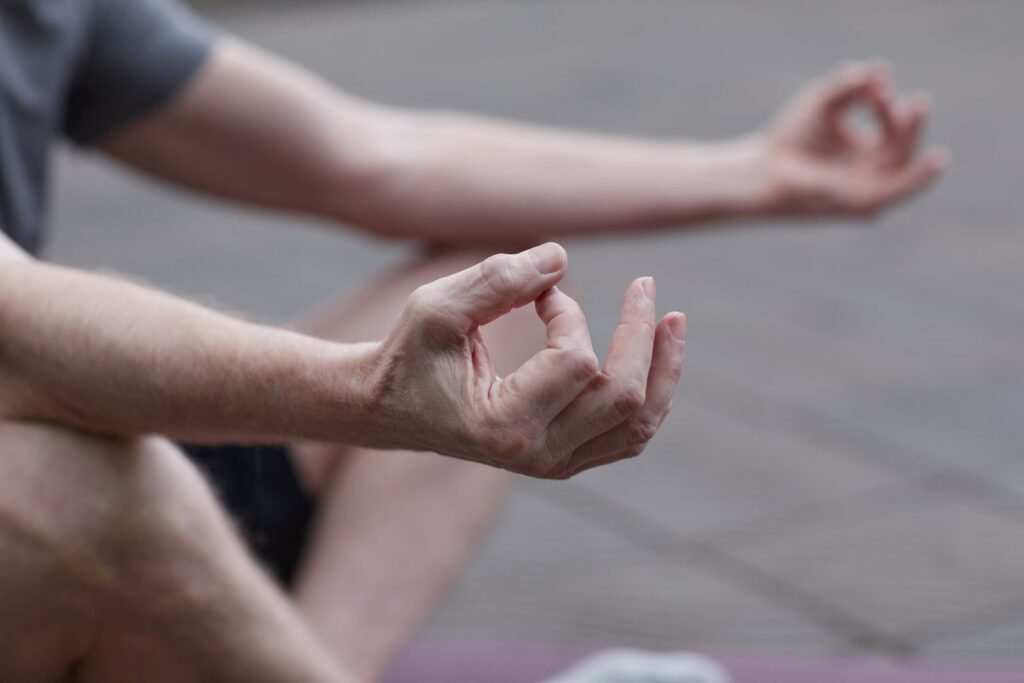
Chitta vritti refers to the fluctuations, ripples, or modifications of the mind — the constant stream of thoughts, perceptions, memories, and mental patterns that arise and pass through consciousness. The term comes directly from Patanjali’s Yoga Sutras, where the definition of yoga is given in Sutra 1.2 as “yogaś-citta-vṛtti-nirodhaḥ,” commonly translated as “yoga is the stilling of the fluctuations of the mind.” Here, chitta is the mind-field as a whole, vritti means a wave or modification, and nirodha means restraint or cessation. Understanding chitta vritti is foundational to understanding what yoga actually claims to do — not just stretch the body, but quiet the mental turbulence that clouds clear perception.
What Does “Yoga Chitta Vritti Nirodha” Actually Mean?
“Yogas chitta vritti nirodhah” is the second sutra of Patanjali’s Yoga Sutras, and many teachers consider it the single most important line in the text because it functions as yoga’s working definition. Broken into its Sanskrit parts, “yogah” means yoga, “chitta” means the mind-stuff, “vritti” means a fluctuation or wave, and “nirodha” means restraint or stilling. Put together, the sutra states that yoga itself — not a pose, not a breathing technique — is the state that arises when the fluctuations of the mind are stilled. This reframes yoga away from being purely a physical discipline and positions it as a technology for mental clarity, with asana and pranayama serving as tools that support this aim rather than being the goal itself.
Yoga Chitta Vritti Nirodha in Hindi and Sanskrit: What the Words Mean
In Devanagari, the sutra is written as योगश्चित्तवृत्तिनिरोधः (yogaścittavṛttinirodhaḥ), and in Hindi explanations it is often broken down word by word: “yog” (योग) meaning union or the practice of yoga, “chitta” (चित्त) referring to the mind or consciousness as a whole, “vritti” (वृत्ति) meaning movement or wave-like fluctuation, and “nirodha” (निरोध) meaning restraint or control. Hindi commentaries typically emphasize that “nirodha” does not imply forceful suppression, but rather a natural quieting that comes from sustained, patient practice — much like sediment settling in still water rather than being forced down. This is one of the most searched Sanskrit phrases among yoga students precisely because it opens nearly every serious study of the Yoga Sutras.
Where Does Chitta Vritti Nirodha Fit in the Structure of the Yoga Sutras?
Patanjali’s Yoga Sutras are organized into four chapters, or padas: the Samadhi Pada (on absorption), the Sadhana Pada (on practice), the Vibhuti Pada (on powers), and the Kaivalya Pada (on liberation). The definition of yoga as chitta vritti nirodha appears in the very first chapter, immediately after Patanjali states his intention to teach yoga (Sutra 1.1: “atha yoga anushasanam”). This placement is deliberate — before describing any technique or posture, the text first defines the destination. Everything that follows can be read as a detailed map of how to arrive at this single state, including the eight limbs of yoga (Ashtanga).
What Are the Five Vrittis (Mental Fluctuations) in Yoga?
Sutra 1.6 names the five categories of vrittis in yoga that Patanjali identifies as making up the mind’s constant activity. Crucially, Patanjali groups all five together as vrittis regardless of whether they feel pleasant or unpleasant (Sutra 1.5 notes vrittis can be either “klishta,” afflicted, or “aklishta,” non-afflicted) — even a “correct” or accurate thought is still classified as a fluctuation of the mind that yoga practice aims to eventually quiet. This is a subtle but important distinction: the goal is not simply to stop negative thoughts, but to reach a state of stillness beneath all mental movement, positive or negative.
| Vritti (Sanskrit) | Meaning | What It Looks Like |
|---|---|---|
| Pramana | Correct perception, valid knowledge | Accurate cognition via direct perception, inference, or trustworthy testimony |
| Viparyaya | Misperception, incorrect knowledge | A false cognition that does not match reality |
| Vikalpa | Imagination, conceptualization | Word-based thought with no corresponding real object |
| Nidra | Sleep | Dreamless sleep, treated as a distinct mental state |
| Smriti | Memory | Retention and recollection of a past experience |
Pramana: Valid, Verifiable Knowledge
Pramana refers to correct cognition — knowledge gained through direct perception, sound inference, or reliable testimony. Classical commentaries on the sutras, including Vyasa’s early commentary, break pramana down into these three sources: pratyaksha (direct sensory perception), anumana (logical inference), and agama (testimony from a trustworthy source). Even though pramana represents accurate knowledge, it is still classified as a vritti because it is a specific, arising mental modification rather than the underlying stillness of awareness itself. This distinction matters in practice: a yoga student can be entirely correct in a thought or observation and still be caught in mental fluctuation, since the aim of chitta vritti nirodha is not accuracy of thought but cessation of the thought-wave pattern itself.
Viparyaya: Misperception and Incorrect Knowledge
Viparyaya is misperception or false knowledge — a cognition that does not correspond to the actual nature of its object, such as mistaking a rope for a snake in dim light, a classical example used across Indian philosophy. In modern terms, viparyaya shows up as assumptions, misunderstandings, and cognitive distortions that feel certain in the moment but do not match reality. Patanjali’s framework treats viparyaya as closely connected to avidya, one of the five kleshas or root causes of suffering, since both involve a fundamental gap between perception and truth. Practicing sustained attention, whether through seated meditation or the focused concentration developed in hatha yoga, is traditionally recommended as a way to narrow this gap between what is perceived and what is actually so.
Vikalpa: Imagination and Conceptual Thought
Vikalpa is a fluctuation built from words and concepts alone, without a corresponding real object — Patanjali’s classical example is the phrase “consciousness of Purusha,” a concept that can be discussed and understood verbally even though it does not refer to a graspable object in the way a chair or a tree does. More broadly, vikalpa covers imagination, hypothetical thinking, daydreaming, and conceptual elaboration — the mind constructing entire scenarios purely through language and association. Because so much of modern mental activity is verbal and conceptual rather than directly perceptual, many teachers consider vikalpa one of the most active and disruptive vrittis in an environment saturated with text, notifications, and constant verbal stimulation.
Nidra: Sleep as a Mental Fluctuation
Nidra, or sleep, might seem like an unusual inclusion in a list of “mental fluctuations,” since sleep is often thought of as the absence of mental activity. Patanjali’s inclusion of nidra as a vritti reflects a specific point: dreamless sleep is still a distinct, identifiable mental state (we can recall having slept deeply and recognize the difference from being awake), which means it is a modification of chitta rather than a true stilling of it. This is a key distinction between ordinary sleep and the stillness aimed for in deep meditation or yoga nidra — despite its name, yoga nidra is a conscious, aware relaxation practice rather than unconscious sleep.
Smriti: Memory and the Retention of Past Experience
Smriti is memory — the retention and recollection of a previously experienced object or event without loss of its essential form. Patanjali treats memory as an active vritti rather than a neutral background function, because remembering involves the mind actively re-presenting past experience, which can pull attention away from what is happening in the present moment. This connects directly to how many meditation and mindfulness techniques work: by repeatedly noticing when attention has drifted into memory (or anticipation, a related activity) and gently returning to present sensation, a practitioner directly trains the capacity described in the sutras as nirodha, or restraint of vritti.

How Do You Actually Practice Chitta Vritti Nirodha? A Step-by-Step Guide
Patanjali’s text does not describe stilling the mind as an instant event but as a gradual, practiced skill, and several sutras following 1.2 outline supportive methods.
- Establish a steady, comfortable seated posture. Sutra 2.46 describes asana as “sthira sukham,” steady and easeful, since physical restlessness makes mental stillness far harder to access.
- Lengthen and steady the breath. Breath and mental state are described throughout yogic tradition as deeply linked — this is the basis of most pranayama practice.
- Choose a single point of focus — the breath, a mantra, or a fixed gazing point (trataka) — since Sutra 1.32 recommends concentrating on a single object to counteract mental scattering.
- Notice each vritti without following or resisting it. When a thought, memory, or flicker of imagination arises, simply notice it, then gently return attention to the chosen focus point.
Repeated over time, this practice is described as thinning out the frequency and intensity of vrittis, similar to how beginning meditators often notice fewer intrusive thoughts after weeks of consistent practice.
What Is the Relationship Between Chitta Vritti and the Kleshas?
Chitta vritti and the kleshas (the five root afflictions: avidya, asmita, raga, dvesha, and abhinivesha) describe two related but distinct layers of Patanjali’s psychological model. Chitta vritti describes the raw mechanics of mental movement — the fact that thoughts, memories, and perceptions constantly arise. The kleshas describe why so many of these fluctuations generate suffering rather than simply arising and dissolving neutrally; they are the afflictive coloring applied to otherwise ordinary mental activity. Sutra 1.5 itself distinguishes between “klishta” (afflicted) and “aklishta” (non-afflicted) vrittis, directly linking the two concepts. In practical terms, working with chitta vritti nirodha through steady practice and working with the kleshas through self-observation are often described as complementary paths toward the same underlying goal of a clearer, less reactive mind.
What Is the Difference Between Vrittis and the Gunas?
Vrittis and the three gunas (sattva, rajas, and tamas) operate at different levels of Patanjali’s framework and are sometimes confused because both describe qualities of mental experience. The gunas are the three fundamental qualities of nature (prakriti) itself — sattva representing clarity and balance, rajas representing activity and agitation, and tamas representing inertia and dullness — and they color the general “texture” of the mind at any given time. Vrittis, by contrast, are the specific, individual fluctuations that arise within whatever guna-based texture is currently dominant. A mind dominated by rajas tends to produce more frequent, scattered vrittis, while a mind leaning toward sattva tends to produce fewer, calmer ones — the gunas shape the general climate, while vrittis are the individual weather events within it.
How Does Chitta Vritti Nirodha Lead Toward Samadhi?
Patanjali’s Yoga Sutras describe a progressive path in which the stilling of chitta vritti is not the final goal in itself, but the gateway to samadhi, the eighth and final limb of Ashtanga yoga. As vrittis are progressively stilled through sustained practice (abhyasa) combined with non-attachment (vairagya, described in Sutra 1.12 as the twin pillars of practice), the mind is described as becoming increasingly capable of resting in its own true nature rather than being carried along by constant mental activity. In deeper states of absorption, the distinction between the observer, the act of observing, and the object observed is described as progressively dissolving, until what remains is a state of stable, clear awareness undisturbed by fluctuation. This is why chitta vritti nirodha functions as both the opening definition of yoga and the thread connecting every subsequent teaching, including concepts explored in the Bhagavad Gita’s teachings on yoga, which similarly emphasize steadiness of mind as the marker of a settled practitioner.
Common Misunderstandings About Chitta Vritti Nirodha
A frequent misreading of “nirodha” is to interpret it as forceful suppression — gritting one’s teeth and refusing to think. Classical commentary generally rejects this reading; nirodha is more accurately a natural settling that occurs when the causes of mental agitation (poor posture, restless breath, unexamined craving and aversion) are addressed at their root, rather than a battle against thought itself. A second misunderstanding treats “stilling the mind” as zero mental activity forever, when the sutras describe nirodha as cultivated gradually, with vrittis becoming progressively thinner rather than instantly and permanently absent. A third misunderstanding conflates chitta vritti nirodha with simply “not thinking,” when the sutras’ own five-part classification shows that even accurate, useful thoughts (pramana) are still fluctuations — the aim is stillness beneath thought’s content, not a judgment about which thoughts are good or bad.
How Can Beginners Start Working With Chitta Vritti Today?
Beginners do not need to master Sanskrit terminology to start engaging with this concept practically. A simple starting point is a daily five- to ten-minute seated practice: sit comfortably, breathe steadily, and notice when the mind has wandered into memory, imagination, or planning, then gently return attention to the breath — this single repeated action is a direct, practical application of nirodha. Journaling briefly afterward, naming whether the mind was mostly caught in memory (smriti), imagined scenarios (vikalpa), or misperception (viparyaya), turns an abstract list into a concrete self-observation tool. Pairing this seated practice with movement, such as a grounding restorative yoga session or a more dynamic vinyasa yoga class, is often recommended because physical steadiness tends to support mental steadiness. Many students also find yoga for anxiety and yoga for stress relief practices an accessible, body-first entry point into the same territory the Yoga Sutras describe philosophically.
Why Chitta Vritti Nirodha Matters Beyond the Yoga Mat
The concept of stilling mental fluctuation has implications that extend well past formal meditation sessions. Recognizing that a stressful reaction is “just a vritti” — a temporary mental wave rather than a permanent fact about reality — can create a small but meaningful gap between stimulus and response in everyday situations: a tense email, a difficult conversation, an anxious thought at 3 a.m. This reframing does not eliminate difficult circumstances, but it changes one’s relationship to the mental noise they generate. Many contemporary teachers connect this ancient framework to modern conversations about mental health and emotional regulation, while noting that yoga philosophy is a complementary practice for building self-awareness, not a replacement for professional care when it’s needed.
Questions People Ask About Chitta Vritti
What does chitta vritti nirodha mean in simple terms?
Chitta vritti nirodha means “the stilling of the fluctuations of the mind.” Chitta is the mind as a whole, vritti refers to the thoughts, memories, and perceptions that constantly arise within it, and nirodha means restraint or quieting. Patanjali’s Yoga Sutras use this phrase as the direct definition of yoga itself in Sutra 1.2, framing yoga primarily as a mental discipline rather than only a physical one.
What are the five vrittis in yoga?
The five vrittis named in Yoga Sutra 1.6 are pramana (correct, verifiable knowledge), viparyaya (misperception or incorrect knowledge), vikalpa (imagination or concepts based on words without a real object), nidra (sleep, treated as a distinct mental state), and smriti (memory). Patanjali groups all mental activity into these five categories, regardless of whether the content feels pleasant, unpleasant, or neutral.
Is chitta vritti nirodha the same as emptying the mind?
Not exactly. Nirodha is generally understood as a natural settling of mental activity that comes from sustained practice, rather than forcing the mind to go blank. Classical commentary treats it as a gradual thinning of fluctuation, cultivated by addressing its root causes such as restlessness and unexamined craving, rather than an instant or forced emptiness.
Where in the Yoga Sutras does chitta vritti nirodha appear?
It appears in Sutra 1.2, the second verse of the Samadhi Pada, immediately after Patanjali states his intention to teach yoga in Sutra 1.1. Its placement at the very beginning of the text signals that this definition — yoga as the stilling of mental fluctuation — is meant to frame everything that follows in the remaining sutras.
How is chitta vritti different from the kleshas?
Chitta vritti describes the basic mechanics of mental activity — thoughts, memories, and perceptions rising and passing. The kleshas describe the afflictive patterns (ignorance, ego, attachment, aversion, and fear) that color these fluctuations and turn them into sources of suffering. Sutra 1.5 itself distinguishes “afflicted” from “non-afflicted” vrittis, directly linking the two ideas.
Can beginners practice chitta vritti nirodha without years of study?
Yes. A simple daily practice of sitting comfortably, steadying the breath, and gently noticing and returning attention whenever the mind wanders is a direct, practical application of this concept. Consistency matters more than duration — even five to ten minutes practiced regularly is commonly recommended as a workable starting point for beginners.
Try This for Yourself
Reading about chitta vritti nirodha explains the theory, but the stilling of the mind Patanjali describes only becomes real through consistent, guided practice. If you would like structured support in building the steady posture, breath awareness, and attention training this concept calls for, consider joining a live online yoga class to begin working with your own mental fluctuations directly.
Related reading: Kleshas in Yoga, Samadhi: The Eighth Limb of Yoga, The Three Gunas in Yoga, The Bhagavad Gita and Yoga, and explore FitStrot’s online yoga classes to begin your own practice.