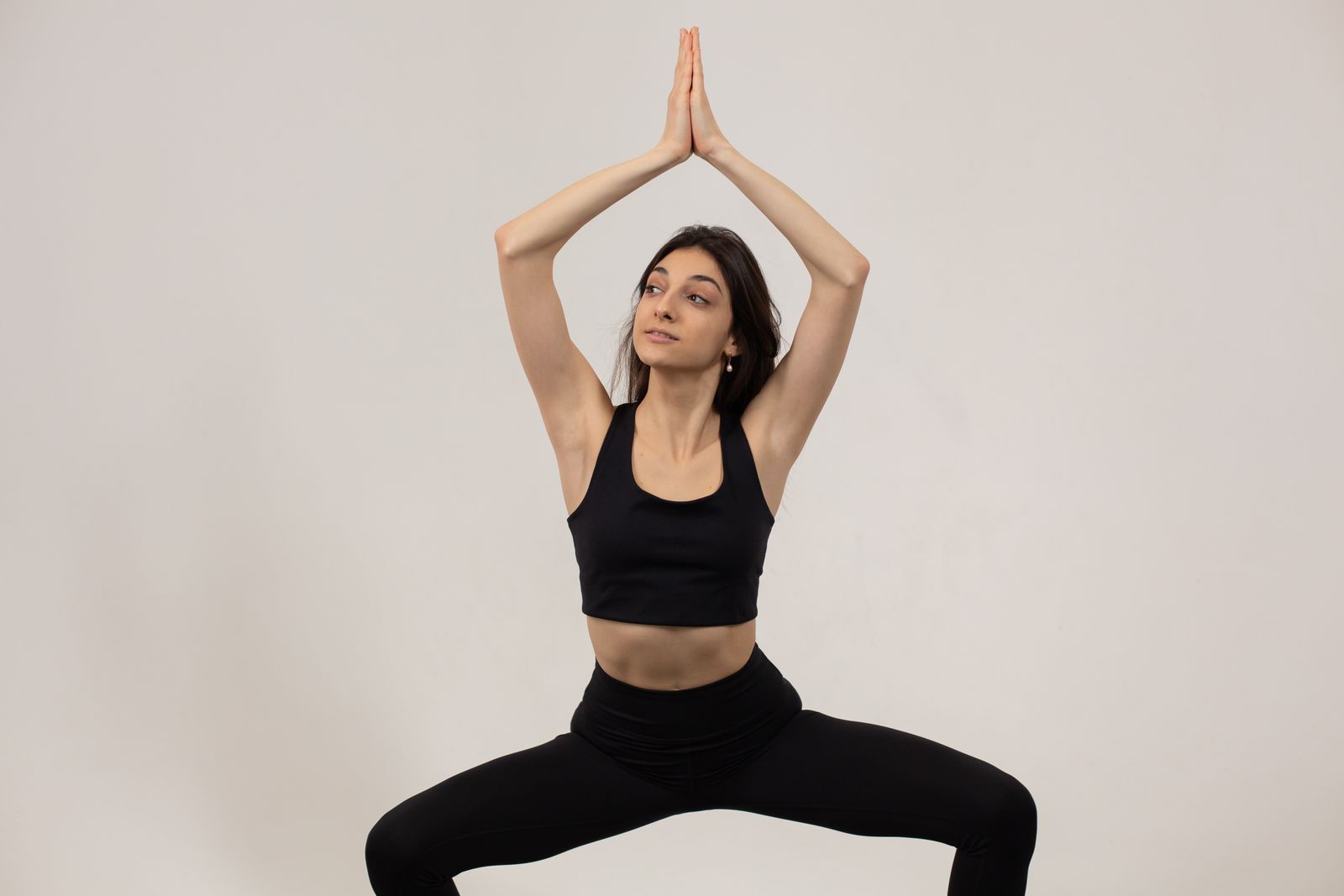
Utkatasana, commonly known as Chair Pose, is a standing yoga posture where you bend your knees as if sitting into an invisible chair while reaching both arms overhead. The name comes from the Sanskrit “utkata,” generally translated as “fierce,” “powerful,” or “intense,” which is why some teachers also call it Fierce Pose or Powerful Pose. It builds strength in the thighs, glutes, and calves, fires up the core, and challenges balance and mental focus all at once. It’s a foundational asana in most vinyasa and Surya Namaskar B sequences, and it’s simple enough for beginners to learn in a single class while still offering enough intensity to challenge advanced practitioners who hold it longer or add variations.
What Does “Utkatasana” Actually Mean?
Utkatasana comes from two Sanskrit roots: “utkata,” meaning fierce, powerful, or intense, and “asana,” meaning pose or seat. Taken together, the literal translation leans toward “fierce pose” or “powerful pose,” though most English-speaking studios default to the more literal descriptive name, Chair Pose, because the shape of the body resembles someone sitting on an invisible chair. Some lineages also refer to it as Awkward Pose, a nod to how ungainly the posture can feel the first few times you try it, with your hips low, spine long, and arms stretched skyward. Understanding the name matters because it hints at the intent behind the pose: this is not a passive stretch. It’s meant to be practiced with deliberate effort and a fierce, focused mind, not a relaxed one.
How Do You Do Utkatasana Correctly?
Start standing at the top of your mat in Tadasana (Mountain Pose) with your feet together or hip-width apart. Inhale and sweep your arms overhead, keeping them shoulder-width apart with palms facing each other or pressed together. Exhale and bend your knees, sitting your hips back and down as though lowering onto a chair, keeping your weight rooted through your heels rather than shifting onto your toes. Your torso will naturally tilt forward slightly to keep you balanced, and your thighs should move toward parallel with the floor as your practice deepens. Keep your spine long, shoulders drawing away from your ears, and gaze either forward or slightly upward toward your thumbs. Hold for five to ten breaths, then inhale to straighten your legs and exhale your arms back down to your sides.
What Muscles Does Chair Pose Strengthen?
Utkatasana is primarily a lower-body strengthening pose. The quadriceps do the majority of the work stabilizing the bent knees, while the glutes and hamstrings co-contract to control the hip hinge. The calves and ankles stabilize balance, especially if you rise onto the balls of your feet in variations. Above the waist, the core (particularly the transverse abdominis and obliques) engages to keep the torso from collapsing forward, and the shoulders, deltoids, and upper back muscles work isometrically to hold the arms overhead without shrugging. Because so many muscle groups fire simultaneously, chair pose is frequently used as a low-equipment strength-endurance exercise, similar in muscular demand to a bodyweight wall sit combined with an overhead shoulder hold.
What Are the Benefits of Chair Pose in Yoga?
Chair pose benefits go well beyond leg strength. Practiced regularly, it can help with:
- Lower body strength: Builds endurance in the quads, glutes, and calves, which supports everyday movements like climbing stairs and standing up from a seated position.
- Core stability: Demands sustained abdominal engagement, which can carry over into better posture and spinal support in daily life.
- Balance and coordination: Holding the pose with arms raised and hips low challenges your proprioception and ankle stability.
- Mental focus and heat-building: Many teachers describe utkatasana as a “heating” pose that builds internal energy (often referred to as tapas in yogic philosophy) and mental resilience through sustained discomfort.
- Shoulder and upper back mobility: Reaching the arms fully overhead while keeping the shoulders down and back can gently improve overhead shoulder flexion over time.
- Cardiovascular engagement: Because it recruits large muscle groups isometrically, holding chair pose for multiple breaths can noticeably raise heart rate, especially when repeated in a flow sequence.
These chair pose yoga benefits are one reason the posture appears so often in general fitness-focused yoga classes, not just traditional hatha or vinyasa lineages. For a broader look at how postures like this contribute to overall wellbeing, see our guide on the benefits of yoga.
Where Does Utkatasana Fit in a Yoga Sequence?
Utkatasana most commonly appears as part of Surya Namaskar B (Sun Salutation B), where it’s used at the very beginning and end of the sequence to build heat before the body moves into forward folds, lunges, and downward-facing dog. If you’re learning the full sequence, our Surya Namaskar guide breaks down each transition step by step. Outside of Sun Salutations, chair pose is a natural bridge between standing poses like Tadasana and balance postures like Vrksasana (Tree Pose), since it primes the legs and core for single-leg stability work. Many vinyasa teachers also use it as a warm-up before deeper standing poses such as Warrior II or Extended Side Angle, because it activates the same muscle chains those poses rely on.
What Are Common Mistakes in Chair Pose?
The most frequent error is letting the knees collapse inward instead of tracking them over the second and third toes, which places unwanted stress on the knee ligaments. Another common mistake is shifting weight onto the toes rather than keeping it rooted through the heels, which can throw off balance and overwork the calves. Many beginners also round the lower back to compensate for tight hips or hamstrings, so the spine loses its natural length. Shrugging the shoulders up toward the ears while reaching the arms overhead is another habitual pattern worth watching for, since it creates unnecessary tension in the neck and traps. Finally, some practitioners hold their breath while gripping through the pose; steady, even breathing through the nose helps sustain the hold longer and keeps the nervous system calmer even while the muscles work hard.
What Are Helpful Modifications for Chair Pose?
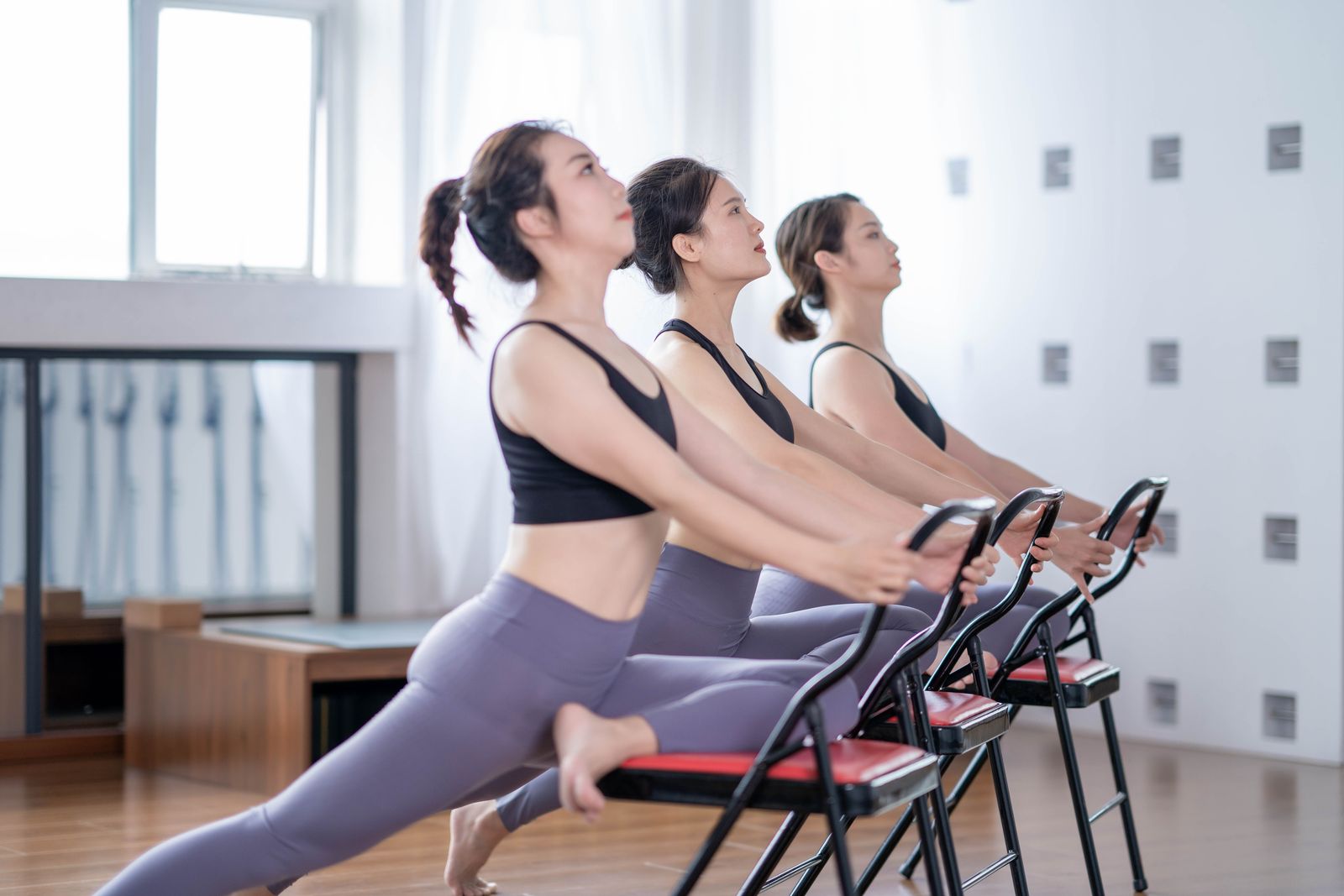
If reaching the arms fully overhead strains your shoulders, you can keep your palms pressed together at heart center instead, which reduces the load on the upper back while still allowing you to focus on the leg work. Practitioners with knee sensitivity can reduce the depth of the bend, keeping the thighs well above parallel rather than pushing toward a deep squat. A block placed between the thighs can help cue inner-thigh engagement and prevent the knees from splaying. For those working on balance, standing with the back lightly touching a wall provides feedback on posture and can help beginners feel the correct hip position before practicing it freestanding. Chair pose can also be practiced holding the back of an actual chair for support, which is a common approach in prenatal and accessible yoga classes.
Who Should Be Cautious With Chair Pose?
Chair pose places sustained load on the knees and lower back, so people with existing knee injuries, meniscus issues, or lower back conditions are generally advised to approach it carefully, reduce the depth of the bend, or skip it depending on their specific condition and their teacher’s or physiotherapist’s guidance. Pregnant practitioners are commonly advised to modify or avoid deep holds of the pose, particularly in later trimesters, since the forward-leaning torso combined with a deep knee bend can feel compromising on balance and pelvic stability; many prenatal yoga teachers suggest a shallower stance with feet wider apart and a chair or wall for support instead. Anyone with shoulder impingement or a rotator cuff issue may also want to modify the overhead arm position rather than reaching in the classic form. As with any physically demanding pose, it’s worth checking with a qualified teacher or healthcare provider if you have a pre-existing condition, rather than pushing through pain.
How Long Should You Hold Utkatasana?
For general strength and endurance building, most yoga teachers suggest holding chair pose for five to ten slow, steady breaths, which usually works out to roughly 30 to 60 seconds depending on your breathing pace. Beginners often start with shorter holds of 15 to 20 seconds and gradually build up stamina over several weeks of consistent practice. In power yoga or vinyasa-style classes, chair pose might be held for a single breath as part of a flowing sequence, while restorative or strength-focused classes sometimes ask students to hold it for a full minute or longer as a standalone strength challenge. If your goal is building muscular endurance rather than moving through a flow, gradually extending your hold time is more effective than adding extra repetitions.
What Are Common Variations of Chair Pose?
Once the basic shape feels stable, there are several variations worth exploring. Twisted Chair Pose (Parivrtta Utkatasana) adds a spinal rotation, bringing one elbow to the opposite knee, which challenges balance and adds an oblique-strengthening component. Chair Pose with a heel lift (sometimes called Utkatasana on the toes) increases the demand on the calves and ankle stabilizers. Eagle Arms Chair Pose combines the leg position of utkatasana with the arm wrap of Garudasana, adding an upper-back and shoulder stretch to the strength-building lower body work. Some teachers also cue a one-legged version, lifting one foot slightly off the floor while holding the squat, which sharply increases the balance and single-leg strength challenge. Each of these variations keeps the core benefits of the base pose while emphasizing a different secondary skill, whether that’s rotation, ankle stability, or shoulder mobility.
How Does Chair Pose Compare to a Regular Squat?
Utkatasana and a standard bodyweight squat share the same hip-and-knee-bending mechanics, but the yoga version adds an overhead arm reach and a strong emphasis on breath and spinal alignment that a gym squat typically doesn’t prioritize. A conventional squat usually goes deeper and is performed for repetitions, while chair pose is practiced as an isometric hold at a shallower depth with continuous, steady breathing, making it closer to a strength-endurance exercise. Many practitioners find that a regular practice including poses like utkatasana complements strength training rather than replacing it, since the isometric hold trains stability in ways dynamic reps don’t fully address.
How Does Utkatasana Support Mental Focus?
Because chair pose is physically demanding to hold, it naturally draws attention to the breath and away from distracting thoughts, which is part of why many teachers use it as a concentration-building tool early in a class. The sustained muscular effort combined with steady breathing creates what many yoga traditions describe as tapas, or the internal heat and discipline generated by voluntarily staying present with discomfort. Practitioners are typically encouraged to soften the face and jaw even as the legs burn, which trains a specific kind of composure under physical stress that many students find transfers directly into other demanding situations off the mat.
How Does Utkatasana Fit Into a Broader Yoga Practice?
If you’re new to structured yoga practice, chair pose is a great entry point because it’s approachable, doesn’t require deep flexibility, and delivers a noticeable strength and focus benefit within the first few sessions. It pairs naturally with other foundational standing poses; once you’re comfortable with utkatasana, exploring the full library of yoga poses is a logical next step, along with learning different practice styles through our guide to the types of yoga. If your primary goal is strength and toning rather than deep flexibility, chair pose sits comfortably alongside other strength-oriented postures covered in our piece on yoga for strength, and if you’re specifically managing lower back tension, our article on yoga for back pain explains how posture-focused standing poses like this one support spinal health over time.
Questions People Ask About Utkatasana
Is Utkatasana good for weight loss?
Chair pose alone won’t cause significant weight loss, but it builds lean muscle in the legs and core, which supports a higher resting metabolism over time. It’s most effective for body composition goals when practiced as part of a full vinyasa yoga flow or a broader fitness routine that includes cardiovascular activity and a supportive diet, rather than as a standalone exercise.
Why does Chair Pose make my legs shake?
Leg shaking during utkatasana is a normal response to sustained isometric muscle contraction, especially in muscles like the quadriceps that aren’t used to holding a static load for multiple breaths. It typically eases as your muscular endurance builds with consistent practice and doesn’t indicate anything is wrong, as long as you’re not in pain.
Can beginners do Utkatasana?
Yes, chair pose is considered an accessible foundational posture suitable for beginners. New practitioners can shorten the hold time, reduce the depth of the knee bend, or rest a hand against a wall for balance while building the strength and confidence to hold the full expression of the pose.
What’s the difference between Utkatasana and Chair Pose?
There’s no difference; Utkatasana is the Sanskrit name, and Chair Pose is simply its common English translation based on the shape of the posture, which resembles sitting on an invisible chair. Some teachers also call it Fierce Pose or Awkward Pose depending on their lineage.
Should my knees go past my toes in Chair Pose?
Generally, teachers cue keeping the knees tracking over the ankles rather than sliding far past the toes, since this helps distribute load evenly through the leg and reduces unnecessary shear stress on the knee joint. Sitting the hips back, as if reaching for a chair behind you, naturally helps keep the knees in a safer position.
How is Utkatasana different from a wall sit?
A wall sit isolates the lower body against a wall for support, while utkatasana is a freestanding pose that simultaneously challenges the legs, core, shoulders, and balance without external support. This makes chair pose a more complete strength and stability exercise, even though both share a similar knee-bend position.
Try This for Yourself
Reading about utkatasana is a good start, but the real benefits come from practicing it consistently, with proper alignment cues and breath guidance from a real teacher who can watch your form. If you’d like structured guidance on chair pose and the standing sequences it belongs to, join a live class with FitStrot’s online yoga classes and build your strength and focus one session at a time.
Related reading: Yoga Poses, Surya Namaskar, Tadasana, Vrksasana, and explore FitStrot’s online yoga classes to practice with expert guidance.