Yoga for shoulder pain works by combining gentle mobility poses, targeted stretches, and controlled strengthening to release tension in the rotator cuff, upper trapezius, and shoulder capsule. Poses like Thread the Needle, Cow Face Pose, Eagle Arms, and supported Cat-Cow help restore range of motion, while slow, breath-led movement calms the nervous system’s guarding response that often makes shoulder pain worse. For most people with mild to moderate shoulder tightness, rotator cuff strain, or postural pain from desk work, a consistent 15-20 minute practice done 3-4 times a week brings noticeable relief within two to four weeks. Yoga is not a substitute for medical diagnosis, though — sharp pain, numbness, or a recent injury should be checked by a doctor or physical therapist before you start any new movement practice.
What Causes Shoulder Pain That Yoga Can Help With?
Shoulder pain generally falls into a few overlapping categories: postural strain from prolonged sitting and screen use, rotator cuff irritation from repetitive movement or old injuries, general stiffness from inactivity, and frozen shoulder (adhesive capsulitis), which is a distinct medical condition involving progressive stiffening of the joint capsule. Yoga is well suited to the first three categories because it directly addresses the muscular tightness, poor thoracic mobility, and shallow breathing patterns that keep the shoulder girdle locked up. If you spend most of your day at a laptop, your pectoral muscles shorten, your upper back rounds, and your shoulder blades stop moving freely — a combination often called upper crossed syndrome. Gentle backbends, chest openers, and scapular mobility work in yoga for back pain routines target this exact pattern, which is one reason shoulder and upper-back pain so often show up together.
Is Yoga Safe for Frozen Shoulder?
Yoga can be genuinely helpful for frozen shoulder, but the approach has to match the stage of the condition. Frozen shoulder most commonly affects adults between 40 and 60, and it typically progresses through three phases: a “freezing” stage lasting anywhere from six weeks to nine months where pain and stiffness build, a “frozen” stage of two to six months where pain eases but stiffness remains, and a “thawing” stage that can take six months to two years as motion gradually returns. People with diabetes appear to be at meaningfully higher risk, with research suggesting 10-20% of people with diabetes develop frozen shoulder at some point. During the freezing stage, gentle, small-range movements matter far more than deep stretching — forcing a frozen joint into a big stretch can flare inflammation. During the thawing stage, yoga for frozen shoulder becomes more useful for actively rebuilding range of motion, since the tissue is more receptive to gradual lengthening. If you suspect frozen shoulder rather than general tightness, a physical therapist can confirm the stage and help you time your yoga practice appropriately.
Which Yoga Poses Are Best for Shoulder Pain?
The most effective yoga poses for shoulder pain work on three levels: they open the chest, they mobilize the shoulder blades, and they gently traction the joint capsule. Below are the poses most commonly used across therapeutic yoga programs for shoulder issues.
- Thread the Needle (Parsva Balasana): From tabletop, slide one arm underneath your body and rest your shoulder and cheek on the mat. This rotates and opens the back of the shoulder and upper back.
- Cow Face Pose arms (Gomukhasana): One arm reaches overhead and bends behind the head while the other reaches up the back to meet it. This stretches the triceps, rotator cuff, and pectorals simultaneously.
- Eagle Arms (Garudasana arms): Wrapping the arms around each other stretches the rear deltoids and rhomboids, an area that’s chronically tight in people who sit at desks.
- Supported Cat-Cow: On hands and knees, alternating between arching and rounding the spine mobilizes the shoulder blades against the rib cage without loading the joint.
- Reverse Prayer or Cactus Arms: Both variations open the front of the shoulder and chest, counteracting the forward-rounded posture common with laptop use.
- Puppy Pose (Uttana Shishosana): A gentler alternative to full Downward Dog that stretches the lats and shoulders while keeping the hips lifted and the lower back protected.
These yoga poses for shoulders can be sequenced into a short daily routine or layered into a full practice alongside hip and spine work found in hatha yoga.
How Do You Practice Shoulder Stand Yoga Safely?
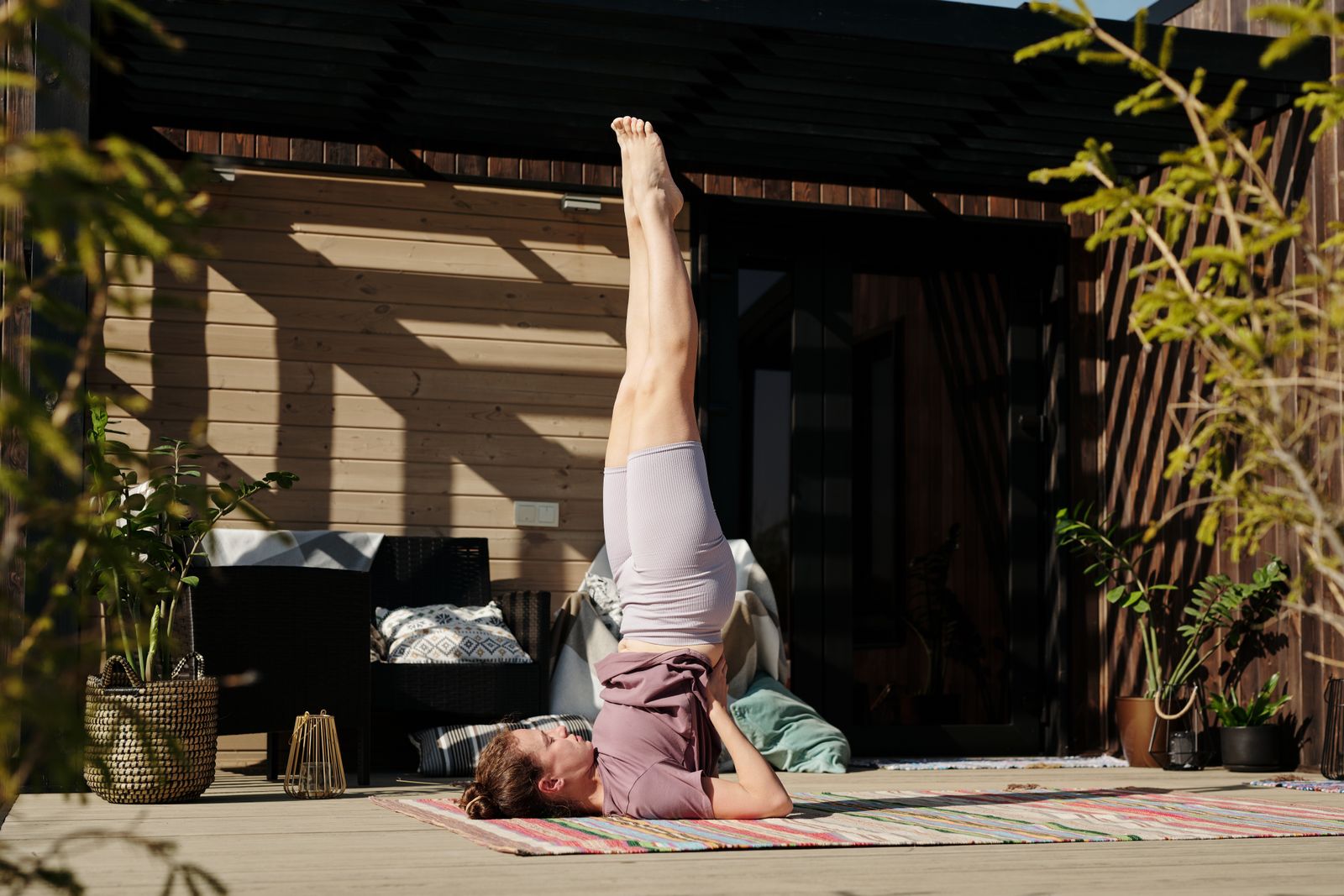
Shoulder stand yoga (Sarvangasana) is often described as one of the more advanced inversions, and it deserves a more cautious approach than most beginner content suggests. In the full pose, your weight rests on your shoulders and upper arms while your legs extend upward, which does build significant shoulder and upper-back strength when done correctly. However, the classic shoulder stand yoga pose places considerable compressive load on the cervical spine and shoulder joints, which is exactly the wrong load for someone with acute shoulder pain, rotator cuff tears, or frozen shoulder. If your shoulders are currently painful, skip full shoulder stand and its variations until the acute pain has resolved. A safer progression is Legs-Up-The-Wall Pose (Viparita Karani), which gives many of the circulatory benefits people associate with shoulder stand yoga without stacking weight onto the neck and shoulders — a pose also commonly recommended in yoga for varicose veins routines for its gentle inversion benefits. Once shoulder pain has eased, working with a qualified teacher on proper alignment — weight distributed through the upper arms rather than the neck, shoulder blades drawn together and down — makes shoulder stand yoga considerably safer to reintroduce.
What’s the Difference Between Yoga for Shoulder Joint Pain and Muscular Tension?
Not all shoulder pain lives in the same tissue, and the distinction changes how you should practice. Muscular tension — tight traps, rhomboids, or pecs from posture and stress — responds well to stretching, breathwork, and gentle movement almost immediately. Yoga for shoulder joint pain, on the other hand, often involves the glenohumeral joint capsule, labrum, or rotator cuff tendons, and these structures need a slower, more progressive approach focused on controlled range-of-motion work rather than aggressive stretching. A useful rule of thumb: if pain is a dull ache that eases with movement, it’s likely muscular and responds to the poses above. If pain is sharp, localized to a specific point, worse with certain arm positions, or accompanied by clicking or catching, it points toward the joint or tendon itself, and yoga should be gentler, slower, and ideally guided by a teacher who understands shoulder anatomy or in coordination with a physical therapist. This distinction matters just as much for anyone managing joint-related discomfort explored in yoga for arthritis, where the same gentle, progressive approach applies.
How Do You Use Yoga for Neck and Shoulder Pain Together?
The neck and shoulders share so much muscular and fascial connection that treating one in isolation rarely gives full relief. The upper trapezius and levator scapulae muscles attach the base of the skull to the shoulder blade, so tightness in one area pulls directly on the other. A combined approach to yoga for neck and shoulder pain typically includes gentle neck rotations and side bends, ear-to-shoulder stretches held for 20-30 seconds per side, shoulder rolls to warm up the joint, and the chest-opening poses covered earlier. Practicing these together, rather than treating the neck and shoulders as separate problems, tends to resolve tension headaches and that “knot between the shoulder blades” feeling more completely. If headaches are a recurring companion to your shoulder and neck tightness, the tension patterns and trigger points covered in yoga for migraine overlap significantly with this same muscle group, and reviewing yoga for back pain content rounds out a full upper-body tension routine.
What Are the Best Shoulder Opening Yoga Poses for Tight Chests?
Shoulder opening yoga poses specifically target the pectoralis major and minor, the muscles that shorten from hours of arms-forward activity like typing, driving, and phone use. Beyond the poses already mentioned, a few additional shoulder opening yoga poses are worth adding to a regular routine. Supported Fish Pose, done with a bolster or rolled blanket under the shoulder blades, passively opens the chest without requiring active effort — useful on days when your shoulders are too fatigued for active stretching, and a technique borrowed heavily from restorative yoga. Doorway chest stretches, while not a traditional asana, are often taught alongside yoga because they isolate the pec stretch precisely. Standing or seated Cactus Arms against a wall reinforces the external rotation that desk posture erodes. Practicing a short sequence of these three or four times a week measurably improves shoulder range of motion over several weeks, particularly when paired with strengthening work for the muscles between the shoulder blades, since a stretch-only approach without any strengthening tends to loosen the front without stabilizing the back.
What Yoga Shoulder Exercises Build Strength Without Strain?
Stretching alone rarely fixes shoulder pain that stems from weakness or instability — the joint also needs strength to hold its new range of motion. Effective yoga shoulder exercises for building strength include Plank Pose held with attention to pressing the floor away and keeping the shoulder blades wide (this activates the serratus anterior, a key scapular stabilizer), Dolphin Pose, which strengthens the shoulders and upper back while being gentler on the wrists than full Downward Dog, and low Cobra Pose, which strengthens the muscles between the shoulder blades that counteract rounded posture. Chaturanga Dandasana, the low plank used in vinyasa transitions, is one of the most common places shoulder injuries actually happen in yoga classes, so it’s worth mastering the shape slowly with knees down before attempting the full weight-bearing version common in vinyasa yoga. Building strength gradually, rather than jumping into advanced yoga shoulder exercises, is what actually prevents the recurring strain-reinjure cycle so many people get stuck in.
How Long Does It Take for Yoga to Relieve Shoulder Pain?
For general muscular tightness and postural shoulder pain, many practitioners notice looser, more mobile shoulders within one to two weeks of consistent practice, and a meaningful reduction in day-to-day discomfort within four to six weeks. For yoga asanas for frozen shoulder, the timeline is longer and tracks the condition’s own natural course — since frozen shoulder itself typically resolves over one to three years regardless of treatment, yoga’s role is to support mobility during the freezing and frozen stages and accelerate range-of-motion recovery once the thawing stage begins. For rotator cuff-related pain, expect gradual improvement over six to twelve weeks as both flexibility and the surrounding stabilizing muscles adapt. Consistency, not intensity, drives results — five 15-minute sessions a week beat one long session, because shoulder tissue responds better to frequent, gentle loading than occasional aggressive stretching.
What Should You Avoid When Doing Yoga for Shoulders?
A few common mistakes turn a therapeutic yoga practice into a source of further shoulder irritation. First, avoid locking out the elbows and cranking into a stretch using momentum — shoulder tissue responds better to slow, sustained holds of 20-30 seconds than to bouncing. Second, be cautious with full weight-bearing poses like Chaturanga, full Wheel Pose, and unsupported handstands if you have any current shoulder pain, since these load the joint under bodyweight in a compromised position. Third, don’t ignore pain that’s sharp, radiating down the arm, or accompanied by numbness or tingling — this is a signal to stop and seek an evaluation rather than push through, since it can indicate nerve involvement rather than simple tightness. Fourth, resist the urge to force range of motion during a frozen shoulder’s freezing stage, when the joint is actively inflamed; gentle is genuinely better here. Finally, don’t skip the warm-up — cold shoulder tissue is far more injury-prone than tissue that’s had a few minutes of gentle movement first, a principle covered in more depth in yoga for beginners guidance.
Can Yoga Help Prevent Shoulder Pain From Coming Back?
Prevention is arguably where yoga offers the most value, since it addresses the root postural and mobility patterns that cause shoulder pain to recur. A regular practice that combines chest opening, scapular mobility, and rotator cuff strengthening — even just 10-15 minutes a few times a week — keeps the shoulder girdle balanced between the muscles that tend to over-tighten (pecs, upper traps) and the ones that tend to weaken (mid-back, rotator cuff, serratus anterior). Building this into a broader practice that also addresses whole-body alignment compounds the benefit; for example, many of the same postural corrections used in yoga for back pain directly support healthier shoulder mechanics, since the thoracic spine and shoulder blades move as a linked system. Pairing a shoulder-focused practice with general strength and mobility work, along with breaks from prolonged sitting or screen time, does more for long-term shoulder health than any single pose ever could. For anyone also managing weight or fitness goals alongside pain relief, a well-rounded yoga for weight loss plan can be structured to avoid loading a sensitive shoulder while still building overall strength.
How Does Yoga Compare to Physical Therapy for Shoulder Pain?
Yoga and physical therapy aren’t competing approaches — they’re complementary, and understanding where each excels helps you build a smarter recovery plan. Physical therapy typically involves a specific diagnosis, targeted exercises prescribed for your exact tissue and stage of injury, and progressive loading protocols backed by clinical assessment. Yoga offers a broader, more holistic practice: breathwork that reduces the muscle guarding that accompanies pain, general mobility across the whole shoulder girdle rather than one isolated muscle, and a sustainable long-term habit that’s easier to stick with than a clinical exercise sheet. For anything beyond mild tightness — a suspected tear, frozen shoulder, or pain following a specific injury — seeing a physical therapist first for an accurate diagnosis, then using yoga as an ongoing maintenance and mobility practice, tends to produce the best outcomes. Many physical therapists actively recommend yoga as a complementary practice once the acute phase of an injury has settled, much the way breath-focused practices support recovery in online yoga for stress relief programs.
Can Online Yoga Classes Help With Shoulder Pain?
Guided, real-time instruction matters more for shoulder work than almost any other body part, because small alignment errors — shrugging the shoulders toward the ears, locking the elbows, or rounding forward during a stretch — are easy to miss without a trained eye watching. Online yoga classes let an instructor observe your positioning through a camera and cue corrections in real time, in much the same way online yoga for mental wellness sessions offer live feedback for breathing and relaxation techniques. This live correction is especially valuable for shoulder stand variations, Chaturanga, and other weight-bearing poses where poor form is the main injury risk. It also means your practice can be adapted week to week as your shoulder pain changes, rather than following a fixed video that can’t respond to how your body feels that day.
Questions People Ask About Yoga for Shoulder Pain
Can yoga make shoulder pain worse?
Yes, if poses are forced, weight-bearing shapes are attempted too soon, or you push through sharp pain. Yoga should feel like a gentle stretch, never a sharp or radiating sensation. Stick to supported, low-load poses during flare-ups, avoid full inversions and Chaturanga while acutely painful, and stop immediately if a pose reproduces sharp pain rather than a mild stretch sensation.
What is the best yoga pose for immediate shoulder relief?
Thread the Needle is widely considered one of the most immediately relieving poses because it passively stretches the back of the shoulder and upper back without requiring strength or balance. Held for 30-60 seconds per side with slow breathing, it’s gentle enough for almost any stage of shoulder pain, including early-stage frozen shoulder.
How often should I do yoga for shoulder pain?
Three to five short sessions a week of 10-20 minutes generally outperforms one long weekly session, since shoulder tissue responds to frequent, gentle loading rather than occasional intense stretching. Daily gentle mobility work, even just five minutes, can meaningfully speed up recovery from general tightness.
Can beginners do yoga for frozen shoulder?
Yes, but beginners should start with the smallest, gentlest range-of-motion movements rather than deep stretches, especially during the freezing stage. Pendulum-style arm swings, supported Cat-Cow, and Thread the Needle are appropriate starting points; save deeper stretches like Cow Face arms for the thawing stage once inflammation has settled.
Should I use props for shoulder yoga?
Props make shoulder yoga considerably safer and more effective. A bolster under the chest in Supported Fish Pose, a strap to bridge the gap in Cow Face arms, and a wall for Cactus Arms all let you get the benefit of a pose without forcing a range of motion your shoulder isn’t ready for yet.
Is it normal for one shoulder to be tighter than the other?
Yes, this is extremely common and usually reflects handedness, work habits, or old minor injuries rather than a serious problem. Practicing poses evenly on both sides, while giving slightly more attention and time to the tighter side, gradually balances the asymmetry over several weeks of consistent practice.
Try This for Yourself
Reading about yoga poses is a good start, but shoulder pain responds best to guided, consistent practice with proper alignment cues you can actually feel in real time. If you want structured support building a shoulder-friendly practice around your specific pain, tightness, or recovery stage, explore FitStrot’s online yoga classes and work with an instructor who can adapt every pose to where your body is today.
Related reading: Yoga for Back Pain, Yoga for Migraine, Yoga for Varicose Veins, Yoga for Weight Loss, or book an online yoga class to get personalized guidance.