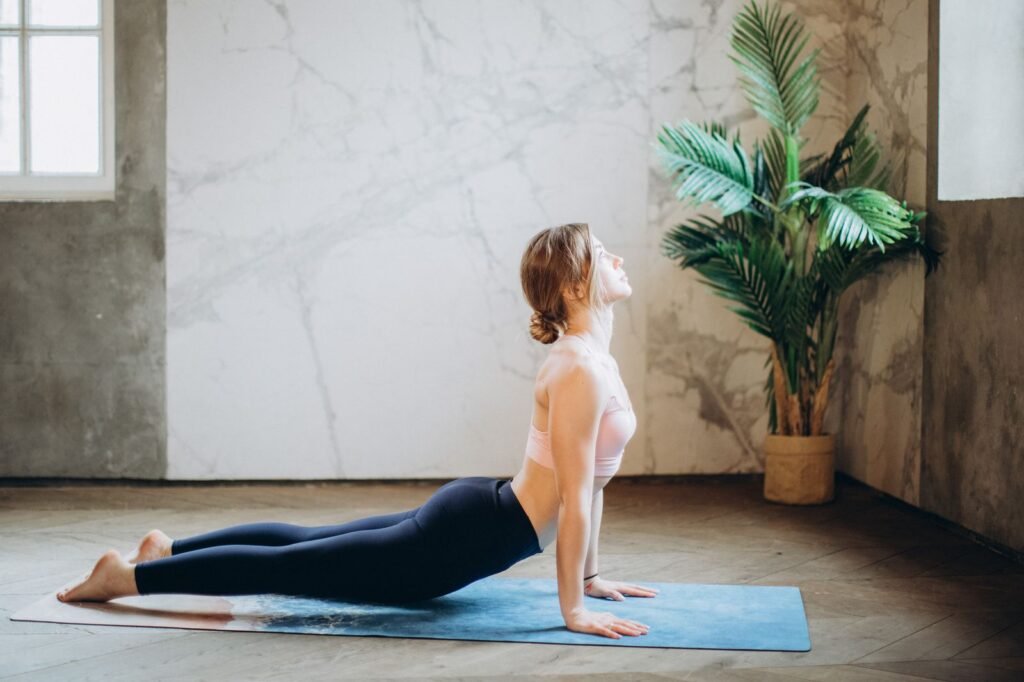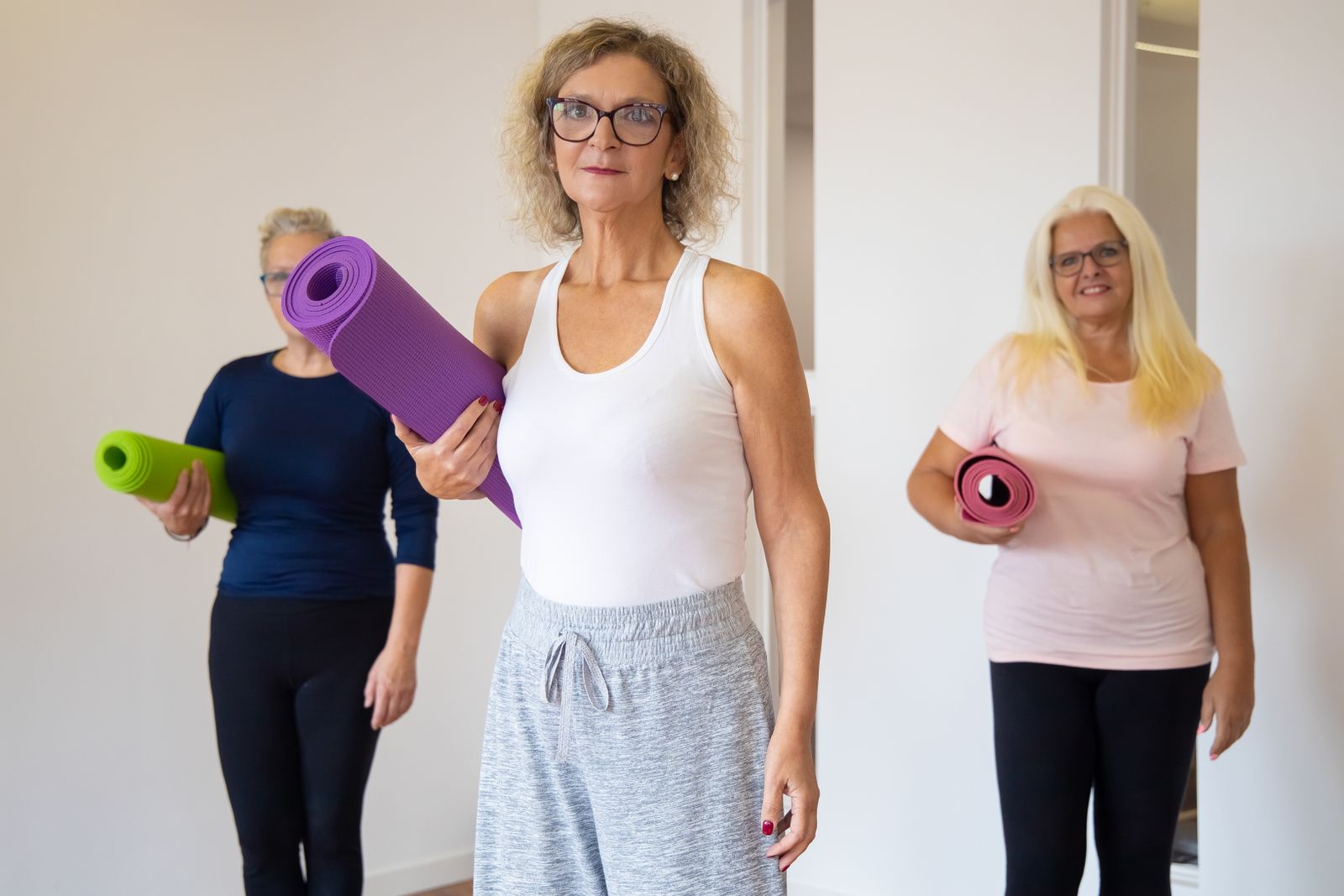
Yoga for elderly practitioners is a low-impact movement practice that combines gentle stretching, seated or standing postures, breathing exercises, and short relaxation sequences designed around the real physical needs of aging bodies: joint stiffness, balance concerns, lower bone density, and slower recovery. Done consistently, even 15-20 minutes a few times a week can improve flexibility, support balance, ease everyday aches, and calm the nervous system, without requiring a senior to get down on the floor or hold a pose for very long. The best entry points are chair yoga and beginner-paced standing sequences, both of which can be adapted to almost any mobility level.
Why Is Yoga Recommended for Older Adults?
Aging changes how the body moves. Cartilage thins, muscle mass declines through a process called sarcopenia, and the vestibular system that governs balance becomes less reliable. Yoga addresses several of these changes at once rather than isolating just strength or just flexibility. A single session typically blends gentle stretching, weight-bearing postures, breath control, and a brief period of stillness or relaxation, giving older adults a more complete movement input than a single-purpose exercise like walking alone provides.
Physical therapists and geriatric fitness specialists frequently recommend yoga because it can be scaled down to almost zero impact. A pose can be practiced standing, seated in a chair, or lying down, which means someone recovering from a hip replacement and someone who has practiced yoga for decades can be in the same room doing recognizably the same posture. That adaptability is rare in group fitness and is one reason yoga has become a staple offering in senior centers and retirement communities.
What Are the Proven Benefits of Yoga for Elderly People?
The benefits of yoga for elderly practitioners extend across physical, cognitive, and emotional domains, and several have been studied directly in older populations.
- Balance and fall-risk support. A systematic review and meta-analysis published in the journal Age and Ageing found that yoga-based exercise improved balance and mobility in adults aged 60 and over. Because falls are the leading cause of injury among older adults, with the CDC reporting that more than one in four people over 65 falls each year, balance-focused practice has real practical stakes, not just fitness value.
- Joint mobility and reduced stiffness. Slow, controlled movement through a joint’s available range, without ballistic or jerky motion, is one of the safest ways to maintain mobility in aging knees, hips, and shoulders.
- Cardiovascular support. Certain slower-paced styles still elevate heart rate modestly and combine with breathing work in ways that can support circulation, particularly for adults who cannot manage higher-impact cardio.
- Better sleep and reduced anxiety. The breathing and relaxation components of a typical class, especially closing rest poses, are associated with reduced stress arousal, which several small trials link to improved sleep quality in older participants.
- Social connection. Group classes, whether in person or through online yoga classes, address isolation, which geriatric health researchers consistently flag as a risk factor for both physical and cognitive decline.
It’s worth being precise about what the evidence does and doesn’t show: yoga is not a substitute for medical fall-prevention programs or physical therapy after an injury, but as a complementary, ongoing practice, research suggests it meaningfully supports the physical qualities that reduce fall risk over time.
What Is the Safest Way for a Beginner to Start?
Yoga for elderly beginners should start seated or supported, not on the floor. The three safest entry points are chair yoga, wall-supported standing poses, and mat work with props like blocks, straps, and bolsters. A first class or first month should prioritize learning to breathe with the movement and understanding personal limits over achieving any particular shape.
A sensible beginner sequence looks like this: five minutes of seated breathing and gentle neck and shoulder rolls, ten minutes of seated or chair-supported stretches, five minutes of standing poses using a wall or chair back for balance, and a five-minute seated or lying relaxation to close. This kind of session fits the structure taught in most yoga for beginners programs, just paced more conservatively and with more props.
Before starting, anyone with osteoporosis, recent surgery, uncontrolled high blood pressure, or significant balance impairment should get clearance from a physician and ideally work with an instructor experienced in yoga for seniors rather than a general beginner class.
What Is Chair Yoga and Who Is It For?
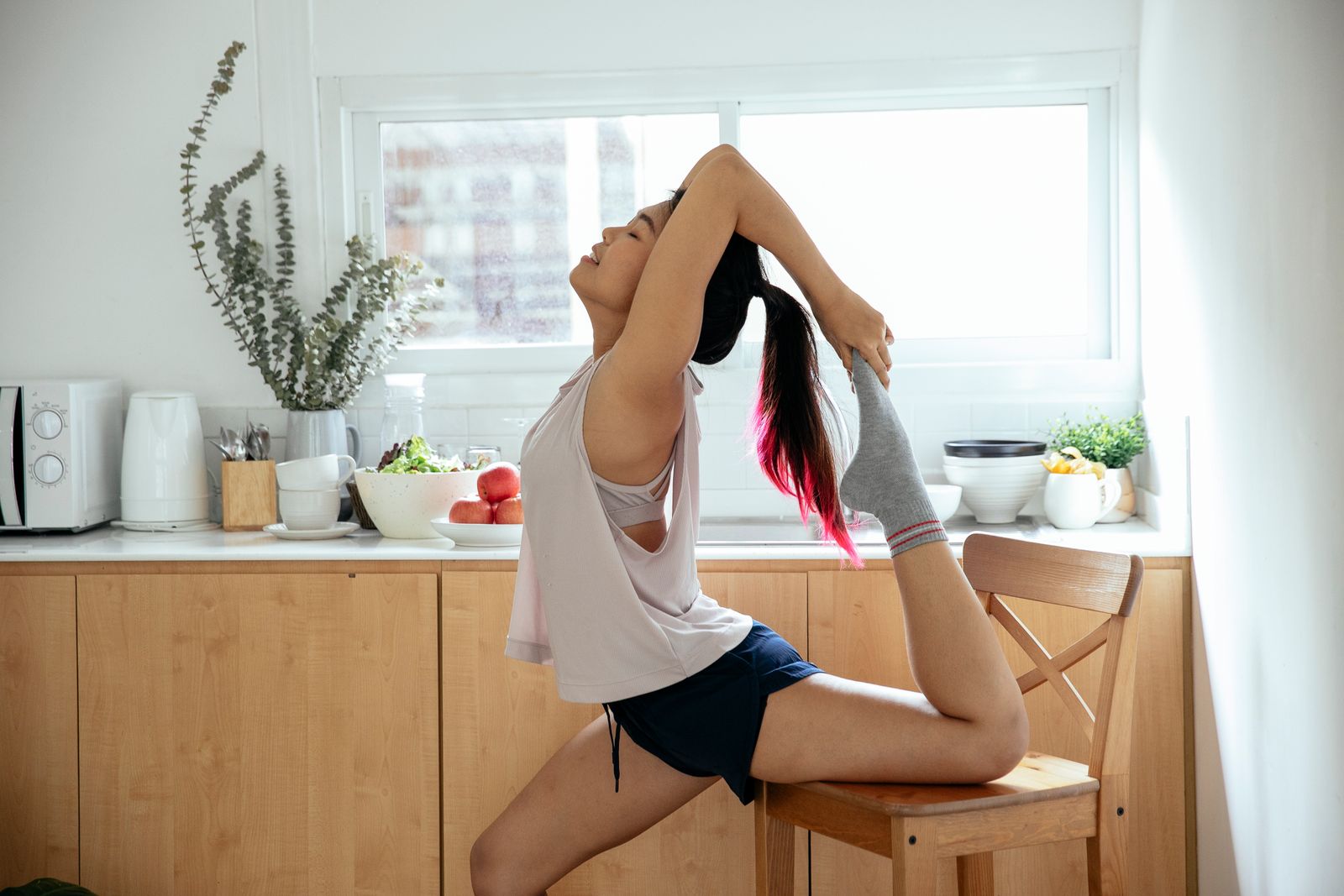
Chair yoga for elderly practitioners adapts traditional postures so they can be performed either seated in a sturdy, armless chair or using the chair as a standing support. It removes the two biggest barriers to yoga participation for older adults: getting down to and up from the floor, and holding single-leg balance without support. Chair yoga is appropriate for people managing arthritis, recovering from joint replacement, using a walker or cane part-time, living with Parkinson’s-related tremor, or simply returning to movement after a long sedentary period.
A typical chair yoga class runs 20-45 minutes and includes seated twists, forward folds over the legs, gentle backbends using the chair back for support, ankle and wrist circles, and seated versions of poses like pigeon or cat-cow. Because the chair provides continuous ground contact, it also lowers the psychological barrier for people who are nervous about falling, which in turn makes it easier to build a consistent habit.
What Are the Best Chair Yoga Poses for Elderly Beginners?
These chair yoga poses for elderly beginners cover the major movement patterns, spinal twists, forward folds, backbends, and side bends, in a sequence that takes about 15 minutes.
- Seated Mountain Pose. Sit toward the front edge of the chair, feet flat, spine long, hands resting on the thighs. This is the reference posture for good alignment throughout the sequence.
- Seated Cat-Cow. Inhale, arch the spine and lift the chest; exhale, round the spine and drop the chin. Repeat 8-10 times to warm up the vertebrae.
- Seated Spinal Twist. Hands on opposite knee or chair arm, rotate gently through the mid-back on an exhale. Hold 3-5 breaths each side.
- Seated Forward Fold. Hinge from the hips over the legs, letting the arms hang. Keep knees soft to protect the lower back.
- Chair-Supported Warrior II. Stand behind the chair, one hand resting on the chair back for balance, and step into a wide stance with arms extended.
- Seated Pigeon. Cross one ankle over the opposite knee and fold slightly forward to open the hip, a gentle alternative to the floor-based version.
- Seated Side Bend. One arm reaches overhead while leaning gently to the opposite side, stretching the ribcage and obliques.
Each pose should be held for three to five slow breaths rather than counted seconds, since breath-paced holds naturally prevent overexertion.
What Standing and Floor Poses Work Well for Active Seniors?
Older adults with good balance and no significant joint restrictions can safely include some standing and mat-based yoga poses for beginners, adapted with props. Tree pose against a wall builds single-leg balance without the fall risk of an unsupported version. Modified Warrior I and II with a shorter stance build leg strength while keeping the center of gravity low. Bridge pose, performed lying down with knees bent and feet flat, strengthens the glutes and lower back safely, and it’s a common building block in yoga for back pain routines. Cat-cow and child’s pose on a mat, with a folded blanket under the knees, remain accessible to most seniors who can get to and from the floor safely, often with a chair nearby as a hand support for transitions.
The rule of thumb: any pose that requires holding a single-leg balance without support, deep backbends, or full inversions like headstand should be avoided or heavily modified, since the risk-to-benefit ratio worsens sharply once a person is past their peak bone density and balance reserve.
How Does Yoga Compare to Other Gentle Exercise for Seniors?
Compared to walking, yoga adds a flexibility and balance component that pure cardio doesn’t provide. Compared to water aerobics, yoga can be done anywhere without pool access, though it lacks the joint-unloading benefit that water offers to someone with severe arthritis. Compared to tai chi, the two practices overlap considerably in their emphasis on slow, controlled movement and balance, and many geriatric fitness programs offer both interchangeably. Yoga’s edge over most alternatives is the built-in breathing and relaxation component, which delivers a stress-reduction benefit that pure strength or balance training doesn’t replicate as directly.
For seniors managing multiple conditions, a reasonable approach is to combine two to three modalities across the week: for example, chair yoga twice a week, a short daily walk, and one tai chi or water aerobics session, rather than relying on a single form of movement to cover every need.
How Should Breathing Be Adapted for Older Practitioners?
Pranayama, the yogic breathing practices, should be simplified for elderly practitioners, particularly those with respiratory conditions like COPD or asthma, or cardiovascular conditions like hypertension. Diaphragmatic breathing, simply breathing slowly into the belly rather than the chest, is safe for nearly everyone and forms the foundation of a good pranayama breathing techniques practice for this age group. Extended breath retention (kumbhaka) and forceful breathing techniques like kapalabhati are generally not recommended for seniors with uncontrolled blood pressure, glaucoma, or recent cardiac events, since the pressure changes involved can aggravate those conditions.
A safe standard is a 4-count inhale through the nose, a brief pause, and a 6-count exhale, repeated for two to three minutes at the start or end of a session. The longer exhale activates the parasympathetic nervous system, which is the physiological basis for yoga’s calming effect and one of the more consistently replicated findings in relaxation research.
What Precautions Should Seniors and Instructors Take?
Safety in yoga for elderly beginners comes down to a short list of concrete practices rather than vague caution. Always warm up joints before any stretch, since cold connective tissue is less pliable and more prone to strain in older adults. Use a wall, sturdy chair, or another person as support for anything involving single-leg balance. Avoid any pose that requires quickly dropping the head below the heart if the person has glaucoma, retinal issues, or uncontrolled blood pressure. Keep a water bottle nearby and watch for dizziness, which is more common in older adults due to slower blood pressure regulation when changing positions.
Instructors teaching mixed-ability senior classes should also learn each participant’s specific conditions in advance, arthritis locations, joint replacements, cardiac history, since a single generic sequence rarely suits an entire room of older students safely.
How Often Should Seniors Practice Yoga for Best Results?
Most geriatric fitness guidance suggests two to three sessions per week of 20-45 minutes as a sustainable starting frequency, building toward daily short practices of 10-15 minutes if the person enjoys it and tolerates it well. Consistency matters more than session length: three short 15-minute sessions a week produce more durable balance and flexibility gains than one long weekly class, largely because motor learning and joint adaptation both respond better to frequent, moderate stimulus than infrequent, intense stimulus.
A realistic beginner’s progression looks like weeks one and two focused purely on seated and chair-supported work, weeks three and four adding a few supported standing poses, and month two introducing longer holds and slightly more complex sequences, always guided by how the body responds rather than a fixed calendar.
Can Yoga Help With Specific Conditions Common in Older Age?
Yoga’s adaptability makes it useful across several conditions that become more common with age, though it should complement rather than replace prescribed medical treatment.
For arthritis, gentle range-of-motion work through yoga for arthritis sequences helps maintain joint mobility without the impact that aggravates inflamed joints. For osteoporosis, poses are modified to avoid spinal flexion under load and deep twists, since compression fractures are a real risk; a program built around yoga for osteoporosis guidelines typically favors gentle extension and standing poses instead. For hypertension, slow breathing and restorative poses support the relaxation response, complementing work found in yoga for high blood pressure routines. For mild cognitive concerns, the combination of movement, breath focus, and social interaction in a group class supports the kind of multi-domain stimulation geriatric researchers associate with healthy cognitive aging.
What Role Does Mindfulness Play in Senior Yoga Practice?
Beyond the physical postures, the meditative and mindfulness elements of yoga carry particular value for older adults navigating retirement transitions, bereavement, or chronic illness. A closing relaxation pose, often a seated or reclined rest with guided breathing, gives practitioners a structured few minutes of present-moment attention that many people otherwise rarely build into their day. This overlaps closely with the goals taught in meditation for beginners content and with the broader philosophy behind yoga and mindfulness practice, both of which emphasize non-judgmental awareness of the present moment rather than achieving any particular physical outcome.
For seniors specifically, this mindfulness component has been associated in small studies with reduced perceived stress and improved mood, complementing the physical fall-prevention and mobility benefits rather than existing separately from them.
How Can Seniors Practice Yoga Safely at Home?
Home practice works well once a senior has learned correct form in a class setting, ideally through online yoga classes or in-person instruction for the first several weeks. A safe home setup includes a sturdy, armless chair placed against a wall so it cannot slide, a non-slip mat if working on the floor, a nearby wall or countertop for standing balance support, and good lighting to see the practice space clearly. It’s wise to avoid practicing alone during the first few weeks of any new pose, and to keep a phone within reach during solo sessions.
Video-guided online yoga for seniors classes are particularly useful because they allow a senior to pause, rewind, or repeat a section, something that isn’t possible in a live in-person class, and they remove transportation as a barrier for those with limited mobility or no longer driving.
Questions People Ask About Yoga for Elderly Practitioners
Is yoga safe for a 70 or 80 year old with no prior experience?
Yes, with modifications. Chair yoga and wall-supported standing poses are specifically designed for first-time older practitioners. The key is starting with a class or instructor experienced in senior-specific modifications rather than a general beginner class, and getting medical clearance if there are existing heart, bone density, or balance conditions.
How long before a senior notices benefits from yoga?
Many practitioners report feeling looser and calmer after the first few sessions, but measurable improvements in balance and flexibility typically take four to eight weeks of consistent practice, two to three times weekly, based on the general timeframes used in most published yoga-for-balance research in older adults.
Can yoga help prevent falls in older adults?
Research, including a systematic review published in Age and Ageing, has found yoga-based exercise improves balance and mobility in adults 60 and over, both of which are directly linked to fall risk. It should be treated as one part of a broader fall-prevention approach that may also include strength training and home safety modifications.
Do seniors need special yoga equipment?
A sturdy armless chair, a non-slip mat, and one or two yoga blocks cover nearly every beginner need. Straps help with limited shoulder or hamstring flexibility, and a folded blanket can cushion knees during floor work. None of this needs to be expensive or specialized.
What’s the difference between chair yoga and regular yoga for seniors?
Chair yoga performs postures seated in or supported by a chair, removing floor transitions and unsupported balance work entirely. Regular senior-adapted yoga may include some floor and standing poses for those with better mobility. Many classes blend both within a single session, moving between chair-supported and standing segments.
Can yoga be combined with medication or physical therapy?
Yes, yoga is generally considered a safe complement to standard medical care and physical therapy for older adults, though it isn’t a replacement for either. Anyone managing a diagnosed condition should mention their yoga practice to their physician or therapist so the two can be coordinated appropriately.
Try This for Yourself
The safest way to start yoga as an older adult is with guided, senior-specific instruction rather than guesswork. FitStrot’s online yoga classes offer live, instructor-led sessions built around real mobility levels, from fully seated chair yoga to gentle standing sequences, so you can build strength, balance, and calm at a pace that matches your body today.
Related reading: Chair Yoga: A Complete Guide, Yoga for Seniors, Yoga for Beginners, Benefits of Yoga, and FitStrot’s online yoga classes.