Yoga poses for kids are simplified, playful versions of classic postures — often named after animals or nature — held for just a few breaths instead of minutes, designed to build strength, balance, and calm without asking a child to sit still for long. The best starting poses are Tree Pose, Cat-Cow, Downward Dog (“puppy pose”), Cobra (“snake pose”), Butterfly, and Child’s Pose, since each is easy to demonstrate, easy to picture, and forgiving of wobbly form. A simple sequence for a child mixes standing balance poses, a few floor stretches, one or two partner poses, and a short relaxation close, all wrapped in storytelling that keeps the practice feeling like a game rather than exercise.
What Are the Best Yoga Poses for Kids to Start With?
Children under about eight respond best to poses that mimic something they already know — an animal, a tree, a vehicle — because the image gives them an instant mental anchor for the shape their body should make. Tree Pose (standing on one leg with the other foot pressed to the inner calf or thigh) teaches balance and focus, much like the version taught in tree pose guides for adult beginners. Cat-Cow (arching and rounding the spine on hands and knees) is a gentle spinal warm-up that most toddlers can copy within seconds, and shows up in nearly every beginner yoga poses routine for a reason. Downward Dog, renamed “puppy pose” in most kids’ classes, stretches the hamstrings and shoulders while doubling as a playful “bark like a dog” moment. These three poses alone cover balance, spinal mobility, and a full-body stretch, making them a natural foundation before moving into a longer yoga for kids routine.
Which Animal Yoga Poses for Kids Work Best?
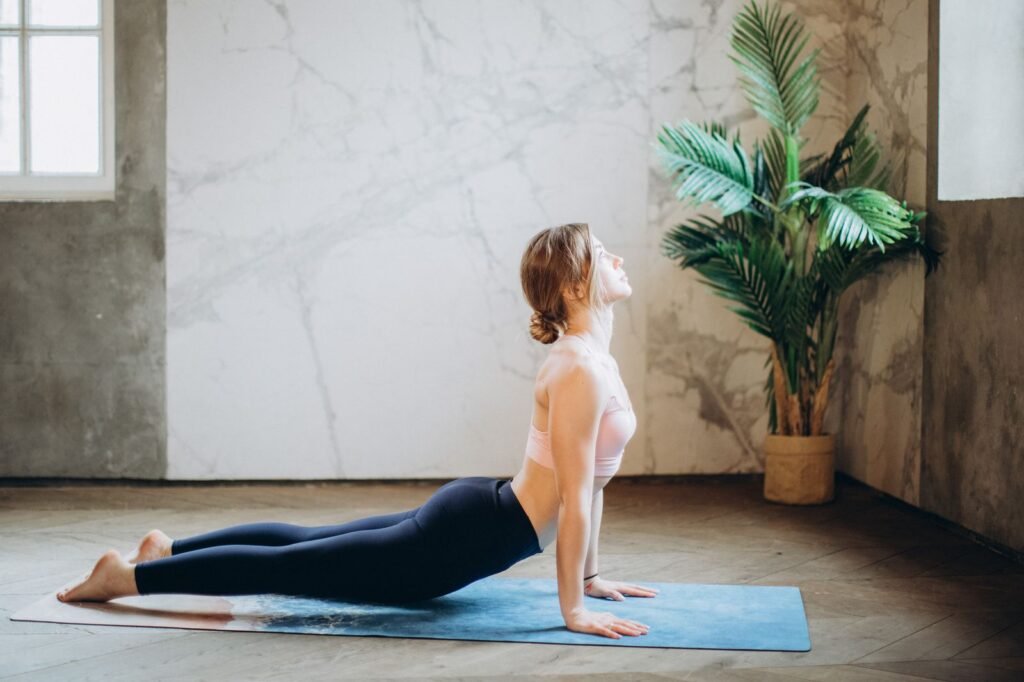
Animal-themed poses are the single most effective entry point for young children because the pose name does the teaching for you — a child asked to make “cobra” or “cat” already has a mental picture to imitate. Cobra Pose (lying on the belly, pressing the chest up with straight arms) builds back strength and is easy to narrate as a snake “hissing” upward. Cat-Cow doubles as two animals in one movement. Frog Pose (a low squat with hands on the floor between the feet) builds hip mobility and gives kids an excuse to hop. Lion’s Breath — inhaling through the nose, then exhaling forcefully through the mouth with the tongue out and a loud roar — is technically a breathing exercise but is usually taught alongside animal poses since children treat it as a game rather than a formal pranayama technique. Eagle Pose (crossing arms and legs while balancing) is a favorite with older kids once their coordination catches up, usually around age six or seven, and pairs well with the balance-focused poses covered in balance yoga poses for older practitioners.
What Are Simple Yoga Poses for Kids Under Five?
Preschool-age children need poses that ask for movement more than stillness, since holding any position for more than a few seconds is developmentally difficult before about age five. Butterfly Pose (sitting with the soles of the feet together, gently flapping the knees like wings) is one of the easiest seated poses because it requires no balance and no strength — just a comfortable hip stretch. Star Pose (standing with arms and legs spread wide) gives a young child a big, satisfying shape to hold for a single breath. Child’s Pose (kneeling and folding forward with arms stretched ahead) works well as a rest position between more active poses, and most toddlers find it instinctively soothing since it mimics a natural curling-up posture. For this age group, sequences work better as a loose string of shapes tied to a story — “first we grow tall like a star, then we curl up small like a seed” — rather than a structured routine, which fits naturally alongside a broader yoga for beginners approach adapted for younger bodies, and mirrors the gentler pacing found in restorative yoga for adults.
What Yoga Poses for Kids Have the Clearest Names?
Knowing the common name alongside the traditional Sanskrit term helps parents and teachers follow along with printable pose cards or video classes. Most kids’ yoga materials lead with the playful English name and mention the Sanskrit term only as a secondary label, since young children engage far more with “puppy” or “warrior” than with unfamiliar Sanskrit syllables.
| Common Name | Sanskrit Name |
|---|---|
| Downward Dog | Adho Mukha Svanasana |
| Cobra Pose | Bhujangasana |
| Tree Pose | Vrksasana |
| Child’s Pose | Balasana |
| Butterfly Pose | Baddha Konasana |
| Warrior Pose | Virabhadrasana |
Warrior Pose (a lunging stance with arms extended) is the same foundational stance explained in depth in warrior pose guides. This naming pattern matters when searching for printable pose charts, since some cards list only the Sanskrit name and can be confusing without the plain-English translation alongside it, a distinction also covered in general yoga poses for beginners resources.
How Do Printable Yoga Poses for Kids Help at Home or in Class?
A printable pose chart turns an abstract instruction like “do some yoga” into a visual menu a child can point to and copy independently. Most printable sets group 10-20 poses onto a single page or card deck, each with a simple illustration, the playful name, and sometimes a one-line cue like “reach your branches to the sky” for Tree Pose. Teachers use printables to run stations, where small groups rotate between pose cards without needing constant verbal instruction, while parents often stick a laminated sheet to a bedroom wall or use individual cards as a bedtime wind-down ritual. The most useful printable sets separate poses by difficulty or body position (standing, seated, balance) so a parent or teacher can quickly build an age-appropriate sequence rather than picking poses at random.
What Standing Yoga Poses for Kids Build the Most Balance?
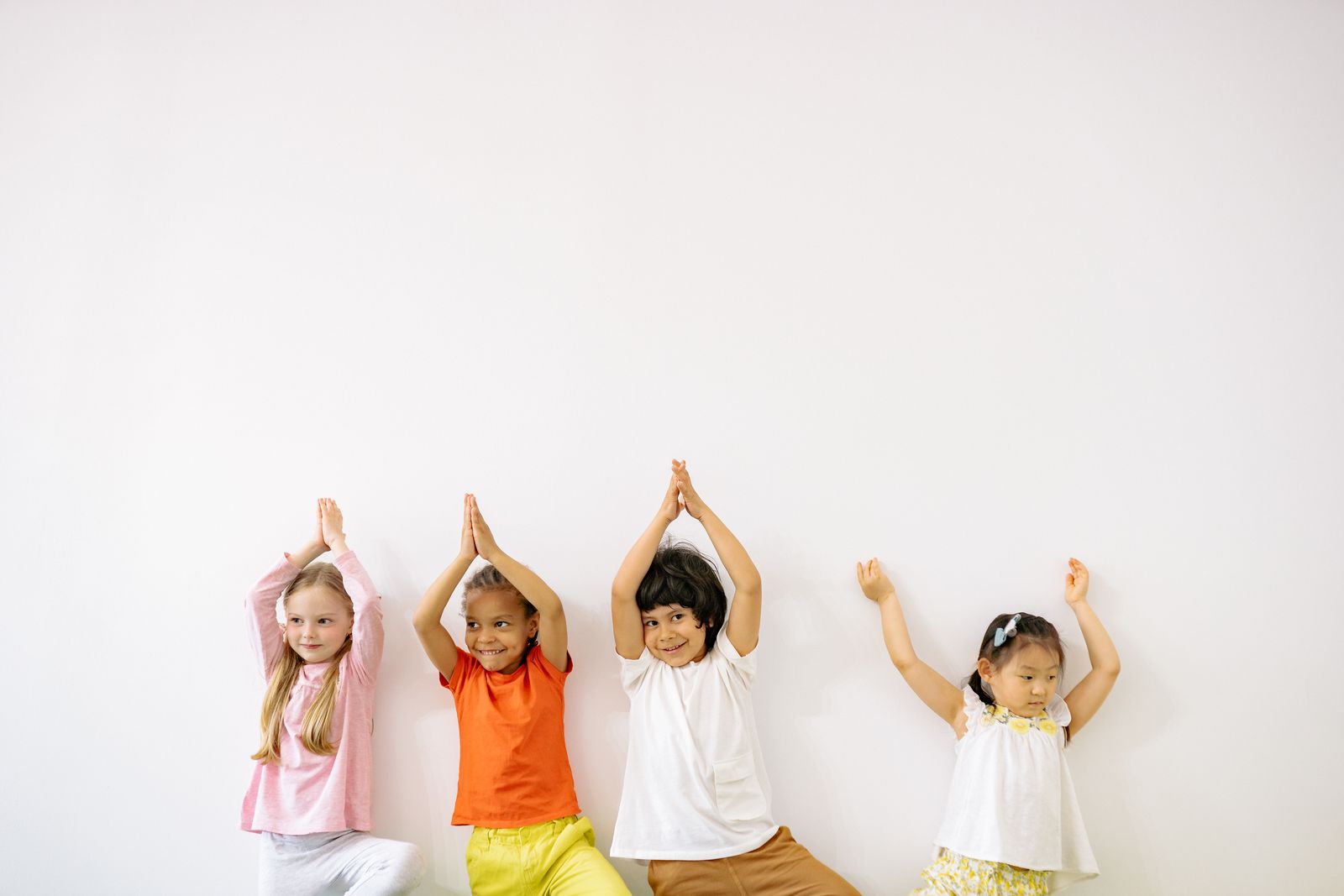
Standing poses are where children first notice their own coordination improving, since balance is a skill that responds quickly to repeated practice. Tree Pose remains the classic starting point, but Warrior Pose adds a strength component by asking a child to hold a lunge with arms reaching overhead like a superhero stance. Airplane Pose (standing on one leg while tipping the torso forward with arms out like wings) challenges balance further and gives kids a fun “flying” visual. Mountain Pose (simply standing tall with feet grounded and arms relaxed) looks unremarkable but teaches the postural awareness that every other standing pose depends on, a concept explored further in standing yoga poses for older practitioners. Standing poses generally suit children from about age four upward, once basic single-leg balance has developed.
What Are Some Fun Yoga Poses for Kids 2 People?
Partner poses turn a solo practice into a cooperative game, which is often what keeps siblings or classmates engaged longer than any solo pose would. Partner Tree Pose has two children stand side by side, each lifting the outer leg into Tree Pose while linking inner arms for support, teaching balance and trust simultaneously. Double Boat Pose has two kids sit facing each other, holding hands, and lifting both legs to touch feet in the air, building core strength while requiring real teamwork to hold the shape. Seesaw Pose (sitting facing each other, holding hands, and alternately leaning back and forward) mimics a playground seesaw and needs no instruction beyond “take turns leaning back.” Partner poses work especially well in classroom or sibling settings where a single child might resist a solo pose but readily joins in when a friend is involved, and they translate naturally into small-group activities used in broader yoga for children programs, following a similar logic to the cooperative sequences found in partner yoga poses for adults and teens.
What Hard or Advanced Yoga Poses for Kids Should Wait Until Later?
Some poses genuinely require more strength, flexibility, or coordination than most children under seven or eight have developed, and introducing them too early usually leads to frustration rather than growth. Crow Pose (balancing the whole body on the hands with knees resting on the upper arms) demands significant arm and core strength most children don’t build until later elementary school. Wheel Pose (a full backbend supported on hands and feet) requires shoulder and spine flexibility that varies enormously by age and should only be attempted with direct supervision. Headstand and Handstand variations carry real fall risk and are generally reserved for children who have already built a base of core strength through simpler poses over months of practice. A reasonable guideline many kids’ yoga teachers use is to treat any inverted or single-limb-support pose as advanced until a child can comfortably hold Tree Pose and Plank for at least 10-15 seconds each, a similar progression to the one outlined in advanced yoga poses for adult practitioners building toward inversions.
What Does a Basic Yoga Poses for Kids Sequence Look Like?
A dependable beginner sequence follows a simple arc: warm up, move through standing and floor poses, add one balance challenge, then wind down. A typical 15-minute session might open with a few rounds of Cat-Cow to warm the spine, move into Downward Dog and Cobra to stretch and strengthen, add Tree Pose or Warrior Pose for balance, include a seated stretch like Butterfly Pose, and close with Child’s Pose followed by a minute or two of lying still in Relaxation Pose (Savasana, usually renamed “starfish pose” or “sleeping pose” for kids), the same closing shape used in most yoga sequence for beginners plans. Keeping the sequence to 5-8 poses total prevents the session from dragging, and ending on a calm, floor-based pose every time helps children associate the practice’s ending with settling down rather than winding up further.
How Should Yoga Poses for Kids Differ by Age?
A three-year-old and a ten-year-old need meaningfully different approaches even when practicing the same pose names. Toddlers and preschoolers (roughly ages 2-5) do best with constant movement, animal sounds, and poses held for a single breath at most, since sitting still is genuinely difficult at this stage. Early elementary kids (ages 6-8) can hold poses for several breaths, follow slightly longer sequences, and start enjoying partner poses and simple balance challenges. Older children (ages 9-12) can handle more traditional class structures, longer holds, and an introduction to basic breathing techniques beyond Lion’s Breath, often bridging naturally into the practices covered for teens in yoga for students and, eventually, the routines described in yoga for teenagers. Matching pose difficulty and hold time to developmental stage, rather than using one script for every age, is the single biggest factor in whether a session holds a child’s attention.
How Can Parents Introduce Yoga Poses for Kids Without a Class?
Home practice works best when it’s framed as playtime rather than a lesson. Picking one simple theme per session — a zoo, an outer-space adventure, a garden — gives a natural excuse to string together five or six poses without needing a formal script. Letting a child call out the next animal or shape keeps them invested, since kids’ yoga works better as a shared game than a set of instructions to follow. A parent doesn’t need to demonstrate perfect form; modeling enthusiasm and a willingness to wobble matters more than alignment at this age. Short, frequent sessions (10 minutes most days) build more consistency than a single long session once a week, and pairing movement with a simple book or story keeps younger children anchored through the whole sequence. Many families find it easier to start with structured video sessions before improvising their own, which is where guided yoga for kids classes tend to help, in the same way many adults benefit from following a yoga for beginners at home plan rather than improvising alone.
What Mistakes Do Parents Make With Yoga Poses for Kids?
A few patterns show up repeatedly when adults try to translate adult-style yoga directly onto children:
- Expecting long, still holds. Most young children physically can’t hold a pose motionless for more than a few seconds without losing interest.
- Over-correcting alignment. This turns a playful activity into a chore; body awareness and movement matter far more at this age than textbook-perfect form.
- Skipping breathing and relaxation elements. Poses alone miss a large part of the emotional-regulation benefit that research on yoga’s broader benefits consistently points toward.
- Treating a kids’ session as a shorter adult class. Sanskrit names, long transitions, and minimal talking usually lose a child’s attention within the first few minutes, whereas a narrated, animal-themed sequence holds it far longer, a contrast also discussed in guides comparing yoga vs exercise approaches for children.
How Do Schools Use Yoga Poses for Kids in the Classroom?
Classroom yoga rarely looks like a full class; it’s usually a two-to-five-minute reset woven into transitions between subjects, before tests, or after recess. Seated poses and breathing exercises that don’t require floor space — like seated Cat-Cow or a few rounds of belly breathing — are the most practical for a classroom, since they need no mat and can be done at a desk. Some schools build a weekly rotation through printable pose cards as a stations activity, letting small groups move between poses without constant teacher instruction. Group settings add a layer that solo home practice doesn’t: the mild social encouragement of trying a wobbly balance pose next to a classmate, and a shared calming ritual that can settle an entire room faster than any single child managing it alone. This approach pairs naturally with school-based introductions to yoga for children more broadly, and often draws on breathing techniques adapted from breathing exercises yoga guides written for adult classrooms and workplaces.
What Equipment Do Kids Actually Need for Yoga Poses?
Very little. A yoga mat helps with grip and marks out personal space, which matters more in group settings than at home, but a carpeted floor or towel works fine for most poses. Bare feet give the best grip for balance poses like Tree and Warrior. Loose, stretchy clothing that doesn’t restrict arm or leg movement matters more than any specialized gear. Printable pose cards, a simple picture book, or a themed playlist can help structure a session, but none of these are required to get started — the poses themselves need nothing more than open floor space and a willingness to move, much like the minimal setup described in yoga equipment for beginners guides for adults.
Questions People Ask About Yoga Poses for Kids
What is the easiest yoga pose for a young child to learn first?
Child’s Pose is usually the easiest starting point since it requires no balance or strength — just kneeling and folding forward with arms extended. It also mimics a natural resting curl, so most toddlers find it intuitive on the first try. Butterfly Pose and Star Pose are close runners-up for the same reason: minimal coordination required.
How long should a child hold a yoga pose?
Most children under five can only comfortably hold a pose for one or two breaths, while children ages six to ten can typically manage five to ten seconds with practice. Rather than aiming for long, still holds, most kids’ yoga sequences move through several poses quickly, keeping engagement higher than a single extended hold would.
Can yoga poses help a child with anxiety or trouble focusing?
Some research on yoga in school settings suggests structured movement and breathing routines may support attention and emotional regulation in children, though results vary and yoga should be treated as a complementary tool rather than a replacement for professional support when anxiety or focus difficulties are significant.
What age can a child start doing yoga poses?
Children as young as two or three can begin simple, playful yoga poses, though sessions at this age should be short, movement-heavy, and led through animal names and stories rather than instruction. More structured sequences with longer holds generally suit children from about age five or six onward.
Do kids need special yoga poses, or can they just do adult poses?
Kids’ yoga poses are usually simplified versions of adult postures — shorter holds, playful names, and less emphasis on precise alignment. Many poses like Tree, Cobra, and Downward Dog are identical in shape to the adult version; what changes is the pacing, the storytelling, and the expectation around stillness.
What’s a good yoga pose for two kids to do together?
Partner Tree Pose is one of the most approachable two-person poses: both children balance on one leg side by side while linking inner arms for support. It teaches balance and cooperation at once and works well for siblings or classmates who might resist a solo pose but enjoy a shared challenge.
Try This for Yourself
The easiest way to know whether these poses fit your child’s energy and attention span is to try a guided session built around real kids’ bodies and real attention spans. Explore FitStrot’s online yoga classes for structured sessions that adapt across age groups and can be practiced from home on your own schedule.
Related reading: yoga for beginners, yoga for kids, yoga for children, yoga for students, and FitStrot’s online yoga classes.