Santosha is the Sanskrit word for contentment, and in yoga philosophy it names the second of the five niyamas (personal observances) that Patanjali lists in the Yoga Sutras. It means cultivating a settled sense of peace with what is, right now, regardless of whether your circumstances are pleasant or difficult. Santosha is not passive resignation or forced positivity — it is an active practice of accepting the present moment fully while still working toward growth. Traditional commentary on Yoga Sutra 2.42 links santosha to the experience of unexcelled happiness, suggesting that contentment cultivated deliberately becomes a stable inner resource rather than something dependent on outside events.
What Does Santosha Actually Mean?
The word santosha (सन्तोष) is built from two Sanskrit roots: “sam,” meaning complete or entire, and “tosha,” from the root “tush,” meaning satisfaction or contentment. Put together, santosha translates loosely to “complete contentment” or “being entirely satisfied.” It is often rendered in English yoga texts simply as “contentment,” but that single word undersells the depth of the concept. Santosha is not about getting everything you want; it is about no longer needing external conditions to change before you allow yourself to feel at peace. This distinction matters enormously in a culture built on comparison, achievement, and constant self-improvement — including much of modern yoga and fitness culture itself.
Where Does Santosha Come From in Yoga Philosophy?
Santosha is the second of the niyamas, the five inward-facing observances described in Patanjali’s Yoga Sutras, which sit alongside the yamas as the ethical foundation of the eight-limbed path of yoga (ashtanga). The five niyamas are:
- Saucha — cleanliness of body, environment, and mind
- Santosha — contentment, the practice explored in this article
- Tapas — disciplined effort, or “heat” directed toward growth
- Svadhyaya — self-study and reflection
- Ishvara pranidhana — surrender to something greater than oneself
Where the yamas govern how a practitioner relates to the outside world, the niyamas govern the practitioner’s relationship with themselves. If you are new to this framework, it helps to first understand the broader system — our guide on the Bhagavad Gita and yoga explores how these ethical ideas show up across foundational yogic texts, not just the Yoga Sutras.
How Is Santosha Different From the Other Niyamas?
It helps to see santosha in context rather than in isolation. Saucha, the first niyama, is about purity and cleanliness of body, environment, and mind — a kind of internal and external decluttering that often precedes contentment. Tapas, the third niyama, is disciplined effort or “heat” — the willingness to do hard things consistently. Santosha sits between these two, which is telling: contentment in yogic philosophy is not the absence of effort. You are meant to practice saucha and tapas — clean living and disciplined striving — while simultaneously practicing santosha, accepting where you are without being attached to a different outcome. This pairing prevents contentment from tipping into complacency, and it prevents discipline from tipping into anxious perfectionism. For a deeper look at self-discipline in yoga, see our piece on how tapas builds sustainable practice.
How Does Santosha Connect to the Yamas Like Ahimsa and Satya?
The niyamas do not exist independently of the yamas — the two work together as a unified ethical foundation. Ahimsa, non-harming, is often the entry point into this system, and santosha extends that same gentleness inward: refusing to harm yourself with constant dissatisfaction, comparison, or self-criticism is a form of ahimsa toward your own mind. Satya, truthfulness, also intersects with santosha in an important way — true contentment requires an honest look at your actual circumstances rather than denial or spiritual bypassing. You cannot be content with a situation you refuse to see clearly. And brahmacharya, often translated as moderation or right use of energy, supports santosha by reducing the constant craving and overconsumption that keep the mind restless and dissatisfied. Together, these principles form a coherent picture: contentment grows out of honesty, restraint, and non-harm, not out of getting more.

How Do You Practice Santosha on the Mat?
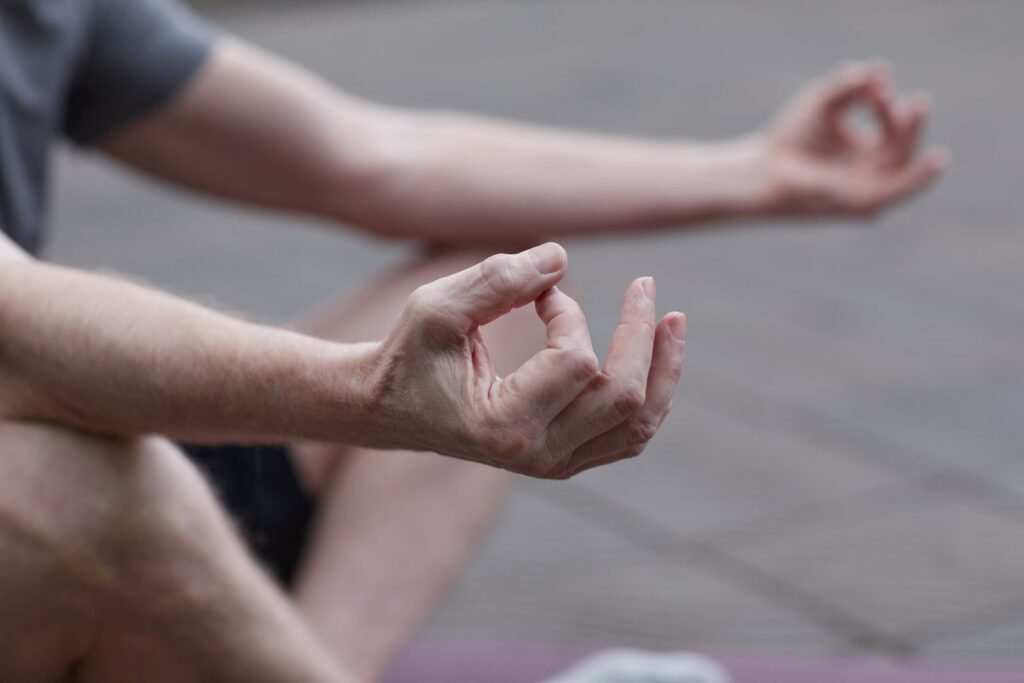
Physical yoga practice is one of the most direct laboratories for santosha because it constantly presents small moments of comparison and frustration — a pose that will not open, a balance that will not hold, a body that feels different than it did yesterday. Practicing santosha on the mat means noticing when the mind starts grasping for a “better” version of the pose and gently returning attention to the sensations of the pose as it actually is today. Restorative postures are particularly useful for this. A supported bridge pose, held for several long breaths with the hands resting in a simple mudra, is commonly used in yoga classes as a physical anchor for contentment work, paired with slow, complete exhales. If you practice a gentler style, our guide to restorative yoga offers more poses that support this kind of settled awareness, and our online yoga for beginners guide is a good starting point if you are building a mat practice from scratch.
How Do You Practice Santosha Off the Mat?
Santosha is meant to extend well beyond the yoga mat into daily decisions, relationships, and self-talk. A few concrete ways practitioners work with santosha in everyday life include:
- A nightly gratitude practice that names specific things rather than generic ones
- A conscious pause before comparing your life, body, or achievements to someone else’s
- A habit of finishing tasks fully rather than immediately reaching for the next goal without acknowledging the current one
Many practitioners also use short breathing practices, such as those explored in our guide to pranayama breathing techniques, as a way to interrupt a spiraling, dissatisfied mental state and return to the present. Because santosha asks you to be honest about your actual state rather than performing calm, it pairs naturally with reflective practices like journaling and yoga nidra, both of which create space to notice discontent without immediately acting on it.
Is Santosha the Same as Being Complacent?
This is one of the most common misunderstandings of the concept, and it is worth addressing directly. Santosha does not mean you stop setting goals, stop working out, stop trying to improve your health, or accept mistreatment from others. The niyama sits deliberately next to tapas (disciplined effort) precisely because yogic philosophy does not want contentment mistaken for passivity. A useful way to hold both ideas is: you can be fully at peace with where you are today while still training toward where you want to be tomorrow. The peace is with your present reality, not a renunciation of future effort. This is a meaningfully different stance from either constant striving without satisfaction or complacency without growth, and distinguishing it clearly is part of what makes santosha a mature practice rather than a slogan.
Why Is Santosha Especially Relevant in Fitness and Corporate Wellness?
Modern fitness culture, including much of the online yoga and personal training world, runs on metrics: reps, streaks, weight lost, poses achieved, calories tracked. This can quietly erode contentment by making satisfaction conditional on constant progress. Santosha offers a counterbalance without asking you to abandon your fitness goals. In a corporate yoga program or workplace wellness setting, teaching santosha alongside movement can reduce the anxiety and burnout that often come from performance-driven wellness initiatives, where employees feel judged by their step count or their ability to touch their toes. Framing fitness as a way to feel more at home in your body — rather than a means of fixing a body you are dissatisfied with — is a practical, workplace-appropriate application of this niyama, and it tends to produce more sustainable participation than metrics-only programs.
What Are the Documented Benefits of Practicing Contentment?
While santosha itself is a philosophical and spiritual concept rather than a clinical intervention, contentment and gratitude practices more broadly have been studied by psychologists, and research in positive psychology generally associates regular gratitude and acceptance practices with improved mood and reduced stress reactivity. It is worth being precise here: santosha as described in classical yoga texts is a lifelong ethical and spiritual discipline, not identical to a modern gratitude journal, even though the two overlap substantially in practice. If you are drawn to the research-backed side of these practices, our article on the benefits of yoga covers the broader evidence base connecting yogic practices to stress reduction and wellbeing, and our piece on yoga for stress relief looks specifically at how breath and movement interact with the nervous system.
How Do You Know When You Are Practicing Real Santosha vs. Avoidance?
Because santosha can sound like an instruction to “just accept everything,” it is worth having a check. Real santosha allows you to feel difficult emotions fully, name real problems honestly (satya), and still take appropriate action, while remaining internally steady rather than thrown into crisis by the situation. Avoidance, by contrast, uses the language of acceptance to bypass necessary action, dismiss genuine grievances, or suppress emotions rather than process them. A simple test: if your “contentment” requires you to stop noticing something true, it is likely avoidance rather than santosha. If your contentment lets you see the situation clearly and respond from steadiness rather than reactivity, that is closer to the niyama as classical texts describe it.
How Can Beginners Start Building a Santosha Practice?
You do not need a philosophy background to begin. Start with a single daily habit: at the end of your yoga practice or workout, spend one minute in a comfortable seated position and mentally note three specific things about your body, your practice, or your day that are genuinely good right now, without qualifying them (“my breath moved fully during that last pose” rather than “I guess that was okay”). Pair this with a weekly review of one area where you notice chronic dissatisfaction — work, body image, relationships — and ask honestly whether the issue calls for acceptance, action, or both. Practitioners building a broader philosophical foundation often pair this with study of the eight limbs of yoga, since santosha makes more sense once you see where it sits in the larger system alongside asana, pranayama, and meditation.
How Does Santosha Show Up in Specific Yoga Styles?
Different styles of yoga tend to emphasize contentment in different ways. Slower, more meditative styles like hatha yoga and yin yoga build long holds specifically to give the mind time to stop grasping and settle into acceptance of a pose as it is. More dynamic styles, such as vinyasa yoga and power yoga, tend to build contentment through a different route — teaching practitioners to stay steady and non-reactive even as the pace and physical demand increase. Even movement-based practices outside traditional asana, like online Zumba classes, can be approached with a santosha mindset by focusing on how movement feels in the moment rather than on burning a target number of calories. The niyama is style-agnostic; what changes is the vehicle used to practice it.
Questions People Ask About Santosha
What is the literal translation of santosha?
Santosha combines the Sanskrit prefix “sam” (complete or entire) with “tosha” (contentment or satisfaction), giving a literal meaning close to “complete contentment.” It is most commonly translated in English yoga texts simply as “contentment,” though that single word only partially captures the depth of the original concept, which implies a settled, non-conditional inner peace.
Is santosha one of the yamas or the niyamas?
Santosha is a niyama, not a yama. The niyamas are the five personal observances in Patanjali’s eight-limbed yoga system that govern a practitioner’s relationship with themselves, as opposed to the yamas, which govern ethical conduct toward others. Santosha is traditionally listed as the second niyama, following saucha (purity) and preceding tapas (discipline).
Can you practice santosha while still pursuing goals?
Yes. Santosha does not require abandoning ambition or fitness goals. It asks you to be at peace with your present circumstances while continuing to work toward change, rather than making your peace of mind conditional on achieving the goal first. In classical yoga philosophy, santosha is deliberately paired with tapas, disciplined effort, to prevent contentment from becoming an excuse for complacency.
How is santosha different from toxic positivity?
Toxic positivity dismisses or suppresses difficult emotions in favor of forced cheerfulness. Santosha, by contrast, is compatible with honestly acknowledging pain, frustration, or disappointment (a form of satya, truthfulness); it asks you to remain internally steady while seeing your situation clearly, not to pretend the situation is other than it is.
What is a simple daily santosha practice?
A common starting practice is a brief end-of-day reflection naming three specific, concrete things that went well or felt good that day, paired with noticing (without judgment) one recurring source of dissatisfaction and asking whether it calls for acceptance, action, or both. Many practitioners combine this with a short seated meditation or the closing minutes of a yoga practice.
Does santosha apply to fitness and body image?
Santosha is often applied to fitness by encouraging practitioners to feel at home in their current body while still training and improving, rather than tying self-worth to reaching a future body or fitness metric. This reframing can reduce the anxiety and comparison that sometimes accompany fitness tracking, without requiring anyone to give up their training goals.
Try This for Yourself
Reading about santosha is a starting point, but the niyama is only fully understood through practice. A guided class gives you the structure to notice, in real time, where your mind grasps for “better” and where it can settle into what is actually here. If you would like to build a contentment practice alongside real instruction and community, explore FitStrot’s online yoga classes and work with a teacher who can guide you through both the physical and philosophical sides of this niyama.
Related reading: Bhagavad Gita and Yoga, Ahimsa, Satya, Brahmacharya, and FitStrot’s online yoga classes.