A home workout is any structured exercise session you do outside a gym, using your bodyweight, resistance bands, or basic equipment like dumbbells, in a space as small as your living room. Done right, it builds strength, improves fitness, and burns fat just as effectively as a gym session, especially in the first six to twelve months of training. The catch is consistency and structure. A random set of push-ups and squats isn’t a program. A real home workout follows the same principles as any good training plan: progressive overload, movement balance, and enough volume to force adaptation.
What Makes Training At Home Actually Work?
Your body doesn’t know the difference between a barbell and its own bodyweight. Muscle grows and gets stronger in response to mechanical tension, and you can create that tension with push-ups, squats, lunges, planks, and pulls just as well as you can with a rack of weights. The difference is how you manage resistance. In a gym, you add plates. At home, you manage resistance by changing body angle, range of motion, tempo, and single-limb variations.
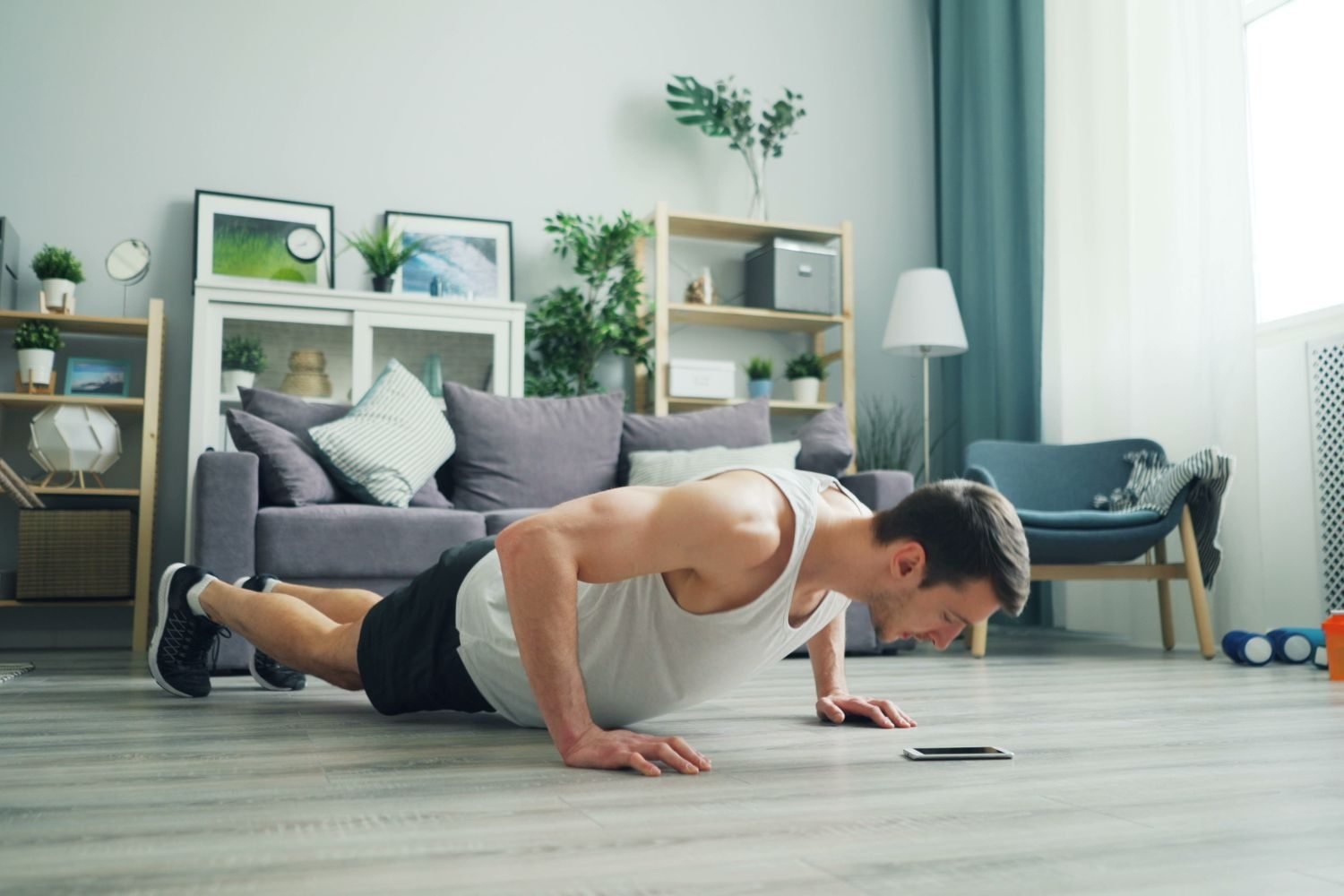
Take the push-up. A standard push-up is moderate difficulty, and from there you can make it progressively harder without touching a weight:
- Elevate your feet on a chair or step
- Slow the eccentric (lowering phase) down to three seconds
- Move to single-arm progressions, a resistance most people can’t handle even with weights
The tools are different, the stimulus is the same.
Do You Need Equipment To Start A Home Workout?
No. You can build a genuinely effective training habit with nothing but floor space and your own bodyweight. Push, pull, squat, hinge, and carry patterns are all trainable without a single piece of equipment. A mat helps for floor work and a pull-up bar opens up back training, but neither is mandatory to start.
Once bodyweight training gets too easy, and it will, the natural next step is adding load. That’s where a home dumbbell workout comes in. A pair of adjustable dumbbells is the single best equipment upgrade for a home gym because it lets you keep progressing the same movement patterns with actual added resistance instead of relying only on harder bodyweight variations. If you already own a set, our guide to dumbbell workouts covers how to structure sessions around them.
How Much Space And Time Do You Actually Need?
Six feet by six feet is enough for almost every bodyweight exercise, including lunges if you turn to face the long side of the space. You don’t need a home gym room. A cleared corner of a bedroom or living room works fine. Time-wise, a proper full-body home workout takes 30 to 40 minutes including warm-up, and you don’t need daily sessions to see results. Three to four sessions a week, done consistently, beats seven rushed ones. This setup matters a lot in Indian cities, where balconies, hostel rooms, and one-bedroom apartments are the norm and a dedicated home gym simply isn’t realistic for most people.
What Does A Full Bodyweight Home Workout Look Like?
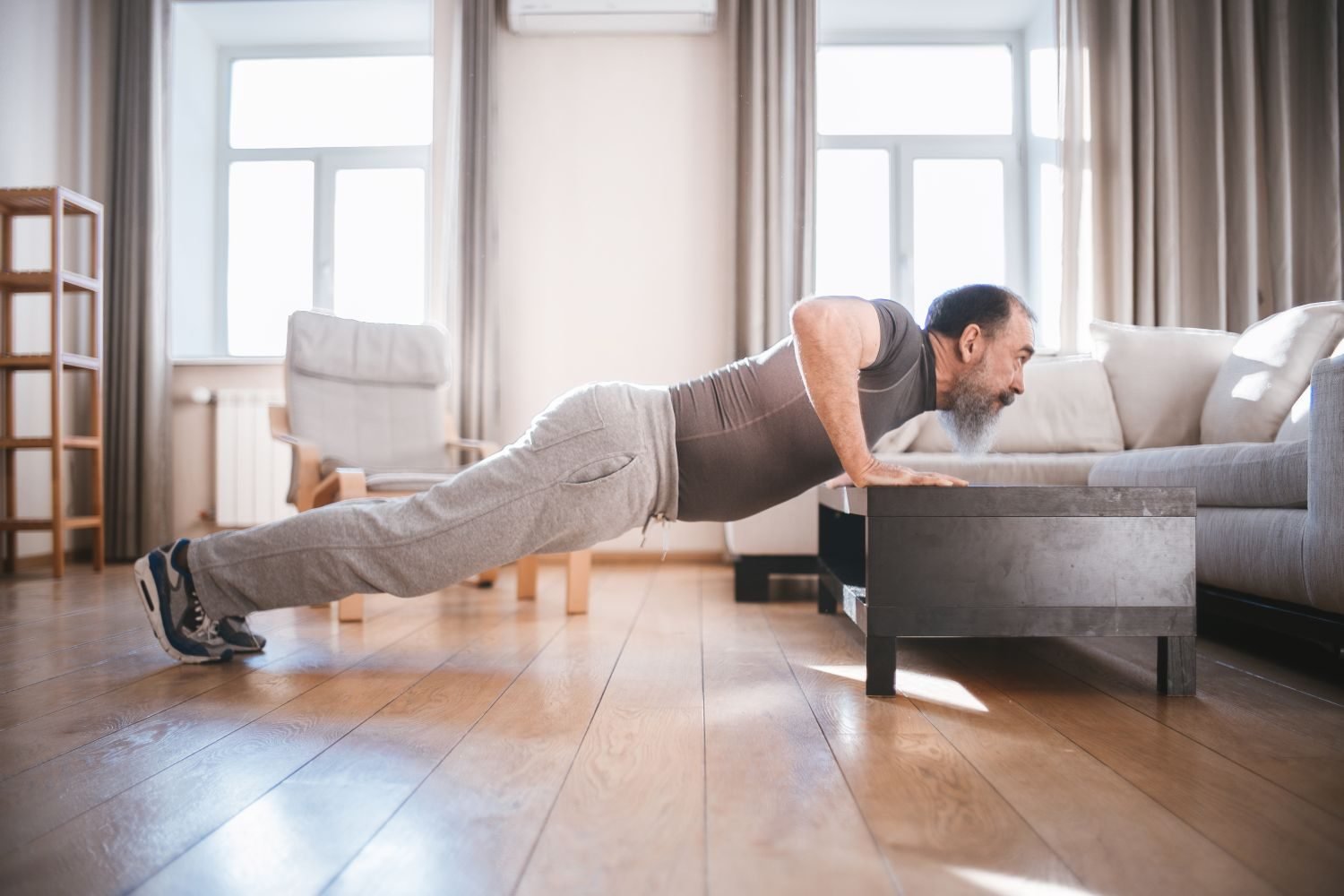
Here’s a sample full-body session we use with clients starting out. It hits every major movement pattern and needs nothing but floor space.
| Exercise | Sets | Reps | Rest |
|---|---|---|---|
| Bodyweight squat | 3 | 15-20 | 60 sec |
| Push-up (knee or standard) | 3 | 8-15 | 60 sec |
| Reverse lunge | 3 | 10 per leg | 60 sec |
| Glute bridge | 3 | 15-20 | 45 sec |
| Plank | 3 | 30-45 sec hold | 45 sec |
| Superman hold | 3 | 12-15 | 45 sec |
| Mountain climbers | 3 | 20 per side | 45 sec |
Run through this as a straight circuit or in traditional sets, resting as noted above. Beginners should stick to two or three rounds twice a week for the first two weeks before adding a third session. Once you can complete all sets with two reps in reserve, it’s time to progress: slow the tempo, add a pause at the bottom, or move to a harder variation like decline push-ups or single-leg glute bridges.
If you want a version of this built specifically around men’s strength goals, our home workout for men guide breaks down a similar structure with heavier progression targets. And if bodyweight training on its own interests you long-term, our dedicated bodyweight workout guide goes deeper into progressions for each pattern.
Where Does A Home Workout Fall Short?
Here’s the part most articles won’t tell you straight. Bodyweight training has a ceiling. You can get remarkably strong and lean using nothing but your own weight, but eventually the exercises stop giving you enough resistance to keep forcing adaptation, especially for your legs and back. A bodyweight squat only asks so much of your quads once you’re doing sets of 40. At that point you either need to make the movement mechanically harder, which has limits, or add external load.
This is where a lot of home training plans stall out. People hit a plateau around the three to six month mark, get frustrated that push-up and squat numbers stop climbing, and assume home training doesn’t work. It’s not that it stopped working. It’s that the exercises ran out of resistance to give. Adding a pair of dumbbells, a resistance band set, or even a weighted vest solves this cleanly and lets you keep the same small-space setup.
In our coaching experience, we see this plateau most often with people who trained hard on bodyweight-only programs for months without ever introducing load. They’re strong relative to where they started, but their squat and press numbers flatten out well before their motivation does. The fix isn’t complicated. It’s just adding resistance before the plateau hits, not after.
Is A Home Workout Enough To Build Muscle Or Lose Fat?
Yes, for most people, most of the time. Fat loss comes down to a calorie deficit and enough training volume to preserve muscle while you’re in it, and a structured bodyweight program covers that easily. Muscle building works too, particularly for beginners, whose bodies respond to almost any consistent resistance training with visible gains for the first several months. Where home training genuinely struggles is late-stage muscle building for people who are already reasonably strong. At that point, without added load, progress slows to a crawl no matter how creative the programming gets.
The other variable that matters more than people expect is coaching. A workout plan you follow inconsistently, with bad form and no progression logic, won’t get you far whether it’s at home or in a gym. This is why pairing home training with actual guidance changes outcomes. If you’re not ready to work with a coach in person, online workouts guided by a real trainer give you the structure and form correction that a YouTube video can’t.
FAQ
What is a home workout?
A home workout is a structured exercise session done outside a gym, typically using bodyweight, resistance bands, or basic equipment like dumbbells. It follows the same training principles as a gym session, progressive overload, movement balance, and adequate volume, just adapted to a smaller space and simpler equipment.
How do you workout at home?
Pick a small clear space, warm up for five minutes, then train a mix of push, pull, squat, hinge, and core movements three to four times a week. Track your reps and sets so you know when to progress. Add difficulty through tempo, range of motion, or single-limb variations before you plateau.
How do you do a home workout properly?
Follow a written plan rather than random exercises, warm up first, and prioritize form over speed or reps. Rest 45 to 60 seconds between sets, progress exercises every one to two weeks, and keep a log so you can see when a movement has stopped challenging you.
What are the benefits of a home workout?
Home workouts save commute time, cost little to nothing, and remove the intimidation factor some people feel in a gym. They build real strength and improve cardiovascular fitness, especially for beginners, and they’re easy to stay consistent with since there’s no travel barrier to starting.
How many days a week should I do a home workout?
Three to four sessions a week is the sweet spot for most people, with at least one rest day between sessions that train the same muscle groups. Daily bodyweight training is fine for mobility or light cardio, but strength-focused sessions need recovery time to actually produce results.
Home training is a legitimate way to get stronger, leaner, and fitter, and for most people it’s the easiest program to actually stick with. But sticking with the wrong plan for too long, or not knowing when to add load, wastes months. If you want a home workout plan built around your goals, equipment, and schedule, with a coach checking your form and adjusting the plan as you progress, FitStrot’s 1-on-1 personal training does exactly that, whether you’re training in a gym or your living room.