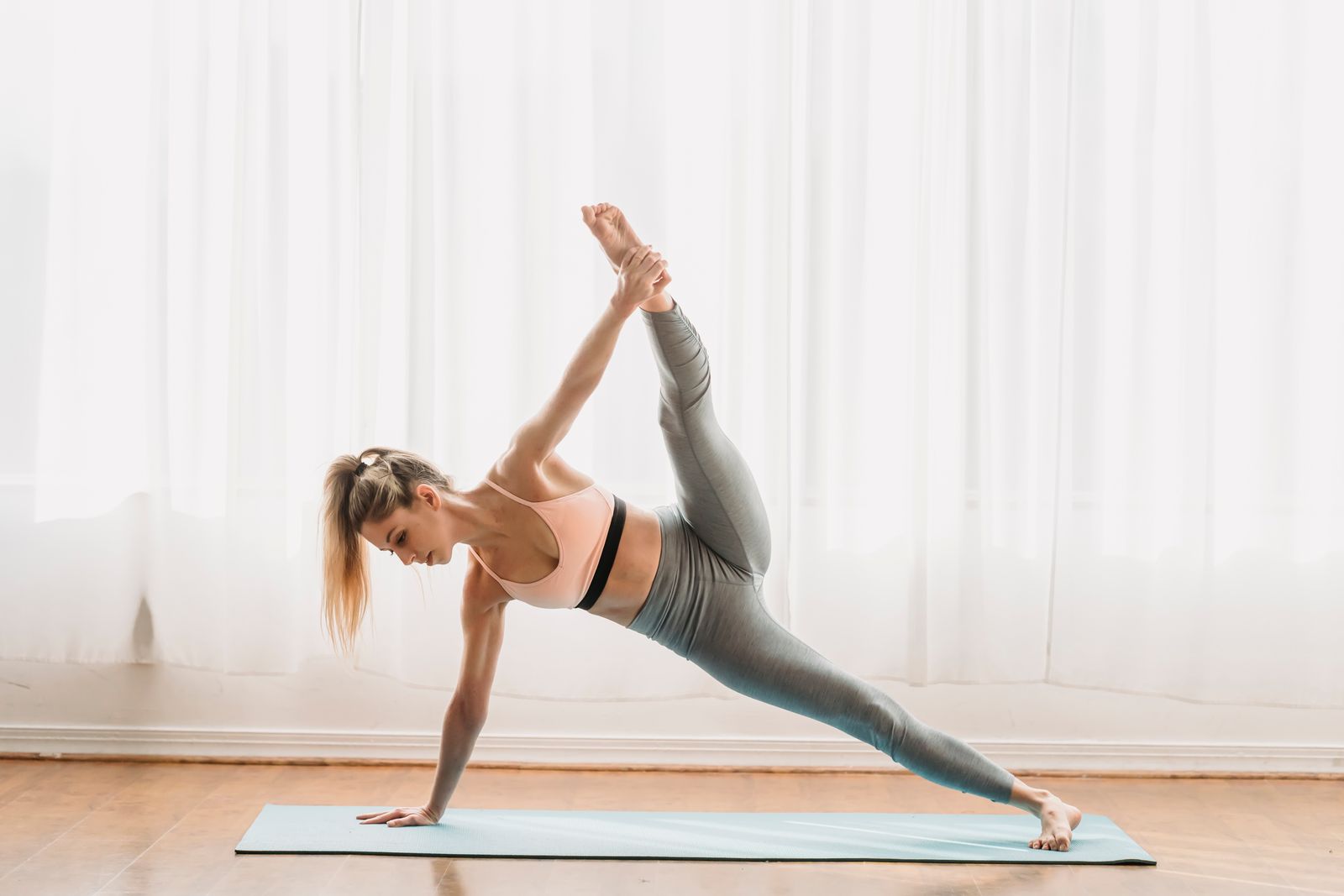
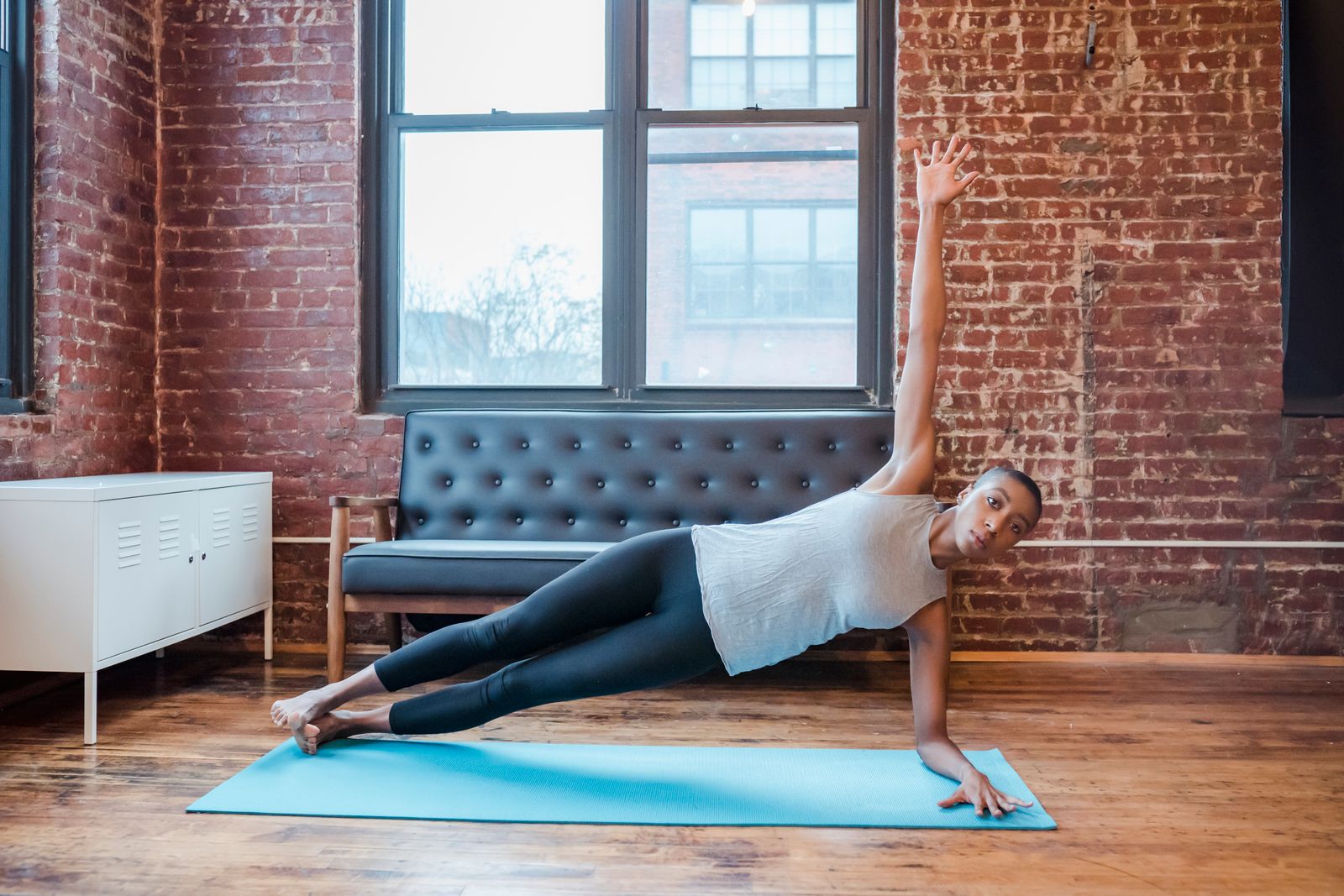
Vasisthasana, known in English as Side Plank Pose, is a balancing arm-support posture in which the body forms a single diagonal line resting on one hand and the outer edge of one foot, while the opposite arm reaches toward the ceiling. It strengthens the wrists, shoulders, obliques, and hips, sharpens balance, and builds the kind of full-body stability that carries over into Surya Namaskar sequences, standing balances, and everyday movement. Named after the sage Vasistha, one of the revered rishis of Indian tradition, this pose is typically practiced after warming up the body and is considered an intermediate posture because it demands both shoulder stability and core control at the same time.
What Is Vasisthasana in Yoga?
Vasisthasana combines two Sanskrit words: “Vasistha,” the name of a sage credited in yogic lore with deep wisdom and steady discipline, and “asana,” meaning pose or seat. The posture asks the practitioner to support the entire body weight on one straight arm and the outer edge of one foot, while the torso, hips, and legs stay in one long line. It belongs to the broader family of arm-balancing yoga poses and is frequently sequenced within a Vinyasa or Ashtanga flow, often emerging directly out of a plank or Chaturanga transition. Because it isolates one side of the body at a time, it also functions as a diagnostic pose, quickly revealing strength or flexibility imbalances between the left and right sides.
How Do You Get Into Side Plank Pose Step by Step?
Begin in a standard plank position with wrists stacked under shoulders and the body in one straight line from head to heels. Shift your weight onto your right hand and the outer edge of your right foot, stacking your left foot on top of the right or staggering it slightly in front for more stability. Rotate your torso and hips open toward the left side of the room. Extend your left arm straight up toward the ceiling, in line with your right arm, so both arms form a vertical line through the shoulders. Press firmly through the base hand and the outer foot, keep the hips lifted so the body does not sag, and gaze forward or up toward the raised hand. Hold for several breaths before lowering back to plank and repeating on the other side.
Which Muscles Does Vasisthasana Strengthen?
Side Plank Pose is a compound strengthener that recruits several muscle groups simultaneously:
- Obliques and transverse abdominis: work hardest to keep the hips from dropping, making this one of the more effective standing-adjacent core exercises in a yoga practice.
- Shoulder stabilizers (rotator cuff and serratus anterior): keep the supporting shoulder joint secure under load.
- Wrist flexors and extensors: absorb weight-bearing stress through the supporting hand.
- Gluteus medius: controls hip alignment on the supporting leg.
- Inner and outer thigh muscles: stay active in both legs, since the top leg must engage rather than simply resting on the bottom one.
Because so many muscle groups fire together, Vasisthasana is often used as a functional strength assessment in a well-rounded practice alongside poses like Vrksasana.
What Are the Benefits of Practicing Vasisthasana Regularly?
Consistent practice of Side Plank Pose builds wrist, shoulder, and core strength in a way few other postures replicate, since it isolates one side of the body under full body-weight load. It sharpens proprioception and balance, which supports better performance in standing poses and reduces the likelihood of falls as the nervous system becomes more efficient at reading joint position. The pose also improves lateral core strength specifically, an area that many forward-and-backward-focused exercise routines neglect. Practitioners commonly report improved posture, since a stronger oblique and shoulder-stabilizer chain makes it easier to hold the spine upright throughout the day. It is also frequently used as functional preparation for more advanced arm balances such as Astavakrasana and Eka Pada Koundinyasana, because it teaches the body to trust a single point of ground contact under load.
What Are Common Mistakes in Vasisthasana?
The most frequent error is letting the hips sag toward the floor, which shifts load away from the core and onto the shoulder joint, raising injury risk. Another common mistake is placing the supporting hand too far forward or too far back relative to the shoulder, which destabilizes the wrist and elbow alignment. Many practitioners also collapse through the supporting shoulder blade instead of pressing the floor away, which can strain the rotator cuff over time. A third mistake is turning the head or torso before the hips are stacked and lifted, which throws off the balance point before the pose is fully established. Finally, holding the breath during the pose is common under exertion, but steady inhalation and exhalation actually make it easier to maintain the position for longer.
What Variations and Modifications Exist for Side Plank Pose?
Side Plank Pose can be adapted for nearly every level, progressing from a supported beginner variation to more advanced hip-opening challenges:
- Knee-down modification: drop the bottom knee to the mat to reduce load on the wrist and shoulder while still building core awareness.
- Staggered foot placement: place the top foot on the floor in front of the bottom foot, rather than stacked directly on top, to widen the base and make balance considerably easier.
- Wall-supported version: lightly touch the supporting hand or foot to a wall to build confidence before attempting the full unsupported pose.
- Vasisthasana II: lift the top leg and catch the big toe with the free hand, adding a hamstring and hip-opening component.
- Half-lotus bind: bend the top knee into a half-lotus-style bind, deepening the hip stretch while still demanding full-body stability.
How Does Vasisthasana Compare to Other Plank Variations?
A standard plank distributes weight evenly across both arms and both feet, making it primarily a front-core and shoulder endurance exercise. Vasisthasana removes one point of contact on each side of the body, converting a bilateral hold into a unilateral balance and strength challenge that emphasizes the obliques far more than a standard plank does. Compared to Tadasana, which builds grounded standing awareness through both feet on the floor, Side Plank Pose trains balance through the hands and a single foot, engaging an entirely different proprioceptive pathway. Reverse plank, by contrast, opens the front of the shoulders and hips while Vasisthasana closes and stabilizes the lateral line of the body, so the two are often used as complementary poses within the same practice.
How Long Should You Hold Vasisthasana?
For most practitioners, holding Side Plank Pose for five to eight breaths per side, roughly 20 to 30 seconds, is a reasonable starting target that builds strength without compromising alignment. As shoulder and core endurance improve, the hold can be extended to 45 seconds or longer, though quality of alignment should always take priority over duration. Beginners are better served by holding a modified version with the bottom knee down for a full breath cycle than by forcing an unsupported hold that collapses through the hips. Practicing both sides for an equal duration is important, since most people have a naturally stronger or more stable side and skipping the weaker side reinforces the imbalance rather than correcting it.
Who Should Avoid or Modify Vasisthasana?
People with wrist injuries, carpal tunnel syndrome, or recent shoulder surgery should approach this pose cautiously or skip it until cleared by a physical therapist, since it places substantial load through the wrist and shoulder joint. Those with acute lower back pain may want to build core strength through gentler options first, since a collapsed side plank can strain the lumbar spine rather than support it. Pregnant practitioners, especially in the second and third trimesters, are generally advised to modify or avoid full unsupported balancing poses on one arm and should consult a qualified prenatal yoga teacher for safer alternatives. As with any new posture, working with an experienced instructor, whether in person or through online yoga classes, helps ensure the pose is modified appropriately for individual injuries or limitations.
How Does Vasisthasana Fit Into a Broader Yoga Practice?
Side Plank Pose is rarely practiced in isolation. It typically appears within a Vinyasa flow as a transition from plank or Chaturanga, often on the way toward a standing sequence or a deeper hip-opening posture. Within Vinyasa yoga, it serves as a strength-building punctuation mark between longer holds, keeping the heart rate elevated while sharpening focus. In a more Hatha-paced class, it might be held longer as a standalone strength posture, bookended by counter-stretches like Balasana or a gentle twist. Teachers frequently pair it with Plank Pose and Chaturanga Dandasana so students build the pressing strength needed before attempting the balance component.
What Breathing Pattern Works Best in Side Plank Pose?
Steady ujjayi breath, a slightly audible ocean-sounding breath through the nose, helps maintain focus and core engagement throughout the hold. Exhaling as you lift into the pose engages the deep abdominal muscles more effectively than a held breath, and continuing to breathe evenly once in position prevents the unnecessary muscular tension that comes from breath-holding under exertion. Many practitioners find that counting breaths rather than seconds makes the hold feel more manageable, since it shifts attention away from clock-watching and back onto the body. This breathing approach mirrors the pranayama principles taught more formally in dedicated pranayama breathing techniques, where breath control is treated as a skill in its own right rather than an afterthought.
How Can Beginners Build Toward a Full Side Plank?
Building toward an unsupported Vasisthasana usually starts with basic plank holds to establish shoulder and core endurance, followed by forearm-supported side plank variations that reduce wrist strain while the stabilizing muscles adapt. Practicing hip lifts from a side-lying position, without the arm balance component, isolates and strengthens the obliques and gluteus medius specifically. Wall-supported side planks, where the raised hand or top foot lightly touches a wall for balance, let beginners feel the correct alignment without the fear of toppling over. Consistent practice two to three times per week for several weeks is generally enough for most people to move from a modified version to a confident full hold, though timelines vary based on existing shoulder and core strength.
What Role Does Vasisthasana Play in Building Core Stability for Other Poses?
Because it trains the lateral core in a way that most forward-facing exercises do not, Side Plank Pose has a direct carryover into balance-dependent postures elsewhere in a practice. Stronger obliques and hip stabilizers make single-leg standing poses noticeably steadier, since the same muscles that keep the hips level in Vasisthasana are recruited to keep the pelvis square in a standing balance. This is one of the reasons teachers often sequence Side Plank Pose earlier in a class, using it to “wake up” the stabilizing muscles before moving into more demanding standing or arm-balance work later in the session. Over time, this cross-training effect reduces wobble and improves confidence across the entire practice, not just within the pose itself.
Questions People Ask About Vasisthasana
Is Vasisthasana good for beginners?
Vasisthasana is generally considered an intermediate pose because it requires both wrist and shoulder strength along with core control. Beginners can still practice a modified version with the bottom knee resting on the mat, which builds the necessary strength safely. With consistent practice of foundational poses like plank, most beginners can work toward the full pose within a few weeks.
What does Vasisthasana mean in Sanskrit?
Vasisthasana comes from “Vasistha,” the name of a revered sage in Indian tradition often associated with wisdom and steadiness, combined with “asana,” meaning pose. The English name, Side Plank Pose, describes its physical shape more directly: a plank position rotated onto one side of the body.
Can Vasisthasana help with core strength specifically?
Yes, Side Plank Pose is one of the more effective yoga postures for targeting the obliques and lateral core muscles, which many standard core exercises overlook. Because the entire body weight is supported on one side, the deep stabilizing muscles of the trunk have to engage continuously to prevent the hips from dropping.
Why do my wrists hurt in Side Plank Pose?
Wrist discomfort in Vasisthasana usually comes from incorrect hand placement or insufficient wrist warm-up before attempting the pose. Make sure the supporting wrist is stacked directly under the shoulder, spread the fingers wide for a broader base, and consider a forearm-supported variation if wrist pain persists.
How is Vasisthasana different from a regular plank?
A regular plank distributes body weight across both arms and both feet, primarily challenging the front core and shoulders. Vasisthasana shifts all of that weight onto one arm and the outer edge of one foot, converting the exercise into a unilateral balance and strength challenge that emphasizes the obliques far more heavily.
Try This for Yourself
Reading about Vasisthasana is a useful starting point, but the fastest way to build a safe, confident Side Plank Pose is with real-time feedback on your alignment. Join a live, guided class with FitStrot’s online yoga classes and get personalized coaching to develop this pose and dozens of others at your own pace, from wherever you practice.
Related reading: explore more foundational postures in our guide to yoga poses, warm up with a full Surya Namaskar breakdown, build grounded awareness with Tadasana, and train balance further with Vrksasana. When you’re ready to practice with expert guidance, check out FitStrot’s online yoga classes.