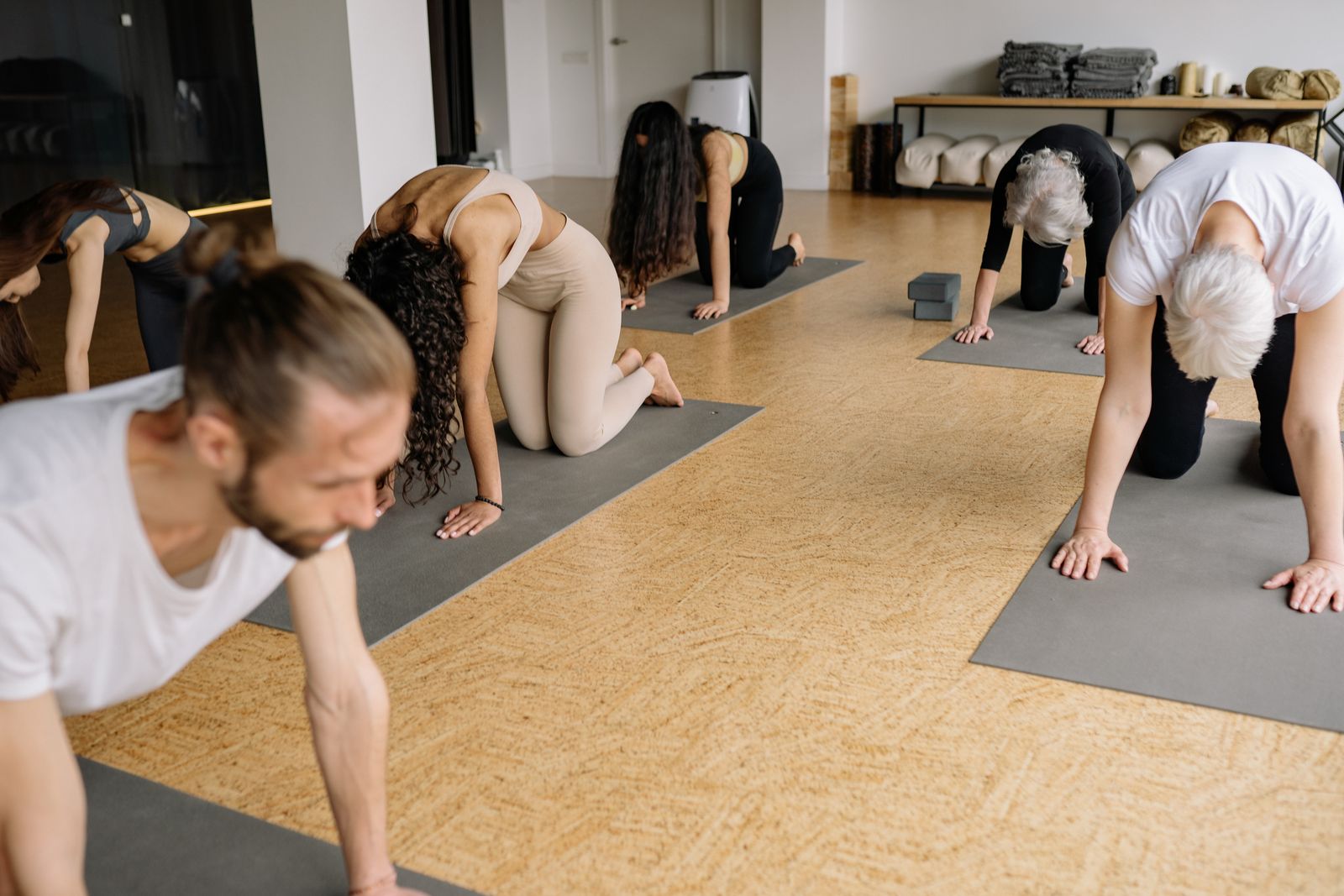
Marjariasana, or Cat Pose, is a kneeling yoga posture practiced on all fours in which you round the spine upward on an exhale, tucking the chin and tailbone, then release into a neutral or slightly extended spine on the inhale. It’s almost always taught paired with Bitilasana (Cow Pose), the two together forming the familiar “cat-cow” flow that warms up the entire spine. The movement mobilizes each vertebra in sequence, releases tension in the neck and lower back, and syncs breath with motion, which is why it opens so many yoga classes regardless of style or level.
What Does “Marjariasana” Mean?
The name comes from Sanskrit: marjari means “cat,” and asana means “seat” or “posture.” The pose is named for the rounded-spine shape a cat makes when it arches its back, and the resemblance is deliberate — the rounding action in Marjariasana closely mirrors how a cat stretches after resting. In most modern classes, Marjariasana refers specifically to the rounded, spine-flexion half of the movement, while the counter-motion (arching the spine, lifting the chest and tailbone) is called Bitilasana, or Cow Pose. Together they’re commonly shortened to “cat-cow,” a name so widely used that many students know the combined flow without ever hearing the Sanskrit terms separately.
How Do You Do Marjariasana (Cat-Cow) Step by Step?
Cat-Cow is a slow, breath-linked flow rather than a static hold. Here’s how to move through it with good form:
- Come onto your hands and knees in a tabletop position. Stack your wrists directly under your shoulders and your knees directly under your hips.
- Spread your fingers wide and press evenly through the palms, distributing weight across the whole hand rather than the wrists alone.
- Find a neutral spine first, with your gaze toward the floor and your neck in line with your back.
- Inhale into Cow Pose (Bitilasana): drop your belly toward the mat, lift your chest and tailbone upward, and let your gaze rise gently toward the ceiling without straining the neck.
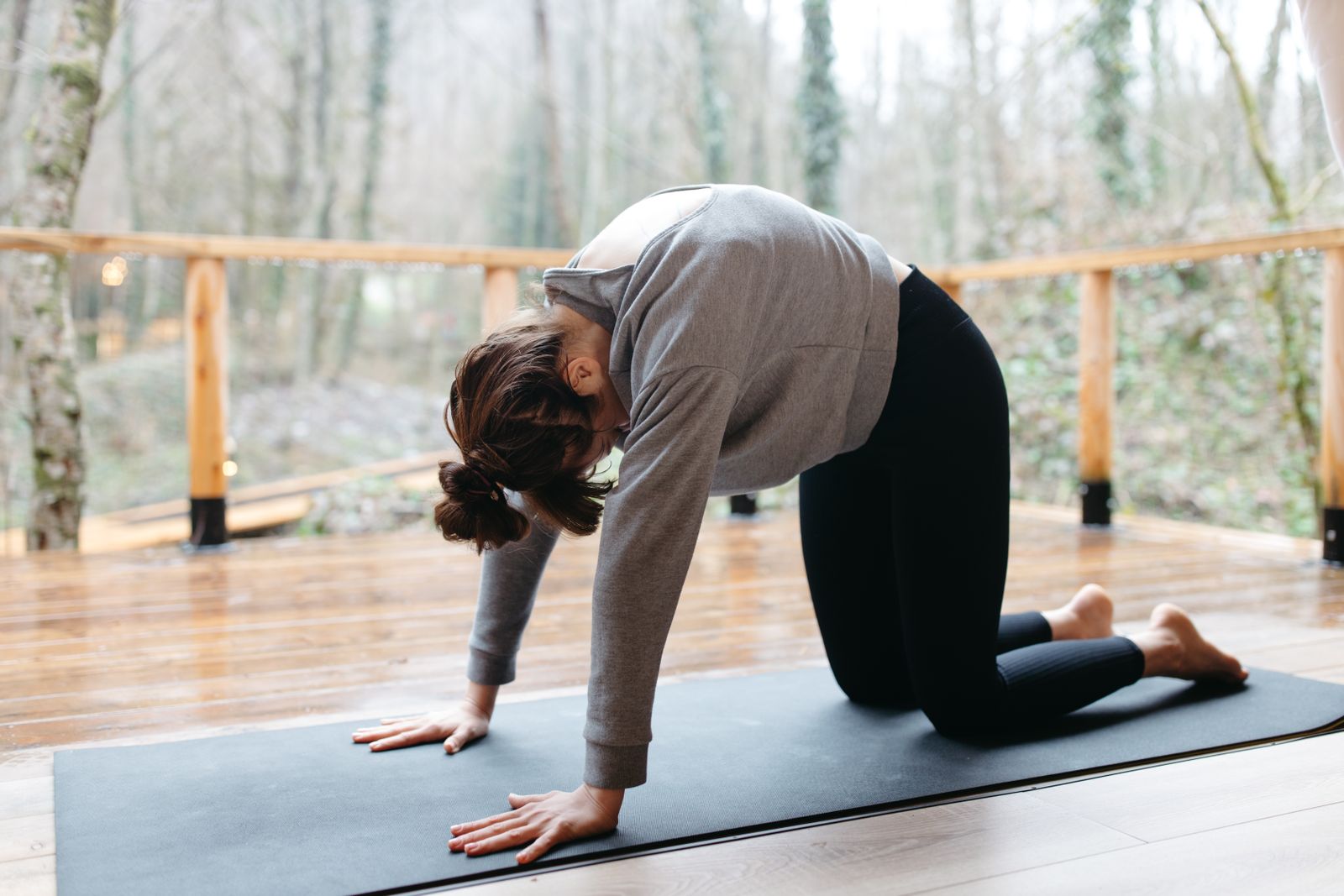
- Exhale into Cat Pose (Marjariasana): round your spine toward the ceiling, tuck your chin toward your chest, and draw your tailbone under, pressing the floor away through your hands and shins.
- Continue moving with your breath, one inhale for Cow and one exhale for Cat, for 8 to 12 rounds, or longer if using it as a warm-up.
- Return to neutral tabletop when finished, then sit back into a comfortable resting position such as Child’s Pose.
If tabletop position itself feels unfamiliar, it helps to first build comfort with foundational yoga poses before layering on the breath-synced movement.
What Are the Benefits of Marjariasana (Cat-Cow)?
Cat-Cow is deceptively simple, but each phase of the movement contributes something distinct to spinal and nervous system health.
Full-spine mobilization. Because the flow alternates flexion and extension through every segment of the spine — cervical, thoracic, and lumbar — it’s one of the few poses that mobilizes the entire back in a single movement pattern, rather than isolating one region.
Relief from stiffness and tension. Regular practice is commonly reported to ease tightness that builds up from sitting or standing for long stretches, particularly through the lower back and between the shoulder blades.
Breath-movement coordination. Linking one full breath to one phase of movement trains the kind of steady, controlled breathing used throughout a broader vinyasa practice, and is often one of the first breath-synced patterns a new student learns.
Gentle core activation. The rounding phase engages the abdominal muscles lightly, while the extension phase calls on the muscles along the spine, giving both sides of the trunk a small, low-intensity workout.
A calming, rhythmic quality. The repetitive, breath-paced nature of the flow has a settling effect similar to other rhythmic warm-ups, making it a common opening sequence before deeper backbend yoga poses or twists.
These benefits are described consistently across yoga teaching resources, though as with most postural claims, they should be understood as reported effects of regular practice rather than guaranteed medical outcomes.
Which Muscles Does Marjariasana Stretch and Strengthen?
The Cat phase stretches the muscles along the back of the spine, including the erector spinae, while gently engaging the abdominal muscles as the spine rounds. The Cow phase does the reverse, stretching the abdominal wall and the front of the torso while engaging the muscles along the back that lift the chest and tailbone. Across both phases, the shoulder stabilizers, wrists, and the muscles supporting the hips work isometrically to keep the tabletop base steady, which is part of why cat-cow is often used as a gentle way to build baseline strength before more demanding core-strengthening yoga poses.
What Are Common Variations of Marjariasana?
Once the basic flow feels steady, a few variations add range, challenge, or accessibility:
- Extended Cat-Cow with arm reach: on the Cow inhale, extend one arm forward while keeping the opposite three limbs grounded, then return to tabletop before switching sides. This adds a balance and stability challenge to the basic flow.
- Cat-Cow with lateral tilt: instead of moving purely in flexion and extension, gently rock the hips side to side at the peak of Cow Pose to add mobility through the sacroiliac joints.
- Seated Cat-Cow: for anyone who can’t comfortably kneel, the same spinal rounding and arching action can be practiced seated in a chair, hands resting on the knees, which makes it accessible during a workday or for those with knee limitations.
- Cat-Cow on an exercise ball: some practitioners use a stability ball instead of tabletop to add a slight balance component while performing the same spinal movement.
These variations pair naturally with a broader warm-up sequence, and many teachers move directly from cat-cow into Surya Namaskar (Sun Salutations) once the spine feels warm and mobile.
How Is Marjariasana Different From Bitilasana?
Marjariasana and Bitilasana are the two halves of the same flow, and the distinction matters if you’re following Sanskrit cues closely. Marjariasana, Cat Pose, is the rounded-spine shape: chin tucked, tailbone drawn under, spine curved upward toward the ceiling, typically paired with an exhale. Bitilasana, Cow Pose, is the opposite action: chest and tailbone lift, the belly drops toward the mat, and the spine arches gently, typically paired with an inhale. In everyday teaching, “cat-cow” usually refers to the two performed together as one continuous flow, but if a teacher cues “Marjariasana” on its own, they mean specifically the rounded, exhale phase.
How Does Marjariasana Fit Into a Yoga Practice?
Cat-Cow is most often used in three ways. First, as a warm-up, it’s frequently the very first movement in a class, mobilizing the spine before any standing or balancing postures. Second, as a transitional or resting flow, it appears between more demanding sequences to give the back a chance to reset. Third, as a therapeutic tool, it’s commonly recommended on its own, outside of a full class, as a short daily practice for spinal mobility and lower back comfort. In a typical sequence, cat-cow might lead into Tadasana and a standing warm-up, or it might follow a seated breathing practice as covered in guides on pranayama breathing techniques, using the movement to bridge stillness and activity.
Who Should Avoid or Modify Marjariasana?
Cat-Cow is a low-intensity, widely accessible pose, but a few situations call for caution or modification:
- Wrist injuries: the tabletop base places weight through the wrists, so anyone with wrist pain, carpal tunnel symptoms, or a recent wrist injury should practice on fists or forearms instead of flat palms, or try the seated variation.
- Knee injuries: kneeling on a hard surface can aggravate sensitive knees; using a folded blanket or thicker mat under the knees usually resolves this.
- Neck issues: avoid dropping the head back too far in the Cow phase if you have neck pain or a cervical spine condition; keep the neck in a long, neutral line instead.
- Pregnancy: cat-cow is frequently recommended during pregnancy for back comfort, but as with any pose during pregnancy, movements should stay gentle and well within a comfortable range, ideally with guidance from a prenatal-qualified instructor.
- Recent spinal surgery or acute back injury: get individualized clearance from a physician before resuming spinal flexion and extension movements.
As with any asana, these are general precautions rather than a substitute for advice from a qualified teacher or physician who knows your specific history.
What Mistakes Do Beginners Make in Marjariasana?
A few habits quietly reduce how much benefit you get from the pose. Watch for these:
Moving faster than the breath. Cat-Cow works because the movement is paced to a full inhale and a full exhale. Rushing through the motion turns it into a quick stretch rather than the slow, mobilizing flow it’s meant to be.
Collapsing into the wrists. Letting the shoulders sink toward the hands instead of pressing the floor away puts unnecessary strain on the wrist joints. Keep a slight push through the palms throughout the flow.
Only moving the neck. Some beginners drop or lift only the head rather than moving the whole spine as a connected unit. The neck should follow the motion of the spine, not lead it.
Skipping neutral tabletop. Jumping straight from Cat to Cow without briefly passing through a neutral spine can make the movement feel jerky rather than fluid. Let the transition flow smoothly through the middle.
How Does Marjariasana Compare to Similar Poses?
Cat-Cow sits in a category of its own as a dynamic, breath-linked warm-up rather than a static hold, which makes it useful to compare against nearby poses. Compared to Vrksasana (Tree Pose), a standing balance posture, cat-cow is grounded on all fours and focused entirely on spinal movement rather than balance. Compared to Tadasana, the foundational standing pose, cat-cow works the spine through active flexion and extension rather than a single tall, static alignment. And compared to deeper backbends elsewhere in a sequence, cat-cow’s Cow phase is a gentle, accessible introduction to spinal extension, making it a sensible warm-up before attempting more advanced backbend yoga poses. If you’re building a broader repertoire of spine-friendly movement, it’s worth exploring the wider library of yoga for back pain and how different poses complement each other.
Can Marjariasana Help With Back Pain?
Cat-Cow is one of the most frequently recommended gentle movements for general lower back discomfort, and it appears often in physical therapy and yoga-therapy contexts alike because it moves the spine through a full, controlled range without loading it under weight. The alternating flexion and extension can help ease stiffness that builds up from prolonged sitting or standing. That said, cat-cow is a general mobility movement, not a treatment for a specific diagnosed condition, so anyone with ongoing or severe back pain should get an individualized assessment before relying on it as a fix. It pairs well with the broader guidance found in resources on yoga for back pain.
How Often Should You Practice Marjariasana?
Because it’s such a low-impact, controlled movement, Marjariasana and Bitilasana can be practiced daily without the recovery concerns that come with more demanding postures. Eight to twelve rounds is a reasonable daily dose for most people, whether used as a stand-alone morning mobility routine or as the opening sequence of a longer practice. If you’re using it purely as a warm-up before a fuller session, a shorter round of five or six repetitions is usually enough to prepare the spine; if you’re using it as a standalone reset during a sedentary day, a longer, slower round can be more effective than rushing through a quick set.
How Does Marjariasana Connect to Broader Yoga Philosophy?
Beyond the physical mechanics, cat-cow is often used as an early teaching tool for the concept of linking breath and movement, a principle that underlies most vinyasa-style practice and is closely related to the broader idea of pranayama, or breath control. Because the pose is simple enough that beginners can focus entirely on the breath-movement pairing without worrying about balance or strength, it’s frequently used in introductory classes to establish this pattern before applying it to more complex sequences. This makes it a natural entry point into the wider philosophy and practice explored in guides on types of yoga and how breath-led movement differs across styles.
Questions People Ask About Marjariasana
Is Marjariasana the same as Cat-Cow Pose?
Marjariasana technically refers only to Cat Pose, the rounded-spine half of the flow. Bitilasana is the Cow Pose half, with the spine arched and chest lifted. In everyday teaching, “cat-cow” refers to the two performed together as one continuous, breath-linked movement, which is how most students practice and recognize it.
How many rounds of cat-cow should I do?
Eight to twelve rounds is a common daily guideline for most practitioners, with each round linked to one full inhale and one full exhale. Shorter rounds of five or six work well as a quick warm-up before a fuller practice, while longer, slower rounds suit a standalone mobility session.
Can beginners do Marjariasana safely?
Yes, Marjariasana is considered one of the most beginner-friendly poses in yoga because it requires no special flexibility or strength, only a stable tabletop position and breath awareness. Beginners with wrist or knee sensitivity can modify the base by using a folded blanket under the knees or practicing on fists instead of flat palms.
Does cat-cow stretch help with back pain?
Cat-cow is widely used as a gentle mobility movement for general back stiffness and is commonly recommended in yoga-therapy and physical therapy settings. It moves the spine through a controlled range without added load. It isn’t a targeted treatment for a specific diagnosed condition, so persistent or severe back pain warrants individualized guidance first.
Can you practice cat-cow during pregnancy?
Cat-cow is frequently recommended during pregnancy for easing back discomfort and maintaining spinal mobility, since it’s low-impact and doesn’t require lying flat on the belly or back. As with any pregnancy practice, movements should stay gentle and within a comfortable range, ideally under guidance from a prenatal-qualified instructor.
What’s the best time of day to practice Marjariasana?
Many practitioners find it most useful first thing in the morning, when the spine tends to feel stiffest after sleep, or as a warm-up immediately before a longer practice. It also works well as a midday reset for anyone who sits for extended stretches, since the movement directly counters the stiffness that builds up from prolonged sitting.
Try This for Yourself
Reading about Marjariasana only gets you part of the way there — the real value comes from feeling the breath-linked movement through your own spine, with someone watching your alignment and pacing. If you’d like personalized guidance on this pose and how it fits into a session built around your body and goals, join a class with FitStrot’s online yoga classes and practice it live with an instructor.
Related reading: Yoga Poses, Surya Namaskar, Tadasana, Vrksasana, and Online Yoga Classes.