A good at-home ab session for men hits all three layers of the core (rectus abdominis, obliques, and transverse abdominis) in 15 to 20 minutes, using a mix of floor holds, rotational moves, and dynamic reps. You don’t need a gym or a stack of equipment. What you need is a circuit that combines a plank variation, a rotation move, a lower-ab exercise, and one dynamic finisher, done consistently three to four times a week. That combination trains strength and stability, not just burn. The rest is diet, and we’ll get to that honestly later in this piece.
What Does a Good At-Home Ab Workout Actually Look Like?
Most men we coach come in thinking ab training means crunches until it hurts. That’s not it. A well-built session covers four things: anti-extension (holding your spine steady against a force, like a plank), anti-rotation (resisting a twist, like a Pallof press), flexion (crunching movements), and rotation (Russian twists, woodchops). If your routine only has crunches and sit-ups, you’re training one pattern out of four, and your core will stay weak in the other three.
We build sessions around 4 to 6 exercises, 3 to 4 sets each, with short rest between. That’s enough volume to fatigue the core properly without turning into an hour-long slog nobody sticks with. If you want a broader look at how we structure programming across a full week, our main guide on ab workouts breaks down progression in more detail.
Which Muscles Are You Actually Training?
“Abs” isn’t one muscle. There are three layers worth knowing, because each one responds to different movement patterns.
- Rectus abdominis – the “six-pack” muscle running down the front of your stomach. It flexes your spine, so crunches, sit-ups, and leg raises hit it directly.
- Obliques – internal and external, running along your sides. They handle rotation and side-bending, so twists, side planks, and woodchop-style moves target them.
- Transverse abdominis – the deep stabilizing layer that wraps around your midsection like a corset. Planks, dead bugs, and hollow holds train this one, and it’s the muscle most home workouts skip entirely.
A session that only trains the rectus abdominis will leave you with a strong front and a weak, unstable everything else. That shows up as lower back tightness during heavier lifts, which is a pattern we see constantly with men who train abs at home but never touch anti-rotation or bracing work.
What Are the Best Bodyweight Ab Exercises for Men?
You don’t need a single piece of equipment to build a strong core. A solid calisthenics ab workout can be built entirely from floor ab workouts and a few standing variations. Here are the exercises worth knowing by name, since a lot of men recognize the movement but not the ab workout names attached to them:
- Plank and its variations (forearm plank, side plank, plank with shoulder taps) for anti-extension and anti-rotation strength.
- Dead bug for training your core to stay braced while your limbs move, which carries over directly to real-life lifting.
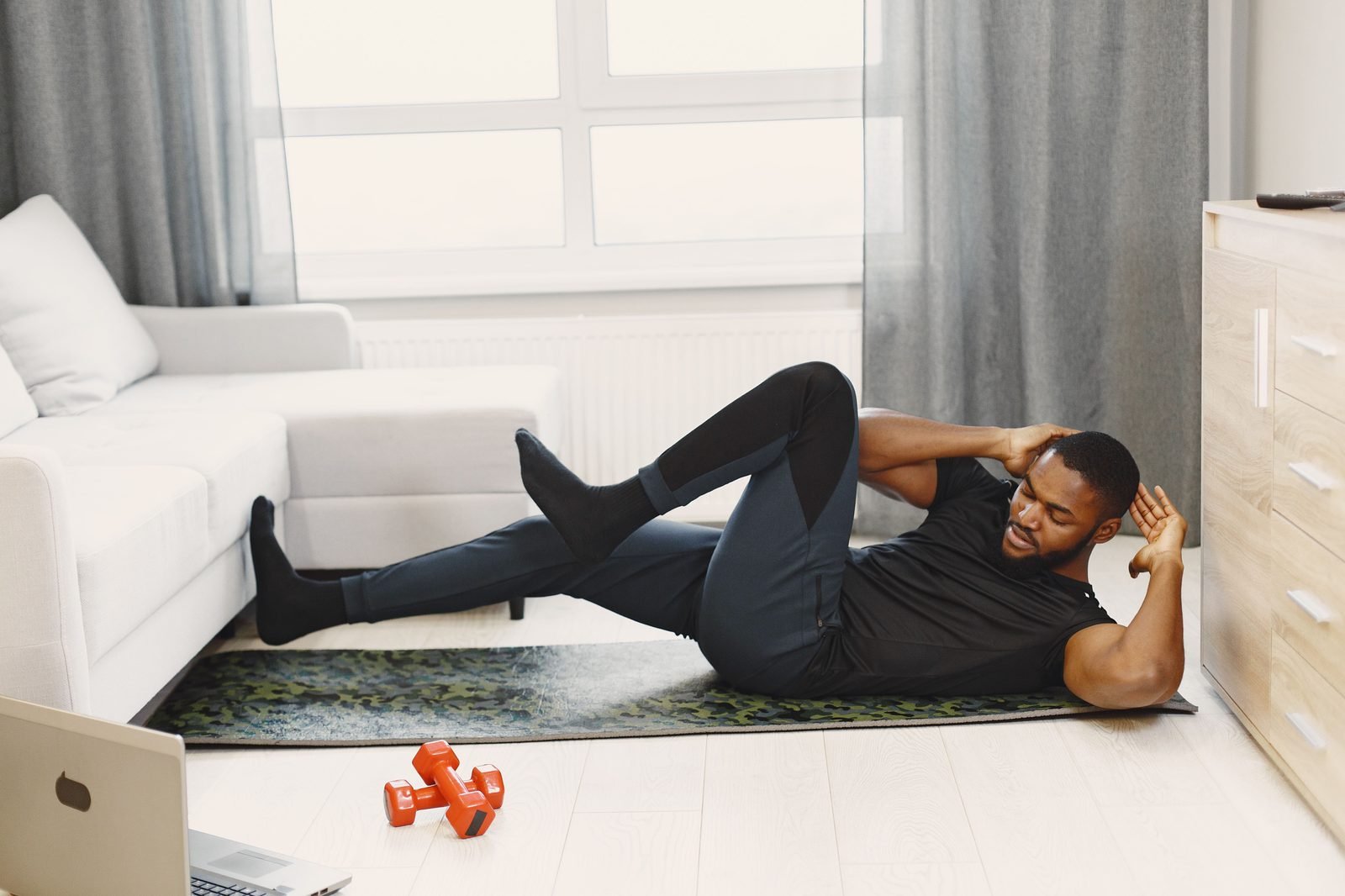
- Bicycle crunch for rotational flexion, hitting the obliques and rectus abdominis together.
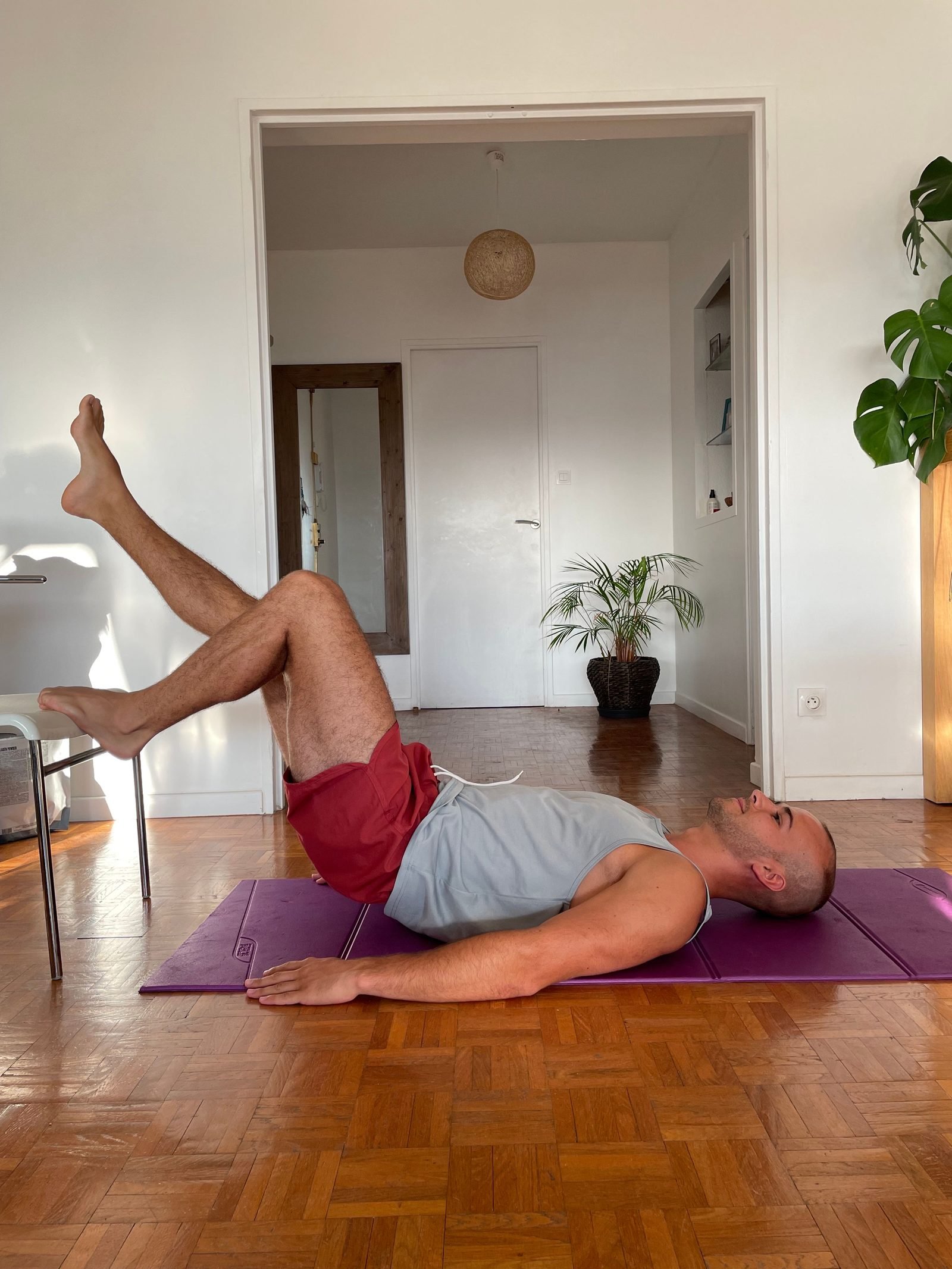
- Reverse crunch and leg raises for the lower abs, which most standard crunches barely touch.
- Mountain climbers for a dynamic finisher that raises your heart rate while still working the core.
- Russian twists for rotational strength, with or without added weight in your hands.
If you have a pull-up bar at home or in a nearby park, a hanging ab workout (hanging leg raises, hanging knee raises, or toes-to-bar) is one of the most effective lower-ab builders you can do, full stop. Gravity does the resistance work for you, so you get more tension per rep than almost any floor movement.
What Does a Sample Home Ab Circuit Look Like?
Here’s a full ab workout we actually give clients who train at home with little to no equipment. Run it as a circuit, resting only between rounds, and complete 3 rounds total.
| Exercise | Sets | Reps / Time | Rest |
|---|---|---|---|
| Forearm Plank | 3 | 40 seconds | 20 seconds |
| Bicycle Crunch | 3 | 20 reps (10 per side) | 20 seconds |
| Reverse Crunch | 3 | 15 reps | 20 seconds |
| Side Plank (per side) | 3 | 25 seconds each side | 20 seconds |
| Mountain Climbers | 3 | 30 seconds | 30 seconds (before next round) |
This whole thing takes about 18 to 20 minutes once you include rest, and it hits flexion, rotation, and anti-extension in a single session. Do it three or four times a week, not daily. Your core needs recovery time like any other muscle group.
Do You Need Equipment for Ab Workouts at Home?
No, but equipment can make things harder in useful ways once bodyweight stops being challenging. Ab workouts with weights, using a single dumbbell, a kettlebell, or even a filled backpack, add resistance to moves like Russian twists, weighted sit-ups, and standing woodchops. This matters most for men who’ve been training for a few months and find that 20 bodyweight reps no longer create much fatigue.
An ab workout with a ball, specifically a stability ball, is also worth adding if you have one lying around. Ball rollouts and stability ball pikes force your core to control an unstable surface, which builds strength that a flat floor simply can’t replicate. It’s not essential gear, but it’s a cheap addition that changes the difficulty curve a lot.
If you’d rather train with a full setup and machines, that’s a different conversation entirely, and one we cover in our piece on abs workout in the gym, which walks through cable and machine-based core training.
How Often Should Men Train Abs at Home?
Three to four sessions a week is the sweet spot for most men. Your abs are a muscle group, and muscle groups need 24 to 48 hours to recover between hard sessions. Training abs every single day, which a lot of men do because it feels “free” compared to leg day, actually slows progress because you never let the tissue rebuild.
If you’re new to structured training, start with easy ab workouts twice a week, just planks, dead bugs, and reverse crunches, and build volume from there over a few weeks. Jumping straight into daily circuits is how people end up with sore hip flexors and a workout they quit after ten days.
Why Aren’t Your Abs Showing? The Truth About Diet and Visible Abs
We’re going to be blunt here because too many articles dance around it: ab exercises build the muscle underneath, but they don’t burn the fat sitting on top of it. Visible abs come down almost entirely to body fat percentage, and body fat percentage comes down almost entirely to diet and total calorie balance. You can do a perfect ab circuit five days a week and still not see a six-pack if your body fat is sitting at 22%.
Spot reduction, the idea that training a specific muscle burns fat specifically from that area, isn’t how the body works. Fat loss happens across your whole body based on genetics and overall calorie deficit, not based on which muscle you just trained. So if visible abs are the actual goal, the honest answer is that your kitchen matters more than your workout plan. Strength training (including ab work), a calorie deficit, and adequate protein intake together get you there. Ab exercises alone don’t.
If a six-pack specifically is what you’re chasing, it’s worth reading our dedicated breakdown on the six pack workout approach, which covers training and nutrition together rather than training in isolation.
What Mistakes Do Men Make With Home Ab Workouts?
A few patterns show up over and over:
- Only doing crunches. As covered above, this trains one movement pattern and ignores rotation and anti-extension entirely.
- Rushing reps with bad form. Fast, sloppy crunches use momentum instead of muscle. Slow the tempo down and you’ll feel the difference within one set.
- Training abs daily and wondering why progress stalls. Recovery matters here as much as it does for any other muscle.
- Expecting visible results from training alone. Covered above, but it bears repeating because it’s the single biggest source of frustration we hear about.
- Skipping the lower abs and obliques. Most home routines default to rectus abdominis moves and skip reverse crunches, side planks, and rotational work entirely.
Fixing these five things alone will get most men further than adding new exercises to an already unbalanced routine.
Should You Train Alone or With a Coach?
Home workouts work, and everything in this article can be done in your living room with zero equipment. But form breaks down fast when nobody’s watching, especially on moves like dead bugs and hollow holds where small errors quietly turn a core exercise into a hip flexor exercise. If you want a program built around your actual body, schedule, and goals, with someone correcting your form in real time, our 1-on-1 personal training coaches at FitStrot build that plan with you from week one and adjust it as you progress.
Frequently Asked Questions
What are good ab workouts for men at home?
Planks, dead bugs, bicycle crunches, reverse crunches, and mountain climbers cover the main core patterns without any equipment. A good session mixes holds, rotation, and dynamic moves rather than repeating one exercise type, done in a circuit of 4 to 6 movements, 3 sets each.
How do you do ab workouts at home?
Pick 4 to 6 exercises covering flexion, rotation, and anti-extension. Run them as a circuit with short rest between exercises and longer rest between rounds. Complete 3 rounds, 3 to 4 times a week, and progress by adding reps, time, or light weight over several weeks.
What are the benefits of ab workouts at home?
A stronger core improves posture, protects your lower back during lifting, and improves balance and stability in everyday movement. It also builds the muscle that shows once body fat drops. Training at home removes the cost and time barrier of a gym membership entirely.
Can you get a six-pack from home ab workouts alone?
Not on their own. Home ab workouts build the muscle, but visible abs require low enough body fat to see that muscle, which depends on diet and overall calorie balance far more than on the workout itself. Combine training with a consistent calorie deficit for actual visible results.
How long before you see results from home ab workouts?
Strength and stability improve within 2 to 3 weeks of consistent training. Visible muscle definition depends on your starting body fat percentage and diet, and can take anywhere from a couple of months to longer, since fat loss, not the ab workout itself, is the limiting factor.