A plank workout is a set of timed holds and controlled movement variations, forearm plank, side plank, plank with shoulder taps, plank with leg lift, that train your core, shoulders, and hips to resist motion instead of create it. You’re not doing reps in the usual sense. You’re holding a straight line from head to heel while your abs, glutes, and shoulders fight to keep you still. Done with correct form, a plank workout takes ten minutes, needs no equipment, and builds core strength that carries over into squats, deadlifts, and everyday posture. Done with sagging hips or held breath, it mostly just burns time. This guide covers the setup, the mistakes we see almost every week in the gym, the best variations to rotate through, and a progression you can follow for eight weeks.

What Muscles Does a Plank Workout Actually Train?
People file planks under “abs,” but a proper plank is closer to a full-body isometric exercise. Your rectus abdominis and transverse abdominis stop your torso from sagging. Your obliques stop it from rotating, and if you want to build that rotational power directly, a woodchopper workout is a better fit than a static hold. Your erector spinae along the spine keeps your back from rounding. Your glutes and quads keep your hips level, and your shoulders and upper back hold your ribcage stacked over your wrists or elbows. That’s why a strong plank tends to show up as better bracing under a barbell, not just a flatter stomach. If your only goal is visible abs, planks alone won’t get you there without attention to diet, but if your goal is a core that actually stabilizes your lifts, this is one of the most direct ways to build it.
How Do You Do a Plank Workout With Correct Form?
Start on the floor. Set your elbows directly under your shoulders, forearms flat and parallel, or slightly angled in if that’s more comfortable on your wrists. Step your feet back until your body forms one straight line from your head to your ankles. Squeeze your glutes, pull your ribs down slightly so your lower back isn’t arching, and brace your core like someone’s about to poke you in the stomach. Keep your neck neutral by looking at the floor a few inches ahead of your hands, not straight down and not up at the wall. Breathe. That last part sounds obvious, but it’s where most planks fall apart.
Mistake 1: Sagging Hips
This is the most common fault we see, and it usually shows up in the second half of a hold, not the first. As the core fatigues, the hips drop toward the floor and the lower back takes over, turning a core exercise into a lower-back exercise. If your hips are sinking, the set is over. Drop to your knees, reset, or just stop the timer. A shorter, clean hold builds more strength than a longer one spent bailing out your spine.
Mistake 2: Raised Hips (The A-Frame Plank)
The opposite problem is just as common, usually from people trying to “cheat” a longer hold time. Piking the hips up into an A-frame takes tension off the core and shifts it onto the shoulders, making the position easier but far less useful. Check yourself against a mirror or have a training partner glance at your side profile. Hips should sit in line with your shoulders and ankles, not above them.
Mistake 3: Holding Your Breath
We see this constantly with newer clients: they lock their core so hard to “brace” that they stop breathing entirely for the whole hold. Your face goes red, your blood pressure spikes, and your core actually loosens as you run out of air near the end. A plank should let you breathe in a controlled, steady rhythm the entire time. If you can’t talk through the last ten seconds of a hold without gasping, you’re either holding too long for your current level or holding your breath instead of bracing properly.
What Are the Best Plank Variations?
Once basic form is solid, static holds stop being the limiting factor and variation becomes more useful than duration. These four cover most of what you need.
Forearm Plank
The standard version and the one to master first. Elbows under shoulders, straight line from head to heel, hold for time. Every other variation on this list builds on this base position.
Side Plank
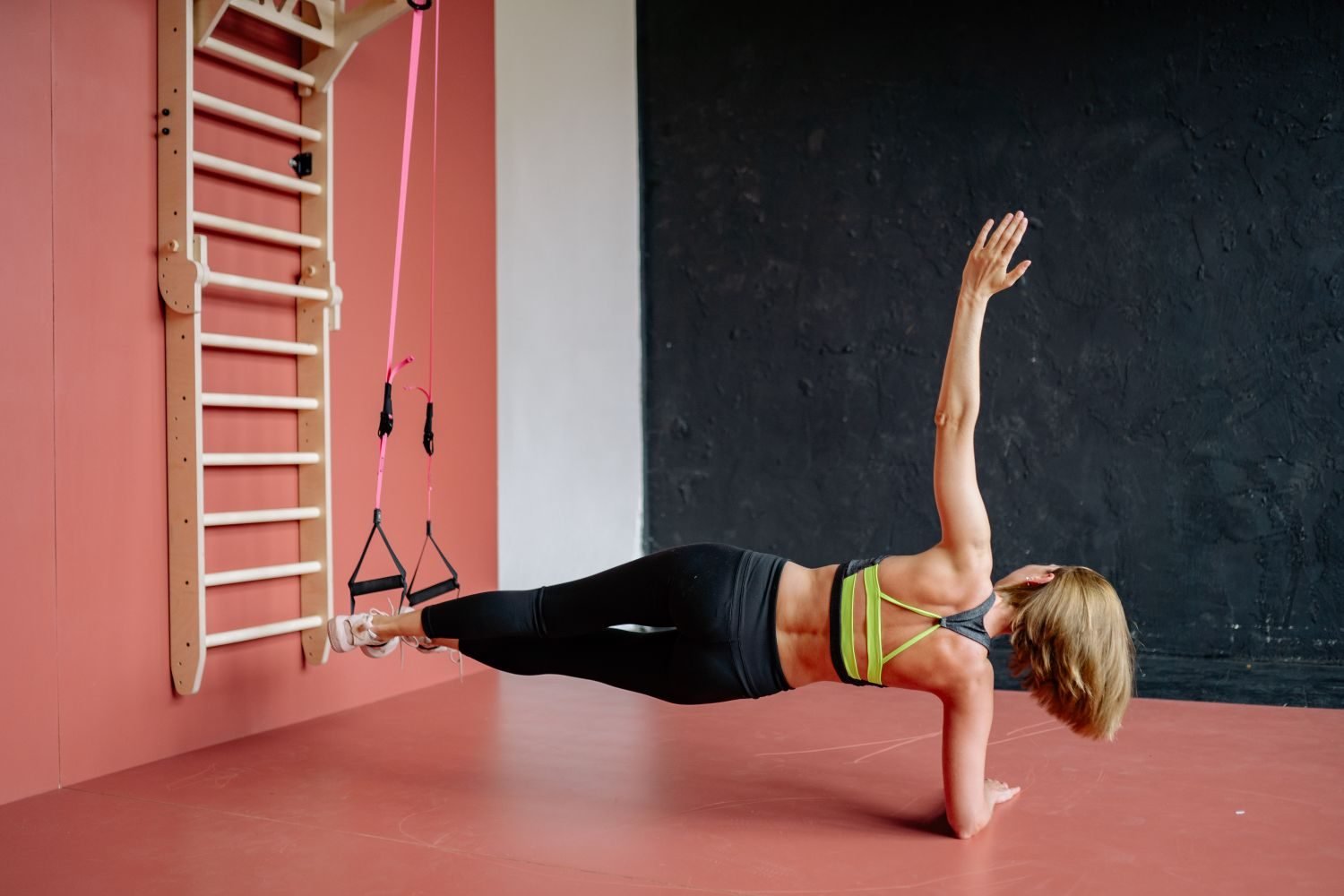
Stack your feet, prop yourself on one forearm directly under your shoulder, and lift your hips until your body forms a straight line from ankle to head. This shifts the load onto your obliques and the smaller stabilizer muscles around the hip, areas a standard plank barely touches. Hold, then switch sides.
Plank With Shoulder Taps
From a high plank on your hands, tap your right hand to your left shoulder, return it to the floor, then tap your left hand to your right shoulder. Keep your hips as still as possible while your arm moves, that’s the entire point of the exercise. If your hips rock side to side with every tap, slow down or widen your foot stance.
Plank With Leg Lift
From a forearm plank, lift one foot a few inches off the floor without letting your hips rotate or drop. Hold briefly, lower with control, and switch legs. This adds a glute and single-leg stability challenge on top of the usual core demand, and it exposes hip sag faster than a static hold does.
What’s a Good Plank Progression From Beginner to Advanced?
Chasing a five-minute plank hold is a poor training goal on its own. It’s a poor use of your training time once you’ve proven the basic pattern, and it rewards bad form more than it builds strength. A better approach is to progress hold time modestly while adding harder variations along the way, the same steady approach you’d use to progress an isolation lift like a preacher curl workout rather than chasing numbers too soon. Here’s the plan we typically give clients starting from scratch:
| Phase | Plank Type | Hold / Reps | Sets |
|---|---|---|---|
| Week 1-2 (Beginner) | Forearm plank (knees down if needed) | 20-30 sec hold | 3 |
| Week 3-4 | Full forearm plank | 40-45 sec hold | 3 |
| Week 5-6 (Intermediate) | Side plank | 20-30 sec per side | 2 per side |
| Week 5-6 | Plank with shoulder taps | 10 taps per side | 3 |
| Week 7-8 (Advanced) | Plank with leg lift | 8-10 lifts per leg | 3 |
| Week 7-8 | Forearm plank | 60-90 sec hold | 2 |
Two or three sessions a week is enough. Planks are demanding on the nervous system in a way that doesn’t need daily repetition to progress, and training them every single day usually just leads to form breaking down under fatigue.
What Are the Benefits of a Plank Workout?
Beyond the obvious core strength, a consistent plank workout pays off in a few specific ways:
- Better posture: a stronger anterior and lateral core makes it easier to hold your ribcage stacked over your pelvis instead of slouching forward through the day.
- Tighter bar path: the trunk stability you build carries over into a tighter, safer bar path under a barbell in squats and deadlifts.
- Lower back-friendly: it’s one of the lower-risk ways to train the core if you’re dealing with a cranky lower back, since there’s no spinal flexion under load like there is with crunches or sit-ups.
A plank workout is also a good anchor for a broader core or full-body session rather than a standalone routine. If you’re building out a complete day, pair it with rotational and pulling work it doesn’t cover on its own, and finish with the around the world workout, which works well as a shoulder finisher after your core block.
Should You Add a Plank Workout to Your Training Plan?
If your core work right now is a few random crunches at the end of a session, yes, swap in a structured plank progression instead. It takes less time, carries less risk to your spine, and builds strength that transfers to your main lifts. The part most people get wrong isn’t motivation, it’s form and pacing, chasing longer holds before the basics are locked in. If you want someone watching your hip position and breathing pattern in real time instead of guessing from a mirror, that’s exactly the kind of detail a coach catches in the first session. You can see how that works through FitStrot’s 1-on-1 personal training service, where your plank work gets built into a plan around your actual goals instead of a generic template.
Plank Workout FAQs
What is a plank workout?
A plank workout is a training session built around isometric holds, forearm plank, side plank, and movement variations like shoulder taps and leg lifts, that train the core, shoulders, and hips to resist motion. Instead of counting reps, you hold a straight body line for time, usually across several sets targeting different angles of the core.
How do you do a plank workout correctly?
Set your elbows under your shoulders, step your feet back into a straight line from head to heel, brace your core, squeeze your glutes, and breathe steadily throughout the hold. Avoid letting your hips sag or pike up. Start with 20 to 30 second holds and build duration and variation gradually over several weeks.
What are the benefits of a plank workout?
Plank workouts build core and hip stability, improve posture, and support safer, tighter positioning in squats and deadlifts. Because they don’t load the spine through flexion the way crunches do, they’re a lower-risk way to train the core, including for people managing minor lower back sensitivity.
How long should a beginner hold a plank?
Beginners should aim for 20 to 30 second holds with clean form rather than pushing for a long time with sagging hips. Quality matters more than duration early on. As your core strength improves over four to six weeks, hold times can progress toward 60 to 90 seconds.
Can you do a plank workout every day?
You can, but it’s not necessary and often backfires. Two to three sessions a week with proper recovery is enough to build strength and lets you progress hold times and variations without form breaking down from accumulated fatigue. Daily planking tends to reinforce bad habits more than it builds strength.