A nutrition diet plan for muscle building comes down to three numbers you can calculate today: your calorie surplus (roughly 200-400 calories above maintenance), your protein target (1.6-2.2 g per kg of body weight, per the International Society of Sports Nutrition), and your meal structure (3-5 protein-anchored meals spread through the day). Nail those three and the rest is detail work — the backbone of solid bodybuilding nutrition, whether you’re a beginner or years into training.
This guide walks through the actual math and offers a flexible daily template, not a rigid seven-day meal plan you’ll abandon by Thursday. For the full picture on why protein matters this much, see our piece on the nutritional value of protein.
How Many Calories Do You Need to Build Muscle?
Start with your maintenance calories — what you’d eat to stay at your current weight — then add a modest surplus on top. Muscle can’t be built from thin air; it requires surplus energy and surplus protein, but the surplus doesn’t need to be large to work.
Here’s the calculation in three steps:
Step 1: Estimate Your Maintenance Calories
A quick, reasonably accurate method is the Mifflin-St Jeor equation, which estimates your Basal Metabolic Rate (BMR), then multiplies it by an activity factor:
- Men: BMR = (10 × weight in kg) + (6.25 × height in cm) − (5 × age) + 5
- Women: BMR = (10 × weight in kg) + (6.25 × height in cm) − (5 × age) − 161
Multiply BMR by an activity multiplier: 1.375 for light activity (training 1-3 days/week), 1.55 for moderate (3-5 days/week), or 1.725 for heavy training (6-7 days/week plus physical work). The result is your estimated Total Daily Energy Expenditure (TDEE), or maintenance calories.
Step 2: Add a Surplus of 200-400 Calories
Most people overcomplicate this. Research on lean bulking consistently shows modest surpluses — roughly 10-20% above maintenance, or 200-400 calories daily — support muscle growth without disproportionately adding fat. Larger surpluses (600+ calories) don’t build muscle faster; they just accelerate fat gain, since muscle protein synthesis has a biological ceiling regardless of extra fuel.
A useful target: gain roughly 0.25-0.5% of body weight per week. For a 75 kg (165 lb) lifter, that’s about 0.2-0.4 kg (0.4-0.8 lb) weekly. If you’re gaining faster, or your waistline is expanding more than your lifts are improving, dial the surplus back toward 200 calories.
Step 3: Track and Adjust Every 2-3 Weeks
Weigh yourself 3-4 times a week under similar conditions and average it out — daily fluctuations from water and food are noise. If your average weight hasn’t moved after two to three weeks, increase intake by roughly 100-150 calories. If you’re gaining faster than the target range above, trim back by the same amount. This is a feedback loop, not a one-time calculation.
For a deeper look at structuring an overall gaining phase, see our guide on nutrition for weight gain.

How Much Protein Do You Actually Need to Build Muscle?
The International Society of Sports Nutrition’s Position Stand on protein and exercise — one of the most cited references in sports nutrition — recommends 1.4-2.0 g of protein per kg of body weight per day for most exercising individuals building and maintaining muscle mass. In practice, most evidence-based coaches round this up to a working range of 1.6-2.2 g/kg/day, since intakes above 2.0 g/kg show no harm and may offer a small edge, particularly during a surplus when appetite is higher and food is easier to eat.
For a 75 kg lifter, that’s roughly 120-165 grams of protein daily. For a 90 kg lifter, roughly 145-200 grams. You don’t need to hit the exact number every day — a consistent weekly average matters more than daily precision.
The ISSN position stand also found considerably higher intakes (2.3-3.1 g/kg/day) may help preserve lean mass during a calorie deficit, but that’s a cutting scenario, not a muscle-building one. For a surplus phase, 1.6-2.2 g/kg/day is well-supported and sufficient. Our article on protein and nutrition breaks down why this macro gets so much attention.
Does Protein Timing Actually Matter, or Just the Daily Total?
Both — but the daily total matters more, and timing is the refinement on top. Research published in the American Journal of Clinical Nutrition found muscle protein synthesis is maximally stimulated by around 20 grams of high-quality protein per meal in most adults (larger individuals may benefit from slightly more, up to ~0.4 g/kg per meal), and eating more than that in one sitting doesn’t meaningfully boost the response further during that window.
This is why spreading protein across the day outperforms cramming it into one or two large meals. Studies comparing distribution patterns found spreading protein evenly across 3-4 meals produces meaningfully more cumulative synthesis over 24 hours than concentrating the same total into one or two feedings — one commonly cited trial found roughly 25% higher synthesis with an even pattern (4 meals of ~20g) versus a skewed pattern with the same daily total.
The practical takeaway: don’t skip breakfast and try to “make up” protein at dinner. Aim for 20-40 grams at each of 3-5 meals or snacks throughout the day — easier to hit than it sounds once you build a few protein anchors into your routine, covered next.
What Should You Eat Before and After a Workout?
Pre- and post-workout nutrition matters less than most fitness content implies, but it’s not irrelevant — it mostly comes down to timing meals sensibly around training rather than obsessing over a narrow “anabolic window.”
Before Training
Eat a meal with protein and carbohydrates 1-3 hours before training — oats with Greek yogurt and berries, or rice with chicken and vegetables both work. The goal is amino acids in your bloodstream and glycogen in your muscles so you can push hard — a well-fueled session drives more growth than any timing trick.
Training fasted or shortly after waking? A smaller pre-workout snack, like a banana with a scoop of whey, can support performance without a full meal.
After Training
Eat a protein-containing meal within a few hours of finishing — the old “30-minute anabolic window” is far more flexible than once believed, extending out several hours, especially if you ate before training. Aim for 20-40 grams of protein plus carbohydrates to replenish glycogen: a whey shake with a banana, followed by a full meal within a couple hours, works well.
What matters more than exact timing is not going 6+ hours without protein on training days, and keeping your daily totals on target. For more, see our guide to sports nutrition.
What Does a Sample Day of Eating Actually Look Like?
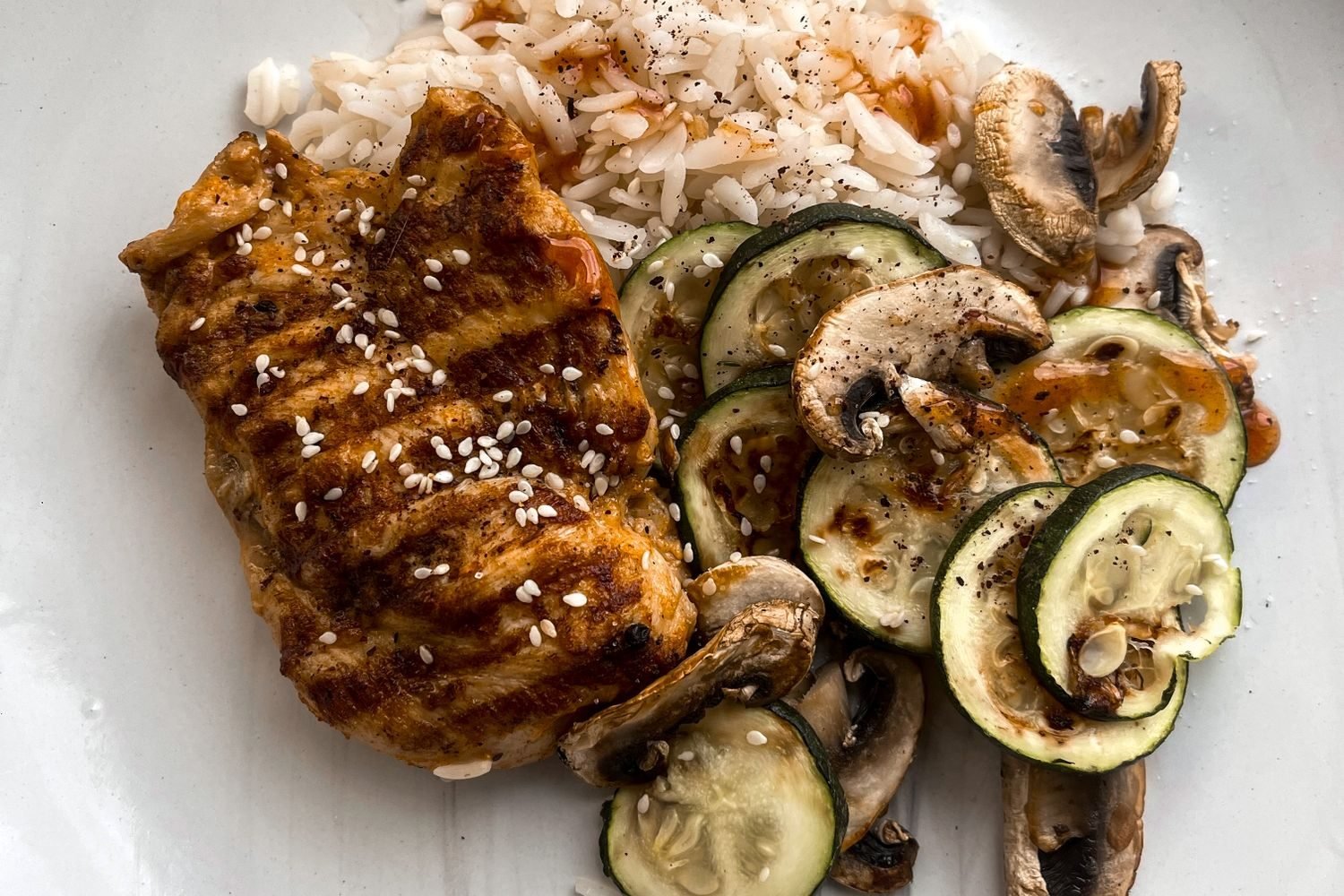
Rather than a rigid meal plan, think of your day as a template with protein anchors at each eating occasion. Here’s a flexible structure for someone targeting roughly 2,800-3,000 calories and 160-180g of protein (adjust portions to your own numbers from the sections above):
| Meal | Protein Target | Example Foods |
|---|---|---|
| Breakfast | ~25-35g | 3 whole eggs plus 2 egg whites, scrambled, with oats or whole-grain toast and a piece of fruit. Swap options: Greek yogurt with granola and berries, or a protein smoothie with oats, banana, and milk. |
| Mid-Morning Snack | ~20-25g | A protein shake, cottage cheese with fruit, or nuts with a hard-boiled egg or two. This slot keeps protein synthesis elevated between meals — don’t skip it just because you’re not “hungry.” |
| Lunch | ~35-40g | A palm-to-fist-sized portion of chicken, turkey, lean beef, or fish, with rice or potatoes and a generous portion of vegetables. Typically your largest meal of the day for both calories and protein. |
| Pre/Post-Workout | ~20-30g | Depending on your schedule: a whey shake with a banana before training, or a full post-workout meal like rice with salmon and greens afterward. |
| Dinner | ~35-40g | Similar structure to lunch — a solid protein source, a carbohydrate (pasta, rice, or bread), and vegetables or a side salad with olive oil. A good place to include fattier cuts of meat or oily fish to hit your fat and calorie targets. |
| Evening Snack (Optional) | ~20-25g | Cottage cheese, Greek yogurt, or a casein-based shake before bed. A slower-digesting protein source here can support overnight recovery. |
Notice the pattern: every eating occasion has a protein anchor of at least 20g, spaced roughly 3-4 hours apart. That’s the research above translated into a day you can actually live with — swap the specific foods freely as long as your protein and calorie totals hold. For more meal-building ideas, our bodybuilding nutrition guide has additional templates.
What Are the Most Common Mistakes People Make on a Muscle-Building Diet?
A few patterns show up repeatedly in people who train hard but don’t see the gains their effort deserves:
- Eating too big a surplus. “Dirty bulking” with 800+ extra calories doesn’t build muscle faster — it mostly builds fat, since muscle growth has a biological rate limit.
- Backloading all their protein to dinner. This leaves earlier hours with minimal amino acids available for muscle repair.
- Not tracking anything. “Eating big” and actually hitting a 300-calorie surplus with 170g of protein are very different things. A few weeks of tracking is worth it to calibrate your eye.
- Chasing supplements before the fundamentals. Creatine and whey, covered in our sports nutrition guide, are useful additions — not substitutes for a solid diet plan.
- Abandoning the plan after one “bad” week. Weight fluctuates. Judge progress over 2-3 week averages, not single days.
Frequently Asked Questions
How much protein do I need per day to build muscle?
Most research, including the ISSN position stand, supports 1.6-2.2 g of protein per kg of body weight daily. For a 75 kg person, that’s roughly 120-165g per day, spread across 3-5 meals with 20-40g per meal for the best synthesis response.
How big should my calorie surplus be to gain muscle without excess fat?
Aim for 200-400 calories above maintenance, or roughly 10-20% above TDEE. This supports steady gain of about 0.25-0.5% of body weight per week while minimizing unnecessary fat gain compared to larger surpluses.
Is it better to eat more meals or fewer larger meals when building muscle?
More frequent, moderate meals generally work better. Research shows spreading protein across 3-5 meals of 20-40g each stimulates more cumulative muscle protein synthesis over 24 hours than concentrating the same total into one or two large meals.
Do I need to eat immediately after my workout to build muscle?
No. The “anabolic window” is far wider than once believed — several hours, not 30 minutes — especially if you ate before training. What matters most is hitting your total daily protein and calorie targets consistently.
Can I build muscle without a calorie surplus?
Some gain is possible at maintenance or a small deficit, particularly for beginners or those returning to training, but it’s slower and less reliable. A modest, consistent surplus with adequate protein remains the most dependable approach.
How long should I stay in a muscle-building phase before reassessing?
Give any surplus at least 2-3 weeks before judging results, since daily weight fluctuates with water and food. Track your average weekly trend and adjust calories by 100-150 if you’re not gaining within your target range.
Getting the numbers right is only half the equation — the other half is adapting this structure to your schedule, preferences, and how your body responds. If you’d rather have a plan built around your specific numbers and training split, an online nutritionist consultation can turn this framework into a plan tailored to you.