Calisthenics is strength training that uses your own bodyweight as resistance, think push-ups, squats, lunges, planks, and pull-ups instead of barbells or machines. A calisthenics home workout usually strings together 6 to 8 of these moves into circuits or straight sets, built around pushing, pulling, squatting, and core patterns. You can do a full session in a living room with nothing but floor space and, ideally, a pull-up bar.
What Does Calisthenics Actually Mean?
At its core, calisthenics is movement-based strength training. You’re not isolating a bicep with a curl, you’re training your whole body to push, pull, hinge, and stabilize using gravity and leverage. A push-up trains your chest, shoulders, triceps, and core all at once. A pistol squat trains your quads, glutes, ankles, and balance simultaneously. That’s the appeal for most people who search “calisthenics home workout” in the first place: one skill, several muscles, zero equipment cost.
We think of calisthenics as a spectrum rather than a fixed list of exercises. On one end you have simple bodyweight squats and knee push-ups. On the other end you have muscle-ups, human flags, and one-arm chin-ups. All calisthenics workouts sit somewhere on that line, and the goal of good programming is to move you steadily from the easy end toward the harder end without stalling out or getting hurt.
How Is Calisthenics Different From a General Bodyweight or Home Dumbbell Workout?
People often use “calisthenics” and “bodyweight training” interchangeably, and honestly, there’s a lot of overlap. A general bodyweight workout might include stretching, mobility drills, light cardio circuits, or yoga-adjacent movements aimed mostly at general fitness. Calisthenics is narrower and more strength-focused. It’s specifically about building pushing, pulling, and core strength through progressively harder skill-based movements, working toward things like a strict pull-up, a dip, or eventually a muscle-up.
A home dumbbell workout is a different tool entirely. Dumbbells let you load a movement externally, so you add weight instead of changing leverage. Both approaches build muscle, but calisthenics tends to build more relative strength, body control, and mobility, while dumbbells make it easier to progressively overload a single lift in small increments. If you’re short on space or gear, calisthenics wins on convenience. If you already own dumbbells and want fine-grained load control, that’s a reasonable path too. Many of our clients actually combine both, and we’ll link out to a broader home workout guide if you want the bigger picture of how these styles fit together.
What Are the Real Benefits of Calisthenics Workouts?
The calisthenics workout benefits people talk about online are mostly true, but a few deserve more emphasis than others. First, you build functional strength that transfers directly to daily life: carrying groceries, climbing stairs, getting off the floor without using your hands. Second, you improve joint stability and mobility because most calisthenics moves work through a full range of motion rather than a locked machine path.
Third, and this is underrated, calisthenics teaches body awareness. You learn to control your own weight in space, which carries over to better posture, balance, and coordination. Fourth, it’s genuinely free. No gym membership, no equipment purchase required to get started. Fifth, it scales. A beginner squat and an advanced pistol squat use the same movement pattern, just different difficulty, so you never really “outgrow” the method, you just get harder versions of it.
What it won’t do as efficiently is build maximal strength the way heavy barbell work does, or add significant muscle mass past a certain point without added resistance like weighted vests or bands. It’s an excellent base, not necessarily the final answer for every training goal.
What Is a Good Calisthenics Home Workout for Beginners?
If you’re building a calisthenics beginner workout plan at home, keep it simple: one push movement, one pull movement, one squat pattern, one hinge or lunge, and one core exercise. Do it three times a week with a rest day in between. Here’s a calisthenics workout plan for beginners at home that we actually give new clients in their first two weeks.
| Exercise | Sets | Reps |
|---|---|---|
| Incline or knee push-ups | 3 | 8-12 |
| Bodyweight squats | 3 | 12-15 |
| Assisted or negative pull-ups (or inverted rows) | 3 | 5-8 |
| Walking lunges | 3 | 10 per leg |
| Plank hold | 3 | 20-30 seconds |
| Glute bridges | 2 | 15 |
Rest 45 to 60 seconds between sets. This whole session takes about 30 to 35 minutes, and it’s enough of a beginner calisthenics workout at home to build real strength within four to six weeks if you’re consistent. You don’t need a calisthenics workout pdf to make this work either. A printable plan looks nice, but a clear written plan you can glance at on your phone does the exact same job. Focus on the exercises and the effort, not the format.
How Do You Progress From Beginner to Advanced Calisthenics?
Progression in calisthenics works by changing leverage and range of motion rather than adding external weight. Once bodyweight squats feel easy for 3 sets of 20, you move to split squats, then Bulgarian split squats, then pistol squats. Once you can do a few strict push-ups, you progress to diamond push-ups, then decline push-ups, then eventually one-arm push-up progressions.
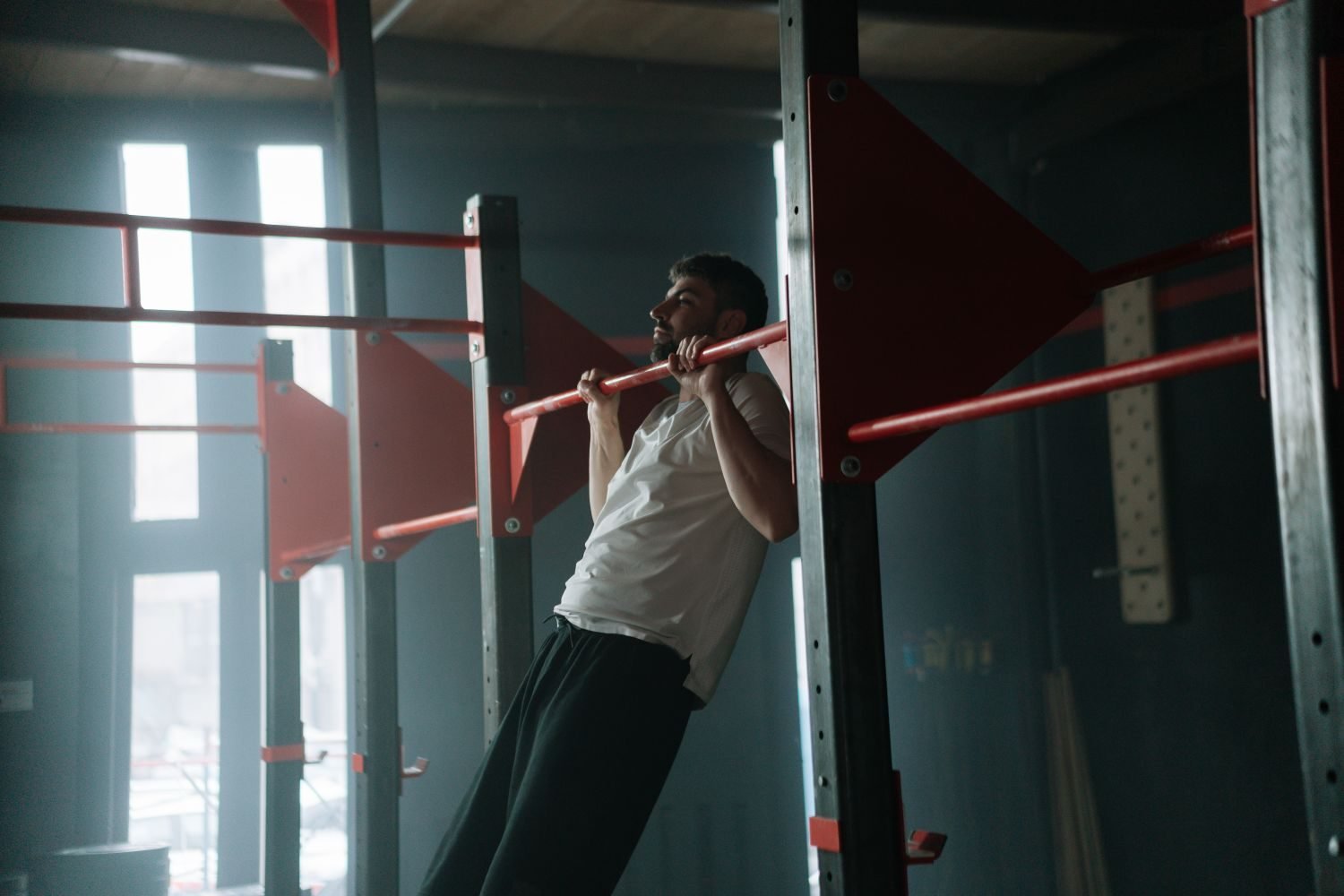
The pull side is usually the slowest to develop because most people start with almost zero pulling strength. Work through dead hangs, then negative pull-ups, then assisted pull-ups with a band, then strict pull-ups. Dips follow a similar arc using a chair, bench, or parallel bars. An advanced calisthenics workout typically layers in goals like strict pull-ups, dips, pistol squats, and eventually muscle-ups, which combine a pull-up and a dip into one explosive movement. These aren’t beginner goals, and treating them as such is where a lot of people get frustrated or injured. Give yourself months, not weeks, to earn them properly.
How Often Should You Train Calisthenics?
Three to four sessions a week works well for most beginners, with at least one rest day between sessions that hit the same muscle groups. Your muscles grow and repair during rest, not during the workout itself, so cramming in daily full-body sessions usually backfires through fatigue or nagging joint pain, especially in wrists and shoulders. As you advance, you can split sessions into push days, pull days, and leg-and-core days, which lets you train five or six days a week without overloading any single muscle group two days in a row.
Do You Need Any Equipment for Calisthenics at Home?
No, and that’s the whole point. Here’s what actually helps, roughly in order of usefulness:
- Floor space: enough room to lie down with arms extended covers push-ups, squats, lunges, and planks
- A sturdy chair: all you need for dips in the early weeks
- A pull-up bar: not mandatory at first, but it unlocks real pulling progressions like inverted rows and negatives once you’re ready
- A resistance band: a cheap, useful add-on for assisted pull-ups and extra tension on lower-body moves
- A yoga mat: purely for comfort
What Mistakes Do Beginners Make?
The most common one is skipping progressions and going straight for the advanced version of a move because it looks impressive online. Someone with no pulling strength tries a full pull-up on day one, fails repeatedly, and gets discouraged instead of building up through negatives first. We see this constantly with new clients who arrive frustrated that “calisthenics isn’t working,” when really they just skipped two or three steps in the progression.
Other frequent mistakes include training every day without rest, rushing reps with poor form instead of controlling the movement, ignoring wrist and shoulder mobility before push and pull work, and treating core training as an afterthought when it’s actually what stabilizes almost every other exercise. A slower, more deliberate approach beats a rushed one nearly every time.
Should You Get Guidance Instead of Guessing?
You can absolutely make progress on your own with the plan above, and plenty of people do. But if you keep hitting plateaus, feel unsure about form, or want a program built around your specific goals and injury history, working with a coach speeds things up considerably. Our 1-on-1 personal training at FitStrot is built exactly for this, matching you with a coach who adjusts your calisthenics progressions week to week instead of leaving you to figure it out from a generic template.
Frequently Asked Questions
What is a good calisthenics home workout?
A good one combines a push, a pull, a squat, a lunge or hinge, and a core exercise, done 3 times a week. Push-ups, bodyweight squats, assisted pull-ups or rows, walking lunges, and planks cover all the major movement patterns without needing any equipment at all.
How do you start calisthenics at home?
Start with the basic six movement patterns at a difficulty you can complete with good form for 8 to 12 reps. Train three days a week, rest between sessions, and progress the exercises only once the current version feels genuinely easy for three full sets.
What are the benefits of calisthenics workouts?
Calisthenics builds functional strength, joint mobility, and body control that transfers to everyday movement. It’s free, scalable from beginner to advanced, and improves posture and balance. It’s less efficient than heavy weight training for pure mass gain, but excellent as a strength foundation.
Can you build muscle with calisthenics alone?
Yes, especially as a beginner or intermediate. Harder progressions like archer push-ups, pistol squats, and weighted dips using a backpack can keep building muscle well past the beginner stage. Very advanced lifters eventually need added resistance to keep progressing significantly.
Is calisthenics better than a home dumbbell workout?
Neither is strictly better, they train strength differently. Calisthenics improves relative strength, mobility, and control with zero equipment cost. Dumbbells allow precise load increases on individual lifts. Many people get the best results combining both across their weekly training split.