A battle rope workout builds conditioning, upper body and core endurance, and grip strength in a way few other tools can match, while torching calories through short, brutal bursts of effort. We program battle ropes with clients who want cardio that doesn’t feel like another treadmill session, and the honest answer is that fifteen to twenty minutes of rope work will leave your shoulders, lats, and lungs working harder than most people expect from something you can do standing in one spot.
What Do Battle Ropes Actually Train?
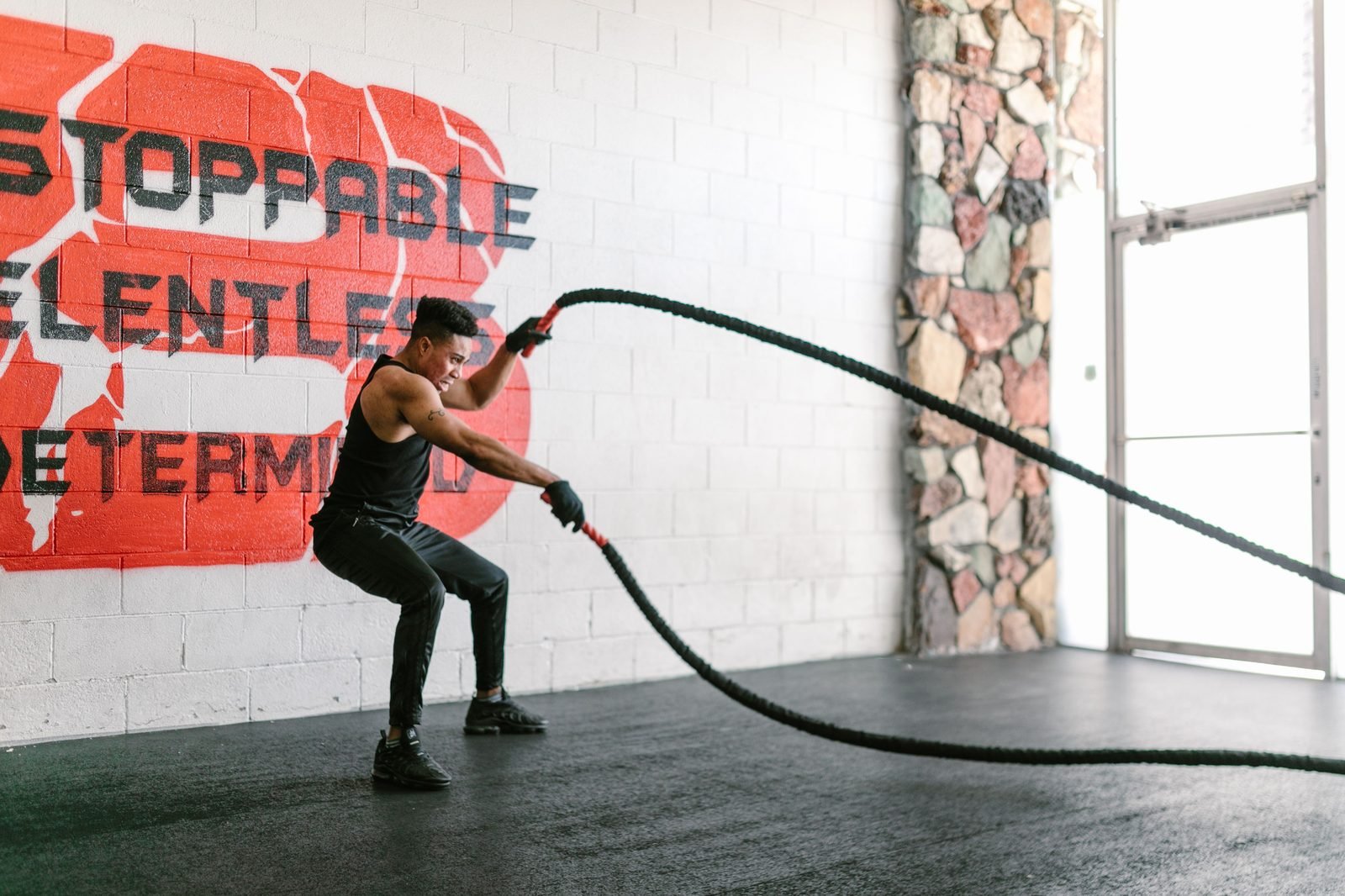
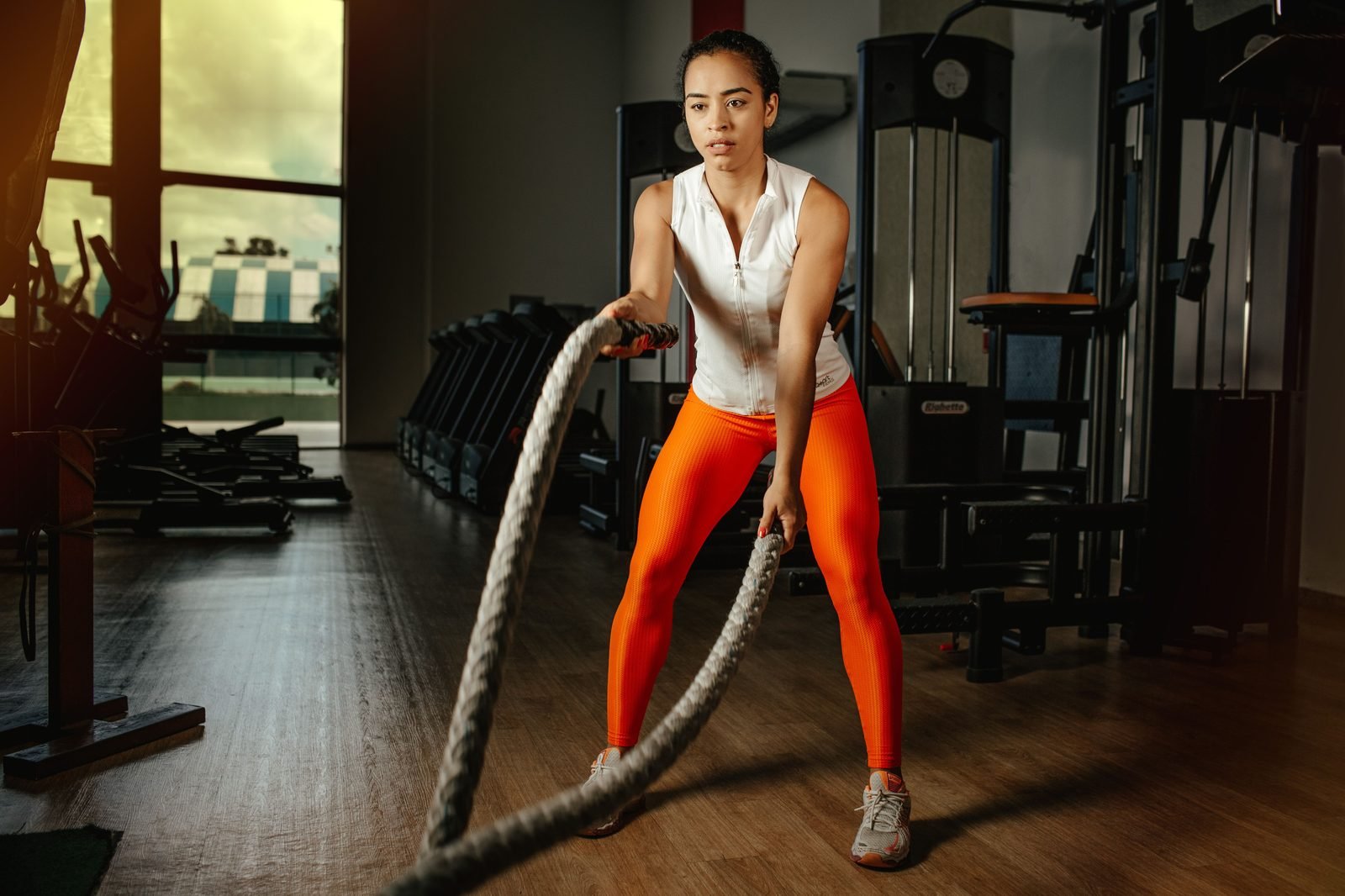
Battle ropes are deceptively simple. You anchor a thick rope to a wall or post, grab both ends, and create waves, slams, or circles with your arms while keeping your core braced. That simplicity is exactly why they work. The rope adds resistance without adding load to your joints, so you get a strength and cardio hybrid without the impact of running or the loading of a barbell.
The primary muscles doing the work are your shoulders, forearms, and upper back, but your core is doing more than you’d think. Every wave pattern forces your abs and obliques to stabilize your torso so the power actually transfers into the rope instead of leaking out through a wobbly spine. Your legs stay engaged too, usually in an athletic half squat stance that keeps your hips low and your base stable. Grip strength takes a real hit by the end of a set, which is part of the point. Rope workout benefits show up fastest in the forearms and traps because those muscles rarely get trained this directly anywhere else.
What Are the Real Benefits of a Battle Rope Workout?
Strip away the marketing and here’s what battle ropes genuinely deliver:
- Cardiovascular conditioning. Sustained wave patterns spike your heart rate fast and keep it there, which builds the kind of engine you need for sports, boot camp workout formats, or just not gassing out on stairs.
- Upper body and core endurance. Repeated waves and slams train your shoulders and midsection to keep producing force even as they fatigue, which carries over to almost every other lift and sport movement.
- Grip and forearm strength. You cannot fake your way through rope work with a weak grip. It builds real, functional hand and forearm strength.
- Joint-friendly intensity. There’s no impact on your knees or spine the way running or box jumps carry, so it’s a smart option if you want hard cardio without pounding your joints.
- Sweat and metabolic response. Rope intervals get you sweating heavily within minutes. The benefits of sweating during a workout are mostly about your body working to cool itself as your core temperature rises, a sign you’re pushing real intensity, not a fat-loss mechanism on its own.
- Mental toughness. Thirty seconds of max-effort waves is genuinely hard. Ropes build the kind of grit that transfers to finishing a tough set of squats or the last mile of a run.
These are the same qualities we care about when we build any client’s overall types of workouts mix. Ropes aren’t a replacement for strength training, but they fill the conditioning gap that a lot of programs miss.
How Do Battle Ropes Compare to Punching Bags and Rebounders?
Battle ropes sit in the same conditioning family as a few other tools we use regularly, and each has a slightly different flavor.
Punching bag workout benefits overlap heavily with ropes: both spike heart rate fast, both build shoulder and core endurance, and both are brutal on grip and forearms if you’re gripping wraps or gloves properly. The difference is that a bag adds a rotational, hip-driven power component and a coordination skill layer that ropes don’t ask for. If you want conditioning with a striking or coordination element, a bag edges out ropes. If you want pure, no-skill-required conditioning you can start on day one, ropes win.
Rebounder workout benefits lean more toward low-impact cardio and lymphatic circulation, with a lighter demand on the upper body. A rebounder is gentler on the joints than almost anything else in a gym and works well for people easing back into training or managing joint pain. Ropes ask far more of your shoulders and core, so they’re the better pick if upper body conditioning and grip strength are the goal.
None of these three tools are interchangeable. We usually rotate them through a client’s workout routine based on what that week’s training actually needs, whether that’s more upper body volume, more low-impact recovery cardio, or a coordination challenge.
What Does a Sample Battle Rope Circuit Look Like?
Here’s a circuit we actually use with clients who are past the beginner stage and have decent shoulder mobility. It runs about 18 minutes including rest.
| Exercise / Wave Pattern | Work Time | Rest Time |
|---|---|---|
| Alternating waves (single arm alternating) | 30 seconds | 30 seconds |
| Double wave slams | 20 seconds | 40 seconds |
| Lateral waves (side to side) | 30 seconds | 30 seconds |
| Rope circles (both directions) | 20 seconds each way | 40 seconds |
| Battle rope jumping jacks | 30 seconds | 30 seconds |
| Max effort slams (finisher) | 15 seconds | 45 seconds |
Run through the full sequence twice for a solid conditioning session. Beginners should cut work time down to 15 to 20 seconds and stretch rest to a full minute until their grip and shoulders adapt.
Is a Battle Rope Workout Good for Fat Loss?
Battle ropes can absolutely support fat loss, but let’s be honest about what they are and aren’t. They’re a conditioning tool that burns real calories during and shortly after the session because of how hard they push your heart rate. They are not a magic fat burner, and no amount of rope waves will out-train a bad diet or offset a calorie surplus.
What ropes do well is add high-intensity volume without beating up your joints, which means you can do them more often and recover faster than you would from repeated heavy leg sessions or long runs. That consistency is what actually drives fat loss over time, not the specific exercise. We see clients get frustrated when they treat a 15-minute rope finisher as their entire fat loss strategy and skip everything else. It works best stacked onto a structured strength program and a diet that actually supports the goal, not as a standalone fix.
Who Should Be Cautious With Battle Ropes?
Ropes are hard on the shoulders because of the repetitive overhead and horizontal shoulder movement under fatigue. If you have a history of shoulder impingement, rotator cuff issues, or ongoing shoulder pain, treat this tool carefully. We’d rather scale intensity down or swap in a gentler conditioning option than have someone push through a shoulder that’s already talking to them.
People with uncontrolled high blood pressure or heart conditions should also check with a doctor before doing max-effort interval work like rope slams, since the intensity spikes fast. Lower back issues are another consideration. If you can’t maintain a braced, neutral spine in an athletic stance, the load on your low back during rope work can aggravate things. Start with shorter intervals, keep your stance wide and stable, and don’t chase intensity before your technique is solid.
How Do You Program Battle Ropes Into Your Week?
Two to three sessions a week is plenty for most people. Ropes are demanding on the shoulders and grip, so back-to-back days tend to backfire with sore forearms and sloppy form. We usually place rope work in one of three spots:
- As a standalone conditioning session on a non-lifting day, similar to how you’d structure any boot camp workout format built around intervals.
- As a finisher after a lower body strength day, when your upper body is still fresh enough to move the rope well.
- Inside a circuit alongside kettlebell swings, sled pushes, or bodyweight work for a full metabolic session.
If you train early and want an extra push, a small dose of caffeine beforehand helps. The benefits of black coffee before a workout are well established for this kind of high-intensity interval work: it sharpens focus and can make those last few brutal rope sets feel slightly more manageable. Just don’t overdo it on an empty stomach before a max-effort session.
After a hard rope session, some clients like to finish with heat exposure. The benefits of a steam room after a workout come down to relaxed muscles and a slower cool-down, which some people find helps with next-day soreness, though it’s a comfort add-on rather than a requirement.
What Mistakes Do People Make With Battle Rope Technique?
The most common mistake is standing too upright. If you’re not in a low, athletic stance with bent knees and a slight hip hinge, you’re putting all the strain on your shoulders and lower back instead of sharing the load through your whole body. Fix your stance first, before you worry about wave height.
The second mistake is going all-out from the first second. Battle ropes punish poor pacing fast. Start controlled, build your wave rhythm, then push intensity in the back half of each interval. The third mistake is gripping the rope too tightly for the entire set. A death grip burns out your forearms before your cardio system is even taxed. Hold firm enough to control the rope, not white-knuckle tight.
Finally, people often let their core go slack once they get tired. That’s when the low back takes over and form breaks down. Keep your ribs down and your abs braced through the whole set, even when it gets ugly toward the end.
Ready to Add Battle Ropes to Your Training?
Battle ropes are one of the most efficient conditioning tools you can add to a program, but they work best when they’re programmed correctly around your strength work, your recovery, and your actual goals rather than thrown in randomly. If you want a coach who’ll build that plan around you specifically, our 1-on-1 personal training programs at FitStrot are built exactly for this. Yash Pathak and our coaching team have spent a decade helping people train smarter, not just harder.
Frequently Asked Questions
What are the benefits of a battle rope workout?
Battle ropes build cardiovascular conditioning, upper body and core endurance, and grip strength while staying easy on your joints. They spike your heart rate quickly, torch calories in short bursts, and build the kind of mental toughness that carries over into other types of training.
How do you do a battle rope workout?
Anchor the rope, stand in a low athletic stance with knees bent, and create wave, slam, or circle patterns with both arms while keeping your core braced. Work in short intervals of 15 to 30 seconds with equal or longer rest, and build up total volume as your grip and conditioning improve.
Is battle rope workout good for fat loss?
Yes, as part of a bigger picture. Battle ropes burn real calories and build conditioning, which supports fat loss, but they won’t offset a poor diet or replace strength training on their own. Treat them as one piece of a structured program, not a standalone fix.
How often should you do battle rope training?
Two to three sessions a week works well for most people. Ropes are demanding on the shoulders and grip, so spacing sessions out gives those areas time to recover and keeps your technique sharp instead of sloppy.
Can beginners use battle ropes?
Yes, but start with shorter work intervals, around 15 seconds, and longer rest periods until your grip, shoulders, and core adapt to the demand. Focus on stance and control before chasing intensity or wave height.