A skull crusher is a triceps isolation exercise where you lie on a bench, hold an EZ bar, a pair of dumbbells, or a straight barbell above your chest, then bend only at the elbows to lower the weight toward your forehead before pressing back up. Despite the alarming name, it’s one of the most effective moves for building triceps size and lockout strength, and it earns a spot in almost every arm program we write at FitStrot, usually paired with a biceps staple like the preacher curl workout. The name describes the bar path, not the actual risk. Keep your elbows locked in place and control the descent, and it’s no more dangerous than a bench press.

What Exactly Is a Skull Crusher?
The skull crusher, also called a lying triceps extension or “French press” in older gym manuals, is a single-joint exercise for the back of your upper arm. You lie flat on a bench, press a bar or dumbbells to arm’s length over your chest, then hinge at the elbows only, lowering the weight in a controlled arc toward your forehead or just behind it. From there you reverse the motion and extend your arms back to lockout.
It’s called an isolation exercise because only the elbow joint moves. Your shoulders stay roughly fixed in space the whole time, which is exactly why it hits the triceps so directly. Compare that to a close-grip bench press, where your shoulders and elbows both move and your chest and front delts pick up some of the load. Skull crushers don’t let the triceps hide.
Which Muscles Does a Skull Crusher Work?
The main target is the triceps brachii, and specifically all three heads: the lateral head, the medial head, and the long head. Most pressing movements in a typical program (bench press, overhead press, dips) bias the lateral and medial heads. The skull crusher, especially when you lower the bar behind your head slightly rather than straight to your forehead, puts the long head into a deeper stretch because that head crosses the shoulder joint as well as the elbow.
Your abs, lats, and shoulder stabilizers also work hard to keep the upper arms still and the bar tracking on a clean path, similar to the core bracing you’d use in a woodchopper workout. That’s a secondary benefit rather than the point of the exercise, but it’s part of why the movement feels more demanding than it looks on paper.
How Do You Do a Skull Crusher Workout?
Form is where most people either build serious triceps or aggravate an elbow. Here’s how we coach it, broken down by the three common tools.
EZ Bar Skull Crusher
Lie on a flat bench with your feet planted on the floor. Grip the EZ bar on the angled inner section, hands roughly shoulder width apart. Press the bar to arm’s length over your chest with your palms facing your feet. From there, bend your elbows and lower the bar in a slow arc until it’s just above or slightly behind your forehead. Keep your upper arms pointing straight up at the ceiling the entire time, then press back to the start without locking out violently.
Dumbbell Skull Crusher
The dumbbell version lets each arm move independently, which is useful if one side is weaker or if you have old elbow niggles. Hold a dumbbell in each hand at arm’s length above your chest, palms facing each other (a neutral grip). Lower both dumbbells toward your temples at the same time, elbows staying still, then press back up. The neutral grip is generally easier on the wrists and elbows than a straight bar.
Barbell Skull Crusher
A straight barbell works the same way as the EZ bar but locks your wrists into full pronation, which some lifters find rough on the joints under heavier loads. If you’ve got any wrist or elbow sensitivity, start with the EZ bar or dumbbells and only move to a straight bar once your joints have adapted.
What Mistakes Wreck Your Skull Crusher Form?
This is genuinely one of the easier exercises to get wrong, and the mistakes matter because they load the elbow joint in awkward directions.
- Elbow flare. Letting your elbows drift outward as you lower the weight turns the movement into a half chest press and shifts stress away from the triceps toward the shoulder joint. Keep your elbows pointing at the ceiling, not out to the sides.
- Bar path drifting toward the forehead. Lowering straight down to your face rather than slightly back toward the crown of your head reduces the stretch on the long head and increases the odds of losing control near your face. A slight backward arc is safer and more effective.
- Going too heavy, too soon. Because your elbows are the only moving joint, there’s nowhere for a shaky rep to hide. A bar that wobbles or drifts off path near your face is a genuine safety issue, not just a form nitpick.
- Bouncing at the bottom. Using momentum to snap the weight back up puts a sudden shearing load through the elbow tendons. Slow the eccentric down and pause briefly before pressing back up.
- Flared wrists. Letting your wrists bend backward under load adds unnecessary strain. Keep them stacked and neutral, gripping the bar firmly.
We see a lot of clients whose elbows start creeping outward once fatigue sets in around rep 8 or 9 of a set, usually because the weight is a notch too heavy for that rep range. Dropping the load slightly and cleaning up the elbow path almost always fixes it within a session or two.
How Should You Program Skull Crushers Into Your Week?
Skull crushers work best as a secondary or accessory movement rather than the first thing you do on triceps day. Do your heavier compound pressing first, close-grip bench or dips, then move to skull crushers while you’re still fresh enough to control the bar but past the point of needing maximal loads.
Two to three sets of 8 to 12 reps, once or twice a week, is enough to drive real growth for most lifters. If your triceps are a lagging body part, you can superset skull crushers with a preacher curl to keep arm day efficient and get more volume done in less time. On days when you’re training rotational power or core strength, a woodchopper session pairs well earlier in the workout, and if shoulder health and stability are part of your goals, working in an around the world workout on a separate day helps keep the whole upper body balanced rather than just chasing arm size.
What Does a Sample Triceps Session With Skull Crushers Look Like?
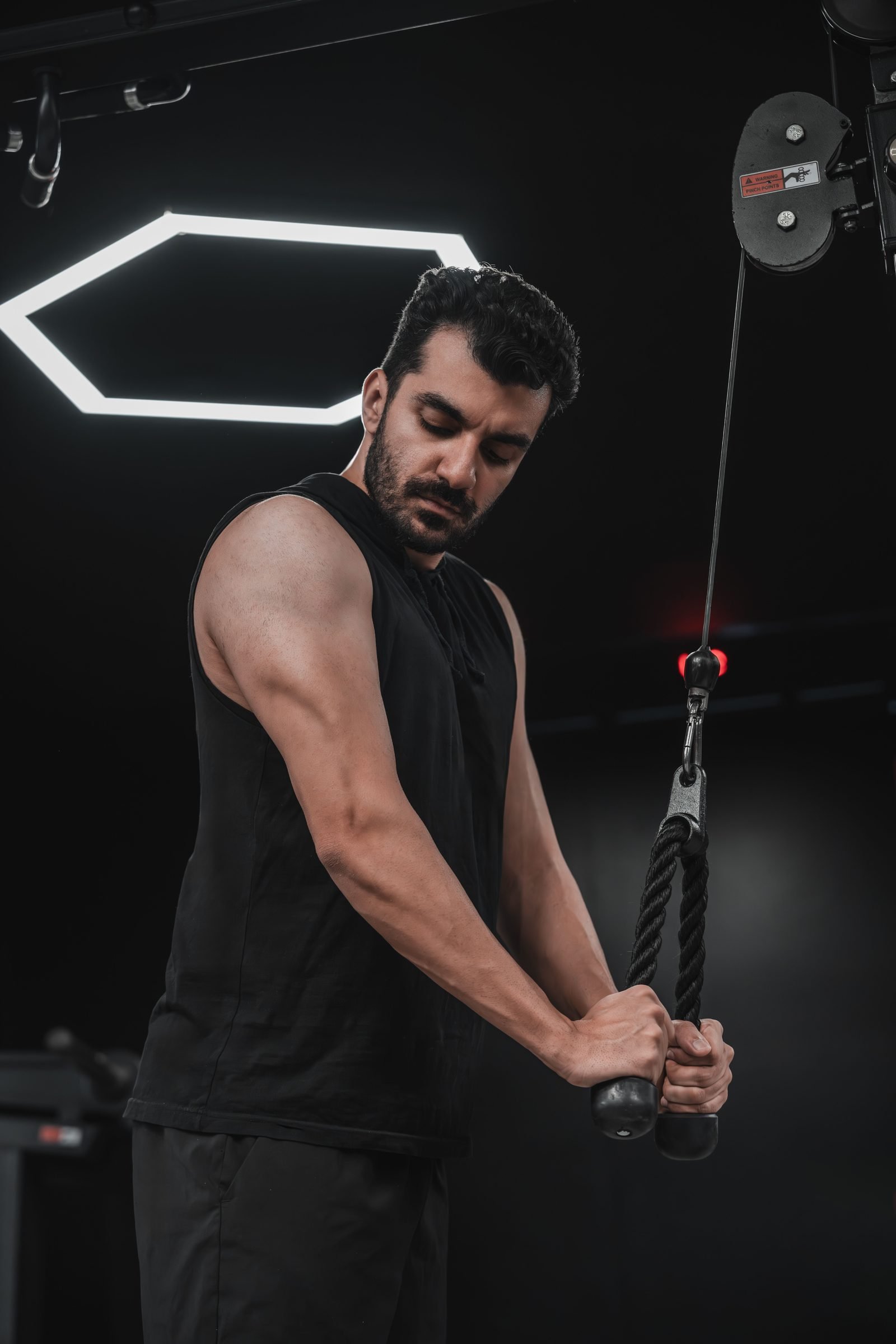
Here’s a full arm-focused session we’d typically program for an intermediate client, with skull crushers slotted in after the main compound lift.
| Exercise | Sets | Reps | Rest |
|---|---|---|---|
| Close-Grip Bench Press | 4 | 6-8 | 120 sec |
| EZ Bar Skull Crusher | 3 | 10-12 | 90 sec |
| Dumbbell Skull Crusher | 2 | 12-15 | 75 sec |
| Overhead Rope Extension | 3 | 12-15 | 60 sec |
| Triceps Rope Pushdown | 2 | 15-20 | 45 sec |
Notice the rep ranges climb as the session goes on and the joint stress per exercise drops. Heavier, more technical movements come first when your form is sharpest; higher-rep, lower-skill finishers come last when some fatigue is expected.
How Much Weight Should You Use for Skull Crushers?
Start lighter than your ego wants to. A good starting point for most people is an empty EZ bar or a pair of light dumbbells (5-10 kg each) for the first couple of sessions, purely to lock in the elbow path and bar control. Once that feels solid, add weight in small increments, 2.5 kg per side on a bar or 1-2 kg per dumbbell, as long as your last two reps of each set stay clean.
A reasonable target for most trained lifters is a weight that makes reps 9 through 12 genuinely hard while your elbow path stays locked in place. If you need to flare your elbows or arch off the bench to finish a rep, the weight is too heavy for that set, full stop. Skull crushers reward control far more than they reward load, so there’s no shame in using less weight here than you’d guess.
Are Skull Crushers Worth the Elbow Risk?
Yes, when you do them right. The exercise has a reputation for being hard on the elbows, but that’s almost always a loading or form problem rather than something inherent to the movement. Keep the weight appropriate, control the eccentric, and stop the descent before your elbow joint feels like it’s at its end range, and skull crushers are no riskier than any other pressing variation. If you already have elbow pain from another cause, it’s worth working with a coach before loading this pattern heavily.
Our founder, Yash Pathak, has spent the last ten years coaching lifters across India through exactly this kind of exercise selection, figuring out which movements build a client’s arms without wrecking their joints along the way. If you’d rather not guess your way through form fixes and progression on your own, our 1-on-1 personal training programs build skull crushers and the rest of your arm work into a plan that’s actually built around your body and your goals.
Frequently Asked Questions
What is a skull crusher workout?
A skull crusher workout is a triceps-focused training session built around the skull crusher exercise, a lying elbow extension performed with an EZ bar, dumbbells, or a straight barbell. It typically pairs skull crushers with other pressing and extension movements to fully develop all three heads of the triceps.
How do you do a skull crusher workout?
Lie on a flat bench, press your chosen weight to arm’s length over your chest, then bend only at the elbows to lower it toward your forehead or slightly behind it. Keep your upper arms still throughout, then extend back to the start. Program it for 2-3 sets of 8-12 reps after a heavier compound press.
What are the benefits of skull crusher workouts?
Skull crushers isolate the triceps more directly than most pressing movements, building arm size and improving lockout strength for lifts like the bench press. Because they stretch the long head of the triceps under load, they also help fill out the back of the upper arm, an area many pressing-heavy programs neglect.
Can beginners do skull crushers safely?
Yes, as long as they start light and prioritize elbow control over weight on the bar. We usually introduce beginners to the dumbbell version first since the neutral grip is gentler on the wrists and elbows, then progress to an EZ bar once the movement pattern is consistent.
How many skull crushers should I do per week?
Two to three sets, once or twice a week, is plenty for most lifters when combined with other triceps work like pushdowns or close-grip pressing. More frequent direct triceps volume than that usually just adds joint fatigue without much extra muscle growth.