An athletic workout trains your body to perform, not just to look a certain way. It combines explosive power work, strength training, agility drills, and conditioning so you get faster, more coordinated, and better at absorbing and producing force, the way an athlete needs to. This is different from a bodybuilding-style session built around isolating muscles for size. If your goal is to move well, react quickly, and hold up under real physical demand, whether that is a weekend football game or just chasing your kid across a park, an athletic workout is what gets you there.

What Makes a Workout “Athletic” Instead of Just Muscle Building?
The difference comes down to the goal you are training for. Bodybuilding-style training chases hypertrophy: bigger muscles, targeted growth, symmetry. It is usually slow and controlled, with long rest periods and a focus on isolating one muscle at a time. An athletic workout chases performance: how fast you move, how much force you can produce in a short window, how well you change direction, and how your body coordinates multiple muscle groups at once.
A bodybuilder trains a muscle. An athlete trains a movement. Both approaches build strength, but athletic training layers in speed, reaction time, balance, and stamina on top of that strength, because size alone does not make you fast or agile. We see this mix-up constantly with clients who have spent years lifting and are still gassed and clumsy on a five-a-side pitch. Big muscles that cannot fire quickly or coordinate under fatigue are not athletic muscles.
None of this means strength does not matter. It is the base everything else sits on. But an athletic program treats strength as one input among several, not the entire program.
What Are the Key Components of an Athletic Workout?
A well-built athletic session usually pulls from four buckets: explosive power work, strength training, agility drills, and conditioning. Skip any one of these and you end up with a gap. A powerful athlete who cannot change direction gets beaten by a slower, more agile opponent. A strong athlete with no conditioning fades in the second half.
- Explosive/plyometric work – box jumps, broad jumps, medicine ball throws
- Strength training – squats, deadlifts, presses, and pulls
- Agility drills – ladder drills, cone drills, shuttle runs
- Conditioning – intervals, sled pushes, circuit-style finishers
Explosive and Plyometric Work
This is anything that trains your muscles to produce force fast: box jumps, broad jumps, medicine ball throws, bounding, and depth jumps. Plyometrics teach the nervous system to fire quickly and use the stretch-shortening cycle (the spring-like effect of your muscles and tendons) efficiently. Most people skip this entirely and go straight to heavy lifting, which is a mistake if speed and power are part of the goal.
Strength Training That Transfers
Strength is still non-negotiable. Squats, deadlifts, presses, and pulls build the raw force production that everything else is built on. The key difference in athletic programming is a bias toward compound lifts that move multiple joints and muscle groups together, since that mirrors how the body actually works during sport. Isolation exercises still have a place for fixing weak links or rehabbing an old injury, but they sit on the side of the program, not at the center of it.
Agility and Change of Direction
Agility is the ability to decelerate, change direction, and accelerate again without losing control or speed. Ladder drills, cone drills, shuttle runs, and reactive cutting exercises all belong here. If you want a deeper breakdown of drills and progressions, our guide on agility workouts covers this in more depth. Most gym-goers never train this quality at all, which is exactly why they look strong but move stiffly.
Conditioning That Matches the Demand
Conditioning should match what you are training for. A footballer needs repeated short sprints with incomplete recovery. Someone training for general athleticism might use intervals, sled pushes, or circuit-style finishers. Long, slow cardio has its place for recovery and base fitness, but it does not replicate the stop-start nature of most sports and should not be the main conditioning method in an athletic program.
What Does a Sample Athletic Workout Session Look Like?
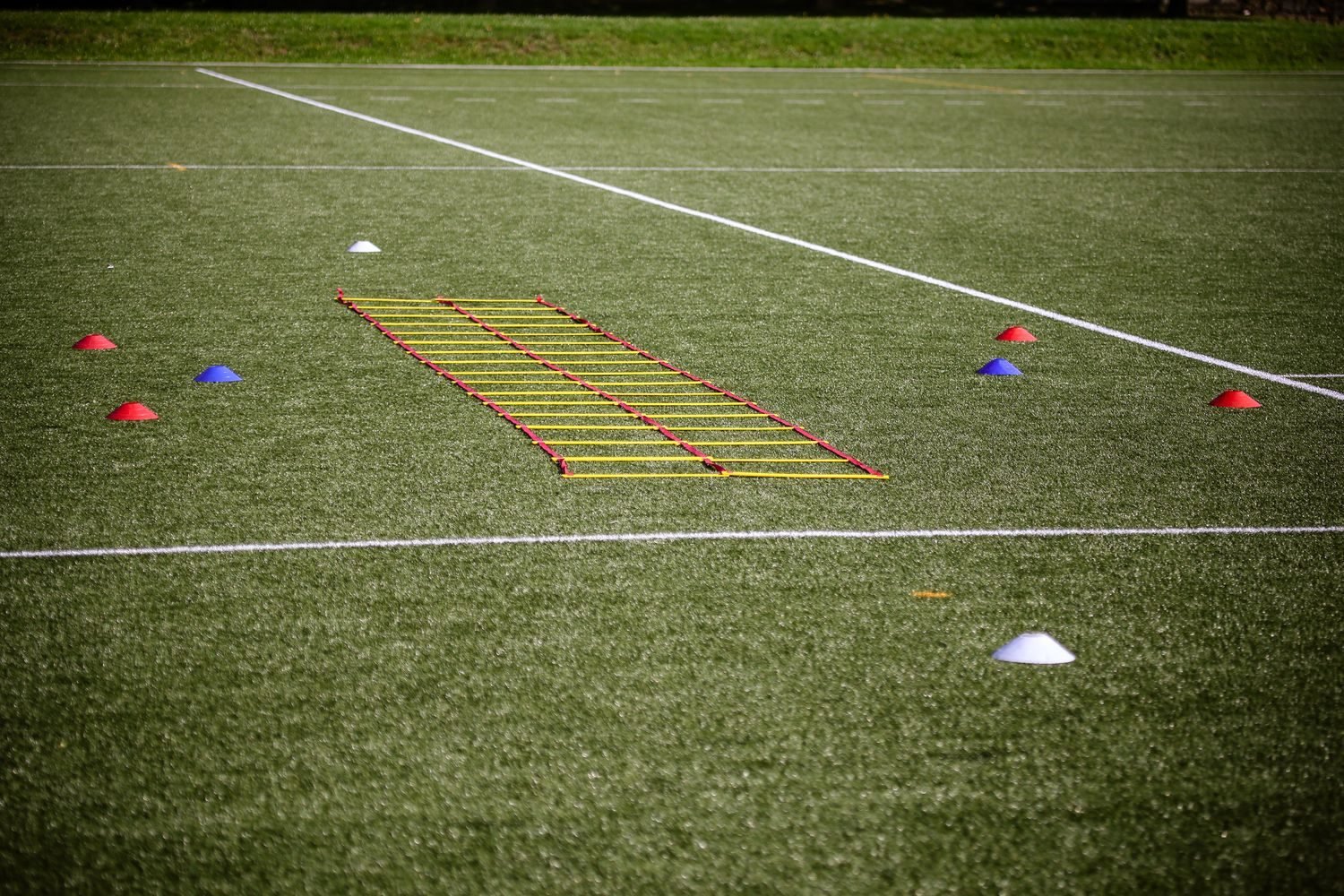
Here is a real session structure we use with clients training for general athleticism (field sport, recreational competition, or just wanting to move better). Adjust load and volume to your current fitness level. Warm up for 10 minutes with dynamic stretching and light movement prep before starting.
| Segment | Exercise | Sets x Reps / Duration | Rest |
|---|---|---|---|
| Power | Box jumps | 4 x 5 | 90 sec |
| Power | Medicine ball rotational throw | 3 x 6 per side | 60 sec |
| Strength | Barbell back squat | 4 x 5 | 2 min |
| Strength | Single-arm dumbbell row | 3 x 8 per side | 90 sec |
| Agility | 5-10-5 shuttle drill | 5 reps | 60 sec |
| Agility | Lateral ladder drill | 4 sets x 20 sec | 45 sec |
| Conditioning | Sled push intervals | 6 x 20m | 45 sec |
Notice the order. Power work comes first, while the nervous system is fresh, because explosive movements need quality over fatigue. Strength follows, then agility, then conditioning last since that is meant to push you into a fatigued state on purpose. Doing this in reverse order (conditioning first) wrecks your ability to move explosively for the rest of the session.
How Many Days a Week Should You Train Athletically?
Three to four sessions a week is enough for most people chasing general athleticism alongside a normal life and job. Competitive athletes in-season might structure this differently, with lighter power and agility work on practice days and full sessions reserved for off days. What matters more than frequency is not skipping the components you find hard. Most people naturally gravitate toward strength work because it is familiar and skip agility and plyometrics because they feel awkward at them. That is precisely the gap worth closing.
Do You Need to Be an Athlete to Train This Way?
No. This style of training benefits anyone who wants to move better, not just competitive athletes. Better coordination, faster reflexes, and stronger tendons and ligaments reduce injury risk in daily life, not just on a field. A 40-year-old who trains agility and power alongside strength will step off a curb wrong less often and recover better when they do. Athletic training is really just training your body’s full range of capability instead of one narrow slice of it.
FAQs About Athletic Workouts
What is an athletic workout?
An athletic workout is training built around performance qualities: speed, power, agility, coordination, and sport-transferable strength. It combines plyometrics, compound lifts, agility drills, and conditioning rather than isolating muscles for size alone. The goal is to move better and produce force efficiently, not just to build bigger muscles.
How do you do an athletic workout?
Structure sessions around four elements: explosive power work first, strength training second, agility drills third, and conditioning last. Train three to four times a week, progress load and complexity gradually, and warm up properly since plyometric and agility work carries more injury risk when muscles are cold or technique breaks down under fatigue.
What are the benefits of an athletic workout?
You get faster reaction time, better coordination, more usable strength, and improved conditioning for stop-start activity. It also builds resilience in tendons and ligaments, which lowers injury risk in sport and daily movement. Unlike pure hypertrophy training, the benefits show up in how your body performs, not just how it looks.
How is an athletic workout different from a regular gym workout?
A regular gym workout, especially bodybuilding-style training, focuses on muscle isolation, controlled tempo, and hypertrophy. An athletic workout prioritizes speed, power, and multi-joint movement patterns that carry over to sport and real-world activity. Both build strength, but only one trains your body to move fast and react under pressure.
Can beginners do athletic training?
Yes, with adjusted intensity. Beginners should start with lower jump heights, simpler agility patterns, and lighter loads on strength work while building movement quality first. A coach can regress plyometric and agility drills so beginners get the same training effect without the injury risk that comes from doing advanced versions too soon.
Building real athletic ability takes more than a random mix of exercises copied from a video. It needs a program that sequences power, strength, agility, and conditioning correctly, and adjusts as you progress. If you want a plan built around your sport, your schedule, and your current fitness level, FitStrot’s 1-on-1 personal training is built exactly for that. Yash Pathak and the coaching team design programs around how you move, not just how much you can lift.