A weight gain workout is a structured strength training program built around heavy compound lifts, progressive overload, and enough recovery to let your body actually use the calories you’re eating to build muscle instead of just fat. It’s not random gym sessions or endless cardio. At FitStrot we build these programs specifically for naturally thin, underweight clients across India who’ve struggled for years to put on size despite eating more, and the training side of the equation matters just as much as the plate.
Why Does Training Matter If You’re Already Eating More?
Most underweight people who come to us have already tried the “eat more” advice on its own. They eat a bigger breakfast, add a protein shake, maybe skip a run or two, and still don’t gain. The missing piece is almost always training stimulus. Your body doesn’t add muscle just because extra calories show up. It adds muscle when you give it a reason to, and that reason is progressive resistance training that tells your muscles they need to get bigger and stronger to handle the load.
This is where a lot of well-meaning advice falls apart. Cardio-heavy routines, long walks, or casual bodyweight circuits burn through the calorie surplus you worked hard to create without giving your body a strong enough signal to grow. We program strength work first for every weight gain client because it’s the only variable that reliably converts extra food into extra muscle rather than just extra fat around the midsection.
How Do You Build a Weight Gain Workout Plan?
A proper weight gain plan follows the same basic structure as any well-designed workout plan, just tuned for mass gain instead of fat loss or general fitness. That means compound lifts as the foundation, a rep range that supports both strength and size (usually 6 to 12 reps for most exercises), enough rest between sets to lift heavy with good form, and a training frequency your body can actually recover from.
We start most underweight clients on a 4-day split that hits every major muscle group twice a week. Twice weekly frequency matters more for skinny lifters than people realize. Training a muscle once a week and calling it a day leaves too much recovery time and not enough total volume to drive growth, especially for someone whose baseline muscle mass is already low.
If you’re a man trying to fill out your frame, the exercise selection and loading patterns in our workout plan for men line up well with this approach, since a lot of the underweight clients we train are men in their late teens and twenties dealing with a fast metabolism and a physique that’s stayed thin no matter what they’ve tried.
What Should a Weekly Training Split Look Like?
You don’t need a complicated split to gain weight. In fact, simpler usually works better for beginners and intermediate lifters who are underweight, because it lets you repeat movements often enough to get stronger week over week. Picking the right structure from our guide on choosing a best workout routine is a good starting point if you’re not sure whether a full body, upper/lower, or push/pull/legs split fits your schedule and recovery capacity.
For most underweight clients starting out, we default to an upper/lower split run four days a week. It hits each muscle group twice, leaves room for proper recovery, and is easy to stick to consistently, which matters more than any clever programming trick.
What Does an Actual Weight Gain Workout Session Look Like?
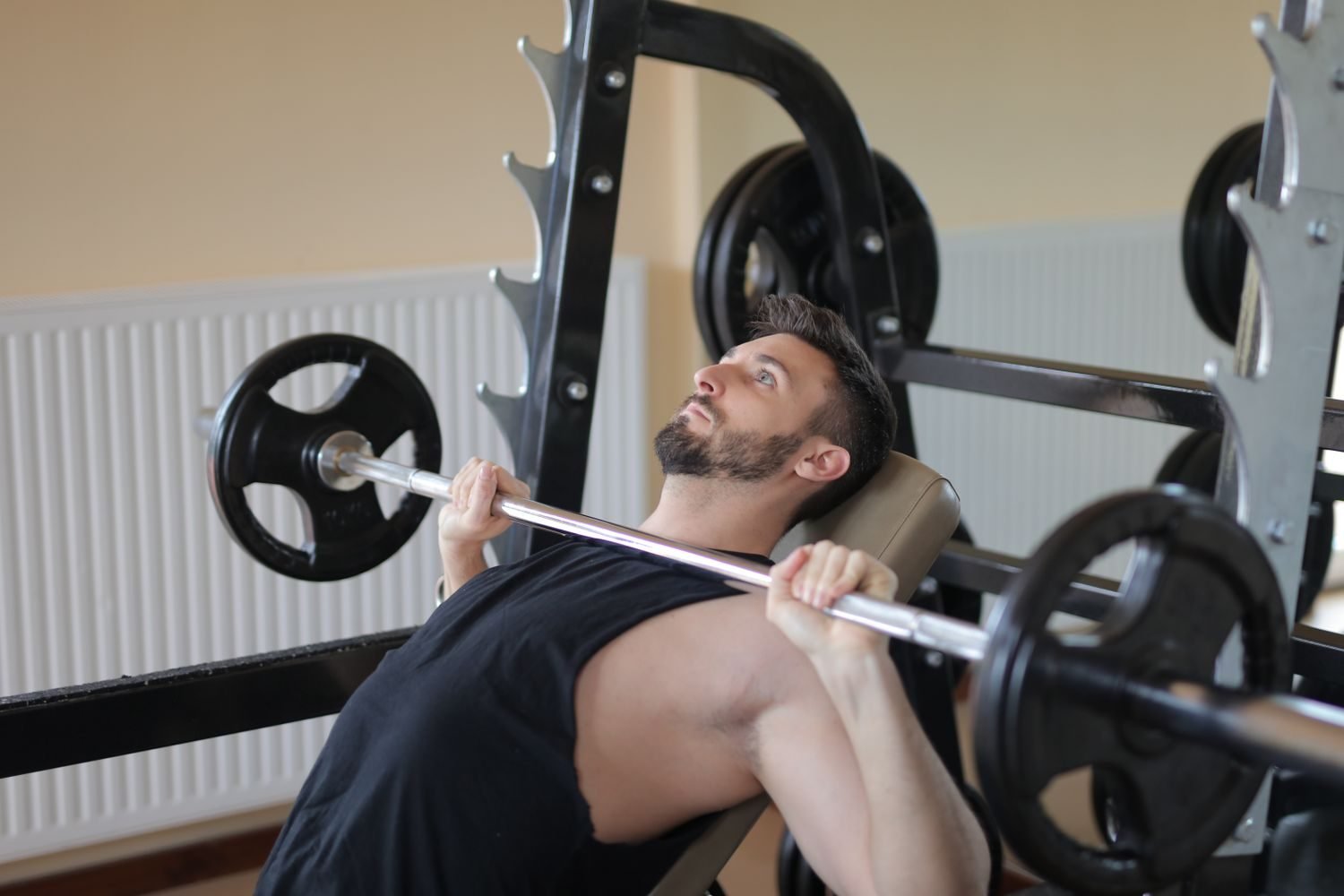
Here’s a sample upper body session we’d typically program in week one or two of a weight gain block. The loads should feel challenging by the last two reps of each set, not easy.

| Exercise | Sets | Reps | Rest |
|---|---|---|---|
| Barbell Bench Press | 4 | 6-8 | 120 sec |
| Bent-Over Barbell Row | 4 | 6-8 | 120 sec |
| Seated Dumbbell Shoulder Press | 3 | 8-10 | 90 sec |
| Lat Pulldown | 3 | 8-10 | 90 sec |
| Incline Dumbbell Press | 3 | 10-12 | 75 sec |
| Barbell Curl | 3 | 10-12 | 60 sec |
| Rope Triceps Pushdown | 3 | 10-12 | 60 sec |
On lower body day, we’d anchor the session around a barbell squat variation and a Romanian deadlift, again in the 6-8 rep range for the main lifts, with accessory work like leg press, leg curls, and calf raises filling out the volume. The heavy compound lifts drive the strength adaptation. The accessory work adds the total volume your muscles need to actually grow in size.
How Much Should You Eat to Support This Kind of Training?
Training creates the stimulus, but you still need a calorie surplus for your body to build new tissue. As a general starting point, most underweight individuals need to eat somewhere around 300 to 500 calories above their maintenance level daily, with protein intake around 1.6 to 2.2 grams per kilogram of bodyweight. This isn’t a precise number for everyone, it’s a starting point you adjust based on how the scale and your strength numbers move over a few weeks.
We keep nutrition guidance simple and food-first for weight gain clients:
- More rice, roti, and dal at each meal
- Ghee added to meals for easy extra calories
- Full-fat dairy such as milk and paneer
- Nuts as a calorie-dense snack
- Enough protein spread across the day through eggs, chicken, paneer, or lentils
Supplements can fill genuine gaps when whole food intake falls short, particularly protein, but they’re a backup plan, not the strategy. We don’t recommend leaning on any specific pre-workout or mass gainer product as a substitute for actually eating enough real food and training hard.
Can Cardio Be Part of a Weight Gain Workout Plan?
Yes, in small doses. A short walk or light cardio session a few times a week supports appetite, digestion, and general health without eating into your recovery. What doesn’t work is running, cycling, or HIIT sessions stacked on top of heavy strength training multiple times a week. That combination burns through the surplus you’re trying to build and competes directly with muscle recovery. If you’re underweight and serious about gaining, cardio takes a back seat during this phase, it doesn’t disappear entirely.
What Mistakes Do Underweight Lifters Usually Make?
We see clients make the mistake of training like a bodybuilder from a YouTube video on day one, chasing a pump with high reps and light weights instead of getting stronger on the basics. Muscle size follows strength gains far more reliably than it follows a burnout finisher. If your squat, bench, row, and deadlift numbers aren’t moving up over 8 to 12 weeks, your training isn’t doing its job, regardless of how sore you feel after a session.
The other common mistake is inconsistency dressed up as busyness. Skipping sessions because of college, work, or travel and trying to make up for it with occasional intense workouts doesn’t work for someone with a naturally fast metabolism. Weight gain rewards boring consistency more than any single great workout.
How Long Does It Take to See Results?
Most clients notice their lifts going up within 2 to 3 weeks, which is the earliest real signal that training and eating are aligned. Visible changes in weight and shape typically show up around the 6 to 8 week mark, and meaningful physique change takes a consistent 4 to 6 month block. There’s no shortcut here. Genetics, training age, and how consistently you eat and sleep all affect the timeline, but the direction should be clearly upward by two months in.
If you’ve tried putting together your own plan and the scale hasn’t moved, the issue is usually one of three things: not enough total training volume, not eating enough consistently, or a program that isn’t built around your actual recovery capacity. If you want a program built specifically for your goals, that’s what our 1-on-1 personal training is for. We look at your training history, your schedule, and your eating patterns before writing a single set, which is the only way a weight gain plan actually works long term.
Frequently Asked Questions
What is the best workout for weight gain?
The best workout for weight gain is a strength training program built around compound lifts like squats, bench presses, rows, and deadlifts, done 4 days a week with each muscle group trained twice. Progressive overload matters more than any specific exercise selection, since strength gains drive the muscle growth that shows up on the scale.
How many calories do you need to gain weight?
Most underweight individuals need roughly 300 to 500 calories above their maintenance level each day, alongside 1.6 to 2.2 grams of protein per kilogram of bodyweight. These numbers are starting points, not fixed rules, and should be adjusted every few weeks based on how your weight and strength are actually progressing.
Can cardio be part of a weight gain workout plan?
Yes, light cardio like walking a few times a week is fine and even helpful for appetite and recovery. Heavy or frequent cardio sessions like running or HIIT should be minimized during a weight gain phase, since they burn through your calorie surplus and compete with the recovery your muscles need to grow.
How long does it take to see weight gain results from training?
Strength improvements usually show up within 2 to 3 weeks, and visible weight or shape changes typically appear around 6 to 8 weeks into consistent training and eating. Meaningful physique change generally takes a full 4 to 6 month block, with results depending on training consistency, sleep, and how reliably you’re hitting your calorie surplus.
Do skinny people need a different workout plan than everyone else?
Not a fundamentally different one, but the emphasis shifts. Underweight lifters generally need more total training volume, twice-weekly frequency per muscle group, and a bigger, more consistent calorie surplus than someone training for general fitness or fat loss. The core lifts stay the same, the dosage and nutrition around them change.