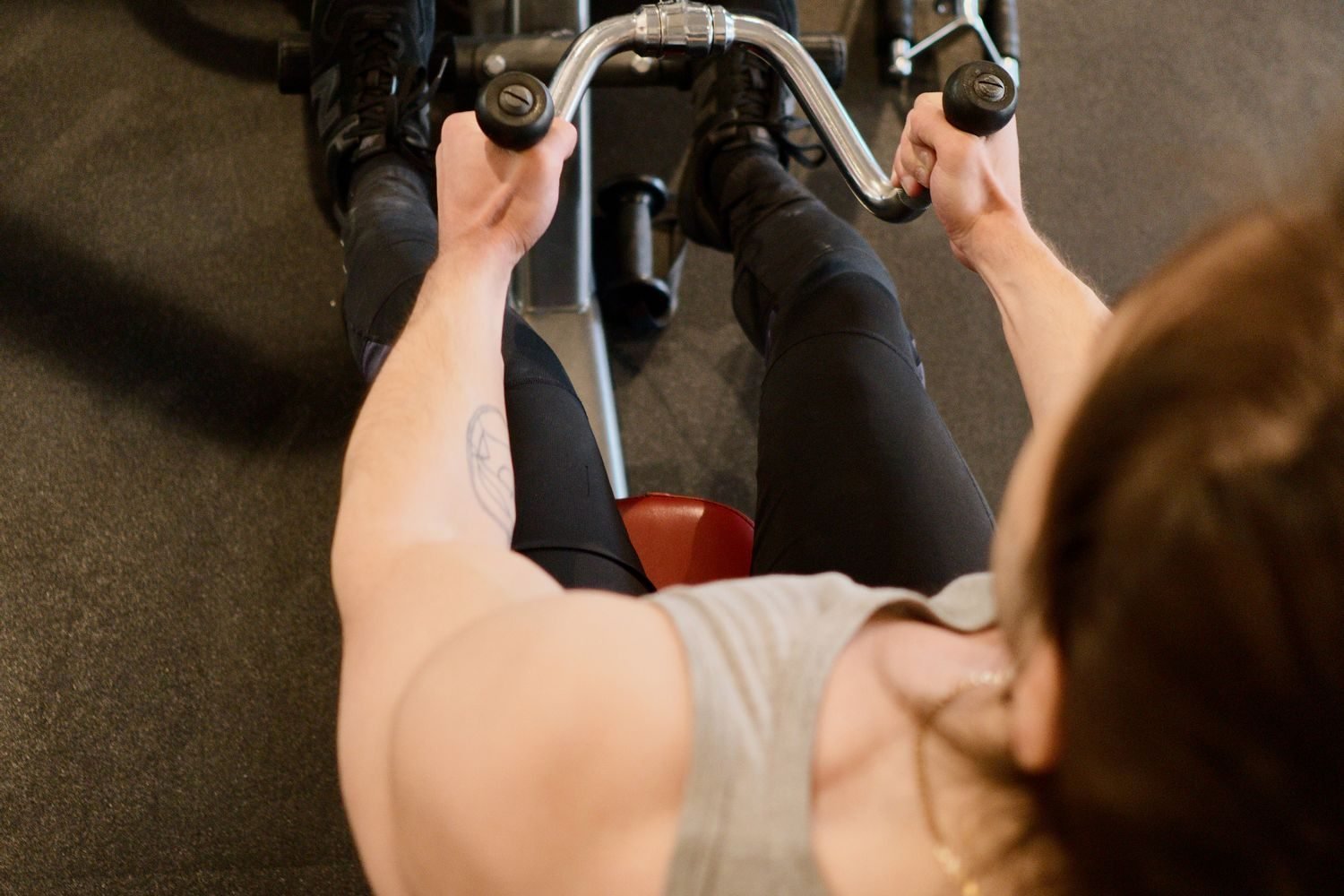
A seated cable row is a horizontal pulling exercise done on a low pulley cable machine, where you sit with your feet braced against a footplate and pull a handle toward your torso. It primarily trains the middle back muscles, the lats, the rear delts, and the biceps, while also demanding core and hip stability to keep your torso still through the pull. It’s one of the most reliable cable back workouts in any gym because the cable keeps constant tension on the muscle through the entire range of motion, something free weights can’t always match.

What Is a Seated Cable Row?
The seated cable row is a compound pulling movement performed on a low-row cable station. You sit on a bench or platform, plant your feet on the footrest, grab a handle attached to the cable, and pull it toward your abdomen while keeping your torso upright. It’s a staple in back day programming because it isolates the pulling pattern without the grip fatigue or balance demands you get from deadlifts or pull-ups.
At FitStrot we program this move for almost every client working on posture or upper body strength, whether they’re brand new to training or years into it. It scales easily by weight, attachment, and tempo, which makes it useful across experience levels.
What Muscles Does the Seated Cable Row Work?
The seated cable row is a back-dominant exercise, but it recruits more than just your lats. Here’s the breakdown:
- Latissimus dorsi – the big back muscle that gives you width, active through the pulling and finishing phase, which is why this move shows up in nearly every serious lat workouts plan.
- Rhomboids and middle trapezius – these do most of the work of squeezing your shoulder blades together at the end of the pull.
- Rear deltoids – help pull your upper arm back and support shoulder health.
- Biceps brachii – assist with elbow flexion throughout the movement.
- Erector spinae and core – work isometrically to keep your spine tall and stable while you pull.
Because the resistance stays constant on a cable, unlike a dumbbell where tension drops off at the top of the movement, your back muscles stay under load for longer per rep. That’s a big part of why coaches lean on cable workouts for hypertrophy-focused back training.
How Do You Do a Seated Cable Row Correctly?
Good form on the seated cable row comes down to controlling your torso and pulling with your back, not your arms. Here’s how we coach it:
- Set up the machine. Attach your chosen handle, sit on the bench, and place your feet firmly on the footplate with a slight bend in your knees.
- Grab the handle and set your spine. Reach forward, grab the handle with both hands, and sit up tall with a neutral spine before you take any weight.
- Initiate the pull from your shoulder blades. Start by drawing your shoulder blades back and down, then bend your elbows and pull the handle toward your lower ribs.
- Keep your elbows close to your body. Let them travel back past your torso rather than flaring out to the sides.
- Squeeze at the finish. Pause for a beat when the handle touches your torso and your shoulder blades are fully retracted.
- Control the return. Extend your arms back out slowly, letting your shoulder blades protract, until you feel a stretch through your lats.
Aim for a two-second pull and a three-second return. Slowing the eccentric down is the single easiest change that improves this exercise for most people we train.
Which Cable Attachment Should You Use?
The handle you choose changes the emphasis and feel of the seated cable row. None of these is objectively best, they just target things slightly differently.
- V-bar (close grip) – The most common choice. The neutral grip lets you pull deeper into your torso and puts a strong emphasis on the mid-back and lower lats. Good default for most lifters.
- Wide bar (pronated or overhand) – Forces your elbows out wider, which shifts more work onto your rear delts and upper back. Useful if you’re chasing upper back thickness.
- Rope attachment – Lets your hands travel independently at the top of the pull, so you can rotate them out for extra rear delt and rhomboid activation. It’s a nice variation to rotate in every few weeks to keep the stimulus fresh.
If you’re only doing one version of this exercise, start with the V-bar. Once your form is solid, swap in the rope or wide bar on alternating weeks so your back gets trained from a few different angles, similar to how we vary attachments in a cable crossover workout for the chest.
What Mistakes Kill Your Seated Cable Row?
This exercise looks simple, which is exactly why people get sloppy with it. The two mistakes we correct most often are momentum and back rounding.
Using momentum to move the weight
Rocking your torso backward to help yank the handle in is the most common fault we see. It turns a back exercise into a half-hearted hip hinge and takes tension off the muscles you’re trying to train. If you need to lean back to move the weight, the load is too heavy. Drop it and rebuild the pattern with strict form first.
Rounding the lower back
Letting your lower back round, especially at the start of the pull when the arms are extended and the stretch is deepest, puts unnecessary strain on the spine. Keep your ribs stacked over your hips and your core braced. If you can’t maintain a neutral spine at a given weight, that’s your cue to lighten the load, not push through it.
Shrugging instead of retracting
Some lifters pull with their traps and shrug their shoulders up toward their ears instead of drawing the shoulder blades back. This shifts the work away from the mid-back. Keep your shoulders down and away from your ears through the whole set.
Seated Cable Row vs Dumbbell Row: Which Is Better?
Both are excellent horizontal pulling exercises, and the honest answer is that you don’t have to pick one forever. They train the same muscles slightly differently.
The seated cable row keeps constant tension through the full range of motion because the cable never goes slack, and it lets you use a controlled, symmetrical pull with both arms working together. It’s easier to load heavy and progress steadily, and it takes less core stability than a bent-over row, which makes it more forgiving for beginners or anyone managing a lower back issue.
A dumbbell row, usually done single-arm with one hand and knee braced on a bench, gives you a longer stretch at the bottom and lets each side of your back work independently. That’s useful for fixing strength imbalances between your left and right sides, something a cable row can mask. If you’re following a structured dumbbell workouts plan at home or in a hotel gym with no cable station, the dumbbell row is your best substitute.
Our general rule: use the seated cable row as your main back-builder for controlled volume, and add a dumbbell row as an accessory to catch imbalances and build unilateral strength. You don’t need to overthink it further than that.
How Do You Program the Seated Cable Row Into a Back Day?
The seated cable row works best placed after your heavier compound pulls, like deadlifts, pull-ups, or barbell rows, when you still have enough energy to control the movement but don’t need maximal loading to get a training effect. We usually program it in the 3-4 sets and 8-12 rep range for muscle growth, or 4-5 sets of 6-8 reps if the goal is straight strength.
Rest between 60 and 90 seconds for hypertrophy work, and closer to 2 minutes if you’re lifting heavier for lower reps. Pair it with a pulldown or pull-up variation earlier in the session and a rear delt or bicep-focused finisher afterward, and you’ve got a complete gym back workout routine.
If you train at home or split your week between free weights and machines, you can rotate the row pattern across sessions, cable one week, dumbbell the next, and even bring in a kettlebell workout for single-arm rows on days you don’t have machine access. Variety like this keeps your back responding without needing to constantly chase heavier numbers.
Sample Back Day Session
Here’s a full back day session we regularly program for intermediate clients, with the seated cable row as the main accessory lift after the primary compound movement.
| Exercise | Sets | Reps | Rest |
|---|---|---|---|
| Barbell deadlift | 4 | 5 | 2-3 min |
| Lat pulldown | 3 | 8-10 | 90 sec |
| Seated cable row (V-bar) | 4 | 10-12 | 60-90 sec |
| Single-arm dumbbell row | 3 | 10 per side | 60 sec |
| Face pull (rope) | 3 | 15 | 45 sec |
| Cable or dumbbell bicep curl | 3 | 12 | 45 sec |
This structure trains the back from top to bottom, spine-loading first, then width, then thickness, then the smaller stabilizers. Adjust the loads and reps based on where you are in your training cycle, but keep the seated cable row anchored right after your main pull.
Ready to Build a Back Day That Actually Works?
Reading about form cues only gets you so far. What actually changes your back development is having someone watch your setup, catch the moment your lower back starts to round, and adjust your programming as you get stronger. That’s the gap a coach closes that no article can. If you want a plan built around your body, your equipment, and your schedule, our 1-on-1 personal training program pairs you with a dedicated coach who builds and adjusts your training week by week.
Frequently Asked Questions
What is a seated cable row?
A seated cable row is a horizontal pulling exercise performed on a low-pulley cable machine. You sit with your feet braced on a footplate and pull a handle toward your torso, primarily working your mid-back, lats, rear delts, and biceps while your core stabilizes your spine throughout the movement.
How do you do a seated cable row correctly?
Sit tall with feet on the footplate, grab the handle, and pull it toward your lower ribs by drawing your shoulder blades back first, then bending your elbows. Keep elbows close to your torso, squeeze at the finish, and control the return slowly rather than letting the weight stack yank you forward.
What are the benefits of the seated cable row?
It builds mid-back thickness and width, improves posture by strengthening the muscles that pull your shoulders back, and keeps constant tension on the target muscles because the cable never goes slack. It’s also lower-risk for your lower back than bent-over rowing variations.
How heavy should you go on a seated cable row?
Choose a weight that lets you complete every rep with your shoulder blades doing the work, not your lower back rocking to generate momentum. If you can’t keep your torso still and your spine neutral for the full set, the weight is too heavy, regardless of what number is on the stack.
Can beginners do the seated cable row?
Yes, it’s actually one of the better back exercises for beginners because the seated position removes the balance and hip-hinge demands of a bent-over row. Start light, focus on pulling with your shoulder blades, and build up load gradually once the movement pattern feels controlled.