A full body workout is a training session that hits your major muscle groups, legs, chest, back, shoulders, and core, in a single sitting, rather than splitting them across different days. It’s the split we recommend most often when someone starts training with us, because it works your whole body three times a week with a day of recovery in between, which is enough stimulus to build strength and muscle without burning you out. If you’re new to lifting or you only have three days a week to train, this is where you start.

What Exactly Is a Full-Body Workout?
Instead of dedicating a session to “chest day” or “leg day,” a full-body session pairs one lower-body movement, one upper-body push, one upper-body pull, and a core or accessory exercise, all in the same workout. You do this three times a week, usually on non-consecutive days like Monday, Wednesday, and Friday, so your muscles get worked and then get 48 hours to recover before you hit them again.
This is different from a split routine, where you train specific body parts on specific days and don’t touch them again for another five to seven days. Full body training front-loads frequency. Each muscle group gets stimulated roughly three times a week instead of once, which matters more than most people realise, especially early on.
Who Should Do Full-Body Training?
We recommend full-body workouts to three types of clients most often:
- Beginners. If you’ve been training for less than a year, your body responds well to frequent, moderate exposure to each lift. You don’t need five different chest exercises to grow your chest. You need to squat, push, and pull consistently and add a little weight or a rep every week or two. A full-body structure makes that progression easy to track because you’re touching the same core lifts multiple times a week.
- People with limited time. If you can only make it to the gym three days a week, a full-body split gets more done per session than an upper/lower or push/pull/legs split would if you’re only hitting the gym that often. You’re not leaving muscle groups untouched for a week at a time.
- Anyone returning after a break. If you’ve been out of the gym for a few months, jumping straight into a five-day body-part split is a fast way to end up sore and demotivated. Full body sessions let you ease back in, spread the workload across the week, and rebuild the habit before you add volume or complexity.
Anyone starting from scratch should read our beginner workout plan alongside this guide. Full body training is the standard structure we build those plans around, and it explains the logic in more depth, sets, reps, and how to progress week to week.
Full body training tends to suit people less well once they’ve been lifting seriously for two or three years and want to specialise, add serious volume to lagging body parts, or train five to six days a week. At that stage a split routine usually makes more sense, and we cover that trade-off properly in our guide to choosing a workout split.
How Often Should You Train Full Body?
Three days a week is the sweet spot for most people. It gives each muscle group enough frequency to drive progress while leaving enough recovery time between sessions that you’re not walking into a workout still sore from the last one. A typical week looks like Monday, Wednesday, Friday, or Tuesday, Thursday, Saturday if weekends suit you better.
Some clients ask if they can do full body four times a week instead. You can, but the returns start to shrink unless you also cut the volume per session, because you need at least one rest day between sessions hitting the same muscles hard. Two full-body days a week works fine too if that’s all your schedule allows. It’s a slower path to progress, but it still beats training inconsistently on a more ambitious split you can’t stick to.
A Sample Full-Body Workout
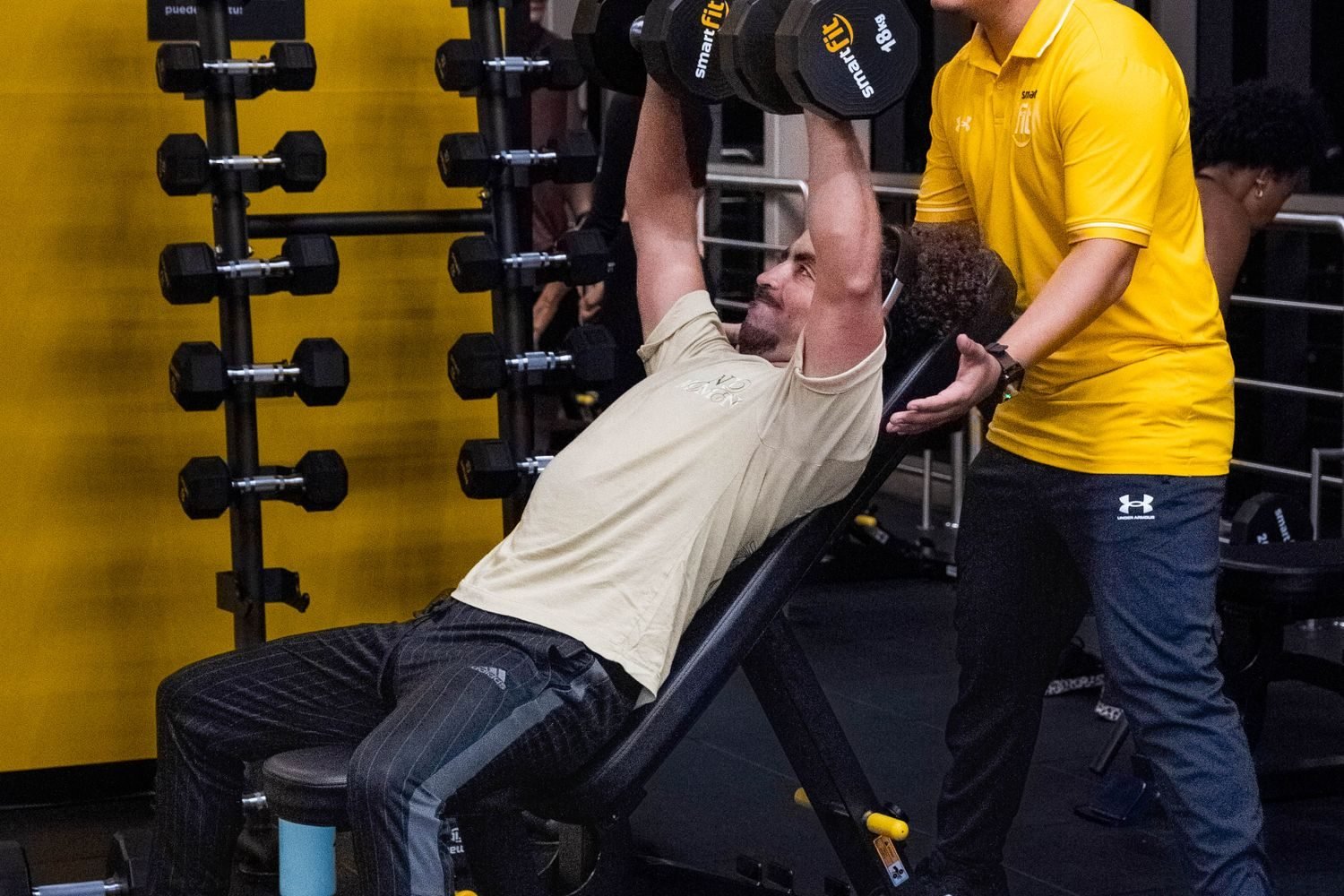
Here’s a session we’d give a client in their first few months of structured training. It covers a squat pattern, a horizontal push, a horizontal pull, an overhead press, and a core movement, which between them work almost every major muscle group in the body.
| Exercise | Sets | Reps | Rest |
|---|---|---|---|
| Barbell Back Squat (or Goblet Squat) | 3 | 8-10 | 90 sec |
| Flat Bench Press (or Push-Up) | 3 | 8-10 | 90 sec |
| Bent-Over Row (or Seated Cable Row) | 3 | 10-12 | 75 sec |
| Standing Overhead Press | 3 | 8-10 | 75 sec |
| Romanian Deadlift | 2 | 10-12 | 60 sec |
| Plank or Hanging Knee Raise | 3 | 30-45 sec / 12-15 reps | 45 sec |
That’s around 45 to 60 minutes depending on how much you rest and how crowded the gym is. Run this same session, or a close variation of it, three times a week and add weight or reps whenever you complete the top of the rep range with good form. If you’d rather split upper and lower body across separate days instead of training everything in one session, our upper body workout guide is a good next step once you outgrow full body training.
Full-Body Workouts vs Split Routines: Which Wins?
Neither one is objectively better. It depends on your training age, your schedule, and honestly, what you’ll actually stick to.
Full body wins on frequency and simplicity. You hit every muscle group three times a week, the program is easy to follow, and there’s less room to accidentally neglect a body part. It’s also more forgiving if you miss a session, since you’re not losing an entire week of chest training the way you might on a strict five-day split.
Split routines win on volume and specialisation. If your goal is to build a bigger back or stronger shoulders specifically, a split lets you throw four or five exercises at that muscle group in one session instead of two. That’s harder to do inside a full-body structure without the workout running past 90 minutes.
We see a lot of clients try to jump into a five-day split before they’ve built the base strength or the consistency to justify it, then burn out within a month because the volume outpaces their recovery and their schedule. Full body first, split later, is usually the more durable order. For a longer breakdown of every split option, including push/pull/legs and upper/lower, read our best workout split guide.
How to Progress a Full-Body Program Over Time
The simplest progression model is adding either a small amount of weight or one to two reps to each lift every week or two, as long as your form holds up. Once you’re comfortable running the same session three times a week, you can start alternating between two slightly different full-body workouts, Workout A and Workout B, so you’re not doing the exact same lifts every single session.
After three to six months of consistent full-body training, most people are ready to either add a fourth day, increase volume per muscle group, or transition toward a split routine if their goals call for it. There’s no fixed timeline. It’s more about whether your recovery and progress have plateaued on the current setup.
If you’re not sure whether you’re progressing correctly, or you want a program built around your actual schedule, equipment, and goals rather than a generic template, that’s exactly what our 1-on-1 personal training is built for. You get a coach who adjusts your full-body plan as you get stronger instead of leaving you to guess.
Frequently Asked Questions
What is a full-body workout?
A full-body workout is a training session that targets your legs, chest, back, shoulders, and core all in one sitting, rather than splitting muscle groups across different days. It’s typically repeated three times a week with rest days in between, making it the go-to structure for beginners and time-limited lifters.
How do you structure a full-body workout?
Structure it around one squat or lunge pattern, one upper-body push like a bench press, one pull like a row, an overhead press, and a core exercise. Do three sets of 8 to 12 reps per movement, rest 60 to 90 seconds between sets, and run the session three times a week on non-consecutive days.
What are the benefits of full-body workouts?
Full-body training hits each muscle group about three times a week instead of once, which speeds up strength and muscle gains for beginners. It’s also time-efficient, easier to stay consistent with when your schedule is tight, and more forgiving if you miss an occasional session.
Is a full-body workout better than a split routine?
Neither is universally better. Full body suits beginners, people with three training days a week, and anyone rebuilding consistency, while splits suit experienced lifters training four or more days who want to specialise on individual muscle groups with more volume per session.
How many days a week should you do full-body workouts?
Three days a week, on non-consecutive days like Monday, Wednesday, and Friday, is the standard recommendation. It gives every muscle group enough training frequency to drive progress while leaving adequate recovery time between sessions.