BMI is a useful starting point for nutrition planning, not a verdict on your health. It’s a quick screening ratio of weight to height that correlates reasonably well with health risk across large populations, but it cannot tell the difference between muscle and fat, doesn’t know where your fat is stored, and was built from data that didn’t reflect the full diversity of body types we see today. The smartest way to use BMI and nutrition planning together is to treat your number as one data point — alongside waist circumference, body composition, and how your body actually functions — rather than the entire picture.
If you’ve ever calculated your BMI and felt like the result didn’t match reality (a muscular number that reads “overweight,” or a “normal” number despite a growing waistline), you’re not imagining things. That’s a documented limitation, not a personal failure to fit the formula. Here’s what BMI actually measures, where it holds up, where it falls apart, and how to build a nutrition plan for weight loss — or any other goal — around the fuller picture.
What is BMI and how is it calculated?
Body Mass Index is a simple calculation: your weight in kilograms divided by your height in meters squared (kg/m²). It was developed in the 1830s by Belgian mathematician Adolphe Quetelet as a population-level statistical tool — not a clinical instrument for individual diagnosis, which is part of why its later use in medicine has drawn so much scrutiny.
Today, the WHO and CDC both use BMI as a low-cost, no-equipment screening tool because it’s fast to calculate and correlates with body fat at a population level. The CDC is explicit that BMI is a screening tool, not a diagnostic one — it isn’t designed to determine whether an individual has excess body fat or a weight-related illness on its own.
What are the WHO BMI categories?
The World Health Organization’s standard adult BMI classification is widely used as a reference point:
| Category | BMI Range (kg/m²) |
|---|---|
| Underweight | Below 18.5 |
| Normal weight | 18.5 – 24.9 |
| Overweight | 25.0 – 29.9 |
| Obese Class I | 30.0 – 34.9 |
| Obese Class II | 35.0 – 39.9 |
| Obese Class III | 40.0 and above |
These cutoffs aren’t universal, either. The WHO’s Western Pacific Regional Office has proposed lower thresholds for Asian populations — overweight starting at 23 instead of 25, and obesity at 25 instead of 30 — because research shows Asian adults tend to carry more central (visceral) fat and face higher cardiometabolic risk at a given BMI than non-Asian populations. That’s a strong signal a single global cutoff was never going to fit everyone equally well.

Why doesn’t BMI account for muscle versus fat?
This is the most cited and most legitimate criticism of BMI. Because the formula only uses weight and height, it has no way to distinguish a kilogram of muscle from a kilogram of fat — or bone density, for that matter. The CDC states plainly that BMI does not distinguish between fat, muscle, and bone mass.
In practice, this cuts both ways:
- Muscular individuals — athletes, serious strength trainers, some manual laborers — can land in “overweight” or even “obese” BMI categories despite low body fat, simply because muscle is denser than fat.
- “Skinny fat” individuals can land in the “normal” BMI range while carrying high body fat and low muscle mass. Research using DXA body composition scans has found that roughly 30% of people classified as normal weight by BMI actually had high body fat levels — a pattern sometimes called normal-weight obesity.
Age compounds this problem. As people get older, they naturally lose muscle and gain fat, favoring strategies built around healthy weight gain and muscle preservation even when the number on the scale — and therefore BMI — stays flat. An older adult’s BMI can look completely unremarkable while their fat-to-lean-tissue ratio has shifted substantially, which matters directly for protein intake and strength-preserving nutrition.
Does BMI account for where fat is stored?
No, and this is arguably a bigger blind spot than the muscle-versus-fat issue. BMI treats a kilogram of fat the same no matter where it sits on the body, but distribution matters enormously for health risk. Visceral fat — stored around abdominal organs — is more strongly linked to type 2 diabetes, cardiovascular disease, and metabolic syndrome than fat stored at the hips or thighs.
Two people can share an identical BMI while having very different health profiles simply because one carries more fat around the midsection. This is why health organizations increasingly recommend pairing BMI with a measurement that captures fat distribution — waist circumference.
What is waist circumference and why does it matter?
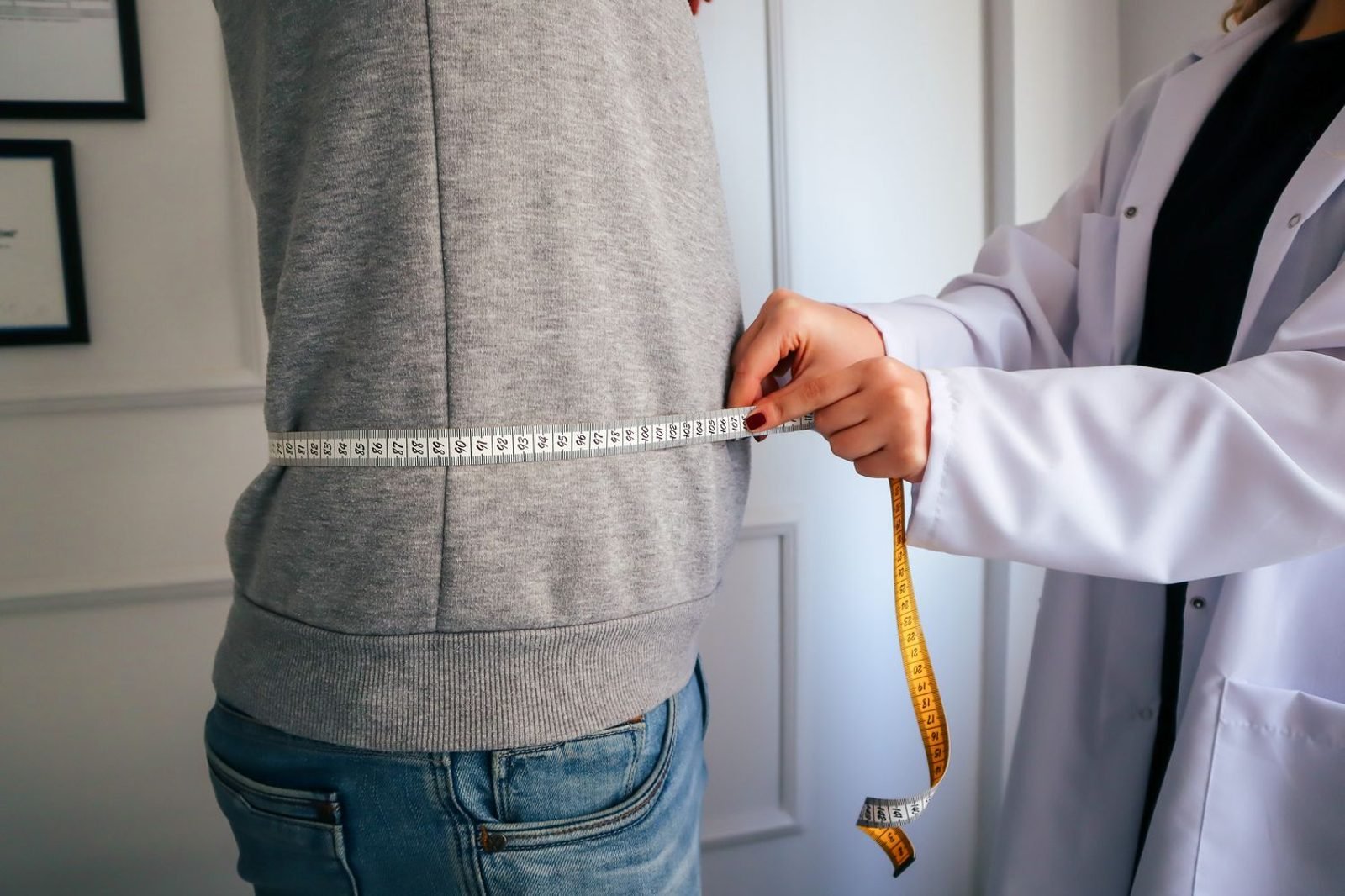
Waist circumference is a simple tape-measure reading around the abdomen, and it’s one of the most practical companions to BMI because it directly reflects abdominal fat — the type most closely tied to metabolic risk. The NIH has established thresholds for increased health risk: a waist circumference of 102 cm (about 40 inches) or more in men, and 88 cm (about 35 inches) or more in women, used alongside BMI rather than as a replacement for it.
A related measure, waist-to-hip ratio, is used by the WHO to define abdominal obesity, with cutoffs above 0.90 for men and above 0.85 for women. Some researchers argue waist-to-height ratio is an even simpler, more predictive early-warning measure than BMI or waist circumference alone.
The practical takeaway: if your BMI sits in the “overweight” range but your waist circumference is well within normal limits, your risk profile likely looks different than someone with the same BMI carrying weight around the midsection. Neither number alone tells the full story, which is why a serious nutrition diet chart for weight loss — or any structured plan — looks at both.
What other measures give a fuller picture than BMI?
BMI is a starting point, not an endpoint. For a more complete read on body composition and health risk, a few additional measures are worth knowing:
- Body composition analysis (DXA, bioelectrical impedance, skinfold calipers): Estimates actual body fat percentage versus lean mass, directly addressing BMI’s biggest blind spot. DXA scans are the research-grade gold standard; bioelectrical impedance scales are a more accessible, if less precise, home option.
- Waist circumference and waist-to-height ratio: As covered above, these capture fat distribution, which BMI cannot.
- Waist-to-hip ratio: Useful for flagging abdominal obesity patterns, particularly in clinical settings.
- Functional and metabolic markers: Blood pressure, fasting blood glucose, triglycerides, and HDL cholesterol collectively describe metabolic health in ways one anthropometric number never can.
None of these measures is perfect alone either — that’s the point. Health risk is multidimensional, and no single number can substitute for looking at the full picture. This is also why a body composition reading, not just a BMI calculation, should inform whether your nutrition strategy leans toward fat loss, healthy weight gain, or simple maintenance with a recomposition focus.
How should BMI actually inform your nutrition plan?
Used correctly, BMI is a first checkpoint, not a prescription. Here’s how to fold it into a nutrition strategy without over-relying on it:
- Use BMI as a screening flag, not a diagnosis. If your BMI falls outside 18.5–24.9, treat it as a prompt to look closer — at waist circumference and activity level — not an automatic mandate to lose or gain weight.
- Pair it with waist circumference. The NIH threshold of 102 cm (men) / 88 cm (women) is a free, five-minute check that adds real information BMI can’t provide alone.
- Consider your training history. If you strength train regularly, your BMI may run higher than population norms suggest simply because you carry more muscle — a case where BMI actively misleads without context.
- Build your plan around goals, not just a number. A well-structured nutrition diet chart should account for activity level, muscle mass, and personal history — BMI is one input, not the blueprint.
- Track trends, not single readings. A BMI or waist measurement moving consistently over months tells you far more than any single snapshot, and it’s more forgiving of day-to-day fluctuations.
- Prioritize nutritional balance over chasing a number. Adequate protein, fiber, and consistent energy balance matter more long-term than hitting a specific BMI figure. Nutritional balance for weight loss is about sustainable habits, not gaming a formula.
Is BMI still worth calculating at all?
Yes, with the right expectations. BMI remains genuinely useful because it’s fast, free, requires no equipment, and correlates with health risk closely enough across large populations to guide screening. Dismissing it entirely would throw away a tool that, used appropriately, still adds value. The mistake isn’t calculating BMI; it’s treating a single ratio as the final word on your health.
If your BMI, waist circumference, and how your body performs day to day are all roughly in agreement, that’s a useful signal. If they disagree — a high BMI with a lean waist and strong energy levels, say — that’s informative too, and usually means the BMI number needs more context, not that the other signals are wrong.
Frequently Asked Questions
Can I have a “normal” BMI and still have too much body fat?
Yes, sometimes called normal-weight obesity. Research using DXA body composition scans has found that around 30% of people in the “normal” BMI range actually carry high body fat percentages, often due to low muscle mass. Pairing BMI with a body composition check or waist measurement closes that gap.
Why do athletes often get misclassified as “overweight” by BMI?
Muscle is denser than fat, so a muscular person can weigh more per unit of height without carrying excess fat. Since BMI only factors in weight and height, it can’t separate muscle from fat mass, which is why athletes and dedicated strength trainers frequently score higher on BMI than their actual body fat suggests.
What waist circumference is considered a health risk?
Per NIH-established thresholds, a waist circumference of 102 cm (about 40 inches) or more in men, or 88 cm (about 35 inches) or more in women, is associated with increased health risk. These figures are meant to be used alongside BMI, not as a standalone replacement.
Should I use different BMI cutoffs if I’m of Asian descent?
Possibly, for screening purposes. The WHO’s Western Pacific Regional Office has proposed lower thresholds for Asian populations — overweight starting at 23 and obesity at 25, versus the standard 25 and 30 — since research shows increased cardiometabolic risk at lower BMI values in these populations. Worth discussing with a healthcare provider.
Is body composition testing better than BMI?
It gives more specific information by directly estimating fat versus lean mass, addressing BMI’s core weakness. It isn’t automatically “better” for every purpose, though — it typically requires equipment or cost BMI doesn’t, so many people use BMI as a quick first check and body composition testing as a follow-up.
How often should I recheck my BMI and waist circumference?
There’s no universal rule, but checking every few months is usually enough to spot meaningful trends without fixating on daily fluctuations. What matters more than frequency is the direction of change over time, alongside how your energy and strength are progressing.
BMI can tell you something useful in thirty seconds, but it was never built to tell you everything. Combine it with waist circumference, a body composition check where possible, and a nutrition plan built around your actual goals — not just a single ratio on a chart. For a plan that accounts for the fuller picture, an online nutritionist consultation can help translate these numbers into a strategy tailored to you.