A back and biceps workout pairs pulling exercises like rows, pull-ups, and lat pulldowns with elbow-flexion moves like curls, because both muscle groups fire together every time you pull something toward your body. When you row a barbell or pull yourself up on a bar, your biceps assist as secondary movers, so training them in the same session lets you finish the pulling work first and then finish off the biceps with direct isolation while they’re already warm. We build this pairing into most of our clients’ programs because it matches how the body actually works, not how a bodybuilding poster splits muscles on paper.

Why Do We Train Back and Biceps Together?
Every major back exercise, whether it’s a deadlift, a row, or a pull-up, relies on your biceps and forearms to hold the bar or bar path steady. The biceps brachii crosses both the elbow and shoulder joint, so it’s mechanically involved any time your arm pulls toward your torso. That overlap is the whole reason the back-biceps pairing exists in classic push-pull-legs and upper-lower splits.
There’s a practical reason too. If you trained biceps before back, you’d walk into your heavy rows and pull-ups with fatigued arms and grip strength that’s already shot. Training back first lets you use your biceps as a supporting player when they’re fresh, then hit them directly once the bigger lifts are done. This is also why a pull day workout almost always groups these two muscle groups, since pulling is the movement pattern that connects them.
How Should You Structure a Back and Biceps Session?
Start with the exercise that demands the most from your nervous system and the most from your grip, then work down to smaller, more isolated movements. A typical structure looks like this: one heavy compound pull, one or two rowing variations to hit the mid-back from different angles, a movement that targets the upper back and rear delts, and then two or three biceps exercises to close things out.
We don’t recommend jumping straight into curls at the start of a session. Your biceps are small and fatigue fast, and if they’re already tired, your grip becomes the limiting factor on every subsequent back exercise. That’s a common reason people plateau on their rows even though their back is strong enough to lift more.
What’s the Right Exercise Order for Back and Biceps Day?
Order matters more than most lifters think. We structure sessions with the following logic:
- Vertical pull first, like pull-ups or lat pulldowns, because they need the most coordination and grip strength while you’re freshest.
- Horizontal pull next, such as barbell rows or seated cable rows, to build thickness through the mid-back.
- A single-arm or machine row to correct imbalances between sides, since most people have one side that pulls slightly harder.
- Rear delt or upper back isolation work, which also cleans up posture over time. If your upper back rounds forward at a desk all day, this is the piece worth prioritizing, and it’s exactly what we cover in our upper back workouts guide.
- Biceps exercises last, moving from heavier compound curls to lighter, higher-rep isolation work.
Cable-based back exercises are worth building into the middle of the session because they keep constant tension on the lats through the full range of motion, unlike free weights where tension drops at the top or bottom of the rep. We go into this in more depth in our piece on cable back workouts, and it’s a section of every program we write for clients chasing lat width.
What Does a Full Back and Biceps Workout Look Like?
Here’s a session we actually program for intermediate clients training three to four days a week. Adjust the load to whatever lets you hit the rep range with one or two reps left in the tank.
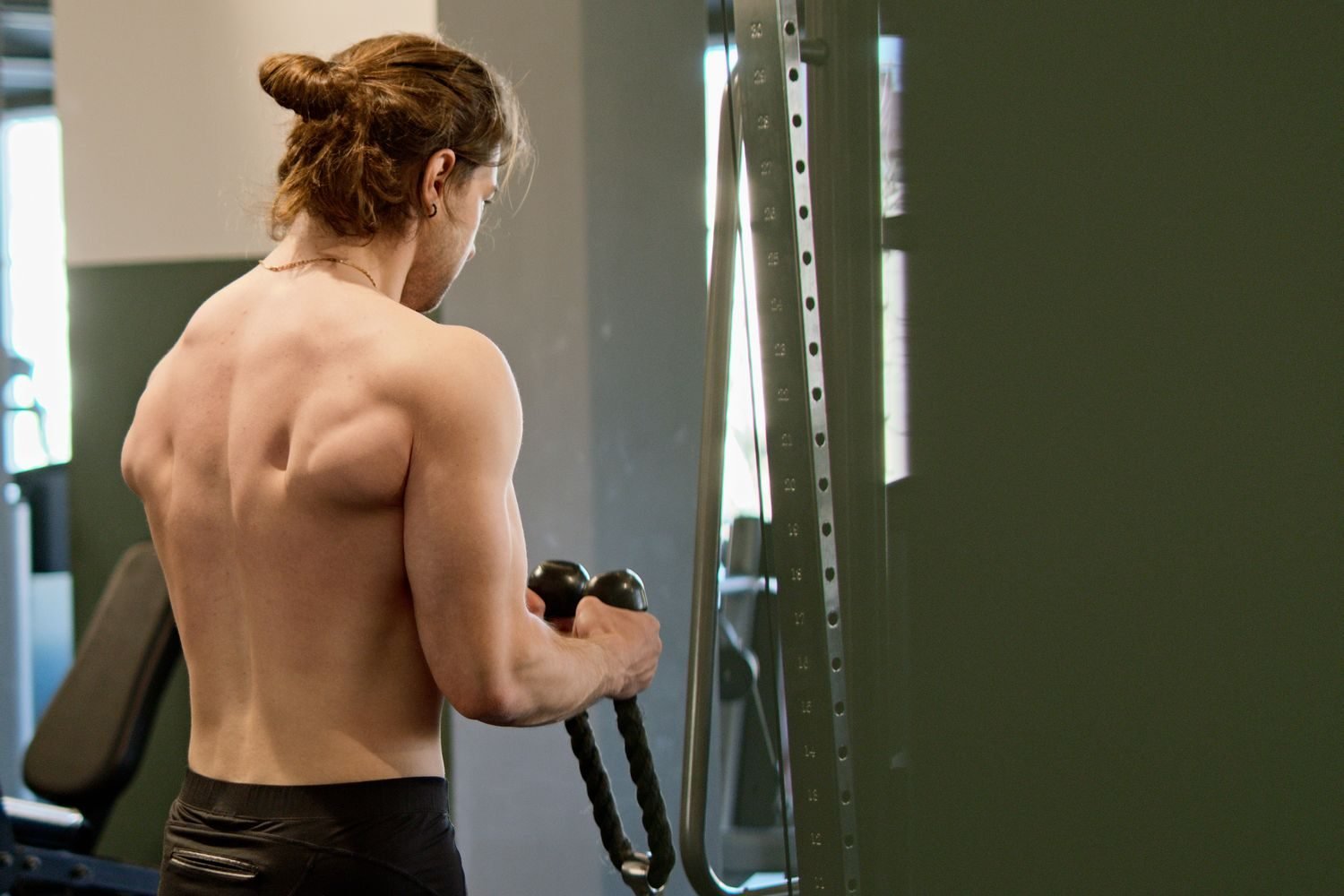
| Exercise | Sets | Reps | Rest |
|---|---|---|---|
| Pull-ups (or lat pulldown) | 4 | 6-10 | 90 seconds |
| Barbell bent-over row | 4 | 8-10 | 90 seconds |
| Single-arm dumbbell row | 3 | 10-12 per side | 60 seconds |
| Seated cable row | 3 | 10-12 | 60 seconds |
| Face pull | 3 | 12-15 | 45 seconds |
| Barbell or EZ-bar curl | 3 | 8-10 | 60 seconds |
| Incline dumbbell curl | 3 | 10-12 | 45 seconds |
| Hammer curl | 2 | 12-15 | 45 seconds |
This gives you five back movements and three biceps movements, which is enough volume to grow both without turning the session into a two-hour grind. If you’d rather split pulling across two days instead of doubling up on biceps every session, alternate this with a back and tricep workout the following week so your arms get balanced attention on both sides of the elbow.
How Many Sets and Reps Should You Actually Do?
For back, we aim for somewhere between 12 and 20 total working sets per week, spread across whatever number of sessions you train back in. For biceps, 8 to 14 working sets per week is plenty for most people, since biceps also get indirect work from every row and pull-up you do. Beginners should sit at the lower end of these ranges. Trying to do 20 sets of back work in week one is a fast way to end up too sore to train the following week.
Rep ranges matter less than people assume, as long as you’re training close to failure. We rotate our clients between 6-10 reps on the heavier compound lifts and 10-15 reps on isolation work, because that mix builds both strength and the muscle size that makes a back workout worth the hour you put into it.
What Mistakes Kill Back and Biceps Day?
The biggest one is letting your arms take over the row. If you find yourself yanking the weight with your biceps instead of driving your elbow back and squeezing your shoulder blade, you’re training arms and shortchanging your back. Slow the eccentric down and focus on the elbow path, not the bar path.
Grip fatigue is another one. If your forearms give out before your back does on heavy pulling sets, use lifting straps on your last one or two sets so you can keep training the muscle you actually came in for. We see clients hit new row personal records within a few weeks of adding straps simply because their grip was the bottleneck the whole time, not their lats.
Skipping rear delt and upper back work is the third common error. Everyone wants a wide back, but the muscles that pull your shoulders back and keep your posture upright get ignored because they don’t show up in the mirror the way lats do. Face pulls and rear delt flyes aren’t optional accessories, they’re part of the reason your rows keep improving without your shoulders aching.
Ready to Build a Program Around This?
A workout on a page only goes so far. Your grip strength, shoulder mobility, and recovery capacity are different from the next person’s, which is why a template rarely fits everyone the same way. Our 1-on-1 personal training service builds your back and biceps sessions, and everything else in your split, around what your body can actually handle right now, with a coach adjusting the plan as you get stronger.
What is a good back and biceps workout?
A good one starts with a compound pull like pull-ups or a barbell row, follows with two or three more rowing or pulldown variations, adds a rear delt or upper back movement, and finishes with direct biceps work like barbell curls and hammer curls. The order matters as much as the exercise selection.
Why train back and biceps together?
Because your biceps are already working as a secondary muscle in almost every back exercise. Grouping them means you train the biceps directly right after they’ve already been warmed up through rowing and pulling, which is more efficient than training them on a separate day with no carryover.
How many exercises for back and biceps day?
Most sessions work well with four to five back exercises and two to three biceps exercises. That’s enough variety to hit the lats, mid-back, and rear delts from different angles without turning the workout into something you can’t recover from.
How often should you do a back biceps workout?
Once or twice a week is enough for most lifters, depending on your overall split. If you’re training four or more days a week, twice weekly with at least 48 hours between sessions lets you push harder each time without your recovery falling behind.
Should biceps be trained on a separate day from back?
You can, but it’s not necessary for most people. Splitting them apart usually only makes sense if you’re specifically chasing arm size and want extra dedicated volume that a combined session can’t fit in.
Can beginners do a back and biceps workout on day one?
Yes, but keep the volume low. Two or three back exercises and one or two biceps exercises is plenty while you learn the movement patterns and figure out how sore you get. You can add sets once your recovery catches up.