The fastest way to build a healthy plate is to stop counting and start dividing: fill half your plate with vegetables and fruit, one quarter with whole grains or cereals, and one quarter with protein like dal, fish, chicken, or paneer, then add a thumb-sized portion of healthy fat. This is the “plate method,” and it comes straight from two credible sources — the Harvard T.H. Chan School of Public Health’s Healthy Eating Plate and the ICMR-National Institute of Nutrition’s “My Plate for the Day” guidelines for Indians. Neither requires a food scale, a calorie app, or memorizing macros. You just need to look at your thali and check the proportions.
Most of us don’t overeat because we lack willpower — we overeat because our plates are quietly skewed toward rice, roti, and fried sides, with vegetables and protein squeezed into whatever space is left. The plate method flips that ratio. Below is exactly how to use it, including a worked example with a real Indian thali.
What is the plate method, and why do dietitians recommend it?
The plate method is a visual portioning system that replaces gram-counting with proportion-checking. Instead of asking “how many calories is this meal,” you ask “does this plate roughly match half vegetables and fruit, a quarter whole grains, a quarter protein, plus a little healthy fat.”
The most widely cited version is the Harvard Healthy Eating Plate, created by nutrition experts at the Harvard T.H. Chan School of Public Health to address gaps in the USDA’s MyPlate. It recommends:
- ½ plate: vegetables and fruits, with variety and color prioritized (potatoes are excluded because of their effect on blood sugar)
- ¼ plate: whole grains such as whole wheat, brown rice, oats, or quinoa, which have a milder effect on blood sugar than refined grains
- ¼ plate: healthy protein such as fish, poultry, beans, or nuts, with red meat limited and processed meat avoided
- Healthy oils in moderation, such as olive or canola oil, with trans fats avoided entirely
- Water, tea, or coffee as the primary drink, with sugary beverages skipped and juice limited to a small glass a day
Dietitians like this model because it’s diagnostic, not restrictive — it doesn’t ban any food group, it just corrects the ratio. It’s flexible enough to work for a bowl of soup, a lunchbox, or a plated Indian meal. If you’re still building foundational habits around meals in general, our guide on healthy eating habits to build is a useful companion to this one.
What does the ICMR-NIN “My Plate for the Day” recommend for Indians?
India has its own evidence-based version, developed by the ICMR-National Institute of Nutrition (ICMR-NIN) as part of the Dietary Guidelines for Indians. The “My Plate for the Day” model is built for a 2,000 kcal reference adult:
- Cereals and millets: 250 g/day, roughly 42% of daily energy
- Pulses (dal, legumes): 85 g/day, roughly 14% of daily energy
- Milk or curd: 300 ml/day, roughly 11% of daily energy
- Vegetables and green leafy vegetables: 400 g/day (including 150 g green leafy vegetables), roughly 9% of daily energy
- Fruits: 100 g/day, roughly 3% of daily energy
- Nuts and seeds: 35 g/day, roughly 9% of daily energy
- Fats and oils: 27 g/day, roughly 12% of daily energy
The key structural point ICMR-NIN makes is this: vegetables, fruits, green leafy vegetables, and tubers should together form essentially half of the plate, while the other half is shared between cereals/millets and pulses, nuts, and oils. This lines up closely with the Harvard model even though the two were developed independently — both land on “half plants, half grains-and-protein” as the practical target. ICMR-NIN also notes that Indian diets tend to lean too heavily on cereals and processed snacks, and too little on legumes, milk, vegetables, and fruit — exactly the imbalance this plate model is designed to correct.
How do you translate the plate method to a typical Indian thali?
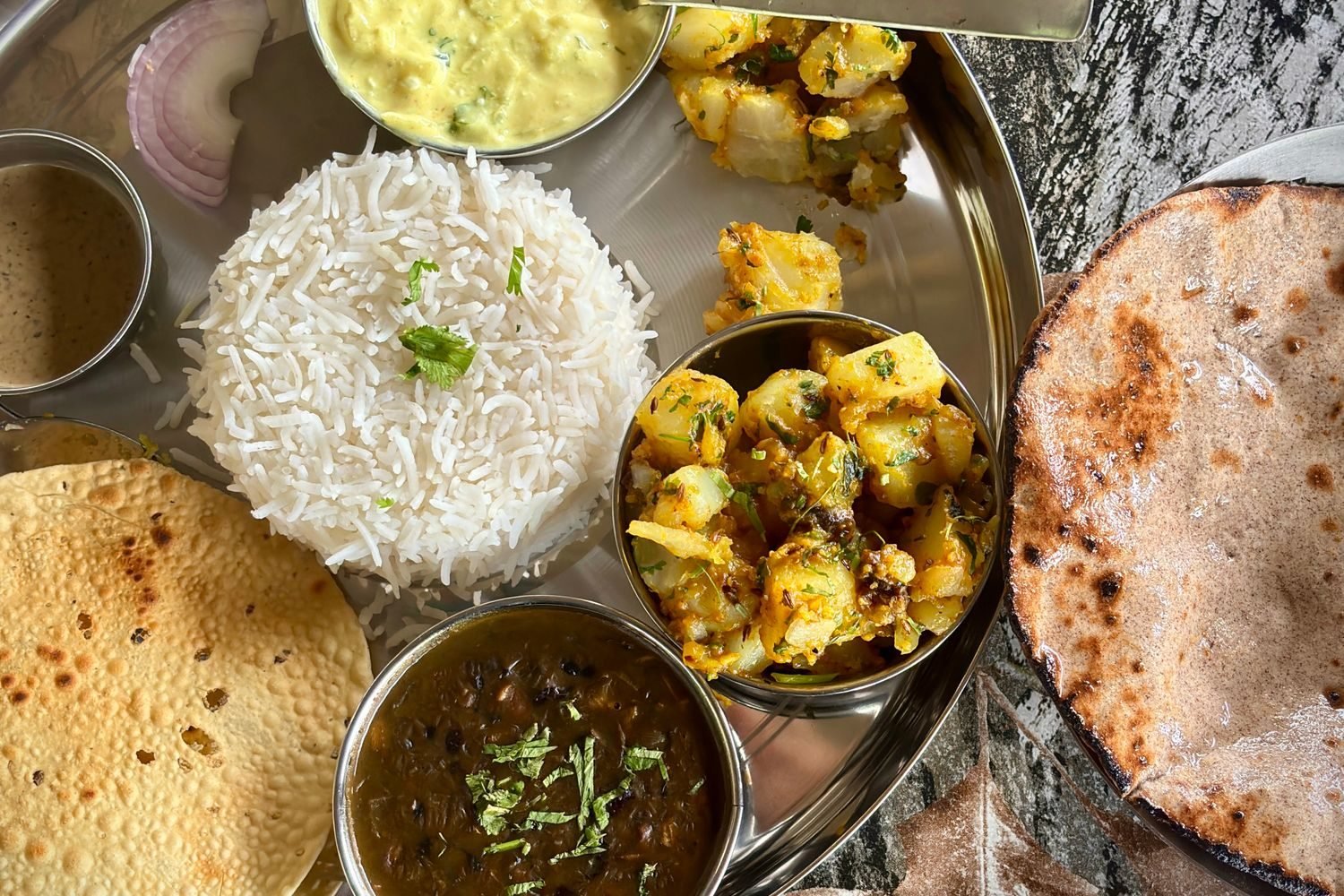
This is where the model earns its keep, because an Indian thali doesn’t naturally arrive in “quarters.” Here’s how to mentally divide a standard lunch or dinner thali.
A worked example: dal, sabzi, roti, rice thali
- Half the plate — vegetables: a generous serving of sabzi (mixed vegetable curry, bhindi, lauki, or a leafy sabzi like palak or methi) plus a side salad of cucumber, tomato, and onion. Aim for a green leafy vegetable most days.
- A quarter — protein: a katori (roughly 150 ml) of dal, sambar, rajma, or chana, or a portion of fish, egg, chicken, or paneer. Pulses do double duty here as protein and fiber.
- A quarter — grains: one to two rotis (preferably whole wheat or multigrain) or a small bowl of rice, not both in full portions. If you want both, halve each.
- A small side — fat and extras: the ghee used to cook the dal, a spoon of curd, and any pickle or papad in modest amounts.
In practice, this means serving yourself a bigger portion of sabzi and dal than habit dictates, and a visibly smaller portion of rice or roti. Most restaurant thalis are built the opposite way — a large mound of rice, a roti basket, and small side katoris of vegetables. Flipping that ratio is the entire exercise.
What if your meal isn’t served on one plate?
Combination meals like biryani or khichdi don’t fit neatly into plate quadrants — and that’s fine. Harvard’s own guidance addresses this: apply the same ratio to the ingredients going into the dish rather than the serving format. For a one-pot meal, that means loading it with vegetables and a protein source (dal, egg, or paneer) rather than treating rice as the whole meal, and pairing it with a side salad or raita to bring the vegetable share up to roughly half.
How much protein, grains, and vegetables should actually be on your plate?
Neither Harvard nor ICMR-NIN prescribes exact grams for every meal — proportions matter more than precision, since calorie needs vary by age, activity, and body size. As rough per-meal anchors for an average adult thali:
- Vegetables and salad: 1.5–2 cups cooked or raw, across at least two vegetables where possible
- Protein (dal/pulses/meat/paneer): one katori of dal (about 150 ml) or 75–100 g of cooked protein
- Grains (rice/roti): a small bowl of rice (about ¾ cup cooked) or 1–2 rotis, not a full serving of both
- Fruit: one medium fruit as a snack or meal-ender, working toward ICMR-NIN’s 100 g/day target
For weight management, the same plate keeps working — adjust the grain quarter down slightly and let vegetables and protein fill the gap, rather than cutting entire food groups. See our guide to nutrition for weight loss for more on this.
How does the plate method affect blood sugar and energy levels?
Both models flag refined carbohydrates as the main lever affecting post-meal blood sugar. Harvard notes that whole and intact grains have a “milder effect on blood sugar and insulin than white bread, white rice, and other refined grains,” which is why the plate method favors whole grains in the carbohydrate quarter.
In an Indian context, that means choosing whole wheat atta over refined maida, adding millets (jowar, bajra, ragi) into your roti or rice rotation, and pairing rice or roti with enough fiber and protein from the rest of the plate to slow digestion. A plate that’s half vegetables and a quarter dal produces a gentler blood sugar rise than the same amount of rice eaten alone. If glycemic response is a specific concern, our article on how to lower the glycemic index of meals covers tactics like meal sequencing that stack well with the plate method.
How do you actually start using the plate method today?
You don’t need a special plate or a nutrition app to start. A few practical steps:
- Serve vegetables first. Filling half the plate with sabzi and salad before adding rice or roti naturally limits space left for refined carbs.
- Use a smaller rice bowl or fewer rotis. Try one and a half rotis instead of two, and see if the extra dal and sabzi fill you up just as well.
- Treat dal as a main, not a side. A generous katori, not a token spoonful, is what makes the quarter-plate protein target realistic.
- Keep green leafy vegetables in weekly rotation. ICMR-NIN calls out 150 g of greens within the daily 400 g vegetable target — palak, methi, or sarson all count.
- Revisit the ratio weekly, not perfectly at every meal. The plate method works best as a habit you check periodically.
Pairing this with slower, more attentive eating makes the proportions easier to stick to, since you’re less likely to reflexively refill the rice bowl before your body has registered that it’s full. If that’s a gap for you, our piece on what is mindful eating and how to start is a good next read, and for turning this into a repeatable weekly routine rather than a one-off effort, see meal planning in nutrition. Building any of these habits sits well alongside our broader list of healthy eating habits to build.
Frequently asked questions
Does the plate method work for weight loss, or just general health?
Both. By prioritizing vegetables and protein, which are more filling per calorie than refined grains, the plate method naturally reduces total calorie intake without requiring you to count anything — a practical starting point whether your goal is weight management or simply better-balanced meals.
Do I need to follow the plate method at every meal, including breakfast?
It’s easiest to apply at lunch and dinner, where vegetables, grains, and protein are all present. For breakfast, adapt the spirit of it — pair a grain (oats, poha) with a protein source (egg, curd, sprouts) and add fruit where you can, rather than forcing an exact quarter split.
Is rice or roti actually bad for me if I follow this method?
No — neither Harvard nor ICMR-NIN eliminates grains; both allocate a real quarter of the plate to them. The method asks you to right-size that portion relative to vegetables and protein, and to lean toward whole grains and millets over refined ones where practical.
How does this differ from just counting calories?
Calorie counting tracks quantity; the plate method tracks composition. You can hit a calorie target with a plate that’s mostly refined carbs and little protein or fiber — this method prevents that by fixing the ratio of food groups first, regardless of exact calories.
What if my thali always comes pre-portioned, like at a restaurant or mess?
Use the same visual check on what’s served and self-correct where you can — ask for extra sabzi, take a smaller rice refill, or add curd if protein looks light. Over repeated meals, these small corrections shift your average intake even without a perfectly proportioned single plate.
The plate method isn’t a diet — it’s a lens for looking at meals you’re already eating. Start by noticing what’s on your plate at your next thali, compare it to the half-quarter-quarter ratio, and adjust one component at a time. For a personalized breakdown based on your goals or a specific condition like diabetes or PCOS, an online nutritionist consultation can translate this framework into a plan built around your actual plate.