Table of Contents
TogglePersonalized Workout Plan: Your Ultimate Guide to Smarter, Faster, and Sustainable Fitness (2026)
In an era where fitness trends are constantly evolving, one concept stands out as a proven game-changer — the personalized workout plan. Whether you’re just starting your fitness journey or striving to break through performance plateaus, a personalized workout plan is your roadmap to smarter training, better gains, and long-term success.
At FitStrot, we believe fitness should adapt to you — not the other way around. In this guide, we’ll explore everything you need to know about personalized workout plans, including:
- What they are and why they work
- The science behind personalization
- How to build your own personalized workout plan
- Common mistakes to avoid
- Sample plans for various goals
- Tools, tracking, and optimization
- Real-world success strategies
Let’s dive in.
What Is a Personalized Workout Plan?
A personalized workout plan is a fitness program tailored specifically to your body, goals, lifestyle, and experience level. Unlike generic workout routines, it’s customized based on factors such as:
- Age & metabolism
- Fitness goals (strength, fat loss, hypertrophy, endurance)
- Time availability
- Injury history
- Equipment access
- Training preferences
This level of personalization ensures you are training efficiently — avoiding wasted effort and minimizing injury risk.
Why a Personalized Workout Plan is More Effective Than Generic Programs
1. Optimized Training Stimulus
Generic plans often follow a “one-size-fits-all” approach, which can lead to:
- Limited progress
- Overtraining
- Plateauing results
Personalization ensures each exercise, set, and rest period is tailored to your physiology and goals — maximizing your return on effort.
2. Improved Motivation and Consistency
When workouts are designed around your preferences (e.g., favorite exercises, best time of day to train), you’re more likely to stick with them — and consistency is the most important predictor of long-term results.
3. Reduced Injury Risk
Personalized plans consider your:
- Past injuries
- Movement limitations
- Muscle imbalances
This customized approach helps reduce strain and keep you training safely.
4. Adaptability and Progression
As your fitness level progresses, so should your workouts. Personalized plans are dynamic — constantly evolving with your progress.
The Science Behind Personalized Workout Plans
Building a personalized workout plan is not guesswork — it’s science.
The key principles include:
Progressive Overload
To build muscle or strength, your body must be challenged gradually over time. Personalized plan control:
- Intensity
- Volume
- Frequency
This ensures meaningful gains without stagnation.
Recovery Optimization
Your ability to recover determines how often and how hard you can train. Personalized plans schedule rest strategically based on:
- Training load
- Sleep quality
- Stress levels
Exercise Selection Based on Individual Capacity
Fitness isn’t just about doing more; it’s about doing what’s best for you. Personalized programs select exercises that suit your body mechanics and goals.
Nutrition Synergy
While the focus here is training, fitness gains are incomplete without nutrition. Personalized workout plans often align with personalized nutrition strategies — balancing calories, macros, and timing.
How to Build Your Own Personalized Workout Plan (Step by Step)
Whether you plan to create your own or use FitStrot’s expert system, here’s the blueprint:
Step 1: Define Your Goal
Your workout plan should begin with a clear objective:
- Fat loss
- Muscle gain (hypertrophy)
- Strength performance
- Athletic conditioning
- Fun & sustainability
Example:
Goal: Lose 10 kg + build lean muscle in 12 weeks
Step 2: Assess Your Current Level
Take an honest look at:
- Fitness history
- Current weight & body measurements
- Strength levels
- Injury history
- The time you can commit each week
This baseline will shape the intensity and structure of your plan.
Step 3: Select Appropriate Training Frequency
Training frequency determines how many days per week you work out.
Typical splits include:
Goal | Frequency |
Beginner | 3 days/week |
Intermediate | 4–5 days/week |
Advanced | 5–6 days/week |
Step 4: Build the Workout Framework
A balanced plan includes:
✅ Warm-up
✅ Skill / Strength work
✅ Main training sets
✅ Cool-down & mobility
Here’s a simple weekly blueprint for fat loss:
Day | Focus |
Mon | Full-Body Strength |
Tue | HIIT Cardio |
Wed | Active Recovery / Mobility |
Thu | Upper Body Strength |
Fri | Lower Body Strength |
Sat | Steady State Cardio |
Sun | Rest |
Step 5: Choose the Right Exercises
Select exercises that match your level and goals:
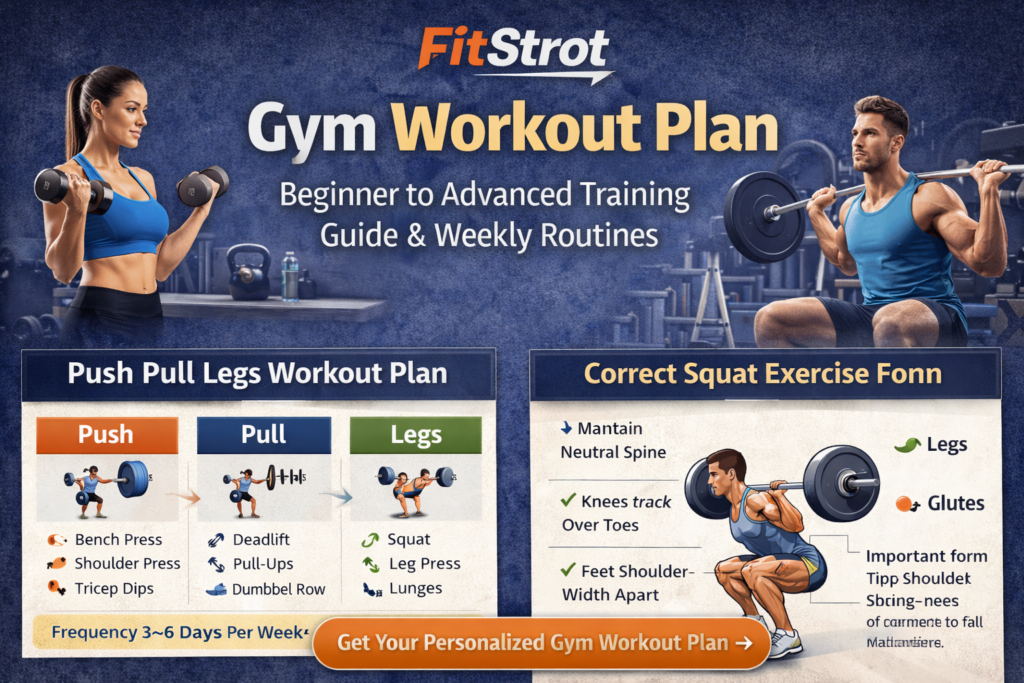
- Compound movements (squats, deadlifts, presses)
- Accessory lifts for muscle balance
- Mobility & stabilization work
Step 6: Set Appropriate Intensity, Sets, and Reps
Example for muscle building:
- 3–4 sets
- 8–12 reps
- 60–90 sec rest
Example for fat loss:
- 3 rounds
- 15 reps
- Minimal rest
Step 7: Track & Adjust
Use:
✔ Weekly progress logs
✔ Photos, measurements
✔ Strength performance records
Adjust based on progress — if something is not working, tweak it.
Common Mistakes When Crafting a Workout Plan (And How to Fix Them)
Many people fall into common traps. Here’s how to avoid them:
Mistake 1: Following Generic Online Workouts
These aren’t built for you. They may:
- Overtrain you
- Cause injury
- Stall progress
Fix: Always tailor exercise selection, volume, and recovery to your body and schedule.
Mistake 2: Ignoring Recovery
Training too hard without recovery leads to burnout.
Fix: Schedule rest, sleep 7–9 hours, monitor stress.
Mistake 3: Skipping Warm-Up / Mobility
Warm-ups prevent injury and improve performance.
Fix: Always include:
- 5–10 min cardio warm-up
- Dynamic stretching relevant to the day’s workout
Mistake 4: Not Tracking Progress
If you don’t track it, you can’t improve it.
Fix: Use a fitness journal or tracking app to record weights, reps, and outcomes.
Sample Personalized Workout Plans (Ready to Use)
Here are two tailored examples you can start with today:
Personalized Plan for Muscle Gain (Intermediate, 4 Days)
Day 1 – Chest & Triceps
- Bench Press: 4×8
- Incline Dumbbell Press: 3×10
- Chest Flyes: 3×12
- Tricep Dips: 3×10
- Tricep Pushdowns: 3×12
Day 2 – Back & Biceps
- Pull-Ups: 3×8
- Bent-Over Rows: 4×8
- Lat Pulldowns: 3×10
- Dumbbell Curls: 3×12
- Hammer Curls: 3×12
Day 3 – Rest / Active Recovery
Day 4 – Legs & Glutes
- Squats: 4×8
- Deadlifts: 3×6
- Lunges: 3×12
- Leg Curls: 3×10
- Calf Raises: 3×15
Day 5 – Shoulders & Abs
- Overhead Press: 4×8
- Lateral Raises: 3×15
- Front Raises: 3×12
- Planks: 3×60 sec
- Cable Woodchoppers: 3×15
Weekend – Light Activity / Stretching
Personalized Plan for Fat Loss (Beginner, 5 Days)
Day 1 – Full-Body Strength
- Goblet Squats: 3×12
- Push-Ups: 3×15
- Dumbbell Rows: 3×12
- Planks: 3×45 sec
Day 2 – HIIT
20 min interval training:
- 30 sec sprint, 30 sec walk × 10
Day 3 – Active Recovery
- Yoga / Stretching / Light walk
Day 4 – Lower Body + Core
- Lunges: 3×12
- Deadbugs: 3×15
- Hip Thrusts: 3×12
- Russian Twists: 3×20
Day 5 – Cardio Endurance
40 min steady-state bike or brisk walk
Tracking Progress: The Secret to Long-Term Success
Tracking is what turns a workout plan into progress.
Here’s what to track:
✔ Body weight & measurements
✔ Strength improvements
✔ Body composition (if possible)
✔ Energy levels
✔ Sleep quality
✔ Consistency rate
Regularly review your data and adjust your plan every 4–6 weeks.
How FitStrot Makes Personalized Training Effortless
At FitStrot, we take personalization further with:
⭐ Tailored programs based on your profile
⭐ Real-time progress tracking
⭐ Adaptive recommendations
⭐ Nutrition synergy
⭐ Professional guidance
Why waste time with guesswork? Let FitStrot design your training plan based on your body, goals, and schedule.
Tools & Tech That Supercharge Personalized Plans
Here are the best tools for tracking and optimizing:
- Fitness apps (FitStrot, Strava, MyFitnessPal)
- Wearables (smartwatches, heart rate monitors)
- Body composition scales
- Mobility and recovery trackers
By pairing smart tools with a personalized plan, you get measurable insight and accountability — essential for real results.
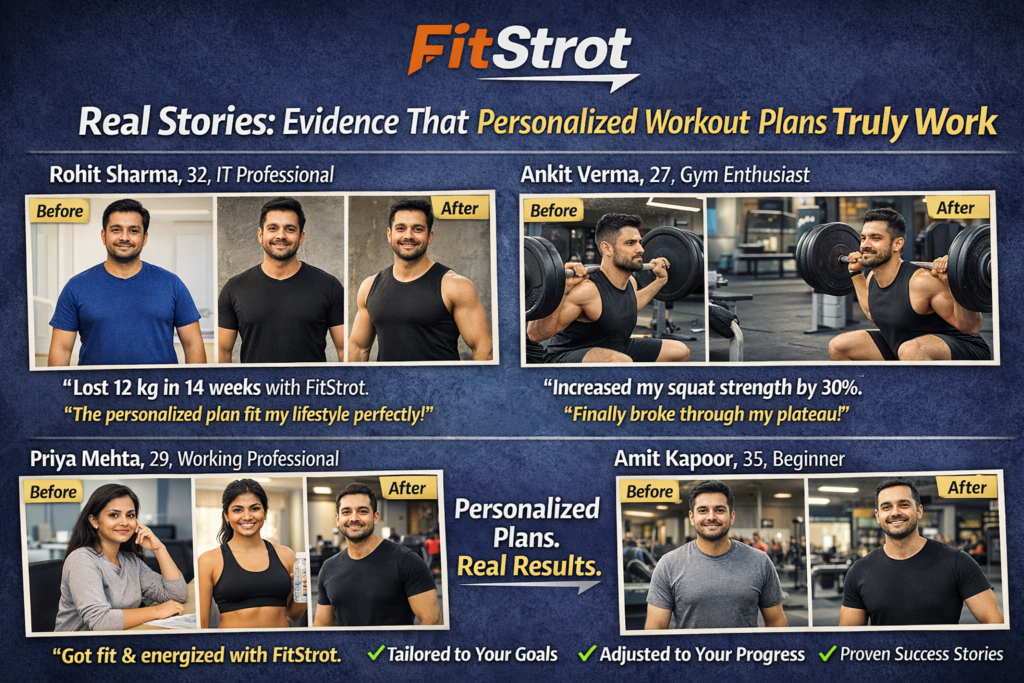
Real Stories: Evidence That Personalized Workout Plans Truly Work
Generic workout routines may look impressive on paper, but real results come from programs designed around real people. At FitStrot, our personalized workout plans are built to match individual goals, lifestyles, and physical capabilities—and our customers’ experiences speak for themselves.
⭐ Rohit Sharma – 32, IT Professional
“I had tried multiple online workout plans before, but nothing really worked long term. FitStrot created a personalized workout plan based on my daily routine and eating habits. In about 14 weeks, I lost nearly 12 kg without feeling exhausted or restricted. The workouts were realistic, easy to follow, and kept me motivated.”
⭐ Ankit Verma – 27, Gym Enthusiast
“My biggest struggle was hitting strength plateaus. The personalized workout plan from FitStrot adjusted my training volume and recovery days properly. Within 8 weeks, my squat numbers improved by almost 30%. What I liked most was how the plan evolved as my strength improved.”
⭐ Priya Mehta – 29, Working Professional
“As someone with limited time, I needed a workout plan that actually fit my schedule. FitStrot designed a plan that I could follow consistently without stress. I became stronger, more energetic, and finally enjoyed working out instead of forcing myself.”
⭐ Amit Kapoor – 35, Beginner
“I was completely new to fitness and honestly scared of gyms. FitStrot’s personalized approach helped me start at my own pace. The exercises were simple, safe, and clearly explained. After a few weeks, I felt more confident and healthier than I had in years.”
Why These Results Matter
These transformations didn’t happen by chance. They happened because each workout plan was:
- Designed around individual goals
- Adjusted based on progress and recovery
- Balanced with lifestyle and time constraints
- Focused on long-term sustainability
Personalization removes guesswork—and replaces it with clarity, confidence, and results.
Frequently Asked Questions (FAQs)
Q1: How long until I see results from a personalized workout plan?
Most people notice initial progress in 2–4 weeks, with significant changes in 8–12 weeks when combined with nutrition and consistency.
Q2: Do I need expensive equipment?
No. Personalized plans can be built for:
✔ gyms
✔ home equipment
✔ body-weight training
Q3: Can beginners benefit from personalized plans?
Absolutely! In fact, beginners often benefit more because customization addresses limitations and builds confidence safely.
Final Thoughts
A personalized workout plan isn’t a trend — it’s the future of effective fitness. Whether your goal is fat loss, muscle gain, strength performance, or better health, a tailored program empowers you to train with purpose and scientifically backed precision.
Remember:
Personalization = Faster results
Tracking = Insight & growth
Consistency = Long-term transformation
At FitStrot, we’re committed to helping you build the fitness path that’s as unique as you are.