Table of Contents
ToggleBeginner Mistakes in Personalized Workout Plans: A Complete Guide for Beginners
Personalized workout plans are increasingly appealing to beginners who are after faster, smarter, and more targeted fitness results. Everyone from fitness apps and online coaches to AI-generated routines is promising a workout plan tailored specifically for your body and goals. However, while personalization sounds like the perfect answer, a lot of beginners unconsciously make such serious mistakes that hinder their progress. These beginner mistakes in personalized workout plans usually result in them getting frustrated, slow progress, injuries, and eventually stopping.The number one problem is not motivation or effort. The real issue is that beginners misunderstand what a personalized workout plan for a beginner should be like. Rather than putting energy into maintaining the workout, mastering the basics, and allowing time for recovery, beginners end up creating their plans being too intense, too complicated, or completely beyond their abilities. Therefore, even tailored workout routines do not work their magic.
In this comprehensive article, we will identify beginner mistakes in personalized workout plans and analyze why they do so and how they can fix these mistakes. Whether it is fat loss, muscle gain, strength, or overall fitness that you are after, steering clear of these errors will help you put together a workout plan that works for you in the long run.
What Is a Personalized Workout Plan?
A personalized workout plan is essentially a fitness workout that is planned specially for a person taking into account the person’s needs, fitness level, body structure, lifestyle, and the ability to recover. These plans are focused on finding the right dose of exercise for your body in terms of both intensity and volume. The body of a beginner undergoes changes and he or she is in great need of such personalization.
Unfortunately, several beginners who have been misguided in this assumption equate personalization with adding more exercises, higher level moves, or more intense workouts. Actually, authentic personalization means simplicity, stepping up, and being regular. The good plan incorporates not just the part of the exercises but equally of the rest, recovery and long-term sustainability. When beginners ignore these principles, beginner mistakes in personalized workout plans become unavoidable.
Why Beginners Struggle With Personalized Workout Plans
Newcomers to fitness encounter a dilemma of their own: there is an overload of information while their experience remains limited. The fitness industry on social media tends to highlight extreme before and after photos, and advanced workout sessions, but very little of the context. This results in unrealistic expectations and pressures to work out more than what is actually necessary. Also, most beginners have no idea how to check if an exercise program matches their current state of fitness.
Consequently, beginners either make their workout routines unnecessarily complicated or end up doing the ones which are at a higher level than they. The faults of beginners in their personal training plans do not mainly stem from their laziness, but they are rather the results of being confused and misled. It cannot be emphasized enough how essential it is to acknowledge the mistakes first if one wants to correct them.
Common Beginner Mistakes in Personalized Workout Plans
Many of the typical beginner mistakes in personalized workout plans can be attributed to very high motivation at the start, which then brings about unrealistic expectations, inadequate planning of the structure, and ignoring basics such as recovery and correct form.
Below is a breakdown of the most frequent mistakes according to the different categories:
1. Training and Programming Mistakes
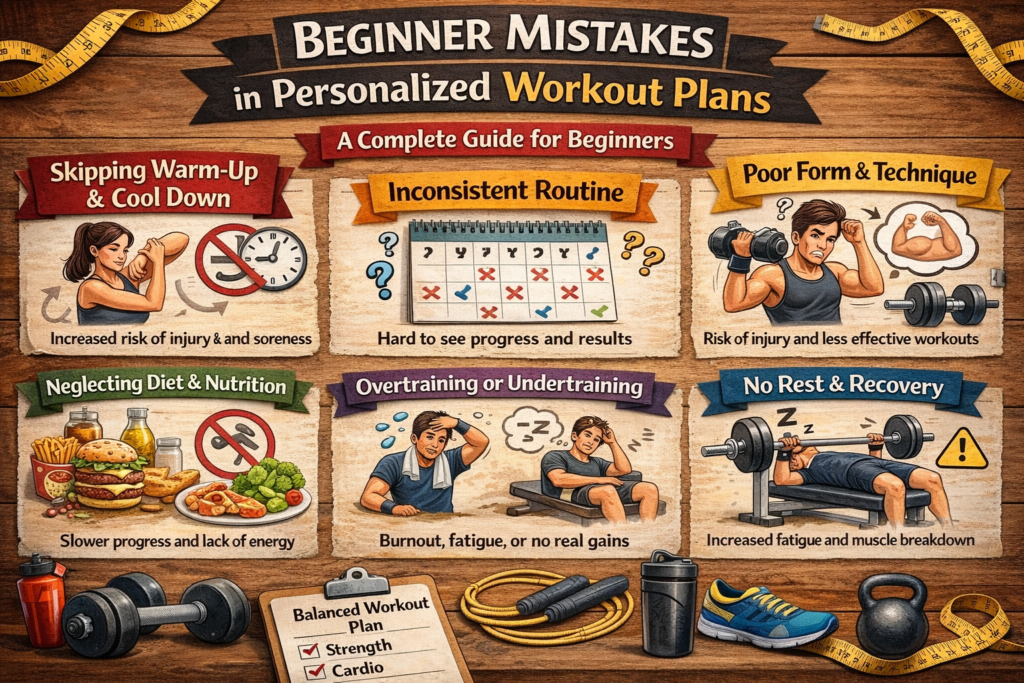
- Doing Too Much, Too Soon: Jumping to very intense workouts drastically increases the risk of burnout, injury, and a major muscle ache.
- Lifting too heavy/ego lifting: When the lifter puts weight above right form, it often results in the wrong technique, less muscle is targeted, and a very high chance of injury.
- Skipping Warm-ups and Cool-downs: Not doing the warm-up and cool-down for 5-10 minutes increases the risk of getting injured and decreases performance.
- Lack of Structure/Consistency: Without a workout plan, the person just wanders through workouts which result in plateaus, inconsistency, and inefficient use of time.
- Neglecting Specific Muscle Groups: If one skips “leg day” or does not do the compound movements, he/she is limiting their total strength and an aesthetic balance.
- Program Hopping: Switching your routine too fast before showing the results (e.g. 2-3 months) will keep you from progressing.
2. Recovery and Nutrition Missteps
- Not Prioritizing Rest: The lack of a rest day in a workout schedule does not allow the muscles to repair and grow, most of the time resulting in the feeling of tiredness or the occurrence of a muscle injury.
- Ignoring Nutrition: You cannot “train out” a bad diet by failing to consume a sufficient amount of protein or by consuming an excessive amount of processed foods as a result of which the recovery will be slowed down.
- Poor Hydration: Being careless about the consumption of water leads to a decrease in strength, concentration, and endurance.
3. Mental and Strategic Errors
- Setting Unrealistic Goals: If you focus on quick and dramatic changes as opposed to small, measurable (SMART) goals you will likely get frustrated and give up very soon.
- Comparing Yourself to Others: If you compare your progress with that of experienced gym enthusiasts, your motivation will drop drastically.
- Ignoring Body Signals: One should not advise a person to take a rest day if only the person is suffering from a sharp pain or extreme fatigue but the same person chooses to ignore the signals and carry on with the workout.
- Not Tracking Progress: If you don’t keep a record of your workouts or use an app to track the number of sets, reps, and weights, it is going to be very hard to evaluate your progress.
How to Avoid These Mistakes
- Start Slow: Establish a base by doing moderate activity 3-4 days a week.
- Master the form First: Use lighter weights and give high priority to the correct movement patterns or even think about a personal trainer to get it right from the start.
- Set Realistic Goals: Concentrate on being consistent rather than aiming for perfection.
- Put Rest First: Plan 12 days of rest each week.
- Monitor everything: Make a log of your workouts for the sake of progression.
How to Build an Effective Personalized Workout Plan as a Beginner
A successful tailored workout routine for beginners concentrates on the basics, rest, and slow advancement. The point is not to exhaust yourself with the hardest workout possible but to practice regularly. Being straightforward, having proper form, and making a schedule that is realistic are the basis on which a person can achieve success for a long time.
Moving correctly and learning to do the exercises, keeping a record of progress, and letting the body get used to the new activities, are the things that beginners should do first. When a workout is personalized properly it will help the person to have less confusion, it will be a good prevention against getting injuries, and one will feel more reliable in one’s abilities. Avoiding common beginner mistakes in personalized workout plans allows fitness to become a sustainable habit rather than a short-term challenge.
Final Thoughts: Why Simplicity Wins in Personalized Workout Plans
Personalized workout plans could be an effective tool for beginners, but only if they are properly made. The main reason why beginners make mistakes in personal workout plans is that they try to overcomplicate the process or look for quick results. Real personalization requires acknowledging your current physical condition and making small steps towards improvement.
By giving priority to basics, rest, setting achievable goals, and staying regular, beginners may create fitness plans that yield permanent results. Fitness does not depend on the perfection of your every move; it depends on continually doing the right things over a long period of time.
FAQs
- What are some of the most common beginner errors in personalized workout plans?
The most common Beginner mistakes in personalized workout plans are primarily related to appropriateness. For example, starters can go for highly advanced workouts without having the prerequisite levels. They can also overtrain without adequate recovery, skip warming up, and target unattainable fitness goals. Besides choosing a workout plan that barely fits their fitness level or lifestyle, smoking, nutrition neglect, and absence of progressive overload also limit their results. Such mistakes return slow progress, injuries, and discontent, even when the plan is said to be personal.
- What is the reason for the failure of personalized workout plans for beginners?
The main reason why personalized workout plans fail for beginners is incorrect personalization. It is because personalization, in some cases, is misinterpreted as intensity or complexity rather than suitability. Beginner mistakes in personalized workout plans, in fact, include copying influencer routines, training too frequently, and neglecting recovery. When a workout plan is not designed in accordance with a beginner’s fitness level, recovery capability, and lifestyle, the quality of the performance drops, and development comes to a halt, thus the plan fails even though the intentions might be good.
- How can beginners avoid mistakes in personalized workout plans?
With the help of personalized workout plans, beginners can easily prevent the common beginner mistakes by simply focusing on basic exercises and realistic training schedules. By giving primacy to the correct form, sufficient recovery, and steady progress, one can stay free from injuries and exhaustion. Monitoring the workouts and tweaking the plans every couple of weeks will keep the progress on the up and up. However, the key thing for beginners is to pick workout plans that are lifestyle-oriented and thus, can be continued for the long run rather than aiming for quick results.
- Are personalized workout plans better than generic workout routines for beginners?
Personalized workout plans can be better than generic routines when designed correctly, but they also increase the risk of beginner mistakes in personalized workout plans if done improperly. A plan tailored to an individual would take into account their fitness level, goals, recovery, and schedule. Most generic routines however, do not consider these factors. But beginners should refrain from making their personalization too complicated. When consistency and recovery are given top priority, simple, beginner, focused plans usually do better than highly customized complicated routines.
- Can beginner mistakes in personalized workout plans cause injuries?
Yes, beginner mistakes in personalized workout plans can significantly increase injury risk. Common causes are simply choosing the wrong exercises, not doing warm, ups, training too much, and lifting weights which are too heavy for the current level of the person. If a workout plan is not geared towards a beginner’s way of moving, the joints and muscles will be subjected to stress that they wouldn’t have to endure otherwise. Proper progression, mobility work, and recovery planning are essential to reduce injury risk and support safe long, term fitness progress.
- What is the frequency of training of beginners to avoid errors in workout plans?
Most beginners ought to train thrice or four times during a week so as to avoid making the mistakes associated with personalized workout plans. This frequency is sufficient to stimulate progress and at the same time offer sufficient rest. The daily training or excessive high-intensity exercise may cause fatigue and halted the outcome. A moderate exercise program helps in muscle recovery, consistency and longevity of the exercise regime which is more significant than high training frequency.
- What is the importance of recovery in personalized exercises in beginners?
Due to the fact that most beginner errors that occur in customized exercises are as a result of training without any rest, recovery is important. It is during rest, rather than the workout, that muscle growth, increases in strength and reduction of fat take place. Lack of proper sleep and rest days among the beginners cause fatigue, poor performance and results are slower. An individual exercise routine should contain rest mechanisms to maintain the gradual improvement and avoid burnout.
- Are novice errors in individualized exercise regimens relevant in fat loss?
Yes, the amateur errors of individual exercise programs can be important contributors to fat loss. Most of the time fat breakage is inhibited by training too hard, neglecting digestion and improper exercise routines. Individualized exercise programs need to balance training and calorie expenditure and rest. With the beginners rectifying such errors and concentrating on consistency and sustainability, fat loss will be more predictable and easier to sustain over time.
- What is the significance of nutrition in preventing beginner workout plan mistakes?
Eating contributes significantly to prevent mistakes of the novices in individual training programs. The lack of protein, calories, and hydration cannot restore the body and serve the needs of training. Most beginners make workouts their only source of progress and neglect the diet, which retards progress. An individualized exercise program is most effective when accompanied by simple nutrition lifestyles that contribute to the desired fitness, more so fat burning and muscle development.
- How often should beginners revise the personal workout plan?
To prevent beginner errors in personalized workout plans, beginners are meant to revise and bring revision in their workout plan after every four to six weeks. The plan should be changed as the strength, endurance and movement increases; otherwise, it will not be effective anymore. Indications of the need to update include stall progress, lack of motivation or exercises being too easy or too hard. Consistent modifications ensure that the training program is in tandem with the objectives and capabilities.